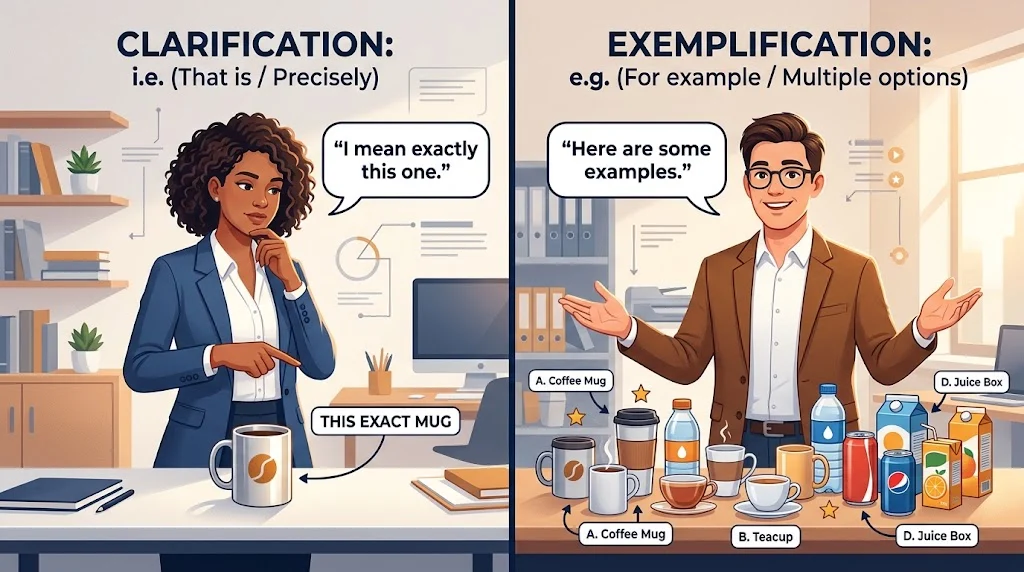
Quick Answer: The difference between ie and eg is simple: ie (from Latin id est) means “that is” or “in other words,” and you use it to clarify or restate something. Eg (from Latin exempli gratia) means “for example,” and you use it to introduce a sample list of possibilities. .
“i.e.” and “e.g.” are commonly used abbreviations in English writing, but they have different meanings. “i.e.” comes from the Latin id est, meaning “that is” or “in other words,” while “e.g.” comes from exempli gratia, meaning “for example.”
Knowing the difference between “i.e.” and “e.g.” helps make your writing clearer and more precise. Use “i.e.” when you want to clarify or restate something, and use “e.g.” when you want to provide one or more examples.
ie vs eg: What is the Difference?
Let us cut through the confusion right now. These two abbreviations are not interchangeable, and treating them as synonyms is one of the most common writing errors in the English language.
ie stands for the Latin phrase id est, which translates to “that is.” In plain English, think of it as meaning “in other words” or “in essence.” You use ie when you are about to restate or clarify something you have just said, usually by providing a more precise definition or explanation.
eg stands for the Latin phrase exempli gratia, which means “for the sake of example.” In everyday language, it simply means “for example.” You use eg when you are about to give one or more examples that illustrate the point you are making, but you are not listing everything.
Comparison Table: ie vs eg at a Glance
| Feature | ie | eg |
| Latin origin | id est | exempli gratia |
| English meaning | “that is” / “in other words” | “for example” |
| Purpose | Clarify or restate | Provide examples |
| What follows | A rephrasing or definition | A sample list (not exhaustive) |
| Can you use “etc” after? | No, because it is a complete clarification | No, because eg already implies an incomplete list |
| Formal vs informal | Used in both, but more common in formal writing | Used in both, very common in all contexts |
Mini Recap
So here is the bottom line: use ie when you want to say the same thing in a different way. Use eg when you want to give a few examples. If you can substitute “that is” or “in other words,” go with ie. If you can substitute “for example” or “such as,” go with eg. That is really all there is to it.
Is ie vs eg a Grammar, Vocabulary, or Usage Issue?
This is a great question because it gets to the heart of why so many people struggle with ie or eg. Technically, this is not a grammar issue in the strict sense. Grammar deals with the rules that govern sentence structure, word order, and the relationships between words. Neither ie nor eg violates any grammatical rule regardless of which one you choose.
Instead, this is a usage and vocabulary issue. These are abbreviations with specific meanings, and using one when you mean the other is a semantic error, not a syntactic one. You are choosing the wrong word for the meaning you intend to convey.
Are They Interchangeable?
Absolutely not. Despite what some people assume, ie and eg are not synonyms. They serve completely different functions. Using ie when you mean eg is like saying “that is” when you really mean “for example.” The sentence might still make grammatical sense, but the meaning will be off.
Formal vs Informal Usage
Both ie and eg are perfectly acceptable in formal and informal writing, but there are nuances. In very formal academic papers, some style guides recommend avoiding Latin abbreviations altogether and using “that is” and “for example” instead. However, in most academic, business, and technical writing, ie and eg are widely used and expected.
In informal contexts like emails, text messages, or social media, you will often see them written without periods as “ie” and “eg.” This is increasingly common and perfectly acceptable in casual communication.
Academic vs Casual Usage
In academic writing, precision matters enormously. Using ie or eg correctly signals that you understand the nuances of scholarly communication. In casual writing, the stakes are lower, but using the wrong abbreviation can still make you look careless or uninformed.
How to Use eg Correctly
The abbreviation eg is your go to tool when you want to offer examples. It signals to your reader that what follows is a sample, not an exhaustive list.
Workplace Example
Our company offers several wellness benefits, eg, gym memberships, mental health days, and flexible working hours.
Here, eg tells the reader that gym memberships, mental health days, and flexible hours are examples of wellness benefits, not the only ones.
Academic Example
Many organic compounds contain functional groups that influence their reactivity, eg, hydroxyl, carbonyl, and amino groups.
In this sentence, eg introduces a few examples of functional groups without claiming this is a complete list.
Technology Example
The new software integrates with popular project management tools, eg, Asana, Trello, and Jira.
Again, eg signals that these are examples, not an exhaustive inventory of every compatible tool.
Short Usage Recap for eg
Remember: eg = examples. Use it when you are giving a sample. Never follow an eg list with “etc” because eg already implies the list is incomplete. And always remember that you are offering possibilities, not defining something precisely.
How to Use ie Correctly
The abbreviation ie is your precision tool. You use it when you want to restate something more clearly or provide a precise definition.
Workplace Example
All full time employees are eligible for the bonus program, ie, those working 40 or more hours per week.
Here, ie clarifies exactly who qualifies as a full time employee. It is not giving an example; it is defining the term.
Academic Example
The study focused on urban dwellers, ie, individuals residing in cities with populations over 100,000.
In this case, ie restates “urban dwellers” with a more precise definition.
Technology Example
The system requires a secure connection, ie, one that uses HTTPS protocol.
The ie here clarifies what “secure connection” means in this specific context.
Short Usage Recap for ie
Remember: ie = in essence or that is. Use it when you are clarifying or rephrasing. If you can replace it with “that is” or “in other words,” you are using it correctly.
When You Should NOT Use ie or eg
Even when you understand the difference, there are situations where you should avoid these abbreviations altogether. Here are six common scenarios where ie or eg can cause problems:
- When clarity is paramount. If your reader might not be familiar with Latin abbreviations, just write out “that is” or “for example.” It is always clearer.
- In very formal academic writing. Some style guides and journals explicitly discourage the use of Latin abbreviations. Check your target publication’s guidelines.
- When introducing an exhaustive list. If you are listing everything, use “namely” or “specifically” instead of eg. Eg implies incompleteness.
- When you are defining something precisely. If you are giving a definition, ie is appropriate. But if you are unsure, just use “that is” to avoid any confusion.
- In speech. These abbreviations are for writing. In spoken English, say “for example” or “that is” instead. Reading “eg” aloud as “ee gee” sounds awkward.
- When the abbreviation might be misread. In some contexts, “ie” could be mistaken for “Internet Explorer” or other common abbreviations. If there is any risk of confusion, spell it out.
Common Mistakes and Decision Rules
Common Mistake Table
| Correct Sentence | Incorrect Sentence | Explanation |
| I enjoy citrus fruits, eg, oranges and lemons. | I enjoy citrus fruits, ie, oranges and lemons. | Oranges and lemons are examples, not a complete definition of citrus fruits. |
| The meeting is at noon, ie, 12:00 PM. | The meeting is at noon, eg, 12:00 PM. | 12:00 PM is not an example of noon; it is what noon means. |
| She reads classic literature, eg, Dickens and Austen. | She reads classic literature, ie, Dickens and Austen. | Dickens and Austen are examples of classic authors, not the only ones. |
| The car needs maintenance, ie, an oil change and tire rotation. | The car needs maintenance, eg, an oil change and tire rotation. | This is a specific list of what maintenance means in this case, not examples of possible maintenance tasks. |
Decision Rule Box
If you mean the action of clarifying or restating, use ie. Think of it as saying “in other words” or “that is.”
If you mean giving examples or a sample list, use eg. Think of it as saying “for example” or “such as.”
A simple memory trick: ie = in essence (both start with i) and eg = example given (both start with e).
ie and eg in Modern Technology and AI Tools
In the age of artificial intelligence and automated writing tools, understanding ie or eg has taken on new importance. AI writing assistants like ChatGPT, Grammarly, and various grammar checkers are trained on massive datasets that include countless examples of both correct and incorrect usage. When you use these tools, they will often flag incorrect usage of ie or eg and suggest corrections.
However, these tools are not perfect. They can sometimes misinterpret your intended meaning, especially in complex sentences. That is why understanding the difference yourself is still essential. Relying blindly on AI suggestions without understanding the underlying rule can lead to errors that slip through.
Moreover, in technical documentation, user interfaces, and software development, abbreviations like ie and eg appear frequently. In code comments, API documentation, and error messages, using the wrong abbreviation can confuse other developers or users. Precision matters in technology just as much as it does in academic writing.
Search engines and AI overviews also pay attention to how you use these abbreviations. Content that uses ie and eg correctly is more likely to be seen as authoritative and well written, which can improve your search rankings. Google’s algorithms are sophisticated enough to recognize proper usage patterns, so getting this right is not just about grammar; it is about SEO too.
Authority and Trust: The Origins of ie and eg
Understanding where these abbreviations come from can help cement the difference in your mind. Both are Latin in origin, which explains why they can feel somewhat foreign to modern English speakers.
ie comes from id est, which literally means “that is.” This phrase was used in Latin to introduce a clarification or a more precise statement. The abbreviation has been used in English since at least the 17th century.
eg comes from exempli gratia, which translates to “for the sake of example.” The phrase exempli means “of example,” and gratia means “for the sake of” or “on account of.” Together, they mean “for example.
Expert Perspective
“The misuse of ‘i.e.’ and ‘e.g.’ was one of the top mistakes I used to see when I edited technical documents. It is not just a minor stylistic error; it can fundamentally change the meaning of a sentence and undermine the writer’s credibility.” — Robert Lee Brewer, Senior Editor of Writer’s Digest
Case Study 1: The Academic Paper That Lost Its Edge
A graduate student submitted a research paper to a top tier journal. The paper was scientifically sound, but the peer reviewers flagged multiple instances where the author had used ie when eg was appropriate. In one case, the author wrote, “The experiment was repeated three times, ie, on Monday, Wednesday, and Friday.” The reviewer noted that Monday, Wednesday, and Friday were examples of when the experiment was repeated, not a definition of what “three times” meant. The paper was sent back for revisions, delaying publication by several weeks. The student learned the hard way that precision with ie or eg matters in academic publishing.
Case Study 2: The Business Proposal That Confused Investors
A startup founder prepared a pitch deck for potential investors. In one slide, they wrote, “Our target market includes young professionals, ie, ages 25 to 35.” An investor interpreted this as a definition, assuming the startup was exclusively targeting that age range. In reality, the founder meant ages 25 to 35 as an example of the target demographic, not a strict definition. The miscommunication led to a confusing Q&A session and ultimately cost the startup the investment round. Using eg instead of ie would have signaled that other age groups were also potential targets.
Error Prevention Checklist
Always Use ie When:
- You are restating something in different words
- You are providing a precise definition
- You can substitute “that is” or “in other words”
- You want to clarify a potentially confusing statement
Never Use ie When:
- You are giving examples (use eg instead)
- You are listing possibilities (use eg instead)
- You can substitute “for example” (use eg instead)
- The list is not exhaustive (use eg instead)
Always Use eg When:
- You are giving one or more examples
- You are illustrating a point with specific instances
- You can substitute “for example” or “such as”
- The list is a sample, not a complete inventory
Never Use eg When:
- You are defining something precisely (use ie instead)
- You are restating something in other words (use ie instead)
- The list is exhaustive (use “namely” or “specifically”)
- You can substitute “that is” (use ie instead)
Related Grammar Confusions You Should Master
Once you have mastered ie or eg, consider tackling these other commonly confused language pairs. Each one trips up writers regularly, and mastering them will significantly elevate your writing.
- affect vs effect – one is usually a verb, the other a noun
- its vs it’s – possessive versus contraction
- your vs you’re – possessive versus contraction
- then vs than – time versus comparison
- who vs whom – subject versus object
- less vs fewer – uncountable versus countable
- among vs between – two items versus more than two
- complement vs compliment – complete versus praise
- stationary vs stationery – not moving versus writing supplies
- principal vs principle – main or head versus rule or belief
FAQs
- What is the difference between “i.e.” and “e.g.”?
- “i.e.” means “that is,” while “e.g.” means “for example.”
- What does “i.e.” mean?
- “i.e.” is used to clarify or restate something in different words.
- What does “e.g.” mean?
- “e.g.” is used to introduce one or more examples.
- Are “i.e.” and “e.g.” interchangeable?
- No, they have different meanings and should be used for different purposes.
- How do I remember the difference?
- Think of i.e. = in other words and e.g. = example given.
- Should I use commas after “i.e.” and “e.g.”?
- In American English, a comma is commonly used after both abbreviations.
Conclusion
Mastering the difference between ie and eg is one of those small but mighty skills that can transform your writing. It is not about pedantry or following arbitrary rules; it is about communicating with clarity and precision.
When you use ie correctly, you are telling your reader, “Let me say that again more clearly.” When you use eg correctly, you are saying, “Here are a few examples to help you understand.” These are fundamentally different messages, and using the wrong one can confuse your reader and undermine your credibility.

Philip Pullman is an American writer dedicated to creating clear and easy to follow English content. Through his work at LingRoya.com, he helps readers strengthen their language skills with practical and reliable guidance so that they can easily understand.