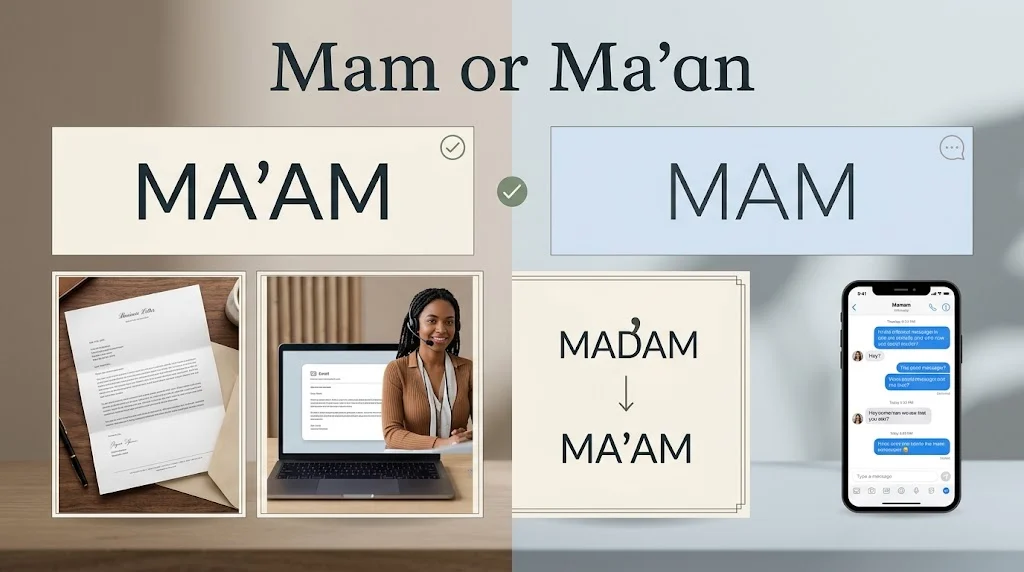
Quick Answer: “Ma’am” is the standard spelling of the polite form of address used for a woman, especially in formal or respectful situations. “Mam” is a common informal spelling, particularly in texting and some regional varieties of English.
Confusion about mam or ma’am usually comes from the way the word sounds when spoken. Both forms are intended to address a woman respectfully, but they do not have the same status in standard written English. Ma’am is the conventional spelling and is a shortened form of “madam,” while mam is commonly used as an informal or regional spelling. This small punctuation difference can matter in emails, letters, customer service messages, school communication, and other situations where polished English is expected.
Mam vs Ma’am: What’s the Difference?
Ma’am is a noun and a form of direct address. It is a conventional shortened form of madam, used when speaking to or referring respectfully to a woman.
For example:
“Excuse me, ma’am. You dropped your wallet.”
“Thank you, ma’am.”
Mam is also used as a form of address in some varieties of English. However, it is generally considered a nonstandard or informal spelling in contexts where ma’am is expected in standard English.
| Term | Part of Speech | Meaning | Standard Usage | Example |
| Ma’am | Noun | A respectful form of address for a woman | Standard | Yes, ma’am. |
| Mam | Noun | Informal or regional form of address | Nonstandard in many formal contexts | Thank you, mam. |
The essential distinction is simple.
Ma’am is the standard written form.
Mam appears frequently in informal communication and regional English.
Both may represent the same spoken form in certain contexts.
For formal writing, ma’am is normally the safer choice.
Is Mam vs Ma’am a Grammar, Vocabulary, or Usage Issue?
The difference is mainly a spelling and usage issue, although punctuation plays an important role.
The apostrophe in ma’am indicates that the word has been shortened from madam. The spelling developed through contraction, which is why the apostrophe is retained.
The two forms are therefore not equally appropriate in every context.
In casual texting, you may encounter messages such as:
“Okay mam, I will send it today.”
The writer clearly intends ma’am, and the meaning is usually understood. Nevertheless, if the same sentence appeared in a formal business email, the spelling would look less polished.
Formal communication generally favors:
“Okay, ma’am. I will send it today.”
Academic writing is slightly different. Since ma’am is a form of direct address, it does not appear frequently in academic prose unless a dialogue, quotation, interview, or specific interaction is being described.
In casual conversation, regional preferences can influence whether people write mam, ma’am, or another local form. Spoken English does not make the apostrophe audible, so the difference becomes noticeable mainly in writing.
How to Use Ma’am Correctly
Ma’am is appropriate when addressing a woman respectfully. It can be used independently or at the beginning or end of a sentence.
Workplace Example
A receptionist might say:
“Good morning, ma’am. How may I help you?”
A customer service representative could write:
“Thank you for contacting us, ma’am. We will review your request.”
In these situations, ma’am communicates courtesy and professionalism.
However, workplace culture varies. In some environments, people may prefer being addressed by their name or professional title rather than “ma’am.” The word is respectful, but context and individual preference still matter.
Academic Example
A student might address a female teacher or administrator:
“Thank you for explaining that, ma’am.”
In a written academic assignment, however, direct address is uncommon. A student would normally write the teacher’s name or title in formal correspondence instead.
For example:
“Dear Professor Smith,”
is generally more appropriate for an academic email than simply beginning with “Ma’am.”
Technology Example
Customer support systems sometimes generate messages containing formal expressions such as:
“Thank you for your patience, ma’am.”
AI assistants, chatbots, and automated customer service tools may also use ma’am when attempting to sound polite. Whether this sounds natural depends on the audience and cultural setting.
Usage Recap
Use ma’am when you need a respectful form of address for a woman.
It is the preferred spelling in standard formal English.
Use it naturally rather than inserting it into every interaction.
How to Use Mam Correctly
Mam is commonly encountered in informal messages, regional varieties of English, and some speech based writing.
For example:
“Thank you, mam.”
“Good morning, mam.”
These sentences are easily understood in many communities, especially where the spoken pronunciation does not distinguish the spelling.
However, mam is not generally the preferred form in polished standard English. If you are writing an official email, business letter, academic communication, application, or customer service message, ma’am is usually the better choice.
Workplace Example
An employee sending a quick informal message might write:
“Okay mam, I will complete it today.”
Although understandable, a more polished version is:
“Okay, ma’am. I will complete it today.”
The second version follows conventional spelling and punctuation.
Academic Example
In an academic setting, writing mam to a teacher may be understood, but it can appear careless in formal correspondence.
A student should generally use an appropriate title and name when available:
“Dear Dr. Ahmed,”
This is more precise and professional than relying on either form.
Technology Example
Search queries, chat messages, social media posts, and AI generated text may contain mam because users frequently type words according to pronunciation rather than standard spelling.
Spell checking software may identify mam as an error when the intended word is ma’am, although dictionaries and regional usage can complicate how individual systems interpret the word.
Usage Recap
Mam is widely understood but is less suitable for formal standard English.
It may reflect informal or regional usage.
When accuracy and professionalism matter, ma’am is generally the stronger choice.
When You Should NOT Use Mam or Ma’am
There are situations where neither form is the best option.
- Do not use ma’am when you already know the person’s professional title. “Professor Ahmed” or “Dr. Ahmed” may be more appropriate.
- Do not assume every woman wants to be addressed as ma’am. Personal and cultural preferences differ.
- Do not use mam in formal business writing when standard spelling is expected.
- Do not use either term when addressing someone by their name would be clearer.
- Do not insert ma’am repeatedly into a conversation. Excessive use can sound unnatural or overly formal.
- Do not treat mam as the preferred standard spelling simply because it matches pronunciation.
- Do not confuse ma’am with “madam” in every situation. Although related, “madam” can have different stylistic and contextual uses.
- Do not assume an apostrophe is optional in formal writing. In the conventional spelling, the apostrophe is part of ma’am.
Common Mistakes and Decision Rules
| Correct sentence | Incorrect or less preferred sentence | Explanation |
| Thank you, ma’am. | Thank you, mam. | Ma’am is the standard spelling in formal English. |
| Good morning, ma’am. | Good morning, mam. | The apostrophe reflects the contraction of madam. |
| Excuse me, ma’am. | Excuse me mam. | Standard punctuation includes the apostrophe and usually a comma for direct address. |
| Yes, ma’am. | Yes, mam. | Ma’am is preferred in polished writing. |
| Dear Professor Ahmed, | Dear ma’am, | A known professional title and name can be more appropriate in formal correspondence. |
Decision Rule Box
If you are addressing a woman respectfully in standard written English, use “ma’am.” If you are writing an informal or regional form that conventionally uses “mam,” the context may permit it.
The action versus person rule sometimes used for other word comparisons does not apply here. Both words function primarily as forms of address. The important distinction is standard spelling versus informal or regional usage.
Mam or Ma’am in Modern Technology and AI Tools
Digital communication has made this spelling distinction more visible.
People often type exactly as they speak, especially in text messages and instant messaging. As a result, mam can appear frequently even when the intended standard form is ma’am.
AI writing tools can also reproduce either spelling depending on their instructions, training patterns, regional language preferences, and conversational context. If you are using an AI tool to draft a professional email, specifying standard English can help produce more appropriate forms of address.
For automated systems, there is another consideration: personalization. A chatbot that repeatedly calls every female customer “ma’am” may technically use correct spelling while still sounding unnatural. Good communication requires more than grammatical correctness. It also requires sensitivity to context.
The Etymology of Ma’am and Mam
Ma’am comes from madam, which ultimately traces back through French madame to Latin expressions associated with addressing or referring respectfully to a woman.
The apostrophe signals the shortened form. Similar contractions occur throughout English, although the spelling conventions vary.
Mam has a separate history of regional and dialectal usage. In several varieties of English, particularly British and Irish usage, “mam” can be used as a familiar term for mother. In other communities, especially in South Asian English and informal communication, it is commonly written as a respectful form of address.
This means mam can have meanings beyond the intended informal spelling of ma’am, depending on the variety of English being used.
Two Practical Case Studies
Case Study One: Customer Service Email
Imagine a customer service employee writing:
“Thank you for your patience, mam. We have reviewed your request.”
The recipient will probably understand the intended meaning immediately. However, if the company values polished written communication, changing the sentence to:
“Thank you for your patience, ma’am. We have reviewed your request.”
removes the spelling issue and creates a more conventional professional impression.
The concrete improvement is simple: the second version follows standard written usage and reduces the chance that a reader will perceive the message as careless.
Case Study Two: Student and Teacher Communication
Consider a student writing:
“Good morning mam, I wanted to ask about tomorrow’s assignment.”
The message is understandable, but a polished version would be:
“Good morning, ma’am. I wanted to ask about tomorrow’s assignment.”
An even more formal academic email could use the teacher’s name and title instead.
The result is clearer communication because the student chooses a form appropriate to the level of formality.
Error Prevention Checklist
Always use ma’am when:
☑ You are addressing a woman respectfully in standard written English.
☑ You are writing a formal or professional message.
Want the conventional shortened form of “madam.”
☑ You are editing text for standard English usage.
Never use mam when:
☑ You are preparing polished formal correspondence.
Writing an academic or professional document where standard spelling matters.
☑ You are using it only because the spoken pronunciation sounds that way.
Want to represent the conventional spelling of “ma’am.”
Remember that regional and informal usage can differ. The goal is not to label every occurrence of mam as meaningless or incomprehensible. The key is to understand when standard English calls for ma’am.
Related Grammar Confusions You Should Master
Once you understand this distinction, several other commonly confused forms are worth learning:
- Madam vs ma’am
- Miss vs Ms
- Mrs vs Ms
- Your vs you’re
- Its vs it’s
- Their vs there vs they’re
- Who vs whom
- Affect vs effect
- Then vs than
- Advice vs advise
Learning these pairs can make everyday writing more precise and professional.
FAQs
Is “mam” or “ma’am” correct?
Ma’am is the conventional standard spelling when you mean the respectful shortened form of “madam.” Mam is also used in some informal and regional varieties of English.
Is “mam” a correct English word?
Yes, “mam” exists in English and has regional meanings, including a term for mother in some varieties. When someone writes “mam” intending the respectful form of “madam,” however, ma’am is generally preferred in standard formal English.
Why does ma’am have an apostrophe?
The apostrophe indicates that ma’am is a shortened form of madam. It represents omitted letters in the contracted form.
Can I use “mam” in a formal email?
It is better to use ma’am if you intend the standard respectful form of “madam.” In very formal communication, however, a person’s name and professional title may be even more appropriate.
Is ma’am only used for older women?
No. The term does not grammatically refer only to older women. It can be used as a respectful form of address for an adult woman, although social preferences about the word vary.
Conclusion
When deciding between mam or ma’am, the safest standard English choice is ma’am when you mean the respectful shortened form of “madam.” Mam is widely understood in informal and regional contexts, but it may not be suitable for polished professional or academic writing. The apostrophe in ma’am is not decorative; it reflects the word’s contracted form. Most importantly, choose your form of address according to context, audience, and personal preference. Correct spelling matters, but respectful communication also means recognizing that not everyone prefers the same form of address.

Philip Pullman is an American writer dedicated to creating clear and easy to follow English content. Through his work at LingRoya.com, he helps readers strengthen their language skills with practical and reliable guidance so that they can easily understand.