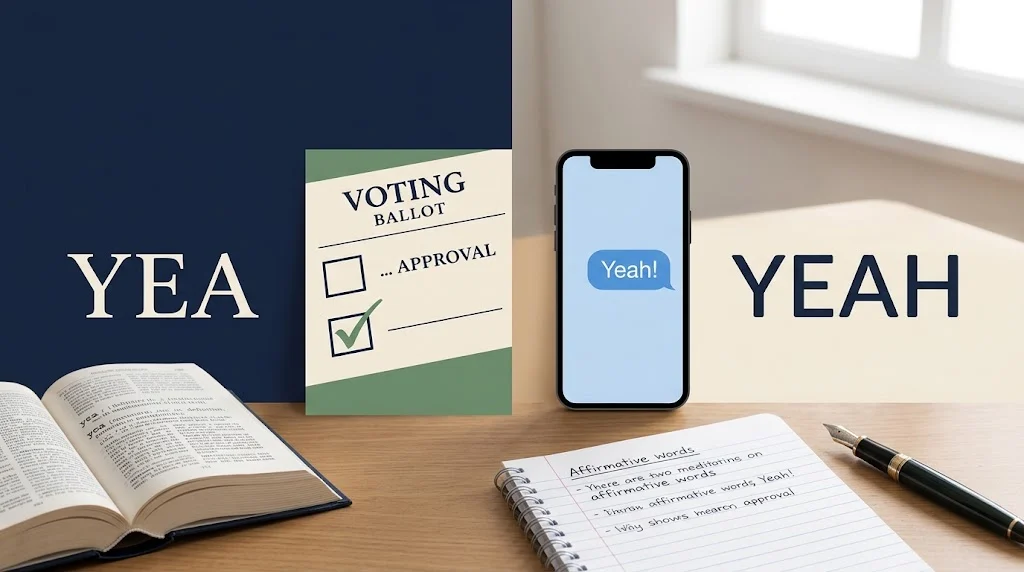
Quick Answer: Yea or yeah have different meanings and uses. Yea is a traditional affirmative word meaning “yes,” often used in formal voting or historical contexts. Yeah is an informal way to say “yes” in everyday conversations, text messages, and casual writing.
Have you ever wondered whether to write yea or yeah when agreeing with someone? Although these words look and sound similar, their meanings and usage differ. As English continues to evolve across professional communication, academic writing, and digital conversations, understanding this distinction helps prevent spelling mistakes and awkward phrasing. From parliamentary votes to everyday text messages, each word serves a particular purpose. Learning when to use yea and yeah makes your writing more accurate, natural, and appropriate for your audience.
Yea vs Yeah: What’s the Difference?
The primary difference between yea and yeah is their context of use. Both can express agreement, but they aren’t equally suitable in every situation.
Yea is an adverb or affirmative response meaning “yes.” It is commonly associated with formal voting, traditional expressions, and older forms of English.
Yeah is an informal interjection meaning “yes” or expressing agreement, acknowledgment, or enthusiasm. It is widely used in everyday speech, text messages, and casual online communication.
| Feature | Yea | Yeah |
| Meaning | An affirmative response meaning yes | An informal way to say yes |
| Part of speech | Adverb or affirmative response | Interjection |
| Tone | Traditional, formal, or ceremonial | Casual and conversational |
| Common usage | Voting, historical language | Conversations, texting, social media |
| Example | The members voted yea. | Yeah, I understand. |
| Suitable for formal writing | Yes, in appropriate contexts | Generally avoided in formal academic writing |
Quick Recap
Yea is appropriate when expressing an affirmative vote or using a traditional expression of agreement.
Yeah is the natural choice for everyday conversations and informal messages.
Both words can communicate agreement, but their tone and context differ.
Choosing the right word makes your message clearer and more suitable for its intended audience.
Is Yea vs Yeah a Grammar, Vocabulary, or Usage Issue?
The distinction between yea and yeah is primarily a vocabulary and usage issue rather than a complicated grammar rule. Both words are accepted English words, but they carry different stylistic associations.
Are Yea and Yeah Interchangeable?
Not always. In a casual conversation, yeah usually communicates agreement naturally. In a formal voting record, yea is often the conventional choice.
For example, “Yeah, I agree with the proposal” sounds natural in conversation. However, “The final vote was 18 yeas and 4 nays” follows established voting terminology.
Replacing one with the other can make a sentence sound unusual even when the general meaning remains understandable.
Formal vs Informal Usage
Yea appears in parliamentary proceedings, traditional language, and certain ceremonial expressions. It can also appear in older religious or literary writing.
Yeah belongs primarily to informal English. Speakers use it to answer questions, acknowledge information, and express enthusiasm. Although it frequently appears in dialogue and informal digital communication, it is generally less appropriate for formal academic essays and professional reports.
Academic vs Casual English
In academic writing, yes is usually preferable when a direct affirmative response is needed. It sounds neutral and professional without the specialized associations of yea or the casual tone of yeah.
In conversations with friends, however, yeah is perfectly natural.
The key is to match the word to the purpose, audience, and setting rather than assuming that one spelling is universally correct.
When to Use Yea
Use yea when you need an affirmative expression associated with voting, traditional language, or a particular formal context. It is a recognized English word, although it is less common in ordinary conversation than yeah or yes.
Workplace Example
During an official committee meeting, a chairperson might record the results as follows:
“The motion passed with 12 yeas and 3 nays.”
Here, yeas refers to affirmative votes. This terminology is suitable for formal meeting minutes and voting records.
Academic Example
A student researching historical parliamentary language might write:
“The recorded yeas demonstrated that most members supported the proposed legislation.”
In this context, the word is appropriate because the sentence describes an affirmative voting result.
Technology Example
A digital voting platform might display the options “Yea” and “Nay” when users vote on a formal motion.
The terminology reflects traditional voting language rather than everyday conversation.
Usage Recap for Yea
Use yea for affirmative votes, traditional expressions, and contexts where its established meaning fits. For ordinary conversation, yes or yeah will usually sound more natural.
When to Use Yeah
Use yeah when agreeing with someone, answering a casual question, acknowledging information, or expressing enthusiasm. It is one of the most common informal alternatives to yes in spoken English.
Workplace Example
A colleague asks, “Can you send me the revised document this afternoon?”
You reply, “Yeah, I’ll send it before lunch.”
This response is natural in a relaxed workplace conversation. In a formal email to a client, however, “Yes, I’ll send it before lunch” would generally be more appropriate.
Academic Example
A student asks a classmate, “Did you understand the professor’s explanation?”
The classmate responds, “Yeah, the example made everything clearer.”
The word fits the informal exchange between students. In an academic paper, the writer would normally use more formal language.
Technology Example
A friend sends a text message asking, “Are we still meeting online tonight?”
You respond, “Yeah, I’ll join at seven.”
This is a natural use of yeah in texting, messaging applications, and online chats.
Usage Recap for Yeah
Use yeah in casual conversations, text messages, friendly exchanges, and informal dialogue. Choose yes instead when a more professional or neutral tone is needed.
When You Should NOT Use Yea or Yeah
Although both words are correct, certain situations call for a different choice. Here are eight common scenarios where using yea or yeah may be inappropriate.
1. Formal academic essays: Avoid yeah in analytical writing. Use yes where an affirmative response is necessary, or rewrite the sentence for a more academic tone.
2. Professional client emails: Avoid casual yeah when confirming a deadline or accepting a business request. A direct response such as “Yes, I can complete this” sounds more professional.
3. Official voting records: Do not automatically replace yea with yeah. Follow the terminology required by the organization or voting procedure.
4. Historical quotations: Don’t change yea to yeah when reproducing a historical source. Preserve the original wording.
5. Unclear affirmative responses: Avoid using either word when a simple “yes” could prevent confusion in a legal, medical, or other important communication.
6. Negative responses: Neither word normally means “no.” Use an appropriate negative expression when disagreeing or declining.
7. Formal presentations: Avoid filling professional presentations with repeated yeah responses. Use clear, complete sentences.
8. Specialized voting terminology: Don’t assume yea means enthusiasm in every context. In a formal vote, it specifically indicates an affirmative position.
The best word is the one that communicates your meaning clearly while matching the situation.
Common Mistakes and Decision Rules
Writers sometimes confuse these words because their pronunciation is similar. Understanding their usual contexts helps prevent errors.
| Correct sentence | Incorrect or less suitable sentence | Explanation |
| Yeah, I’ll help you. | Yea, I’ll help you. | Yeah is more natural for casual agreement. |
| The committee recorded 15 yeas. | The committee recorded 15 yeahs. | Yeas is the conventional term for affirmative votes. |
| Yes, I accept the offer. | Yeah, I accept the offer. | Yes generally sounds more professional. |
| Yeah, that’s a great idea! | Yea, that’s a great idea! | Yeah is the usual conversational choice. |
| The motion received 20 yeas and 5 nays. | The motion received 20 yeahs and 5 nays. | Formal voting terminology favors yeas. |
Some sentences using the less suitable word aren’t strictly ungrammatical. The issue is usually tone, convention, or meaning rather than an absolute grammatical prohibition.
The Decision Rule
Use Yea
When referring to an affirmative vote or using established traditional voting terminology.
Use Yeah
When expressing casual agreement or acknowledgment in everyday conversation.
Use Yes
When you need a neutral, professional, or academic affirmative response.
Yea and Yeah in Modern Technology and AI Tools
Digital communication has made yeah especially common. People use it in text messages, social media comments, online meetings, and conversational interfaces because it reflects the way many people speak naturally.
AI writing assistants may also recognize yeah as an informal expression and recommend yes when a more professional tone is required. For example, an assistant editing a business email might replace “Yeah, I can attend” with “Yes, I can attend.”
The word yea remains relevant in digital polls, legislative databases, and electronic voting systems that use traditional affirmative and negative voting labels.
Neither spelling is inherently better for technology. The appropriate choice depends on the meaning, audience, and purpose of the message.
Etymology: Where Do Yea and Yeah Come From?
Yea is an old English affirmative word with roots in earlier forms of English. It has traditionally been used to express agreement or affirmation and remains familiar through expressions such as “yea or nay.”
Yeah developed as a colloquial form of yes and became firmly established in everyday spoken English. Its spelling reflects an informal pronunciation that is widely understood in modern English.
Although the words overlap in expressing agreement, their histories and established conventions explain why they aren’t always interchangeable.
An Expert Perspective on Yea vs Yeah
A useful editorial principle is:
“Choose the word that fits the context, not merely the sound.”
This is an editorial guideline rather than a quotation attributed to a named linguist. It reflects a central principle of effective communication: correct word choice depends on meaning, register, audience, and purpose.
For English learners, this means recognizing that a word can be valid without being suitable in every situation.
Two Practical Case Studies
The following examples illustrate how word choice affects communication in realistic settings.
Case Study 1: A Formal Committee Vote
A committee secretary prepares minutes for a meeting in which 14 members support a proposal and 6 oppose it.
The secretary writes, “The motion passed with 14 yeas and 6 nays.”
This wording uses established voting terminology and communicates the result precisely. Replacing yeas with yeahs would sound less conventional in this context.
Result: The record maintains a formal tone and clearly identifies the affirmative votes.
Case Study 2: A Casual Workplace Message
An employee receives a message from a colleague: “Can you review the presentation before our meeting?”
The employee replies, “Yeah, I’ll take a look this morning.”
The response sounds natural in a friendly workplace chat. If the same employee were responding to a senior client in a formal email, “Yes, I’ll review it this morning” would generally be a safer choice.
Result: Matching the expression to the communication channel makes the response sound appropriate without changing its underlying meaning.
These examples demonstrate practical applications rather than measured experimental results.
Error Prevention Checklist
Before using either word, check the following points.
Always use yea when:
- Referring to an affirmative vote in traditional voting terminology.
- Writing about a formal vote that records yeas and nays.
- Preserving the original wording of a historical quotation.
Never use yeah when:
- A formal document requires established voting terminology and yea is the specified term.
- A casual expression would undermine the professional tone of your writing.
- You’re quoting a source that uses a different original spelling.
Remember that yeah isn’t incorrect English simply because it is informal. Its suitability depends on context.
Related Grammar Confusions You Should Master
Learning the difference between yea and yeah can help you understand other commonly confused English words. Explore these related topics to strengthen your vocabulary and writing skills.
- Your vs You’re: Understand possession versus the contraction of “you are.”
- There vs Their vs They’re: Distinguish location, possession, and a contraction.
- Its vs It’s: Learn the difference between a possessive form and a contraction.
- Then vs Than: Separate time and sequence from comparison.
- Affect vs Effect: Identify the usual differences between a verb and a noun.
- To vs Too vs Two: Recognize direction, excess or addition, and the number.
- Everyday vs Every Day: Distinguish an adjective from a time expression.
- Yourself vs Yourselves: Understand singular and plural reflexive pronouns.
- Yes vs Yeah: Choose between a neutral affirmative response and an informal one.
- Yea vs Nay: Learn the traditional terms used for affirmative and negative votes.
Frequently Asked Questions About Yea or Yeah
1. Is yea or yeah the correct spelling?
Both are correct English words, but they serve different purposes. Yea commonly refers to an affirmative vote, while yeah is an informal way of saying yes.
2. Does yea mean the same as yeah?
They can both express agreement, but they aren’t always interchangeable. Yea is associated with formal voting and traditional language, whereas yeah is common in casual conversation.
3. Should I use yea or yeah in a text message?
Use yeah in most casual text messages when you want to agree with someone or acknowledge a statement. It sounds natural in everyday digital communication.
4. Is yeah considered a real word?
Yes. Yeah is an established English word listed in dictionaries. It is an informal affirmative expression used widely in speech and casual writing.
5. Is yea still used in modern English?
Yes. Yea remains in use, particularly in formal voting terminology, parliamentary proceedings, and expressions such as “yea or nay.”
6. Is yeah unprofessional in an email?
Not necessarily, but it can sound too casual in formal business communication. Using yes is generally a better choice when writing to clients, managers, or unfamiliar professional contacts.
7. What is the difference between yea, yeah, and yes?
Yea commonly indicates an affirmative vote, yeah expresses informal agreement, and yes is a neutral affirmative response suitable for both everyday and formal communication.
8. Is it correct to write yea or nay?
Yes. “Yea or nay” is a recognized expression meaning an affirmative or negative vote. It is often used when discussing formal decisions or asking someone to approve or reject a proposal.
9. Can I use yeah in academic writing?
You can use yeah in quoted dialogue or when discussing informal language. However, in most academic arguments and formal essays, yes is the more appropriate choice for an affirmative response.
Conclusion
Understanding yea or yeah comes down to recognizing the difference between traditional affirmative language and everyday informal speech. Use yea when referring to an affirmative vote or following established voting terminology. Choose yeah when agreeing with someone in a casual conversation, text message, or friendly online exchange.
When neither word fits the tone, yes offers a clear and versatile alternative for professional and academic communication. By considering your audience and purpose before choosing a word, you can avoid awkward phrasing and communicate more confidently. Both words have a place in English, and knowing when to use each one makes your writing more precise and natural.

Philip Pullman is an American writer dedicated to creating clear and easy to follow English content. Through his work at LingRoya.com, he helps readers strengthen their language skills with practical and reliable guidance so that they can easily understand.