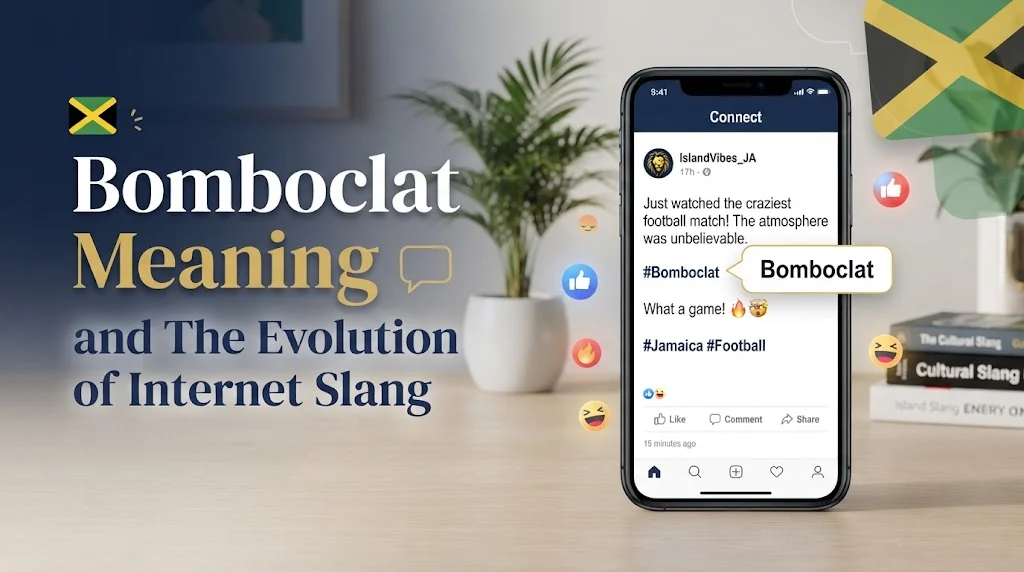
The bomboclat meaning is connected to Jamaican Patois, where the word is a vulgar expression often used to communicate anger, shock, frustration, or emphasis. Online, people sometimes use it as a reaction to something surprising or entertaining. However, the term has cultural roots and can be offensive.
Bomboclat, also spelled bumboclaat or bumbaclot, is a Jamaican Patois profanity. Traditionally, it is a vulgar exclamation associated with anger, disgust, frustration, or surprise. Its precise force depends on the speaker, situation, and local usage.
On social media, the word may appear as a short reaction to an unusual picture, an unexpected event, or something that makes people laugh. However, its online use does not erase its connection to Jamaican language and culture.
For example:
“Bomboclat! Did that really just happen?”
Here, the speaker is expressing shock or disbelief. The word adds emotional emphasis rather than providing a literal description of what happened.
| Detail | Explanation |
|---|---|
| Main meaning | A Jamaican Patois profanity or strong exclamation |
| Language | Jamaican Patois |
| Common emotional uses | Anger, frustration, shock, or emphasis |
| Online usage | Comments, memes, reactions, and informal conversations |
| Tone | Vulgar, emphatic, and potentially offensive |
| Formal or informal | Highly informal |
How People Use Bomboclat in Text Messages
People use bomboclat to communicate strong feelings. Its intended meaning can change according to the situation, especially when it appears in a short message without additional explanation.
To Express Shock or Surprise
Someone may use bomboclat when they encounter unexpected news or witness something unbelievable.
Example: “Bomboclat! You actually won the competition?”
The expression emphasizes the sender’s surprise. Depending on the relationship, it may sound like an excited reaction or a stronger, more emotional outburst.
To Express Anger or Frustration
The term can also communicate annoyance when something goes wrong or someone behaves disrespectfully.
Example: “Bomboclat, why would you delete the entire file?”
In this situation, the speaker is frustrated and uses the profanity to emphasize their reaction.
To React to Memes and Funny Content
On social media, people sometimes use the word as an expressive comment under unusual, funny, or shocking content.
Example: “Bomboclat, this picture is unreal.”
The commenter is reacting strongly to the picture. The exact emotion could be amusement, disbelief, or astonishment.
These examples illustrate possible interpretations, not a separate definition for every situation. The word’s established meaning remains rooted in Jamaican Patois profanity.
Does Bomboclat Have Different Meanings Online?
The word does not have a completely different standard meaning on every platform. Instead, online communities may use it in different ways.
Its traditional Jamaican usage is a strong exclamation, while some internet users employ it more loosely as a reaction word. In certain meme contexts, it can also appear as a prompt for people to react to an image or caption.
The intended meaning still depends on the surrounding content.
| Usage | Context | Likely Meaning |
|---|---|---|
| Traditional Jamaican usage | Everyday speech or an emotional outburst | Profanity expressing strong emotion |
| Social media comment | A shocking or unusual post | Surprise, disbelief, or emphasis |
| Meme or reaction post | Funny or unexpected content | An expressive reaction |
| Angry message | An argument or frustrating event | Anger or irritation |
It is best not to treat every online use as a literal translation. Social media can broaden how people use a word without changing its original cultural background.
How Context Changes the Bomboclat Meaning
When you encounter bomboclat, look at the surrounding message rather than assuming it always expresses the same emotion.
1. Surprise
“Bomboclat! You met the actor in person?”
The question suggests amazement or disbelief.
2. Frustration
“Bomboclat, the internet stopped working again.”
The complaint indicates annoyance with a frustrating situation.
3. Humor
“Bomboclat, look at what my cat did.”
If the attached picture shows a funny mess, the sender may be reacting with amusement.
4. Anger
“Bomboclat! Don’t touch my things again.”
The direct warning suggests irritation or anger rather than playful surprise.
Capitalization and punctuation can make the message appear more intense, but they do not establish its meaning by themselves. Emojis, the relationship between speakers, and the subject of the conversation also provide useful clues.
Bomboclat Meaning on Different Platforms
The word generally retains its connection to Jamaican Patois profanity across social platforms. What changes is how people present it and what reaction they want from others.
Bomboclat on TikTok
On TikTok, someone may use bomboclat in a comment or caption to react to an unexpected video, a funny situation, or a surprising reveal.
Example: “Bomboclat, I wasn’t expecting that ending.”
The expression communicates a strong reaction. Whether it is humorous or offensive depends on the content and audience.
Bomboclat on Instagram
On Instagram, the word may appear in comments, captions, or replies to pictures and Reels.
Example: “Bomboclat, what happened here?”
The commenter may be expressing disbelief, confusion, or frustration about the image or video.
Bomboclat on Snapchat
In Snapchat conversations, bomboclat can appear as an informal reaction to a friend’s snap or message.
Example: “Bomboclat 😂 how did you manage that?”
The laughing emoji suggests amusement, although it does not automatically make the profanity harmless or appropriate.
Bomboclat on X and Other Online Discussions
On X and other discussion platforms, the word may appear in short reactions to controversial statements, surprising events, or humorous posts.
Example: “Bomboclat, this conversation took a wild turn.”
Here, the writer is emphasizing the unexpected direction of the discussion.
These are illustrative examples of possible usage, not claims that the word has a separate official meaning on each platform.
Real Conversation Examples of Bomboclat
The following fictional conversations show how the term may function in different situations.
Example 1: Friends sharing surprising news
Person A: “I got accepted into my first choice of college!”
Person B: “Bomboclat! That’s amazing!”
Meaning: Person B is expressing strong surprise and excitement, although the profanity may not suit every audience.
Example 2: A frustrating situation
Person A: “Someone deleted the group project by mistake.”
Person B: “Bomboclat, we have to redo everything?”
Meaning: Person B is expressing frustration about the unexpected problem.
Example 3: A funny social media post
Person A: “Look at the picture my brother took.”
Person B: “Bomboclat 😂 what is that pose?”
Meaning: Person B is reacting humorously to the picture.
The surrounding words help readers interpret each message, but the term remains vulgar even when used jokingly.
Tone and Emotional Meaning of Bomboclat
Bomboclat is a strong expression, and its tone can range from humorous emphasis to serious anger. Understanding that range helps you avoid misreading a message.
Is Bomboclat Rude?
Yes, bomboclat is generally considered vulgar and can be offensive. Its acceptability varies with the speaker, setting, and audience. Some people may use it casually, but others may consider it highly disrespectful.
Is Bomboclat a Bad Word?
Yes, it is commonly treated as profanity in Jamaican Patois. It is not simply a neutral alternative to “wow” or “really.” Although online users sometimes use it playfully, that usage does not remove its vulgar associations.
Can Bomboclat Be Funny?
It can be used humorously among friends or in memes, particularly when someone reacts dramatically to an unexpected event. However, humor depends on shared understanding. A joke that seems harmless to one person may offend another.
Is Bomboclat Appropriate for Everyone?
No. It is safer to avoid the term in professional settings, formal writing, sensitive conversations, and interactions with people whose comfort with profanity is unknown.
How to Reply to Bomboclat
Your response should match the conversation rather than automatically copying the other person’s language.
Funny Replies
If a friend is clearly joking, you can respond playfully without repeating the profanity.
- “I know, right? 😂”
- “Even I wasn’t ready for that.”
- “You should have seen it in person.”
- “The whole situation was unbelievable.”
Calm or Polite Replies
If the word appears during an argument or makes you uncomfortable, you can respond without escalating the situation.
- “What’s wrong? Tell me what happened.”
- “Let’s talk about this calmly.”
- “Please keep the language respectful.”
- “I understand you’re frustrated. What can we do?”
Replies When You Are Confused
If you do not understand why someone used the word, ask for clarification.
- “What do you mean by that here?”
- “Are you surprised or upset?”
These questions help clarify the intended emotion without assuming the sender is angry.
When Should You Use Bomboclat?
Use caution if you are considering using bomboclat in a conversation. It is most likely to be understood in contexts where the participants are familiar with Jamaican Patois or the expression’s online usage.
Even then, consider the audience and the situation. Knowing a word from a meme does not necessarily mean you understand its cultural significance or how it sounds to native speakers.
If you are learning Jamaican Patois, pay attention to how fluent speakers use the expression and remember that profanity can carry different levels of force in different situations.
When Should You Avoid Bomboclat?
Avoid bomboclat when respectful, neutral, or professional language is expected.
For example, it is generally unsuitable for:
- Professional emails and workplace communication.
- Academic assignments and formal announcements.
- Conversations with unfamiliar people.
- Sensitive discussions where someone may feel insulted.
- Situations where you are unsure how the audience will interpret the word.
You can often express the same emotion with clearer alternatives.
- “Wow!” expresses surprise without profanity.
- “Seriously?” communicates disbelief.
- “That’s frustrating.” describes annoyance directly.
- “What happened?” asks for an explanation.
- “Unbelievable!” conveys strong surprise.
These alternatives are easier to use when you want to avoid offending someone.
Common Mistakes About Bomboclat
Understanding the term requires more than recognizing it in a social media comment.
| Common Mistake | Correct Understanding |
|---|---|
| Assuming it simply means “wow” | It is a vulgar Jamaican Patois expression that can convey several strong emotions |
| Believing it is harmless internet slang | Its cultural background and profanity remain relevant online |
| Assuming every use expresses anger | It can also communicate surprise, frustration, or humorous emphasis |
Another mistake is treating the word as though it belongs exclusively to internet culture. Its online use is only one part of its broader linguistic and cultural context.
Bomboclat and Similar Slang Terms
Some English expressions can communicate similar emotions, but they are not exact equivalents.
| Term | Meaning | Main Difference |
|---|---|---|
| Bumboclaat | An alternative spelling of bomboclat | Refers to the same Jamaican Patois expression |
| WTF | What the fuck | Common English abbreviation for shock, confusion, or anger |
| Damn | An exclamation of frustration or surprise | Often less intense, depending on context |
| Jeez | An exclamation of surprise or annoyance | Generally milder and less vulgar |
| Blimey | An informal British exclamation | Usually expresses surprise without the same vulgar force |
The closest choice depends on what you want to express. For example, “Wow” may communicate surprise, while “That’s frustrating” may better describe annoyance without profanity.
Origin and Cultural Background of Bomboclat
Bomboclat comes from Jamaican Patois, an English based creole language with its own grammar, vocabulary, and expressive traditions. The word is also written as bumboclaat and bumbaclot. These spellings reflect variations in how the expression is represented in writing.
The term has historically been associated with profanity and strong emotional expression in Jamaican speech. Its exact historical development should not be reduced to a single internet trend or an invented date.
Online circulation has introduced the expression to people who may not speak Jamaican Patois. As a result, some users encounter it through memes without knowing its original context.
Understanding this background helps distinguish a word’s established cultural use from the looser ways people may adopt it online.
Quick Recap: Bomboclat Meaning
- Bomboclat is a vulgar expression rooted in Jamaican Patois.
- It can express anger, frustration, shock, or strong emphasis.
- Online use may be playful, but the word remains potentially offensive.
- Context, punctuation, emojis, and relationships help clarify the intended tone.
- Use a milder alternative when speaking to unfamiliar people or communicating professionally.
Frequently Asked Questions
What does bomboclat mean in text?
Bomboclat is a Jamaican Patois profanity used in texts to express strong emotions such as anger, surprise, frustration, or disbelief.
Is bomboclat a bad word?
Yes, bomboclat is generally considered vulgar profanity, although its perceived severity varies with context, speaker, audience, and cultural familiarity.
What does bomboclat mean on TikTok?
On TikTok, bomboclat may appear in comments or captions as an expressive reaction to surprising, funny, frustrating, or unexpected content.
Is bomboclat the same as bumboclaat?
Yes, bumboclaat is a common alternative spelling of bomboclat, although written forms and pronunciation can vary.
How should you reply to bomboclat?
Respond according to the context by acknowledging the surprise, asking what happened, joking with a familiar friend, or calmly addressing frustration.
Final Thoughts
The bomboclat meaning is rooted in Jamaican Patois, where it is a vulgar expression used to convey strong emotions. Online, people may use it to react to surprising news, funny pictures, frustrating situations, or unexpected events. However, its tone is not always playful, and its cultural background should not be overlooked.
When you encounter bomboclat on TikTok, Instagram, Snapchat, or in a text message, consider the surrounding conversation before interpreting it. If you choose to use the term, make sure you understand its meaning and consider whether a less offensive expression would communicate your message more clearly.
Discover More Articles:
- Tomatoes or Tomatos: Which Spelling Is Correct In 2026
- Gage or Gauge: Which Spelling Is Correct In 2026
- Yea or Yeah: Meaning, Differences & Usage for 2026

Neil Gaiman is an American writer who contributes educational content to LingRoya.com. His work focuses on helping readers improve their English with clear, practical and easy to follow guidance.