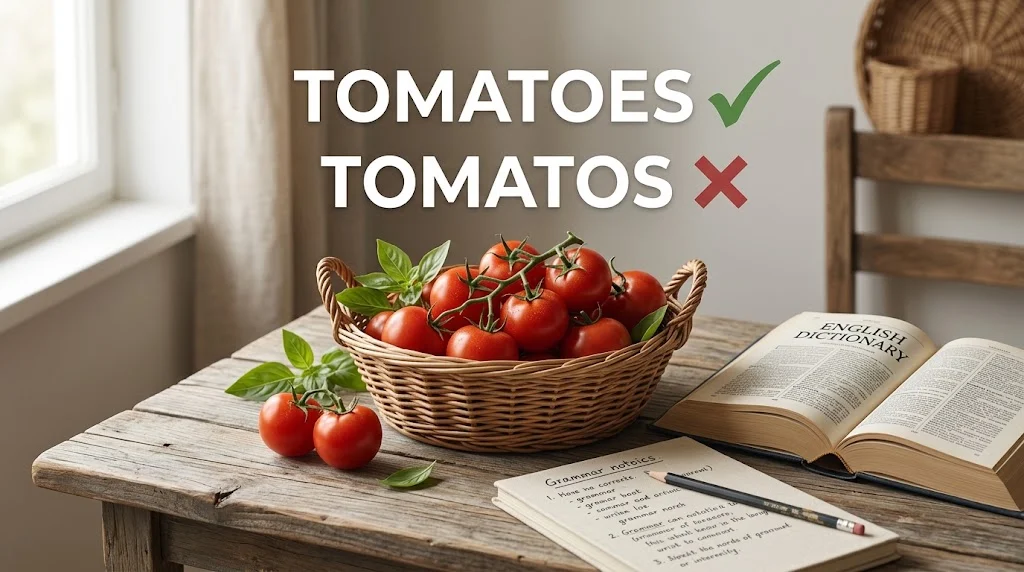
Tomatoes is the correct plural spelling of tomato, while tomatos is incorrect in standard English. Although many English nouns form their plurals by adding “s,” tomato follows a common spelling pattern in which “es” is added. Use tomatoes in academic writing, professional documents, recipes, and everyday communication to ensure your spelling is accurate.
Have you ever hesitated before writing tomatoes or tomatos in a recipe, school assignment, or blog post? You’re not alone. Words ending in “o” can be confusing because some take “s” while others take “es.” However, the standard plural of tomato is always tomatoes. As an English language and writing principle, learning this spelling rule helps you avoid common mistakes and communicate more confidently.
Whether you’re discussing fresh vegetables, sharing cooking instructions, or writing an academic report, knowing the correct plural form makes your writing clearer and more professional.
Tomatoes vs Tomatos: What’s the Difference?
The difference between tomatoes and tomatos is simple: tomatoes is the correct plural noun, while tomatos is a misspelling in standard English.
Tomatoes is the plural form of the noun tomato. It refers to two or more tomato fruits.
Tomatos is an incorrect plural spelling. Although it may look reasonable because many nouns form their plurals by adding “s,” it doesn’t follow the established spelling of tomato.
| Feature | Tomatoes | Tomatos |
|---|---|---|
| Part of speech | Plural noun | Intended plural noun |
| Correct spelling | Yes | No |
| Singular form | Tomato | Tomato |
| Meaning | More than one tomato | Intended to mean more than one tomato |
| Standard usage | Formal and informal English | Nonstandard spelling |
| Example | She bought five tomatoes. | She bought five tomatos. |
| Suitable for publication | Yes | No |
Quick Recap
Tomatoes is the correct spelling for the plural of tomato.
Tomatos is a common spelling mistake.
Add “es” to tomato to form its standard plural.
Use tomatoes in essays, recipes, business writing, and everyday conversations.
Why Is Tomatoes the Correct Spelling?
English plural spelling isn’t always predictable. Most regular nouns form their plurals by adding “s,” as in book becoming books. However, certain words ending in “o” take “es.”
Tomato belongs to this group. When you want to refer to more than one tomato, add “es” to the singular form.
Examples:
- One tomato, three tomatoes.
- One potato, six potatoes.
- One hero, several heroes.
- One echo, two echoes.
These examples demonstrate a common plural pattern, although English also has words ending in “o” that simply take “s,” such as photos, radios, and pianos.
The best approach is to learn the established plural form of each word rather than assume that every noun ending in “o” follows the same rule.
Is Tomatoes vs Tomatos a Grammar, Vocabulary, or Usage Issue?
The difference between tomatoes and tomatos is primarily a spelling issue related to English plural formation. It also connects to grammar because the plural form must be used correctly in a sentence.
Are Tomatoes and Tomatos Interchangeable?
No. In standard English, tomatoes is correct and tomatos is not an accepted alternative plural spelling.
For example:
Correct: The market sells fresh tomatoes every morning.
Incorrect: The market sells fresh tomatos every morning.
The second sentence contains a spelling error, even though the intended meaning remains understandable.
Formal vs Informal Usage
Tomatoes is correct in both formal and informal situations. You should use it in professional emails, reports, grocery lists, recipes, social media posts, and casual conversations.
Tomatos shouldn’t be used as an alternative in informal writing simply because the message is casual. Standard spelling remains important in everyday communication.
Academic vs Casual Usage
In academic writing, use tomatoes when discussing plant growth, nutrition, agriculture, or food science.
For example:
“The researchers measured the growth rates of tomato plants and recorded the number of tomatoes produced.”
In casual writing, the same spelling applies:
“I bought some tomatoes to make pasta sauce.”
The context changes, but the plural spelling doesn’t.
When to Use Tomatoes
Use tomatoes whenever you need the plural form of tomato. The word is appropriate for cooking, gardening, agriculture, scientific research, and ordinary conversation.
Workplace Example
A restaurant manager might write:
“Please order 20 fresh tomatoes before the lunch service begins.”
The sentence uses the correct plural form in a professional setting.
Academic Example
A biology student could write:
“Tomatoes develop from the flowers of tomato plants after successful pollination.”
This example is suitable for an assignment about plant reproduction.
Technology Example
A grocery inventory application might display:
“Current stock: 48 tomatoes.”
The word remains unchanged in digital products, inventory systems, and database reports.
Usage recap: Use tomatoes whenever you’re referring to more than one tomato. The spelling stays the same regardless of the setting.
When You Should Not Use Tomatoes or Tomatos
Understanding the correct spelling also means knowing when the word itself may be inappropriate.
1. Don’t use tomatos as the plural. The standard spelling is tomatoes.
2. Don’t use tomatoes when referring to one fruit. Use tomato for the singular form.
3. Don’t use tomatoes with a singular quantity. Write “one tomato,” not “one tomatoes.”
4. Don’t confuse tomato with potato. Their plural forms are tomatoes and potatoes, respectively.
5. Don’t assume every word ending in “o” takes “es.” Words such as photos and radios usually take only “s.”
6. Don’t omit the plural ending when describing multiple items. Write “three tomatoes,” not “three tomato.”
7. Don’t rely entirely on spellcheck. Some tools may fail to identify a misspelling in unusual contexts, so proofreading is still useful.
8. Don’t confuse the plant with its fruit. Use the surrounding sentence to make clear whether you’re discussing tomato plants, tomato fruits, or tomato products.
Common Mistakes and Correct Usage
The following examples show how to use tomato and tomatoes accurately.
| Correct sentence | Incorrect sentence | Explanation |
|---|---|---|
| I bought four tomatoes. | I bought four tomatos. | Tomatoes is the correct plural spelling. |
| She sliced one tomato. | She sliced one tomatoes. | One requires the singular noun. |
| We need ten tomatoes for the recipe. | We need ten tomato for the recipe. | A plural quantity normally requires the plural form. |
| These tomatoes are ripe. | These tomato is ripe. | These takes a plural noun and plural verb. |
| This tomato is fresh. | This tomatoes are fresh. | This refers to a singular item. |
| The farmer harvested many tomatoes. | The farmer harvested many tomatos. | Many is followed by a plural noun. |
Decision Rule
If you mean one fruit, use tomato.
If you mean two or more fruits, use tomatoes.
Never use tomatos as the standard plural spelling. Remember the final “es” to avoid this common mistake.
Tomatoes and Tomatos in Modern Technology and AI Tools
Digital writing tools, search engines, educational applications, and AI assistants frequently encounter spelling questions like tomatoes or tomatos.
Most modern spellcheckers recognize tomatoes as the correct plural form and may flag tomatos as a spelling error. Grammar tools can also identify number agreement problems, such as “these tomato is fresh.”
However, automated tools aren’t perfect. A misspelled word may sometimes pass unnoticed, especially in specialized documents or unusual sentence structures.
If you’re creating website content, recipes, product descriptions, or educational articles, proofread important text before publishing. Search engines can often understand spelling variations and mistakes, but correct spelling improves readability and creates a more professional impression.
For English learners, the most useful technique is to study the singular and plural forms together: tomato, tomatoes; potato, potatoes; photo, photos.
Etymology: Where Does the Word Tomato Come From?
The word tomato ultimately comes from the Nahuatl word tomatl, referring to the fruit. It entered English through Spanish, where the form tomate developed.
The word became established in English as tomato. Its plural follows an English spelling convention rather than directly copying the plural rules of its source language.
Over time, tomatoes became the accepted plural spelling in standard English. Although tomatos may appear in informal writing as a mistake, it isn’t the standard form recognized by conventional English dictionaries.
This history also illustrates an important language principle: borrowed words often adapt to the spelling and grammatical patterns of the language that adopts them.
Expert Insight: How to Remember Tomatoes
A useful spelling principle is to learn common plural forms as complete words rather than relying on a single rule for every noun ending in “o.”
For example, remember these pairs together:
- Tomato becomes tomatoes.
- Potato becomes potatoes.
- Hero becomes heroes.
- Photo becomes photos.
- Piano becomes pianos.
This approach is especially helpful for students and English learners because English has exceptions to many spelling patterns.
Two Practical Case Studies
Case Study 1: A Food Blog
Imagine a food blogger publishing a recipe for homemade tomato sauce. The draft includes the sentence, “Add five tomatos to the pan.”
During proofreading, the editor changes tomatos to tomatoes and checks the remaining ingredient lists for similar mistakes.
Result: The published recipe uses standard spelling and presents clearer instructions. The scenario illustrates an editing improvement, not a measured increase in website traffic.
Case Study 2: A Student’s Science Report
Consider a student writing a report about the effect of watering frequency on tomato plants. The student repeatedly uses tomatos when describing the harvested fruit.
A teacher identifies the error and explains that tomato forms its plural by adding “es.” The student corrects the report and reviews related words, including potatoes and heroes.
Result: The revised report uses the correct plural spelling and demonstrates a better understanding of standard English conventions. This is an illustrative educational scenario rather than a documented experiment.
Error Prevention Checklist
Use this quick checklist before submitting an assignment or publishing an article.
Always Use Tomatoes When
- Referring to two or more tomatoes.
- Writing recipes or ingredient lists.
- Preparing school assignments and academic reports.
- Creating professional food, gardening, or agricultural content.
- Describing multiple tomatoes in a photograph, database, or inventory.
Never Use Tomatos When
- Writing in standard English.
- Preparing formal documents or academic work.
- Publishing website content that requires correct spelling.
- Describing several tomatoes in everyday communication.
Remember that tomato is singular and tomatoes is plural. This simple distinction covers most everyday situations.
Related Grammar Confusions You Should Master
Learning the plural of tomato can help you understand other commonly confused English forms.
- Potato vs Potatoes: Learn why the plural adds “es.”
- Photo vs Photos: Understand why some nouns ending in “o” add only “s.”
- Hero vs Heroes: Explore another common plural pattern.
- Piano vs Pianos: Recognize nouns that take a simple “s.”
- Tomato vs Tomato’s: Distinguish a singular noun from a possessive form.
- Its vs It’s: Separate possession from a contraction.
- There vs Their: Understand differences in meaning and usage.
- Woman vs Women: Learn an irregular plural form.
- Child vs Children: Recognize a plural that doesn’t follow the usual “s” pattern.
- Advice vs Advices: Understand how uncountable nouns work in standard English.
These topics provide a useful foundation for improving spelling, grammar, and overall writing accuracy.
Frequently Asked Questions
1. Is it tomatoes or tomatos?
Tomatoes is the correct spelling. Tomatos is a misspelling in standard English, even though it may seem logical to add only “s.”
2. Why is tomatoes spelled with an es?
Tomato follows a common English plural pattern in which “es” is added to the singular noun. This produces tomatoes, the accepted plural form.
3. What is the plural of tomato?
The plural of tomato is tomatoes. For example, “The farmer harvested 100 tomatoes from the greenhouse.”
4. Is tomatos ever correct?
Tomatos is not the standard plural spelling of tomato. In ordinary English writing, use tomatoes instead.
5. Is tomato’s the same as tomatoes?
No. Tomatoes is the plural form, while tomato’s usually indicates possession, as in “the tomato’s skin,” or appears in a contraction in an appropriate context.
6. Do all words ending in o add es in the plural?
No. Some nouns ending in “o” take “es,” such as tomatoes and potatoes, while others take only “s,” such as photos and radios.
7. How do you spell tomatoes correctly?
Spell the singular as tomato and add “es” to form tomatoes. Remembering the complete pair makes the correct plural easier to recall.
8. Is tomatoes correct in academic writing?
Yes. Tomatoes is the standard plural spelling in academic writing, including biology reports, agriculture research, nutrition studies, and food science assignments.
9. How many tomatoes are correct grammatically?
Use tomatoes after plural quantities, such as two tomatoes, five tomatoes, or several tomatoes. Use tomato when referring to one fruit.
Conclusion
When choosing between tomatoes or tomatos, remember that tomatoes is the only standard plural spelling. The singular noun tomato becomes tomatoes by adding “es,” following an established English spelling pattern. Tomatos may look reasonable, but it isn’t accepted as the correct plural in standard English.
Whether you’re writing a recipe, completing a school assignment, preparing an agricultural report, or publishing a blog post, always use tomatoes when referring to more than one fruit. Learning the correct form alongside related words such as potatoes and heroes can make English spelling easier to remember. With this simple rule in mind, you’ll be able to write confidently and avoid a common mistake

Philip Pullman is an American writer dedicated to creating clear and easy to follow English content. Through his work at LingRoya.com, he helps readers strengthen their language skills with practical and reliable guidance so that they can easily understand.