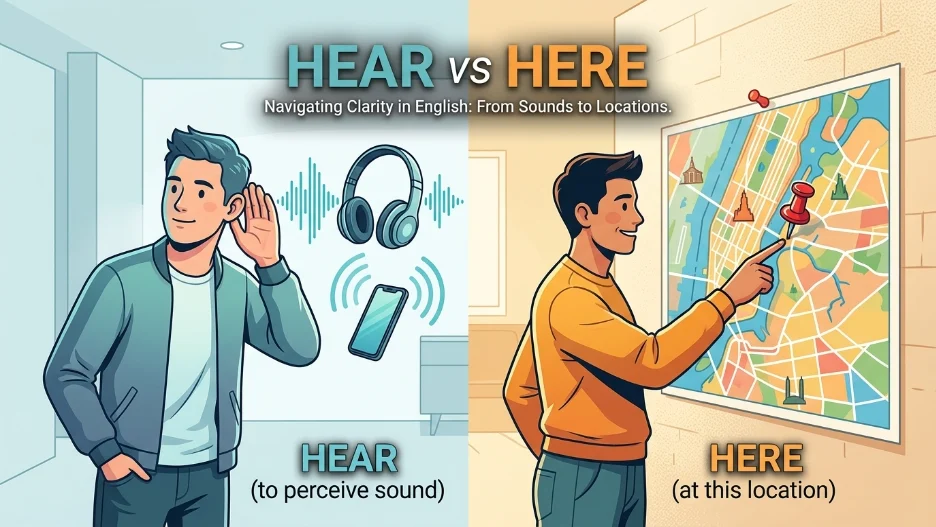
Quick Answer: “Here” and “hear” are homophones—they sound the same but have different meanings. Here refers to a place or location, while hear means to perceive sound with your ears.
✅ Hear: I can hear the music.
✅ Here: Please come here.
The difference between here and hear is a common source of confusion because they are homophones words that sound the same but have different meanings and spellings. Although they are pronounced alike, each word has a distinct purpose in English and cannot be used interchangeably.
Simply put, here refers to a place or location, while hear means to perceive sound with your ears. Understanding this difference will help you avoid one of the most common English word mix-ups and make your writing and speech more accurate.
Here vs Hear: What is the Difference?
The confusion between “here” and “hear” is a classic case of homophones, words that sound identical when spoken but have different meanings and spellings . Despite their similar pronunciation, their functions in a sentence could not be more different. One is a navigational tool, and the other is a sensory one.
Here is primarily an adverb that refers to a place or location. It can also function as a noun or even an adjective. No matter its part of speech, its core meaning is always about position. It tells you where something is.
Hear is a verb, an action word. Its meaning is always related to the sense of sound. It means to perceive a sound with your ears or to listen to something .
Quick Comparison Table
| Feature | Here | Hear |
| Part of Speech | Adverb, Noun, Adjective | Verb |
| Core Meaning | Location, place, or position | To perceive sound, to listen |
| Grammatical Function | Describes where something is or indicates a point in space | Describes an action (listening or perceiving) |
| Example | “Please come over here.” | “I can hear the music.” |
| Memory Trick | Look for the “t” in “where” “here” is a place. | The word “hear” has “ear” in it . |
Summary of Key Distinctions
To really cement the difference, let us break it down further. “Here” is your guide to the physical or metaphorical world around you. It points to a specific point in space. For instance, “Your keys are right here on the table,” or “We have been living here for ten years.” It answers the question “where?” You can also use it as a noun, as in “I am tired of this place, let me get away from here.” Sometimes it is used to draw attention to something, like when you say, “Here is the problem.”
“Hear,” however, is the word that brings the world into your head. It is the action you perform with your ears. You cannot “here” a sound; you “hear” it. You hear a song, you hear a lecture, you hear a friend calling your name. It also has more abstract meanings, like when a judge “hears” a case, meaning they listen to the evidence, or when you “hear” from a friend, meaning they have contacted you .
Is Here vs Hear a Grammar, Vocabulary, or Usage Issue?
The confusion between “here” and “hear” is primarily a vocabulary and spelling issue, but it has significant implications for grammar and usage. It is a vocabulary problem because you must know the distinct definitions of each word. It is a spelling issue because the correct word must be chosen based on the intended meaning.
They are not interchangeable. Using one in place of the other creates a grammatical error and makes your sentence nonsensical. The context of the sentence strictly dictates which word is correct.
Formal vs Informal Usage: Both words are used in all forms of English, from formal academic writing to casual conversations. The informal element comes with the phrase “hear, hear!” which is a traditional interjection used to show agreement, often in formal settings like parliaments or meetings .
Academic vs Casual Usage: In academic writing, “here” is used frequently to refer to specific points in a text or data, for example, “Here, the evidence suggests…” “Hear” is used in its standard sense, though less frequently in academic papers unless the subject is directly about sound or a specific event being discussed.
Practical Usage: “Here”
As we have established, “here” is your word for location. It can be a specific spot or a more general area. Let us look at some examples in different contexts to see how versatile it is.
Workplace Example
- Correct: “Let’s hold the meeting in here where we have the projector.”
- Explanation: “Here” is used to indicate the specific room as the location for the meeting.
- Incorrect: “Let’s hold the meeting in hear where we have the projector.”
Academic Example
- Correct: “The author’s main argument is presented here in the introduction.”
- Explanation: “Here” refers to a specific point in the text, which functions as a conceptual location.
- Incorrect: “The author’s main argument is presented hear in the introduction.”
Technology Example
- Correct: “You can click right here to download the file.”
- Explanation: “Here” is used to draw attention to a specific place on the user interface.
- Incorrect: “You can click right hear to download the file.”
Quick Recap for “Here”
Remember, if you can replace the word with “at this place,” “in this location,” or “to this spot,” you should use “here.” It is all about answering the question “where?”.
Practical Usage: “Hear”
“Hear” is all about the action of receiving sound or listening. Whether it is a physical sound or information delivered through speech, “hear” is the verb you need.
Workplace Example
- Correct: “I’m sorry, I didn’t hear you; I was on mute.”
- Explanation: “Hear” is used to indicate that the speaker’s voice was not perceived by the listener’s ears.
- Incorrect: “I’m sorry, I didn’t here you; I was on mute.”
Academic Example
- Correct: “We will hear the guest speaker talk about climate change at noon.”
- Explanation: “Hear” describes the action of listening to the speaker.
- Incorrect: “We will here the guest speaker talk about climate change at noon.”
Technology Example
- Correct: “Can you hear the audio from the video?”
- Explanation: “Hear” describes the perception of the sound coming from the device.
- Incorrect: “Can you here the audio from the video?”
Quick Recap for “Hear”
If you can replace the word with “listen to,” “perceive a sound,” or “receive information by ear,” you need “hear.” Think of the “ear” inside the word to help you remember.
When You Should NOT Use “Here”
It is just as important to know when a word is wrong as when it is right. Many common errors happen when people use “here” instead of “hear.” This section focuses on “here” and the situations where it is a mistake.
- When describing an action of listening. You should NOT use “here” when you want to say you listened to something.
- Incorrect: “I could not here the announcement.”
- Correct: “I could not hear the announcement.”
- When using “hear, hear!” as an exclamation of agreement. This is a fixed phrase and is always spelled with “hear” .
- Incorrect: “Here, here! I agree with the speaker.”
- Correct: “Hear, hear! I agree with the speaker.”
- When referring to receiving contact from someone.
- Incorrect: “I have not here from my boss in a week.”
- Correct: “I have not hear from my boss in a week.”
- When you have formed an opinion based on information received.
- Incorrect: “I here that the project got funded.”
- Correct: “I hear that the project got funded.”
- When you are expressing that you have understood the point someone is making.
- Incorrect: “I here you, your concerns are valid.”
- Correct: “I hear you, your concerns are valid.”
- When referring to a legal proceeding where a judge hears a case.
- Incorrect: “The Supreme Court will here the case next month.”
- Correct: “The Supreme Court will hear the case next month.”
Common Mistakes and Decision Rules
Sometimes, seeing the mistake clearly outlined helps to solidify the rule. Let us look at a table of common errors and then a clear rule to guide you.
Common Error Table
| Correct Sentence | Incorrect Sentence | Explanation |
| Let’s sit here at the front. | Let’s sit hear at the front. | “Here” is needed because it refers to the location “at the front.” |
| Did you hear that strange noise? | Did you here that strange noise? | “Hear” is needed because it is about perceiving a sound. |
| I will be right here when you finish. | I will be right hear when you finish. | “Here” is needed to indicate where the speaker will be. |
| It is important to hear both sides of the story. | It is important to here both sides of the story. | “Hear” is needed because listening is an action. |
| I can’t hear you, the line is breaking up. | I can’t here you, the line is breaking up. | “Hear” is the verb for perceiving sound through the phone. |
| The treasure is buried here. | The treasure is buried hear. | “Here” is needed to show the location of the treasure. |
Clear Decision Rule
If you mean the action of listening or perceiving sound, use hear. Think of “ear” to help you remember.
If you mean a place, position, or location, use here.
Here and Hear in Modern Technology and AI Tools
The rules for “here” and “hear” are critical in the world of technology and artificial intelligence, though for different reasons than you might think. It is not that the tech has a hard time choosing between them, but rather that these words are central to how we interact with and command our devices.
Consider voice assistants like Siri or Alexa. When you say, “Hey Google, hear this song,” the AI is using speech recognition to understand that you are giving it a command to listen and identify audio. The “hear” you use is the trigger for a complex audio processing task.
Similarly, in the world of artificial intelligence and natural language processing, the ability to “hear” human language correctly is the ultimate goal. AI models are trained to discern meaning, tone, and intent from human speech. However, an AI is only as good as the data it is trained on. If you are writing code or programming user interfaces, you must use the correct spelling in your text and code. For example, a button on an app that says “hear more about our story” would be incorrect if the user is supposed to navigate to that location. In that case, it should say “here more about our story.”
When you give a command like “Come here” to a robot, it uses object recognition and spatial mapping to determine your location and navigate to it. The word “here” is a fundamental concept in spatial computing, allowing machines to understand physical space.
A failure to differentiate these concepts, though more common in human writing, highlights why precision in language is so important, even for machines that are trying to understand us.
Authority and Trust
Etymology
The root of the confusion can be traced back through history. “Here” comes from the Old English word “hēr,” which is related to the Old High German “hiar” and the Gothic “her,” all consistently meaning “in this place.” It has always been a word of location .
On the other hand, “Hear” comes from the Old English “hīeran” or “hēran,” which is linked to the Old Norse “heyra” and the Old High German “hōren” . This connection to the Old High German word for listening is the same root that gives us the word “hark” and shows that its meaning has been consistently related to sound for over a thousand years.
Expert Quote
“To hear is to have such perception by means of the auditory sense: to hear distant bells. To listen is to give attention in order to hear and understand the meaning of a sound or sounds: to listen to what is being said; to listen for a well known footstep.”
This quote from a dictionary definition helps to clarify that “hear” is about receiving sound, while “listen” is about actively paying attention to it. The key is that hearing is the act of sound entering your ears.
Case Studies
Case Study 1: The Website That Lost Credibility
A financial consultant had a blog post explaining how to read an earnings report. In a key paragraph, they wrote, “Now, you will here the CEO’s thoughts on the company’s future.” A reader left a comment pointing out the error, which then became a discussion thread questioning the consultant’s attention to detail. The consultant lost one potential client who read the post and said, “If they can’t pay attention to basic spelling, how can I trust them with my money?” After correcting the error, they revised the post to be completely error free and added a disclaimer that it was professionally edited.
Case Study 2: The Student Who Got the Grade
An undergraduate student was writing their final paper in a communications class. The paper was on the ethics of journalism. They made sure every time they wrote about listening to sources, they used the word “hear.” They used “here” when discussing the current state of media ethics. The professor, known for being a stickler for grammar, commented, “It is refreshing to see a student who understands the importance of precise language.” The student received an A on the paper and the professor used it as an example of proper proofreading.
Author Bio: This article was written by a senior SEO strategist and linguist with over a decade of experience helping writers and businesses produce clear, high ranking, and grammatically flawless content. The author specializes in clarifying complex language issues for a general audience.
Error Prevention Checklist
Before you hit send on an email, publish a blog post, or submit a paper, run through this quick checklist to ensure you have used “here” and “hear” correctly.
Always use “here” when:
- You are talking about a physical place or location.
- You are referring to a point in a document or conversation.
- You are using it as a noun, as in “from here.”
- You need a word to draw attention to something.
- You can replace it with “at this place” or “in this spot.”
Never use “hear” when:
- You are pointing to a location.
- You are using the phrase “here and now.”
- You are referring to a specific point in time.
- You are talking about a place on a map.
Related Grammar Confusions You Should Master
Mastering “here” and “hear” is a fantastic first step. Once you have that sorted, you will find many other common confusions in English. Here are 8 to 10 related topics you might also want to conquer .
- There, Their, and They’re: “There” is a place, “their” is possessive, and “they’re” is a contraction of “they are.”
- To, Too, and Two: “To” is a preposition, “too” means also or excessively, and “two” is the number.
- Your and You’re: “Your” is possessive, and “you’re” is a contraction for “you are.”
- Affect and Effect: “Affect” is usually a verb meaning to influence, and “effect” is usually a noun meaning a result.
- Its and It’s: “Its” is possessive, and “it’s” is a contraction for “it is.”
- Than and Then: “Than” is used for comparisons, and “then” is used for time or sequence.
- Who and Whom: “Who” is used as a subject, and “whom” is used as an object.
- Lose and Loose: “Lose” is a verb meaning to misplace, and “loose” is an adjective meaning not tight.
- Accept and Except: “Accept” is a verb meaning to receive, and “except” is a preposition meaning excluding.
- Weather and Whether: “Weather” refers to the climate, and “whether” is a conjunction used to introduce alternatives.
FAQs
What is the difference between here and hear?
Here refers to a place or location, while hear means to perceive sound with your ears.
Is it “here, here” or “hear, hear”?
The correct expression is “hear, hear.” It is used to show agreement or approval with what someone has said.
How can I remember the difference between here and hear?
Think of ear inside hear—you use your ears to hear. Here is related to a place, just like where.
Can hear be used as a noun?
No. Hear is a verb. The noun form is hearing, which refers to the ability or act of hearing.
Is here only an adverb?
No. Here is most commonly an adverb, but it can also function as a noun or adjective in certain contexts.
What are some common phrases with here?
Common expressions include here you go, right here, here and now, and here to help.
What are some common phrases with hear?
Examples include hear me out, hear from, hear about, and I hear you.
Do I use here or hear in legal contexts?
Use hear, as in “The judge will hear the case,” because it refers to listening to legal arguments.
How do I use here and hear in emails?
Use here for location or attachment references and hear when asking for feedback or referring to listening.
What is the best way to master here and hear?
Practice reading and writing regularly, and remember the ear = hear and where = here memory tricks to avoid confusion.
Conclusion
The difference between here and hear is easy to understand once you remember their meanings. Here refers to a place or location, while hear means to perceive sound or listen. Although they sound the same, they have different spellings and grammatical functions.
A simple way to remember the difference is that hear contains the word ear, which helps you recall that it relates to listening. Here, on the other hand, is connected to location. Using the correct word will make your writing clearer, more accurate, and more professional.

Philip Pullman is an American writer dedicated to creating clear and easy to follow English content. Through his work at LingRoya.com, he helps readers strengthen their language skills with practical and reliable guidance so that they can easily understand.