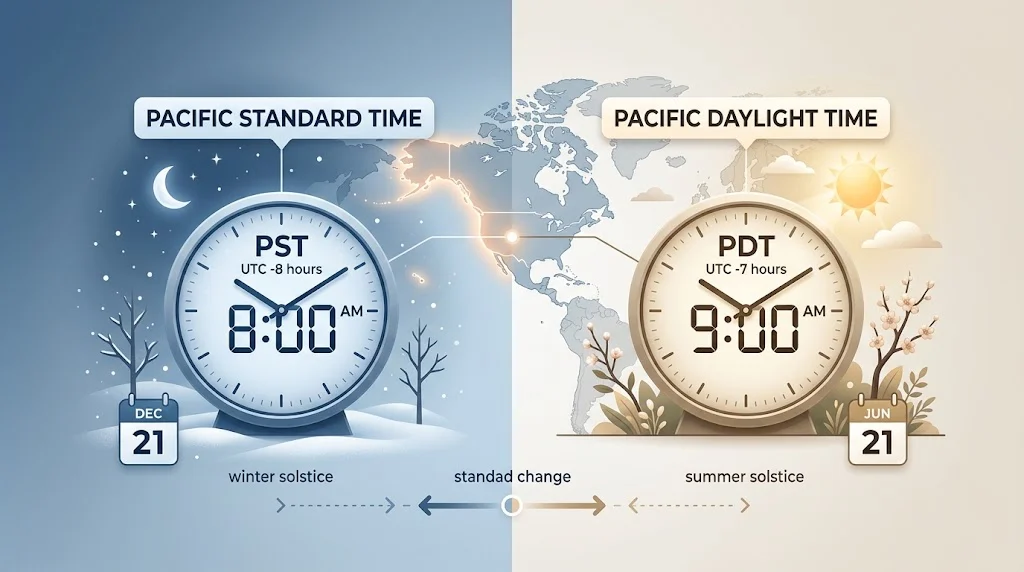
PST or PDT refers to two different Pacific Time designations used in the United States and Canada. PST means Pacific Standard Time and equals UTC minus 8 hours, while PDT means Pacific Daylight Time and equals UTC minus 7 hours.
If you’ve ever received an invitation saying “3 PM PST” in summer, you may have wondered whether the sender actually meant Pacific Daylight Time. PST or PDT is a common source of confusion because both abbreviations refer to Pacific Time, but they describe different UTC offsets.
PST stands for Pacific Standard Time. It is the standard time designation for the Pacific Time Zone when daylight saving time is not active. PDT stands for Pacific Daylight Time and applies when daylight saving time is active. In the United States, Pacific Standard Time is UTC minus 8 hours, while Pacific Daylight Time is UTC minus 7 hours.
PST vs PDT: What’s the Difference?
PST is a noun based time zone abbreviation representing Pacific Standard Time. PDT is the corresponding abbreviation for Pacific Daylight Time. Neither is a verb, adjective, or grammatical tense. They are labels used to identify a particular time standard or local time designation.
The key distinction is whether daylight saving time is in effect.
The simplest way to remember the distinction is that standard time uses the standard UTC offset, while daylight time moves the clock one hour forward.
PST is UTC minus 8 hours.
PDT is UTC minus 7 hours.
Both belong to Pacific Time, but they are not the same designation.
Is PST vs PDT a Grammar, Vocabulary, or Usage Issue?
The question is primarily a usage and timekeeping issue, rather than a traditional grammar problem.
PST and PDT are abbreviations. Their meanings cannot normally be exchanged without changing the time represented. If someone writes “10 AM PST” when they actually mean the local Pacific time during daylight saving time, the statement can technically indicate a different moment.
In casual conversation, people sometimes use PST as a general label for Pacific Time throughout the year. That practice is understandable, but it can create ambiguity in professional or international communication.
For academic writing, technical documentation, legal records, scientific work, and scheduling systems, precision is preferable. The National Institute of Standards and Technology explains that Pacific Time may be identified as PST during standard time and PDT during daylight saving time, while PT can be used as a general designation when the specific seasonal status is not being stated.
So the practical distinction is simple. Use the seasonal abbreviation when the exact offset matters. Use Pacific Time or PT when you deliberately want a general designation.
How to Use PST Correctly
PST means Pacific Standard Time and represents UTC minus 8 hours. It applies when the Pacific Time region is observing standard time.
Workplace example
A company might announce:
“Our quarterly meeting begins at 9 AM PST.”
If the meeting occurs during a period when Pacific Time is observing standard time, the designation is appropriate.
For an international team, however, adding the UTC offset can remove uncertainty:
“The meeting begins at 9 AM PST, which is UTC minus 8 hours.”
Academic example
A university might state:
“Applications must be submitted by 11:59 PM PST.”
This is useful when a deadline is tied to a specific standard time period. Students in other countries should convert the stated time carefully rather than assuming every Pacific Time reference has the same offset.
Technology example
A server log might record an event as occurring at a particular local time under PST. Developers working with distributed systems should generally prefer UTC based timestamps internally because local abbreviations can create ambiguity around daylight saving transitions.
Usage recap
Use PST when Pacific Time is actually observing standard time.
Remember that PST represents UTC minus 8 hours.
Do not automatically use PST as a year round substitute for Pacific Time.
For systems and international scheduling, an explicit UTC offset is often safer.
How to Use PDT Correctly
PDT means Pacific Daylight Time. It represents UTC minus 7 hours and is used while daylight saving time is in effect.
Workplace example
Imagine a California based company schedules a webinar at:
“2 PM PDT.”
During the daylight saving period, this means 2 PM at UTC minus 7 hours. A participant in London, Tokyo, or Lahore needs to convert that specific offset rather than assuming Pacific Time is always UTC minus 8 hours.
Academic example
An online examination might state:
“The examination portal closes at 8 PM PDT.”
Students should treat PDT as the actual time zone designation rather than interpreting the abbreviation as a generic reference to the Pacific region.
Technology example
A cloud application could display:
“System maintenance begins at 1 AM PDT.”
If the software has been configured correctly, the underlying time zone rules should determine whether daylight saving time is active. Modern operating systems generally use time zone databases and updated rules rather than relying solely on manually entered abbreviations.
Usage recap
Use PDT when daylight saving time is active.
PDT represents UTC minus 7 hours.
It is one hour ahead of PST.
For automated systems, use a recognized geographic time zone identifier or UTC when possible.
When You Should NOT Use PST or PDT
There are several situations in which choosing one abbreviation without checking the context can cause errors.
- Do not use PST during daylight saving time simply because you mean Pacific Time generally.
- Do not use PDT during the standard time period.
- Do not assume Pacific Time has the same UTC offset throughout the year.
- Do not convert an international meeting using PST without checking whether daylight saving time is active on the relevant date.
- Do not treat PST and PDT as interchangeable abbreviations.
- Do not manually hardcode a seasonal abbreviation into software that needs to operate across the entire year.
- Do not assume another country or region follows identical daylight saving rules merely because it uses a Pacific time designation.
- Do not rely on an abbreviation alone when a legal, financial, scientific, or technical timestamp requires maximum precision.
The U.S. daylight saving schedule currently begins on the second Sunday of March and ends on the first Sunday of November. For 2026, NIST lists March 8 as the beginning and November 1 as the end of daylight saving time in the United States.
Common Mistakes and Decision Rules
Decision Rule Box
If you mean Pacific Time during standard time, use PST.
If you mean Pacific Time during daylight saving time, use PDT.
If you mean the Pacific Time region without specifying the seasonal offset, use PT or state the UTC offset.
PST or PDT in Modern Technology and AI Tools
Modern technology has made time zone handling more sophisticated, but it has also made accurate time zone data more important.
Operating systems, calendar platforms, cloud services, programming environments, and AI tools may automatically convert between time zones. NIST notes that computer systems can receive UTC and apply local time zone and daylight saving information through the operating system.
For software development, geographic identifiers are generally more useful than ambiguous abbreviations. A location based time zone can contain rules for seasonal changes, whereas a fixed abbreviation can represent only one offset.
AI assistants face a similar challenge. When a user asks for a meeting conversion, an accurate answer depends on the date, location, and applicable daylight saving rules. An AI system that treats PST as a permanent Pacific Time offset can produce an answer that is one hour wrong.
The safest technical approach is to store timestamps in UTC and convert them into the user’s local time only when displaying them.
A Short Etymology and History
The terms standard time and daylight saving time developed from the broader history of standardized timekeeping. Standard time established consistent local clock references across regions, while daylight saving time introduced a seasonal one hour shift.
The abbreviations follow a straightforward pattern. The first two letters identify Pacific, while the final letter distinguishes Standard from Daylight. The result is PST for Pacific Standard Time and PDT for Pacific Daylight Time.
NIST’s official time guidance identifies the Pacific standard offset as UTC minus 8 hours and the Pacific daylight offset as UTC minus 7 hours.
Expert perspective
NIST explains that on the U.S. West Coast, time can be referred to as “Pacific standard time (PST) or Pacific daylight time (PDT).”
That distinction captures the central rule: the abbreviations describe different seasonal versions of Pacific Time.
Two Practical Case Studies
Case Study 1: International business meeting
A technology company based in California schedules a meeting for 10 AM during daylight saving time. A manager incorrectly labels it as PST.
The intended local time is actually PDT, which is UTC minus 7 hours. A participant converting the literal PST designation would calculate UTC minus 8 hours instead. The result is a one hour scheduling error.
Concrete result: the incorrect abbreviation can shift the interpreted meeting time by exactly one hour.
Case Study 2: Automated publication system
Imagine a publishing platform configured to release an article at midnight Pacific Time. If the developer hardcodes a fixed UTC minus 8 offset throughout the year, the release can become misaligned during daylight saving time.
Using a location based time zone or a system that automatically applies seasonal rules avoids that problem.
Concrete result: the publication schedule remains aligned with the intended local midnight instead of drifting by one hour during daylight saving time.
These examples demonstrate why time zone abbreviations are not merely labels. They can directly affect real world outcomes.
Error Prevention Checklist
Always use PST when
The Pacific region is observing standard time.
You specifically mean UTC minus 8 hours.
A historical or archived timestamp was recorded using PST.
The document requires the standard time designation.
Never use PDT when
Daylight saving time is not active.
You specifically mean UTC minus 8 hours.
A historical record clearly identifies standard time.
You are using PDT merely as a generic name for Pacific Time.
Likewise, never assume PST is appropriate simply because a person says “Pacific Time.” Check the date first.
Related Grammar Confusions You Should Master
Understanding time abbreviations is part of broader language accuracy. Other common confusion pairs worth learning include:
- EST vs EDT
- CST vs CDT
- MST vs MDT
- UTC vs GMT
- AM vs PM
- a.m. vs p.m.
- time zone vs timezone
- daylight saving time vs standard time
- farther vs further
- affect vs effect
These distinctions show a broader principle of precise communication: similar looking forms can carry different meanings, functions, or contexts.
FAQs
What does PST stand for?
PST stands for Pacific Standard Time. It represents Pacific Time at UTC minus 8 hours when standard time is in effect.
What does PDT stand for?
PDT stands for Pacific Daylight Time. It represents Pacific Time at UTC minus 7 hours during daylight saving time.
Is PST the same as PDT?
No. PST and PDT represent different UTC offsets. PST is UTC minus 8 hours, while PDT is UTC minus 7 hours.
Which is correct in summer, PST or PDT?
For U.S. Pacific Time locations observing daylight saving time, PDT is the appropriate designation during the daylight saving period.
Is PDT one hour ahead of PST?
Yes. PDT is UTC minus 7 hours, while PST is UTC minus 8 hours, making PDT one hour ahead.
Is PST or PDT used by California?
California uses Pacific Time and observes daylight saving time. Therefore, the applicable abbreviation changes between PST and PDT depending on the season.
Conclusion
PST or PDT is ultimately a question of seasonal timekeeping. PST means Pacific Standard Time at UTC minus 8 hours, while PDT means Pacific Daylight Time at UTC minus 7 hours. The two abbreviations should not be treated as interchangeable because choosing the wrong one can create a one hour error.
For everyday communication, remember the simplest rule: standard time uses PST, while daylight saving time uses PDT. When you don’t need to identify the seasonal status, Pacific Time or PT can be clearer. For software, databases, and international scheduling, use UTC or a recognized location based time zone whenever practical.

Neil Gaiman is an American writer who contributes educational content to LingRoya.com. His work focuses on helping readers improve their English with clear, practical and easy to follow guidance.