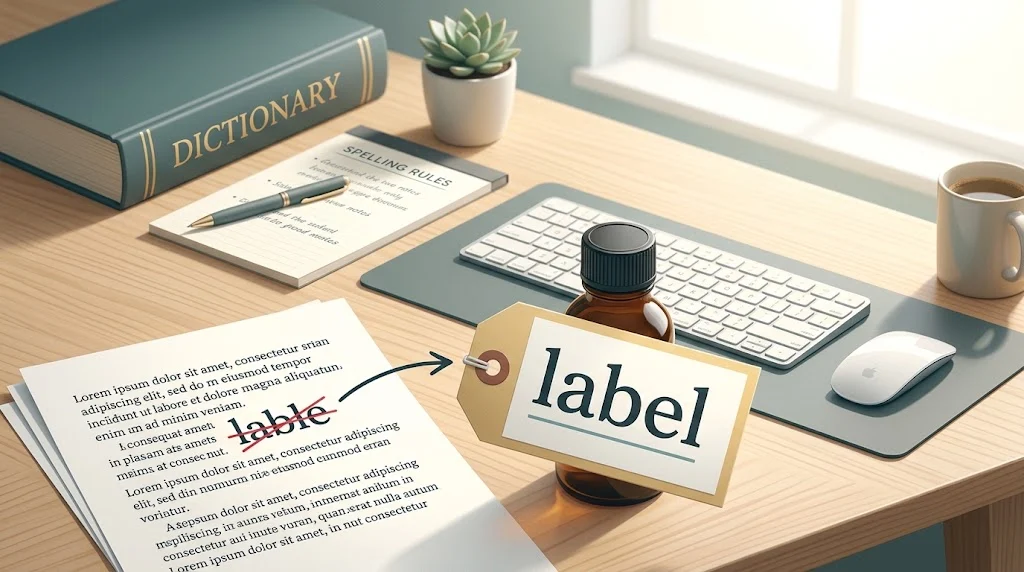
Label is a noun meaning a tag, description, or identifying mark, and it can also be a verb meaning to attach a label or describe something. Lable is a common spelling mistake caused by the pronunciation and letter order of label.
Have you ever typed a word that sounds completely natural but looks strangely different when you see it written down? The question of lable or label creates exactly this problem because the letters can easily be placed in the wrong order. Label is the established English spelling for a tag, identifying description, category, or the act of attaching such information. Lable, by contrast, isn’t a standard English word. This small spelling mistake can affect emails, assignments, product descriptions, technical documentation, and online content. Understanding why label is correct, how it functions grammatically, and where people commonly make mistakes gives writers a simple way to avoid an error that can undermine otherwise polished communication.
Lable or Label: What’s the Difference?
The difference is straightforward: label is the correct English word, while lable is a misspelling.
| Feature | Label | Lable |
| Correct spelling | Yes | No |
| Part of speech | Noun and verb | Not a standard English word |
| Meaning | A tag, description, category, or identifying mark | No accepted standard meaning |
| Example | Please check the label. | Please check the lable. |
| Formal writing | Correct | Incorrect |
| Academic writing | Correct | Incorrect |
| Technology | Common | Incorrect |
As a noun, label refers to a piece of information attached to an object or used to identify something.
For example:
The label on the bottle lists all the ingredients.
As a verb, label means to attach a label or identify something with a particular description.
The technician labeled each cable before installation.
The spelling lable doesn’t represent an accepted alternative. It is simply an error involving the placement of the letters e and l.
Mini Recap
Label is the standard spelling in English.
It can be used as both a noun and a verb.
Lable is a spelling mistake rather than a legitimate variant.
When writing professionally or academically, use label.
Is Lable vs Label a Grammar, Vocabulary, or Usage Issue?
This is primarily a spelling and vocabulary issue, rather than a complicated grammar problem.
Label is an established vocabulary item with several grammatical uses. It can describe a physical tag, a category, a descriptive term, or the action of identifying something.
For example:
The label contains important safety information.
Here, label is a noun.
The researcher labeled the samples carefully.
Here, labeled is the past tense of the verb label.
The word lable isn’t interchangeable with label. It isn’t an informal version, a British alternative, or an acceptable casual spelling. Using it in an academic paper, business email, résumé, website, or report would normally be considered an error.
This distinction matters because some English spelling differences are legitimate. Words such as color and colour represent accepted regional variants. Label and lable don’t work that way. There is no standard English variety in which lable is the normal spelling.
How to Use Label Correctly
Label is extremely versatile, which is one reason it’s worth learning properly. It appears in everyday conversations, professional communication, education, manufacturing, technology, science, and publishing.
Workplace Example
Imagine a warehouse employee preparing packages for delivery.
Please label every box with the customer’s address.
Here, label is a verb because it describes an action.
It can also be a noun:
The shipping label was damaged.
In professional communication, accurate spelling matters because labels often contain information that must be understood quickly. A spelling error in a document, instruction, or digital record can create unnecessary confusion.
Usage recap: Use label when referring either to an identifying tag or to the act of attaching or assigning identifying information.
Academic Example
Students and researchers frequently use label when describing diagrams, figures, samples, and categories.
Label each part of the diagram clearly.
Here, label is a verb.
Another example is:
The label beneath Figure 2 explains the experimental setup.
In academic writing, label can also refer to a descriptive classification.
Researchers sometimes label these behaviors as defensive responses.
The correct spelling remains label regardless of whether it refers to a physical object or an abstract classification.
Usage recap: In academic contexts, use label for identifying parts of diagrams, categorizing information, or describing classifications.
Technology Example
Technology provides countless examples of the word label.
A software application might allow users to label messages, files, photographs, or folders.
For example:
Users can label emails according to their priority.
A database might contain a field called label, while a programming interface might use labels to identify sections of information.
In user interface design, labels help people understand what buttons, fields, menus, and controls do.
Add a label above the search field.
Writing lable in technical documentation can make an otherwise professional interface appear poorly edited.
Usage recap: In technology, label commonly identifies interface elements, categories, fields, tags, files, and organizational systems.
When You Should NOT Use Lable or Label
There are several situations where writers frequently make the mistake of treating lable as an alternative spelling.
- Don’t use lable in academic assignments. It is not an accepted spelling variation.
- Don’t use lable in professional emails. Workplace writing should use the standard form label.
- Don’t use lable in product descriptions. Customers expect clear and accurate written information.
- Don’t use lable in technical documentation. Incorrect terminology can reduce clarity.
- Don’t use lable in website content. Search engines and readers benefit from correctly written language.
- Don’t use lable when describing a physical tag. The correct noun is label.
- Don’t use lable as the past tense of the verb. The standard form is labeled in American English and labelled in British English.
- Don’t assume pronunciation determines spelling. English spelling often cannot be predicted perfectly from pronunciation.
Common Mistakes and Decision Rules
| Correct sentence | Incorrect sentence | Explanation |
| Please read the label. | Please read the lable. | Label is the correct noun. |
| Label the containers carefully. | Lable the containers carefully. | Label is the correct verb. |
| The product label is missing. | The product lable is missing. | Lable is a spelling error. |
| Each diagram should be labeled. | Each diagram should be labled. | The verb form is based on label. |
| Check the shipping label. | Check the shipping lable. | Label is the established spelling. |
Decision Rule Box
If you mean an identifying tag, description, category, or the action of identifying something, use label.
If you have written lable, check the spelling because lable is not the standard English form.
A useful memory trick is to think of the word as label, with the final el clearly visible. Avoid switching the order of the final letters.
Lable and Label in Modern Technology and AI Tools
Modern technology has made the word label even more common.
Email platforms use labels to organize messages. Image management systems use labels to classify photographs. Machine learning systems use labels to identify categories within training data.
For example, an AI dataset might contain images labeled as cats, dogs, cars, or buildings. In this context, a label is a category assigned to a data item.
Natural language processing systems can also work with labeled text. A dataset might label a sentence according to its sentiment, topic, or grammatical structure.
This makes correct spelling especially important in technical environments. A typo such as lable may be harmless in an informal message, but errors inside documentation, variable descriptions, datasets, or user interfaces can cause confusion.
Why Do People Spell Label as Lable?
The mistake usually happens because English spelling doesn’t always match pronunciation perfectly.
When people hear the word label, they may mentally process the sounds without clearly noticing the order of the final letters. Because the word contains a relatively unstressed second syllable, the spelling can become easy to misremember.
Another reason is visual confusion. English contains many words with different arrangements of letters that sound similar or have related patterns. Once someone repeatedly sees or types lable, the incorrect version can begin to look familiar.
The best solution isn’t to rely entirely on pronunciation. Instead, memorize the written form:
label
You can also connect it with familiar compounds such as labeling, labeled, label maker, and product label.
Labeling, Labeled, or Labelled?
Once you know label, another spelling question may appear.
American English generally uses:
labeling
labeled
British English commonly uses:
labelling
labelled
The difference comes from regional spelling conventions involving the final consonant.
Notice that both forms are built from label, not lable.
Examples:
The researcher labeled the samples.
The researcher labelled the samples.
Both can be correct depending on the variety of English being used.
Etymology of Label
The English word label has a long linguistic history. It entered English through Anglo French and Middle English forms related to a strip, list, or narrow piece of material used for identification or marking. Over time, its meaning expanded from a physical identifying piece to include descriptions, classifications, and categories.
Today, label can refer to something attached to a product, a description applied to a person or concept, or a category assigned to information.
This historical development helps explain why label has such a broad range of modern meanings.
Expert Style Explanation
A practical way to think about the distinction is this:
Label is an established English word; lable is a spelling error, not a competing spelling.
That rule works across everyday, academic, professional, and technical writing.
Two Practical Case Studies
Case Study 1: Academic Editing
Consider a student preparing a biology assignment containing the sentence:
Lable the parts of the cell.
The intended meaning is perfectly clear, but the spelling is incorrect. Replacing lable with label produces:
Label the parts of the cell.
The grammatical structure stays exactly the same. Only the spelling changes, but the corrected version meets standard academic writing expectations.
Result: One spelling correction eliminates an avoidable language error without changing the meaning or structure of the instruction.
Case Study 2: Product Documentation
Suppose a company prepares packaging instructions containing:
Check that every box has a shipping lable.
The corrected sentence is:
Check that every box has a shipping label.
Again, the meaning is unchanged, but the corrected spelling improves the professionalism of the document.
Result: Correcting the spelling produces a publication ready sentence suitable for customer facing or workplace documentation.
These are practical language examples rather than claims about a particular published research experiment. They demonstrate how the error appears and how easily it can be prevented.
Error Prevention Checklist
Always use label when:
☑ You mean a tag attached to an object.
Mean a category or identifying description.
☑ You mean the action of identifying something.
☑ You’re writing an academic assignment.
Preparing professional or technical content.
☑ You’re describing software or AI data categories.
Never use lable when:
☒ You are writing formal English.
Labeling a product or package.
☒ You are writing an academic paper.
Creating technical documentation.
☒ You are preparing website content.
Naming an interface element.
Related Grammar Confusions You Should Master
English contains many spelling and usage pairs that look or sound deceptively similar. Learning these can significantly improve writing accuracy.
- Affect or effect
- Advice or advise
- Practice or practise
- Licence or license
- Complement or compliment
- Principal or principle
- Stationary or stationery
- Their, there, or they’re
- Its or it’s
- Then or than
The important lesson is that familiar sounding words aren’t always interchangeable. Checking both spelling and meaning is often necessary.
FAQs
Is lable a correct spelling?
No. Lable is not the standard English spelling. The correct word is label.
Is label a noun or a verb?
Label can be both a noun and a verb. As a noun, it can mean an identifying tag or description. As a verb, it means to attach identifying information or classify something.
Is lable acceptable in British English?
No. British English uses label, just as standard American English does. British spelling differences do not make lable correct.
What is the past tense of label?
The past tense is labeled in American English and commonly labelled in British English.
Is labeling or labelling correct?
Both can be correct. Labeling is the standard American English spelling, while labelling is commonly used in British English and several other varieties.
How do you remember the spelling of label?
Remember that the word ends with el: label. Connecting it with familiar phrases such as product label and name label can reinforce the correct spelling.
Is label a synonym for tag?
Sometimes. A label can be a physical tag attached to an object, but label also has broader meanings involving descriptions, categories, classifications, and identifying information.
Can label be used in academic writing?
Yes. Label is completely appropriate in academic writing when referring to diagrams, figures, categories, samples, classifications, or identifying information.
Conclusion
The correct spelling is label, not lable. Label functions as both a noun and a verb and appears across everyday communication, education, business, technology, science, and AI. Whether you’re referring to a product tag, a diagram description, a software category, or the act of identifying something, label is the standard form.
Remember the simple rule: label is correct; lable is a spelling mistake. If you’re unsure, focus on the final two letters and remember that the word ends in el. Mastering this small distinction can prevent unnecessary errors and make your writing look more polished and professional.

Margaret Atwood is an American writer who contributes to LingRoya.com creating clear and engaging content about the English language and everyday communication. She enjoys helping readers build confidence in their writing through simple, practical guidance.