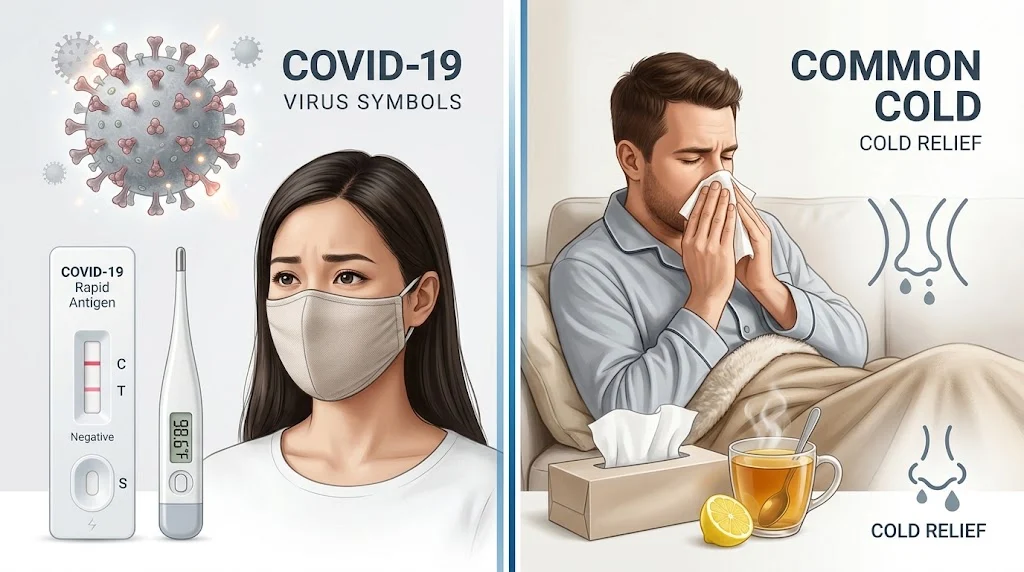
Quick Answer: COVID 19 and a common cold are different respiratory illnesses, but their symptoms can look remarkably similar. A cold is usually caused by viruses such as rhinoviruses, while COVID 19 is caused by SARS CoV 2. Symptoms cannot always distinguish them reliably, so testing is important.
The search for covid or cold often begins with a simple question: “I have a sore throat, runny nose, and cough, so which illness do I have?” The problem is that COVID 19 and the common cold share many symptoms. A cold is a viral upper respiratory infection commonly associated with nasal congestion, sneezing, runny nose, and sore throat. COVID 19 is an infectious disease caused by SARS CoV 2 and may produce fever, cough, tiredness, sore throat, headache, muscle aches, congestion, or changes in taste and smell.
This confusion matters in real life. Misidentifying an infection can affect decisions about work, school, travel, contact with vulnerable people, and whether you seek medical advice. A person with mild symptoms might have COVID 19, a cold, influenza, RSV, or another respiratory infection. Symptoms alone are therefore not a dependable diagnostic method.
COVID or Cold: What’s the Difference?
The key difference is the cause. COVID 19 results from infection with SARS CoV 2, while a common cold can be caused by several viruses. In everyday English, both COVID 19 and cold function primarily as nouns when naming illnesses.
Mini Recap
COVID 19 and a cold are separate illnesses.
Their symptoms can overlap substantially.
A symptom such as congestion does not automatically identify either illness.
Testing becomes especially useful when COVID 19 is suspected.
Is COVID or Cold a Grammar, Vocabulary, or Usage Issue?
This is primarily a vocabulary and usage issue, not a traditional grammar problem. Both terms are grammatically valid nouns, but they identify different medical conditions.
They are not interchangeable. Saying “I have a cold” communicates a specific type of illness, while saying “I have COVID 19” identifies infection with SARS CoV 2. In casual conversation, people may use broader expressions such as “I’m sick” or “I’ve got a virus,” but those expressions do not identify the exact cause.
In formal writing, academic work, workplace communication, and medical contexts, precision is particularly important. A statement such as “She has a respiratory infection” may be accurate when the specific cause is unknown, whereas “She has COVID 19” should generally be supported by appropriate evidence.
How to Use COVID 19 Correctly
COVID 19 is appropriate when you are discussing the disease caused by SARS CoV 2. Because it is the name of a specific illness, it should not be used merely because someone has cold like symptoms.
Workplace Example
“Maria stayed home after testing positive for COVID 19.”
This sentence identifies a specific illness and gives a clear reason for the absence.
Academic Example
“The study examined respiratory symptoms among participants with confirmed COVID 19.”
Here, the term is suitable because the research concerns a specific infection.
Technology Example
“Several health applications can provide information about symptoms and testing, but an application cannot determine a diagnosis from symptoms alone.”
Digital tools can help people access testing information, healthcare services, and public health guidance. However, technology should not be treated as a substitute for professional medical evaluation.
Usage Recap
Use COVID 19 when you are referring specifically to the disease caused by SARS CoV 2. Avoid using it as a general synonym for being sick or having a cold.
How to Use Cold Correctly
The word cold has several meanings in English, but in this context it refers to a common viral respiratory illness.
Workplace Example
“I think I have a cold, so I’m going to work from home today.”
The statement communicates that the speaker believes the illness is a common cold, although symptoms alone cannot always prove that conclusion.
Academic Example
“The researchers investigated how common cold viruses spread among school children.”
This use clearly identifies the ordinary respiratory illness rather than temperature or weather.
Technology Example
“The symptom checker suggested that the symptoms could be consistent with a cold, but it recommended testing when COVID 19 could not be ruled out.”
This is a useful example of responsible technology language because symptom checking can organize possibilities but cannot establish every diagnosis.
Usage Recap
Use cold for the common respiratory illness. Do not assume that every runny nose or sore throat is automatically a cold.
When You Should NOT Use COVID or Cold
Several common situations can lead to inaccurate wording or poor health decisions.
Do not call every respiratory infection COVID 19 without evidence.
Not assume a negative first home antigen test completely rules out COVID 19.
Do not describe COVID 19 and the common cold as the same illness.
Notot rely on one symptom such as a cough to make a diagnosis.
Do not use “cold” when you actually mean any infectious respiratory illness.
Not use a chatbot or symptom checker as definitive proof of a diagnosis.
Do not ignore a potential COVID 19 exposure simply because your symptoms seem mild.
Do not assume that the absence of one classic symptom means COVID 19 is impossible.
The FDA explains that an initial negative home antigen result does not necessarily rule out infection because these tests may fail to detect the virus early in an infection.
Common Mistakes and Decision Rules
Decision Rule Box
If you mean a specific infection caused by SARS CoV 2, use COVID 19.
When you mean the common viral respiratory illness generally called a cold, use cold.
If you do not know which illness is responsible, describe the symptoms or use the broader term respiratory infection instead of guessing.
Testing Matters More Than Symptom Guessing
One of the most important practical differences between these illnesses is the role of COVID 19 testing. The FDA states that people with symptoms should test immediately and repeat the test according to the test instructions when the first antigen result is negative. For symptomatic people, repeat antigen testing is recommended 48 hours after the first negative result, for a total of at least two tests.
Molecular tests such as PCR and other nucleic acid amplification tests are generally more sensitive than home antigen tests. At home antigen testing, however, offers convenience and rapid results.
A positive result on an authorized COVID 19 test strongly indicates infection. A negative result has to be interpreted in context, particularly early in illness.
COVID or Cold in Modern Technology and AI Tools
Modern technology has changed how people approach respiratory illness. Home testing allows people to collect samples themselves and receive results without immediately visiting a laboratory. The FDA notes that authorized home COVID 19 antigen tests are designed for self testing and that repeat testing can reduce the risk of missing an infection.
AI based symptom tools can also help users organize information about fever, cough, fatigue, congestion, exposure, and other symptoms. Their greatest value is educational rather than diagnostic. An AI assistant can explain why symptoms overlap, but it should not turn an uncertain symptom pattern into a certain medical diagnosis.
Etymology: Where Do These Terms Come From?
The word cold, referring to a respiratory illness, has a long history in English. Its use reflects the historical association between cold weather and respiratory symptoms, even though the illness itself is caused by viruses rather than simply by being exposed to cold temperatures.
COVID 19 is a modern medical name derived from “coronavirus disease,” with the number referring to the year 2019 when the newly recognized disease emerged. WHO identifies COVID 19 as the disease caused by SARS CoV 2.
“COVID 19 affects different people in different ways.”
WHO
That observation is important because no single symptom profile applies perfectly to every person.
Two Evidence Based Case Studies
Case Study One: Home Test Performance
In an FDA reviewed study of the Flowflex COVID 19 Antigen Home Test, the test correctly identified 89.8 percent of positive samples and 99.3 percent of negative samples among symptomatic people with upper respiratory infection symptoms. The FDA also emphasized repeat testing after an initial negative result because early infection can be missed. (U.S. Food and Drug Administration)
The practical lesson is simple: a home test can provide useful evidence, but timing and repeat testing matter.
Case Study Two: Workplace Outbreak Testing
A CDC published investigation involving horse racetrack workers compared BinaxNOW rapid antigen testing with molecular testing. Across 769 paired specimens from 342 people, positive percent agreement was 43.3 percent while negative percent agreement was 100 percent in that study. The researchers supported immediate isolation for positive rapid results and confirmatory testing for negative people when appropriate. (CDC)
The study demonstrates why a rapid test result should be interpreted within the clinical and exposure context rather than viewed in isolation.
Error Prevention Checklist
Always use COVID 19 when
You are referring specifically to SARS CoV 2 infection.
A COVID 19 test is positive.
A medical source or healthcare professional has identified COVID 19.
You are discussing COVID 19 research, treatment, testing, or public health guidance.
Never use cold when
You are simply guessing the cause of symptoms.
A COVID 19 infection has been confirmed.
The broader diagnosis remains uncertain.
You are using the word as though it were a universal term for every respiratory infection.
Related Grammar Confusions You Should Master
English learners frequently encounter similar word choice problems where two expressions seem interchangeable but have different meanings or usage patterns. Useful topics to study include:
Advice or advise
Your or you’re
Their, there, or they’re
Fewer or less
Then or than
Compliment or complement
Further or farther
Who or whom
Learning these pairs builds the same skill needed here: choosing language according to meaning rather than appearance.
FAQs
What is the difference between COVID 19 and a common cold?
COVID 19 is caused by SARS CoV 2, while the common cold can result from several different viruses. Their symptoms overlap considerably, so symptoms alone cannot always distinguish the two.
Can a cold turn into COVID 19?
A cold does not transform into COVID 19. They are separate illnesses caused by different viruses. However, a person may initially assume they have a cold when their symptoms are actually caused by COVID 19.
Is a runny nose more likely to mean a cold or COVID 19?
A runny or blocked nose can occur with COVID 19 as well as with a common cold. Therefore, a runny nose alone cannot establish which illness you have.
Can a negative COVID 19 rapid test rule out infection?
Not necessarily. The FDA states that an antigen test can miss an infection, particularly early in illness. Symptomatic people should repeat testing 48 hours after an initial negative result according to FDA guidance.
Should I test for COVID 19 when I have cold symptoms?
Testing can be appropriate when COVID 19 is possible, particularly when symptoms occur after exposure or when you may interact with someone at higher risk of severe illness.
Is COVID 19 a cold virus?
No. COVID 19 is caused by SARS CoV 2. A common cold is a broader category of respiratory illness caused by several viruses.
Can you have COVID 19 without obvious symptoms?
Yes. COVID 19 does not produce the same symptoms in everyone, and some infected people may have mild symptoms or no noticeable symptoms. (World Health Organization)
Conclusion
The main lesson behind covid or cold is that language and diagnosis both depend on precision. COVID 19 identifies a specific disease caused by SARS CoV 2, while a cold describes a common viral respiratory illness with many possible causes. Because the symptoms can overlap, it is safer to avoid making a confident diagnosis from symptoms alone. When COVID 19 is possible, appropriate testing and current medical guidance provide better evidence than guesswork. (U.S. Food and Drug Administration)
Understanding the distinction also improves everyday communication. Saying “I have a cold” communicates one thing, while saying “I tested positive for COVID 19” communicates something much more specific. Choosing the correct term makes your writing clearer, your conversations more accurate, and your health related communication more responsible.

Margaret Atwood is an American writer who contributes to LingRoya.com creating clear and engaging content about the English language and everyday communication. She enjoys helping readers build confidence in their writing through simple, practical guidance.