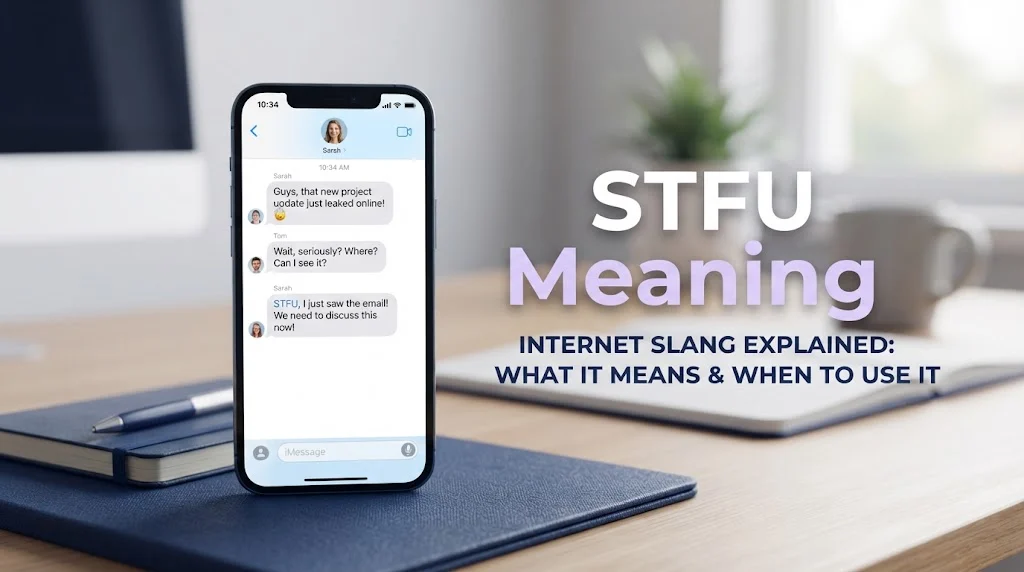
The STFU meaning is “shut the fuck up,” a blunt and vulgar expression used to tell someone to be quiet or stop speaking. People use it in text messages, online games, social media comments, and group chats. Although it can express frustration, some friends also use it jokingly when reacting to surprising news.
STFU stands for “shut the fuck up.” It is an informal internet abbreviation that tells someone to stop talking, remain quiet, or stop making comments.
The phrase contains profanity, so it usually sounds stronger and more aggressive than simply saying “be quiet.” However, its tone can change depending on the situation. Close friends may use it playfully, while strangers or frustrated people may use it as an insult.
For example:
“STFU! You actually won the concert tickets?”
Here, the sender may be expressing disbelief and excitement rather than genuinely demanding silence.
The same abbreviation can sound hostile in another conversation, particularly when someone uses it during an argument.
| Detail | Explanation |
|---|---|
| Full form | Shut the fuck up |
| Main meaning | Tell someone to stop talking or be quiet |
| Tone | Rude, angry, joking, or surprised |
| Common platforms | Text messages, TikTok, Snapchat, Instagram, and Discord |
| Formal or informal | Highly informal and vulgar |
How People Use STFU in Text Messages
People commonly use STFU to express irritation, disbelief, or a strong reaction. Its meaning becomes clearer when you consider what happened immediately before the message.
Here are three common uses.
To tell someone to stop talking
A person might use STFU when they feel annoyed by repeated comments, unwanted advice, or an argument.
Example: “STFU and let me finish explaining.”
This use is direct and confrontational because the sender wants the other person to stop speaking.
To express shock or disbelief
Friends sometimes use STFU when they hear unexpected news. In this situation, the expression can mean something like “No way!” or “I can’t believe it!”
Example: “STFU, you met your favorite singer?”
The sender probably wants more details rather than silence.
To react to teasing or annoying behavior
Someone might use STFU when a friend keeps joking about an embarrassing moment.
Example: “Bro, STFU about that picture.”
Depending on their relationship, the message could be playful or genuinely irritated.
Is STFU Always Rude?
STFU is generally considered rude because it contains profanity and can sound dismissive. However, it is not always intended as a serious insult.
The most important difference is between the literal meaning and the sender’s intention.
- Angry: Someone uses STFU to end an argument or express frustration.
- Playful: Close friends use it while teasing each other.
- Surprised: Someone reacts to unbelievable news with “STFU!”
- Dismissive: Someone uses it to shut down another person’s opinion.
For example, “STFU, no way you got promoted!” may express excitement between friends. In contrast, “STFU, nobody asked you” is clearly hostile and disrespectful.
Even if the sender intends a joke, the recipient may still find the wording offensive. Your relationship with the person and the surrounding conversation matter more than the abbreviation alone.
Is STFU Offensive?
Yes, STFU can be offensive because its full form includes a strong swear word. It may be especially inappropriate when directed at strangers, coworkers, family members during serious discussions, or anyone who has not shown that they are comfortable with this language.
If you are unsure how someone will react, a less aggressive expression is usually a better choice.
STFU Meaning on Different Platforms
The basic meaning of STFU generally stays the same across social media platforms. What changes is how people use it and how others interpret the tone.
STFU in Text Messages
In texting, STFU can express anger, disbelief, or playful surprise. Because text messages lack vocal tone and facial expressions, the intended meaning may not be obvious.
Example: “STFU, you’re moving to California?”
The message likely expresses surprise if the conversation is friendly.
STFU on TikTok
On TikTok, users may write STFU in comments, captions, or replies to videos. It can criticize someone’s statement, react to unexpected information, or jokingly express disbelief.
Example: “STFU, this ending was actually incredible.”
The comment may communicate excitement or amazement, although the wording remains vulgar.
STFU on Snapchat
On Snapchat, STFU may appear in private chats, group conversations, or replies to snaps. Its meaning depends on the relationship and the message being discussed.
Example: “STFU 😭 you really sent that to everyone?”
The crying emoji may signal laughter or embarrassment, suggesting a playful reaction rather than serious anger.
STFU on Discord and Gaming Chats
On Discord and in multiplayer gaming chats, people may use STFU when someone is distracting the team, arguing, or repeatedly speaking over others.
Example: “STFU for a second so we can hear the footsteps.”
Here, the sender wants quiet to communicate more effectively. The message can still sound aggressive, particularly when teammates do not know each other well.
Real Conversation Examples of STFU
These examples show how the same abbreviation can communicate different emotions.
Example 1: Friends sharing exciting news
Person A: “I just got tickets to see our favorite band.”
Person B: “STFU, seriously? When?”
Meaning: Person B is expressing surprise and excitement, not necessarily asking Person A to stop talking.
Example 2: An argument between classmates
Person A: “You keep interrupting everyone during the presentation.”
Person B: “STFU. You do the same thing.”
Meaning: Person B is responding defensively and using the abbreviation aggressively.
Example 3: A gaming group
Person A: “Can everyone hear the enemy approaching?”
Person B: “STFU for a second and listen.”
Meaning: Person B wants the group to stop talking so they can concentrate, but the wording may sound unnecessarily harsh.
How to Reply to STFU
The best response depends on whether the sender is joking, expressing anger, or trying to end a conversation. You do not have to respond with the same level of aggression.
Funny Replies
If a close friend uses STFU playfully, you can keep the conversation light.
- “Make me 😂”
- “Not until I finish my story.”
- “You heard me the first time!”
- “Okay, dramatic much?”
Use these replies only when you know the other person will understand the joke.
Polite or Calm Replies
If the message feels disrespectful, a calm response can establish a boundary without escalating the argument.
- “You can disagree without speaking to me like that.”
- “Please talk to me respectfully.”
- “I’m happy to listen when we can speak calmly.”
- “If you need a break, just tell me.”
These responses work better when the conversation is becoming tense or the sender is genuinely upset.
Replies When You Are Confused
If you cannot tell whether the person is joking or angry, ask for clarification.
- “Are you joking or actually upset?”
- “Wait, what did I do?”
- “Did you mean that seriously?”
A direct question is often more useful than assuming the worst based on four letters.
When Should You Use STFU?
STFU is best limited to informal conversations where the people involved understand each other’s humor and are comfortable with profanity.
Possible situations include:
- Casual conversations with close friends who regularly use this language.
- Playful reactions to surprising or unbelievable news.
- Informal gaming chats where blunt language is already accepted.
- Private group chats where everyone understands the intended tone.
Even among friends, consider the person’s mood and the subject of the conversation. A joke that works during a gaming session may sound hurtful when someone is discussing a personal problem.
When Should You Avoid STFU?
Avoid using STFU when respectful, clear communication is important.
For example, it is generally better to avoid it in professional emails, job applications, academic writing, client conversations, and formal announcements. It can also be a poor choice when talking to unfamiliar people or resolving a sensitive disagreement.
Instead of saying “STFU,” consider these alternatives:
- “Please be quiet.” A direct but less vulgar request.
- “Could you let me finish?” Useful when someone keeps interrupting.
- “Let’s take a break.” Appropriate when an argument becomes heated.
- “I need a moment of silence.” Helpful when you need to concentrate.
- “No way!” A suitable alternative when you mean to express surprise.
Choosing the right phrase helps you communicate your intention without unnecessarily offending someone.
Common Mistakes About STFU
People sometimes misunderstand the abbreviation because they focus only on its literal meaning.
| Common Mistake | Correct Understanding |
|---|---|
| Assuming STFU always expresses anger | It can also communicate playful surprise or disbelief |
| Thinking it is harmless because it is abbreviated | Its full form contains strong profanity |
| Assuming an emoji makes it friendly | Emojis provide clues but do not guarantee a playful intention |
Another common mistake is assuming that everyone interprets internet slang the same way. A close friend might understand STFU as teasing, while someone unfamiliar with the sender’s humor may consider it disrespectful.
STFU and Similar Internet Slang
Several abbreviations have meanings similar to STFU, but they differ in tone and purpose.
| Term | Meaning | Main Difference |
|---|---|---|
| STFU | Shut the fuck up | Vulgar and often confrontational |
| SHUT UP | Stop talking | Direct, but not necessarily profane |
| STFD | Shut the fuck down | Usually refers to stopping or shutting something down, not simply being quiet |
| GTFO | Get the fuck out | Tells someone to leave or expresses disbelief |
| LOL | Laughing out loud | Signals amusement rather than demanding silence |
These expressions are not interchangeable. For example, GTFO may communicate disbelief in some conversations, but its literal meaning differs from STFU.
Origin and Popularity of STFU
STFU developed as part of informal written communication, where abbreviations make messages shorter and quicker to type. It is associated with internet slang, online discussions, chat rooms, and text messaging.
The exact origin of the abbreviation is uncertain, so assigning it a specific creator or first-use date would be misleading. Its meaning is closely connected to the longer spoken phrase “shut the fuck up.”
Like many internet abbreviations, STFU can be written in uppercase or lowercase. Both “STFU” and “stfu” generally communicate the same expression, although capitalization may make a message feel more emphatic.
Quick Recap: STFU Meaning
- STFU stands for “shut the fuck up.”
- It usually tells someone to stop talking, but it can also express surprise or disbelief.
- Its tone may be playful, angry, dismissive, or offensive.
- Context, punctuation, emojis, and the relationship between speakers help reveal the intended meaning.
- Use it cautiously because the full expression contains strong profanity.
Frequently Asked Questions
What does STFU mean in text?
STFU means “shut the fuck up” in text messages, usually telling someone to stop talking or expressing strong surprise.
Is STFU rude?
Yes, STFU is generally considered rude because it contains profanity, although close friends sometimes use it jokingly.
What does STFU mean on TikTok?
On TikTok, STFU usually means “shut the fuck up” and may express disbelief, annoyance, criticism, or playful surprise.
How should you reply to STFU?
Respond with humor if a friend is joking, ask for clarification if unsure, or calmly set a boundary if the message feels disrespectful.
Can STFU have different meanings?
STFU generally has one recognized full form, but its emotional meaning changes with context, relationships, and the conversation’s tone.
Final Thoughts
The STFU meaning is “shut the fuck up,” a vulgar expression used to tell someone to stop talking or to react strongly to surprising information. Although it can be playful between close friends, it may sound aggressive, dismissive, or offensive in other situations.
When you see STFU in a text message, TikTok comment, Snapchat conversation, or gaming chat, consider the surrounding words and your relationship with the sender before interpreting it. If you plan to use the abbreviation yourself, make sure the audience understands your intention. When respect and clarity matter, a simpler phrase is often the better choice.
Discover More Articles:-
- Isle or Aisle: Meaning, Difference & Examples for 2026
- Semaglutide or Tirzepatide: Key Differences, Benefits & Risks …
- An or A: Correct Usage of Article In 2026 – LingRoya

Neil Gaiman is an American writer who contributes educational content to LingRoya.com. His work focuses on helping readers improve their English with clear, practical and easy to follow guidance.