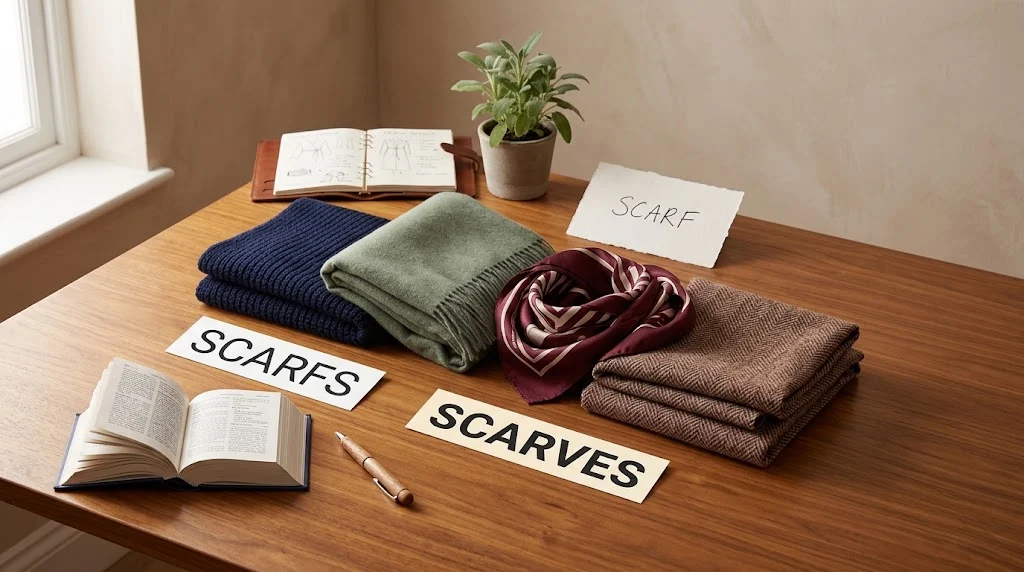
Scarfs or scarves are both accepted plural forms of the noun “scarf,” which refers to a piece of fabric worn around the neck, head, or shoulders. Scarves is the more common plural form in standard English, while scarfs is also correct.
Have you ever paused while writing and wondered whether the plural of scarf is scarfs or scarves? Both spellings are grammatically acceptable, but scarves is the more widely used and generally preferred form. The difference follows a familiar English spelling pattern in which some nouns ending in “f” change to “ves” in the plural. Whether you’re describing winter clothing, writing a fashion blog, or preparing an online product listing, knowing when to use each form makes your writing more natural and accurate.
Scarfs vs Scarves: What’s the Difference?
The main difference between scarfs and scarves is how frequently each plural form is used. Both refer to more than one scarf, but scarves is generally the conventional choice in everyday and formal writing.
Scarfs is a plural noun and can also be the third person singular form of the verb “scarf,” as in “He scarfs down his lunch.” Scarves is the standard and more common plural noun referring to multiple pieces of clothing.
| Feature | Scarfs | Scarves |
|---|---|---|
| Part of speech | Plural noun or verb form | Plural noun |
| Singular form | Scarf | Scarf |
| Meaning as a noun | More than one scarf | More than one scarf |
| Standard usage | Correct but less common as a plural noun | More common and widely preferred |
| Formal writing | Acceptable, depending on context | Generally preferred for the plural noun |
| Fashion and retail | Understandable | More conventional |
| Example | The shop sells several scarfs. | The shop sells several scarves. |
Quick Recap
Scarves is the usual choice when referring to multiple pieces of clothing.
Scarfs is also an accepted plural noun, although it is less common.
Scarfs can additionally function as a verb meaning eats quickly or greedily.
Both plural spellings refer to the same clothing items when used as nouns.
What Does Scarfs Mean?
Scarfs has two grammatical uses. It can be a plural noun referring to more than one scarf, and it can be a verb form of “scarf” meaning to eat something quickly or greedily.
As a noun, scarfs is correct, although many writers prefer scarves.
Examples:
- The clothing store sells wool scarfs in several colors.
- She packed three scarfs for her winter holiday.
- He scarfs down his breakfast before leaving for work.
In the first two examples, scarfs refers to multiple pieces of fabric. In the third, scarfs describes an action performed by a person.
The verb usage is informal and is often associated with eating quickly. In professional or academic writing, a more neutral expression such as “eats quickly” may be more appropriate.
What Does Scarves Mean?
Scarves is the most common plural form of scarf. It refers to two or more pieces of fabric worn for warmth, modesty, decoration, or protection from the weather.
Examples:
- She bought two colorful scarves for winter.
- The designer displayed silk scarves in the new collection.
- We donated several warm scarves to a local charity.
The spelling scarves follows a common English pattern in which certain nouns ending in “f” change to “ves” when pluralized. Similar examples include leaf and leaves, knife and knives, and wolf and wolves.
However, this isn’t a universal rule. Some nouns ending in “f” simply add “s,” such as roofs and beliefs.
Usage recap: Use scarves when you want the most familiar and widely accepted plural form of scarf. It is especially suitable for formal writing, shopping descriptions, and fashion content.
Is Scarfs vs Scarves a Grammar, Vocabulary, or Usage Issue?
The difference between scarfs and scarves is primarily a spelling and usage issue involving plural formation. Both are correct as plural nouns, but they differ in frequency and conventional preference.
Are Scarfs and Scarves Interchangeable?
Yes, when both words are used as plural nouns referring to clothing, they have the same meaning.
For example:
“ The boutique sells handmade scarves.”
“The boutique sells handmade scarfs.”
Both sentences are grammatically possible, but the first sounds more natural to most English readers.
The two forms aren’t interchangeable in every grammatical context. When scarfs is used as a verb, it means eating quickly or greedily. Scarves cannot replace that verb form.
Formal vs Informal Usage
In formal writing, scarves is generally the safer choice because it is the more established plural form.
Scarfs may appear in casual writing, but some readers may consider it unusual or less polished. If your goal is to maintain a conventional style, prefer scarves.
Academic vs Casual Usage
Academic assignments, essays, and professional reports should normally use scarves when referring to multiple scarves. This choice aligns with common written English conventions.
In casual conversations, either plural noun form can be understood. Still, using the more common form helps avoid distracting readers.
When to Use Scarfs
Use scarfs when it fits your intended meaning and context. As a plural noun, it is an accepted alternative to scarves. As a verb, it describes someone eating something quickly or greedily.
Workplace Example
A fashion shop owner might write:
“Our winter collection includes handmade scarfs in a variety of colors.”
The plural noun is understandable, although scarves would generally be the more conventional choice for retail copy.
Academic Example
A linguistics student might write:
“The noun scarf illustrates variation in English plural formation because both scarfs and scarves are accepted.”
This sentence is appropriate when discussing the two forms themselves.
Technology Example
A restaurant review application might contain the sentence:
“He scarfs down his meal before leaving a review.”
Here, scarfs is a verb rather than a plural noun. The sentence describes how someone eats.
Usage recap: Scarfs is acceptable as a plural noun, but it is particularly useful to recognize its separate role as a verb. For ordinary clothing descriptions, scarves is usually preferable.
When to Use Scarves
Use scarves when referring to multiple pieces of clothing. This is the standard choice for most readers and works well across professional, academic, and everyday contexts.
Workplace Example
A clothing retailer might write:
“Our store offers lightweight scarves, wool scarves, and seasonal accessories.”
This wording is natural for a product category or sales page.
Academic Example
A student writing about clothing traditions might say:
“Silk scarves have played an important role in fashion across different cultures.”
The plural noun is appropriate in formal explanatory writing.
Technology Example
An online shopping platform could display the category:
“Women’s scarves and winter accessories.”
This wording is concise, familiar, and suitable for an e commerce interface.
Usage recap: Choose scarves for general writing, fashion articles, academic assignments, and online shopping descriptions. It is the clearest option when you simply mean more than one scarf.
When You Should NOT Use Scarfs or Scarves
Even though both plural forms are accepted, some situations require careful word choice.
1. Don’t use scarfs when your style guide specifically requires the conventional plural scarves. Follow the publication’s spelling standards.
2. Don’t use scarves as a verb meaning eats quickly. The correct form is scarfs, as in “He scarfs down his lunch.”
3. Don’t assume every noun ending in “f” changes to “ves.” English plural formation includes exceptions such as roofs and beliefs.
4. Don’t use either plural form for a single item. Use scarf when referring to one piece of fabric.
5. Don’t switch between scarfs and scarves without a reason. Consistency improves readability, especially in long articles.
6. Don’t confuse spelling preference with grammatical correctness. Scarfs is less common as a plural noun, but that doesn’t automatically make it wrong.
7. Don’t use scarfs in product titles simply because it is shorter. Scarves is generally more familiar to shoppers and readers.
8. Don’t confuse the noun with the verb. In “She bought scarves,” the word identifies clothing. In “He scarfs down food,” it describes an action.
Common Mistakes and Decision Rules
The following table highlights common errors and explains how to correct them.
| Correct sentence | Incorrect sentence | Explanation |
|---|---|---|
| She bought three scarves. | She bought three scarf. | A plural noun is needed after three. |
| He scarfs down his lunch. | He scarves down his lunch. | Scarfs is the third person singular form of the verb in this expression. |
| The store sells colorful scarves. | The store sells colorful scarve. | Scarves requires the final “s.” |
| I packed two scarfs for the trip. | I packed two scarf for the trip. | Scarfs is an accepted plural noun, while scarf is singular. |
| These scarves are made of wool. | These scarves is made of wool. | The plural subject requires the plural verb are. |
Decision Rule
If you mean multiple pieces of clothing, use scarves.
If you mean someone eats quickly or greedily, use scarfs as a verb.
If you are using the plural noun, scarfs is also acceptable, but scarves is the more common choice.
Scarfs and Scarves in Modern Technology and AI Tools
Modern writing tools, online stores, and AI content platforms frequently process both scarfs and scarves. However, a spelling checker may recommend one form over the other depending on its dictionary and language settings.
For example, an AI writing assistant might suggest replacing scarfs with scarves in a fashion product description because the latter is more conventional. In a sentence such as “He scarfs down his lunch,” however, changing scarfs to scarves would introduce a grammatical error.
Writers should therefore consider the word’s role in the sentence rather than accepting every automated suggestion. Context aware proofreading is especially important for words that can function as different parts of speech.
For SEO content, scarves is generally the more natural choice for product categories, fashion guides, and articles about winter accessories. Use relevant wording naturally instead of repeating both spellings unnecessarily.
Etymology: Why Does Scarf Become Scarves?
The plural form scarves reflects a historical English spelling pattern in which some nouns ending in “f” or “fe” developed plural forms ending in “ves.” Similar examples include knife and knives, life and lives, and leaf and leaves.
However, English spelling has never followed this pattern consistently. Words such as roofs, chiefs, and beliefs retain the final “f” sound and simply add “s” in the plural.
The word scarf has more than one accepted plural form, scarfs and scarves. Over time, scarves became the more widely established form in standard usage, while scarfs remained acceptable.
This variation is a useful reminder that English plural rules are patterns rather than absolute laws. Learning common examples can help, but checking a dictionary is worthwhile when a word has more than one accepted form.
Expert Insight: Which Form Should Writers Prefer?
A useful editorial principle is to choose the form that readers recognize most easily, unless your sentence requires a different grammatical form.
For the noun, scarves is the safest general recommendation because it is the more common conventional plural. For the verb meaning to eat quickly, use scarfs.
This distinction is more useful than memorizing one spelling as correct and the other as incorrect. Good writing depends on both grammatical accuracy and an understanding of how words function in context.
Two Practical Case Studies
Case Study 1: An Online Fashion Store
Imagine an online clothing retailer preparing product pages for winter accessories. The initial product descriptions use both scarfs and scarves, making the category labels inconsistent.
The content editor standardizes the plural noun to scarves across product titles, descriptions, and category pages.
Result: The store’s product language becomes more consistent, and customers see the familiar spelling throughout the shopping experience. This is an illustrative example, not a report of measured sales results.
Case Study 2: An English Learning Website
Consider an English learning website publishing an article about words that have multiple plural forms. Its draft states that scarfs is always incorrect.
A language editor revises the explanation to clarify that both scarfs and scarves are accepted plural nouns, while scarfs can also function as a verb.
Result: The revised article provides a more accurate explanation, avoids misleading learners, and distinguishes spelling preference from grammatical correctness. This is an illustrative case study rather than a documented experiment.
Error Prevention Checklist
Before publishing your writing, review these points.
Always Use Scarves When
- Referring to multiple pieces of clothing in ordinary writing.
- Writing fashion articles and product descriptions.
- Preparing school assignments or professional documents.
- Choosing the more common plural form for a broad audience.
Never Use Scarves When
- You need the verb form in a sentence such as “He scarfs down his lunch.”
- The word is intended to describe someone eating quickly or greedily.
- You are discussing the spelling scarfs itself as a verb form.
Remember that scarfs isn’t automatically wrong as a plural noun. The goal is to choose the form that best suits your meaning and audience.
Related Grammar Confusions You Should Master
Understanding scarfs and scarves can help you recognize other English spelling patterns. Here are ten related topics worth exploring.
- Leaf vs Leaves: Why some nouns ending in “f” change to “ves.”
- Knife vs Knives: A common example of irregular plural formation.
- Roof vs Roofs: A noun that normally adds “s.”
- Life vs Lives: A spelling change that affects the plural.
- Wife vs Wives: Another noun following the “ves” pattern.
- Loaf vs Loaves: A common plural spelling distinction.
- Half vs Halves: How some nouns change their final consonant spelling.
- Shelf vs Shelves: A familiar example of plural formation.
- Cloth vs Clothes: The difference between material and garments.
- Advice vs Advise: How similar spellings can represent different grammatical functions.
These examples demonstrate why English spelling is best learned through patterns, usage, and context rather than a single universal rule.
Frequently Asked Questions
1. Is it scarfs or scarves?
Both are correct plural forms of scarf. Scarves is more common and generally preferred in standard English, while scarfs is also acceptable.
2. Why is the plural of scarf scarves?
Scarves follows a common English pattern in which some nouns ending in “f” change to “ves” in the plural. This pattern also appears in words such as leaves and knives.
3. Is scarfs grammatically correct?
Yes, scarfs is grammatically correct as a plural noun, although it is less common than scarves. It is also a verb form meaning eats quickly or greedily.
4. Should I write scarfs or scarves in an essay?
Use scarves in most essays because it is the more widely accepted and familiar plural form. Use scarfs when discussing the alternative spelling or when the context specifically calls for it.
5. What is the singular form of scarves?
The singular form of scarves is scarf. For example, “She bought one scarf” refers to a single item, while “She bought three scarves” refers to several items.
6. Is scarfs a verb or a noun?
Scarfs can be either a noun or a verb. As a noun, it can refer to multiple scarves; as a verb, it means eating something quickly or greedily.
7. Which is more common, scarfs or scarves?
Scarves is the more common plural noun form in standard English. It is generally the better choice for formal writing, educational content, and retail descriptions.
8. Do you say two scarfs or two scarves?
Both expressions are accepted, but “two scarves” is more conventional and sounds more natural to most English speakers.
9. What is the plural of scarf in British English?
Scarves is the usual plural form in British English. Scarfs is also accepted, but it is less commonly used when referring to multiple pieces of clothing.
Conclusion
When deciding between scarfs or scarves, remember that both forms can be correct as plural nouns, but scarves is the more common and widely preferred choice. It is suitable for everyday communication, academic writing, professional documents, and fashion related content.
Scarfs also has a separate grammatical role as the third person singular form of the verb “scarf,” meaning to eat quickly or greedily. Understanding this difference prevents confusion and helps you choose the correct form for your sentence.

Neil Gaiman is an American writer who contributes educational content to LingRoya.com. His work focuses on helping readers improve their English with clear, practical and easy to follow guidance.