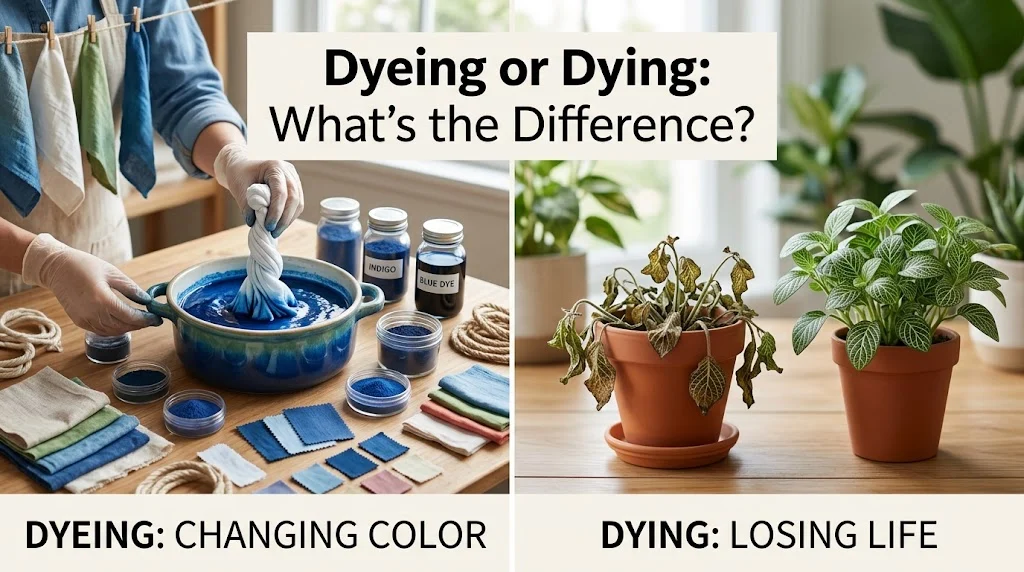
Dyeing refers to changing the color of fabric, hair, or another material, while dying means approaching the end of life or, figuratively, fading away. Both words are correct, but confusing them can change the meaning of a sentence completely. The key is to remember that dyeing comes from the verb dye, while dying comes from die.
Have you ever paused while writing and wondered whether to use dyeing or dying? Although these words look and sound similar, they describe very different actions. Dyeing means adding or changing color, such as dyeing your hair or coloring a cotton shirt. Dying refers to the process of losing life or something gradually disappearing. Understanding this spelling difference is essential for students, writers, teachers, and professionals who want to communicate clearly.
A simple way to remember the distinction is to connect dyeing with color and dying with life. This guide explains their meanings, grammar, examples, and practical usage so you can choose the correct word confidently.
Dyeing vs Dying: What’s the Difference?
The difference between dyeing and dying comes from their base verbs. Dyeing is the present participle of dye, while dying is the present participle of die. Although their pronunciation is nearly identical in most English accents, their meanings are not interchangeable.
| Feature | Dyeing | Dying |
|---|---|---|
| Base verb | Dye | Die |
| Part of speech | Verb form or gerund | Verb form or gerund |
| Main meaning | Adding or changing color | Losing life or fading away |
| Common context | Hair, fabric, clothing, textiles | People, animals, plants, traditions |
| Example | She is dyeing her hair brown. | The plant is dying without water. |
| Related noun | Dye | Death |
| Spelling rule | Retains the final e before adding ing | Drops the ie combination and adds ing |
Quick Recap
Dyeing means coloring something with a dye.
Dying means losing life or gradually disappearing.
Dyeing comes from the verb dye, while dying comes from die.
Both words are correct, but they have different meanings.
What Does Dyeing Mean?
Dyeing is a verb form that describes the process of applying color to a material. It can also function as a gerund, meaning the activity itself.
Dyeing is common in fashion, textile production, beauty treatments, arts, and crafts. People dye their hair to change their appearance, while manufacturers dye fabrics to produce specific colors.
Examples:
- Maria is dyeing her hair a darker shade of brown.
- The factory specializes in dyeing cotton fabrics.
- Dyeing the curtains blue gave the room a fresh appearance.
- The artist enjoys dyeing wool for handmade projects.
In each example, dyeing involves changing or adding color.
The spelling can be confusing because adding ing to a verb usually follows familiar spelling patterns. With dye, the final e is retained to distinguish the word from dying, which comes from die.
What Does Dying Mean?
Dying is the present participle of the verb die. It describes the process of losing life or, in figurative contexts, something gradually disappearing, declining, or coming to an end.
The word can refer to people, animals, plants, customs, businesses, or interests.
Examples:
- The patient is dying from a serious illness.
- The flowers are dying because they haven’t received enough water.
- The old tradition is dying as younger generations adopt new customs.
- The company is dying financially after several difficult years.
Dying can also appear in familiar expressions. For instance, “I’m dying to know” means that someone is extremely eager to learn something, not that the person is literally losing their life.
Usage recap: Use dying when discussing the loss of life, a decline, or an intense figurative feeling. Use dyeing when referring to coloring materials.
Is Dyeing vs Dying a Grammar, Vocabulary, or Usage Issue?
The difference between dyeing and dying is primarily a spelling and vocabulary issue. Both words follow standard English grammar, but their different base verbs give them different meanings.
Are Dyeing and Dying Interchangeable?
No. You cannot normally substitute one for the other without changing the meaning of a sentence.
Consider these examples:
- Correct: She is dyeing her hair red.
- Incorrect for the intended meaning: She is dying her hair red.
The second sentence suggests that she is losing her life while her hair is red, rather than coloring it.
Similarly, “The flowers are dying” means that the flowers are losing their health or life. “The flowers are dyeing” would suggest that the flowers are coloring something, which is not the intended meaning in an ordinary gardening context.
Formal vs Informal Usage
Both words are acceptable in formal and informal English. Neither is more professional or grammatically correct than the other.
In a formal report, a textile manufacturer might discuss dyeing techniques. A medical report might describe a patient who is dying. In casual conversation, someone might talk about dyeing their hair or a plant dying on a windowsill.
Academic vs Casual Usage
Academic writing often uses dyeing in chemistry, textile engineering, fashion studies, and materials science. Dying appears in medicine, biology, sociology, and literature.
In casual English, both words appear in everyday conversations. The important point is to identify the intended meaning before choosing the spelling.
When to Use Dyeing
Use dyeing when describing the act of changing or applying color to an object or material.
Workplace Example
A textile manager might write:
“Our team is dyeing the fabric in carefully controlled batches to maintain consistent color quality.”
The sentence describes a manufacturing process.
Academic Example
A student researching sustainable fashion could write:
“The study examines how natural dyes affect the dyeing process and the environmental impact of textile production.”
Here, dyeing refers to a technical procedure.
Technology Example
A fashion design application might display this instruction:
“Select a fabric color and preview the results before dyeing the material.”
In this context, the word describes a color changing process represented by the software.
Usage recap: Choose dyeing when the action involves coloring fabric, hair, yarn, or another material. Think of the word dye whenever color is involved.
When to Use Dying
Use dying when referring to the process of losing life or when something is gradually declining or disappearing.
Workplace Example
A business analyst might write:
“The company is struggling to remain competitive as demand for its older products declines, leaving the brand in danger of dying out.”
The word is used figuratively to describe decline.
Academic Example
A biology student might write:
“The researchers observed that the plants were dying because the soil lacked sufficient moisture.”
Here, dying describes the loss of life in plants.
Technology Example
A technician might say:
“The laptop battery is dying, so the device needs to be connected to a power source.”
This is an informal expression meaning the battery is running out of charge.
Usage recap: Choose dying when describing a living thing losing life, a trend disappearing, or something gradually coming to an end.
When You Should NOT Use Dyeing or Dying
These words are easy to confuse, but several common situations can help you avoid mistakes.
1. Do not use dyeing to describe the loss of life. Write “The plant is dying,” not “The plant is dyeing,” when the plant is withering.
2. Do not use dying to describe coloring hair. Write “She is dyeing her hair,” not “She is dying her hair,” when she is changing its color.
3. Do not confuse dyeing with dying in textile instructions. A guide about fabric coloration should use dyeing.
4. Do not assume dying always refers to literal death. The word can also describe a declining industry, fading tradition, or dwindling interest.
5. Do not assume dyeing only applies to clothing. It can refer to hair, yarn, leather, paper, and many other materials.
6. Do not confuse spelling with pronunciation. The words sound alike in many accents, so context is often more helpful than pronunciation.
7. Do not replace one word with the other during proofreading without checking meaning. A spellchecker may accept both spellings even when one is incorrect in context.
8. Do not confuse dyeing with dying out. Dyeing changes color, while dying out means gradually disappearing or becoming extinct.
Common Mistakes and Decision Rules
The following table shows how the wrong spelling can change a sentence’s meaning.
| Correct sentence | Incorrect sentence | Explanation |
|---|---|---|
| She is dyeing her hair black. | She is dying her hair black. | Dyeing means changing hair color. |
| The flowers are dying in the heat. | The flowers are dyeing in the heat. | Dying means losing life. |
| The workers are dyeing the cotton fabric. | The workers are dying the cotton fabric. | Dyeing describes the coloring process. |
| The old custom is dying out. | The old custom is dyeing out. | Dying out means gradually disappearing. |
| He enjoys dyeing wool with natural colors. | He enjoys dying wool with natural colors. | Dyeing is the correct verb for applying color. |
Decision Rule Box
If you mean changing or adding color, use dyeing.
Examples: dyeing clothes, dyeing hair, dyeing yarn.
If you mean losing life or gradually disappearing, use dying.
Examples: a dying plant, a dying animal, a dying tradition.
Memory trick: Dyeing contains the word dye, which is associated with color. Dying comes from die, which is associated with life and death.
Dyeing and Dying in Modern Technology and AI Tools
Modern technology uses both terms in different contexts. Textile manufacturing software may use dyeing to describe digital color recipes, fabric treatment, and automated production processes. Digital fashion platforms may also simulate how different dyes affect a garment’s appearance.
Dying appears in health monitoring, biology research, environmental analysis, and everyday technology discussions. For example, a device owner might say a battery is dying when its charge is nearly depleted. In environmental research, scientists might study dying coral reefs or dying plant populations.
AI writing assistants can help identify spelling mistakes, but they may not always recognize the intended meaning from a short sentence. Both words are correctly spelled, so the surrounding context matters.
For reliable proofreading, check whether the sentence describes a change in color or a loss of life. This simple distinction is often more useful than relying on automatic spelling suggestions alone.
Etymology: Why Are Dyeing and Dying Spelled Differently?
The difference comes from the base verbs dye and die, which have different meanings and spelling histories.
When the verb dye takes the ending ing, its final e is retained, producing dyeing. This spelling helps distinguish it from dying, which is formed from die by replacing the final ie with y before adding ing.
The same spelling pattern appears in other English verbs. For example, lie becomes lying, while tie becomes tying. These changes help maintain conventional spelling and pronunciation patterns.
Although dyeing and dying look similar, their distinct spellings reflect the different verbs from which they originate.
An Expert Style Rule for Remembering the Difference
A useful editorial principle is to identify the base verb before choosing the ing form. If the base verb is dye, write dyeing. If the base verb is die, write dying.
This approach works because English spelling often changes when verb endings are added. Rather than memorizing each sentence individually, connect the spelling to the action you want to describe.
For example, “She dyes the fabric” becomes “She is dyeing the fabric.” In contrast, “The plant dies” becomes “The plant is dying.”
Two Practical Case Studies
Case Study 1: A Fashion Design Assignment
Imagine a student preparing a report on natural textile colors. The student writes, “The researchers tested several methods of dying cotton using plant extracts.”
The intended meaning is the process of applying color. During proofreading, the student recognizes that the correct spelling is dyeing.
The revised sentence reads, “The researchers tested several methods of dyeing cotton using plant extracts.”
Result: The revision clarifies the technical meaning and improves the accuracy of the student’s report. This is an illustrative example, not a measured research result.
Case Study 2: A Gardening Website
Consider a gardening blogger writing about a houseplant that has yellow leaves and weak stems. The draft states, “The plant is dyeing because it receives too little sunlight.”
The writer checks the meaning and realizes that the sentence describes the plant losing its health, not changing color. The sentence is corrected to “The plant is dying because it receives too little sunlight.”
Result: The revised sentence communicates the intended meaning clearly and avoids a common spelling mistake. This is an illustrative example, not a documented experiment.
Error Prevention Checklist
Always Use Dyeing When
- You are describing hair coloring.
- You are explaining textile or fabric coloration.
- You are discussing applying dyes to yarn, leather, or other materials.
- You are referring to a process involving color treatment.
Never Use Dying When
- You mean applying color to a material.
- You are describing a hair coloring treatment.
- You are explaining a textile dyeing technique.
- The intended action is changing color rather than losing life.
Remember that dying remains correct when something is losing life, declining, or gradually disappearing. The goal isn’t to avoid the word, but to use it in the right context.
Related Grammar Confusions You Should Master
Learning other commonly confused English words can help you become a more accurate writer.
- Breath vs Breathe: A noun describing air and a verb describing the act of taking air in and out.
- Lose vs Loose: Losing something versus something that isn’t tight.
- Quiet vs Quite: Calm or silent versus fairly or completely.
- Then vs Than: Time or sequence versus comparison.
- Affect vs Effect: Usually a verb meaning influence versus a noun meaning result.
- Advice vs Advise: A noun for guidance versus a verb meaning to give guidance.
- Their vs There: Possession versus a place or introductory expression.
- Passed vs Past: The past tense of pass versus a word referring to earlier time or position.
- Principal vs Principle: A person or something primary versus a fundamental rule.
- Everyday vs Every Day: An adjective meaning ordinary versus a phrase meaning each day.
Frequently Asked Questions
1. What is the difference between dyeing and dying?
Dyeing means changing the color of a material, while dying means losing life or gradually disappearing. The words come from different base verbs.
2. Is it dyeing or dying your hair?
Dyeing your hair is correct when you are changing its color. The word comes from the verb dye, which means to add or change color.
3. Why is dyeing spelled with an extra e?
Dyeing retains the final e from the base verb dye to distinguish it from dying, which comes from the verb die.
4. Is dying a word for changing color?
No. Dying normally refers to losing life or gradually declining. Dyeing is the correct word for changing the color of hair, fabric, or other materials.
5. Is it dyeing or dying fabric?
Dyeing fabric is correct because the process involves applying color to a material. The same spelling applies to dyeing yarn, cotton, and other textiles.
6. What is the difference between dye, die, and their ing forms?
Dye means to color something, and die means to lose life. Their ing forms are dyeing and dying, respectively.
7. Does dying always mean death?
No. Dying can be used figuratively to describe something disappearing or declining, such as a dying tradition or a dying business. It can also appear in expressions such as “dying to know.”
8. How can I remember whether to use dyeing or dying?
Remember that dyeing contains dye, which is associated with color. Dying comes from die, which refers to losing life or something coming to an end.
9. Is dyeing or dying correct in British and American English?
Both words are correct in British and American English. Their distinction is based on meaning, not regional spelling. Use dyeing for coloring and dying for losing life or declining.
Conclusion
The two words are pronounced similarly, but they aren’t interchangeable. Remember the base verbs: dye becomes dyeing, while die becomes dying. This small spelling rule can prevent confusion in academic assignments, workplace documents, creative writing, and everyday communication. Before publishing, check the intended meaning rather than relying solely on a spellchecker.

Philip Pullman is an American writer dedicated to creating clear and easy to follow English content. Through his work at LingRoya.com, he helps readers strengthen their language skills with practical and reliable guidance so that they can easily understand.