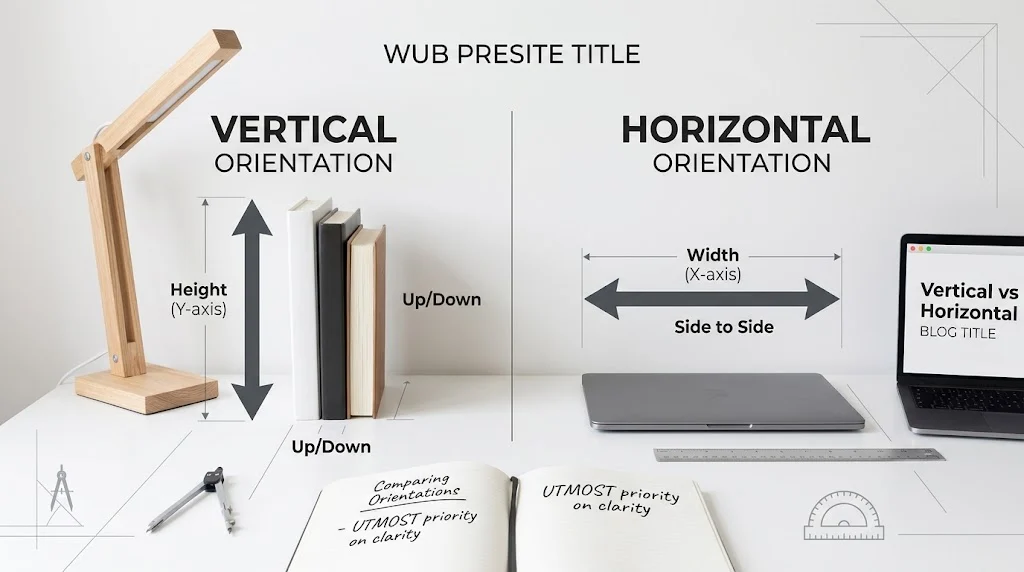
Vertical or horizontal describes two basic directions. Vertical means moving or positioned up and down, while horizontal means moving or positioned from left to right or side to side. Confusing these directions can cause practical mistakes in documents, screen layouts, photography, design, construction, data presentation, and everyday communication, especially when someone needs to describe orientation clearly.
The easiest way to remember the difference is to look at the direction involved. Vertical describes an up and down position, while horizontal describes a side to side position. Think of a standing person as vertical and a person lying down as horizontal. This simple distinction becomes important when choosing page orientation, arranging images, designing websites, reading charts, setting up equipment, or giving workplace instructions.
Although the terms are simple, using the wrong one can lead to incorrect layouts, misunderstood instructions, and poor visual communication. From everyday conversations to academic writing and modern technology, knowing exactly when to use each term makes descriptions more precise and professional.
Vertical vs Horizontal: What’s the Difference?
Vertical is an adjective and sometimes a noun. As an adjective, it describes something that extends upward and downward or is positioned at a right angle to a level surface. A vertical line moves from top to bottom.
Horizontal is also primarily an adjective and can function as a noun. It describes something that extends from one side to another and is generally parallel to the ground or a level surface. A horizontal line moves from left to right.
| Feature | Vertical | Horizontal |
| Basic direction | Up and down | Side to side |
| Typical position | Upright | Level or lying across |
| Example line | Top to bottom | Left to right |
| Common page orientation | Portrait | Landscape |
| Common visual association | Standing person | Lying person |
| Opposite term | Horizontal | Vertical |
Mini Recap
Vertical means up and down.
Horizontal means side to side.
A standing object is usually vertical.
A table surface is usually horizontal.
The two words describe different orientations and are not normally interchangeable.
Is Vertical vs Horizontal a Grammar, Vocabulary, or Usage Issue?
The difference between vertical and horizontal is mainly a vocabulary and usage issue, rather than a grammar problem. Both words are grammatically correct, but they communicate different spatial relationships.
They are not interchangeable when describing direction. Saying that a wall is horizontal when you mean it rises from the floor to the ceiling changes the meaning completely.
The distinction also remains important in formal and informal English. In casual conversation, people might say “up and down” or “side to side.” In technical, academic, workplace, and professional communication, vertical and horizontal are often more precise.
For example:
“Arrange the boxes vertically” means place them one above another.
“Arrange the boxes horizontally” means place them beside one another.
Academic writing often uses these terms when discussing graphs, structures, relationships, organization, and orientation. Technology uses them constantly when describing screens, menus, layouts, images, and interfaces.
When to Use Vertical
Use vertical when something is arranged upward and downward or stands upright.
Workplace Example
A manager might instruct an employee to arrange several files vertically on a shelf. This means the files should follow an upright arrangement rather than being spread across the shelf from left to right.
Another example is a vertical organizational structure, where levels of authority are arranged from higher positions to lower positions.
Academic Example
A teacher may ask students to draw a vertical line through the center of a diagram. In mathematics, vertical lines have a specific relationship with the coordinate system and are represented differently from horizontal lines.
A vertical comparison can also describe information organized in a top to bottom structure.
Technology Example
A smartphone is commonly held in a vertical orientation when its longer dimension runs from top to bottom. Websites and applications may also use vertical menus, vertical navigation, or vertically stacked content.
A vertical video is taller than it is wide and is especially common on mobile focused platforms.
Usage Recap
Use vertical when the primary direction is upward and downward. Think of a person standing, a tall building, a vertical line, or items stacked from top to bottom.
When to Use Horizontal
Use horizontal when something extends across from one side to another or rests level with the ground.
Workplace Example
A workplace instruction might say, “Place the labels horizontally across the boxes.” This tells workers to position the labels from one side toward the other rather than from top to bottom.
Horizontal communication can also describe communication across people or departments at a similar organizational level.
Academic Example
In mathematics, a horizontal line runs from left to right. On a standard coordinate plane, a horizontal line has a constant vertical position.
Researchers may also use horizontal analysis when comparing information across a particular period or category, depending on the subject.
Technology Example
Computer monitors, televisions, and many presentation screens commonly use a horizontal orientation. A horizontal video is wider than it is tall and is frequently used for presentations, films, websites, and desktop viewing.
Horizontal navigation menus also place options across the screen from left to right.
Usage Recap
Use horizontal when the direction is side to side or level. Think of a person lying down, a tabletop, a horizon line, or a wide screen.
When You Should NOT Use Vertical or Horizontal
Understanding when not to use these words is just as useful as knowing their definitions.
- Do not use vertical for side to side movement.
If an object moves from the left side of a room to the right side, horizontal is the appropriate description. - Do not use horizontal for upward movement.
An elevator moving from one floor to another moves vertically. - Do not describe every tall object as vertical without considering orientation.
Height alone does not always determine the intended meaning. The word should describe direction or position. - Do not confuse vertical arrangement with vertical movement.
Objects can be arranged vertically even when they are not physically moving. - Do not assume portrait always means vertical in every context.
Portrait normally refers to a taller page or image format, but vertical is the more direct term when discussing direction. - Do not use horizontal when describing an upright structure.
A standing pole is vertical even if it is located beside a horizontal surface. - Do not treat the words as interchangeable synonyms.
They describe opposite orientations in many ordinary contexts. - Do not rely only on visual intuition in technical instructions.
When precision matters, explain the exact direction as well.
Common Mistakes and Decision Rules
| Correct sentence | Incorrect sentence | Explanation |
| Draw a vertical line. | Draw a horizontal line. | A vertical line runs up and down. |
| Place the image horizontally. | Place the image vertically. | The intended layout runs across the page. |
| The pole is vertical. | The pole is horizontal. | The pole stands upright. |
| The shelf is horizontal. | The shelf is vertical. | The shelf extends across at a level position. |
| Hold the phone vertically. | Hold the phone horizontally. | The longer direction is positioned upward and downward. |
Decision Rule Box
If you mean up and down, use vertical.
If you mean side to side, use horizontal.
A quick physical test can help. Imagine drawing an arrow. If the arrow points upward or downward, think vertical. If it points left or right, think horizontal.
Vertical and Horizontal in Modern Technology and AI Tools
Technology depends heavily on orientation language. Smartphones, tablets, computer screens, cameras, websites, artificial intelligence interfaces, and digital advertisements frequently distinguish between vertical and horizontal layouts.
A vertical layout usually gives more height than width. This format can work well for mobile screens, scrolling interfaces, portrait photography, and content designed for handheld devices.
A horizontal layout gives more width than height. It can provide additional space for dashboards, spreadsheets, presentations, video editing interfaces, charts, and desktop websites.
AI image and video tools also use orientation instructions. A user might request a vertical image for a mobile presentation or a horizontal image for a website header. In these situations, choosing the wrong orientation can produce a result that does not fit the intended space.
Vertical and Horizontal Etymology
The word vertical comes from Latin verticalis, connected with vertex, meaning the highest point or top of something. Its modern meaning developed around the idea of an upright or perpendicular direction.
Horizontal comes from Greek horizōn, associated with the horizon. The horizon appears level across the viewer’s field of vision, which explains the connection between horizontal orientation and a level surface.
Their histories make the distinction easier to remember: vertical is associated with an upward direction, while horizontal is closely connected with the horizon.
An Expert Perspective
A useful principle for professional communication is this:
“Use orientation words to describe direction precisely, not merely appearance.”
This distinction matters because a clear spatial term can remove ambiguity from instructions that might otherwise require lengthy explanations.
Two Practical Case Studies
Case Study 1: Document Formatting
Imagine a company preparing a printed report containing a wide financial table. The designer chooses a horizontal page orientation because the table contains many columns.
If the designer mistakenly uses a vertical page layout, the columns may become cramped, forcing smaller text or awkward formatting.
The practical result is a document that becomes harder to read. Choosing horizontal orientation gives the table more width and improves visual organization.
Case Study 2: Mobile Content
Consider a business creating promotional content for smartphone users. The designer creates the graphic horizontally even though the intended display area is vertical.
The image may appear smaller, require cropping, or leave unwanted empty space.
Changing the design to a vertical format allows the content to occupy the available screen more naturally. The result is a better visual fit and clearer presentation.
Error Prevention Checklist
Always use vertical when:
☑ You mean up and down.
☑ Something stands upright.
☑ Items are stacked from top to bottom.
☑ A line extends upward or downward.
☑ A screen or image is taller than it is wide.
Never use horizontal when:
☑ You actually mean upward or downward.
☑ An object is standing upright.
☑ Something is arranged from top to bottom.
☑ You are describing a vertical line or direction.
At the same time, remember that horizontal is appropriate for side to side or level arrangements.
Related Grammar Confusions You Should Master
If you are working on precise English usage, these related distinctions are also useful:
- Above vs below
- Up vs down
- Across vs through
- Beside vs besides
- Further vs farther
- Between vs among
- In vs into
- Near vs nearly
- Toward vs towards
- Lay vs lie
These pairs and groups can create confusion because their meanings overlap in everyday communication while remaining distinct in precise contexts.
Frequently Asked Questions
What is the difference between vertical and horizontal?
Vertical means up and down, while horizontal means side to side or level. A standing person is a simple example of vertical orientation, while a person lying down represents horizontal orientation.
Is vertical up or sideways?
Vertical means up and down. It describes an upright direction that generally forms a right angle with a level surface.
Is horizontal left or right?
Horizontal can describe movement or direction from left to right or right to left. The important idea is side to side rather than upward and downward.
Is a standing person vertical or horizontal?
A standing person is generally vertical because the person’s body extends upward from the ground.
Is a phone vertical or horizontal?
A phone can be either vertical or horizontal depending on how it is held. Holding it upright creates a vertical orientation, while turning it sideways creates a horizontal orientation.
Is portrait vertical or horizontal?
Portrait orientation is normally vertical because the image or page is taller than it is wide. Landscape orientation is normally horizontal because it is wider than it is tall.
What is a vertical line?
A vertical line extends upward and downward. On a standard coordinate plane, it is parallel to the vertical axis.
What is a horizontal line?
A horizontal line extends from side to side. On a standard coordinate plane, it is parallel to the horizontal axis.
Are vertical and horizontal opposites?
Yes. In ordinary discussions of direction and orientation, vertical and horizontal describe contrasting directions. Vertical refers to up and down, while horizontal refers to side to side.
Conclusion
The difference between vertical or horizontal becomes simple once you focus on direction. Vertical means up and down, while horizontal means side to side or level. This distinction appears everywhere, from writing and mathematics to photography, workplace instructions, website design, smartphones, and AI tools. When precision matters, ask one simple question:

Philip Pullman is an American writer dedicated to creating clear and easy to follow English content. Through his work at LingRoya.com, he helps readers strengthen their language skills with practical and reliable guidance so that they can easily understand.