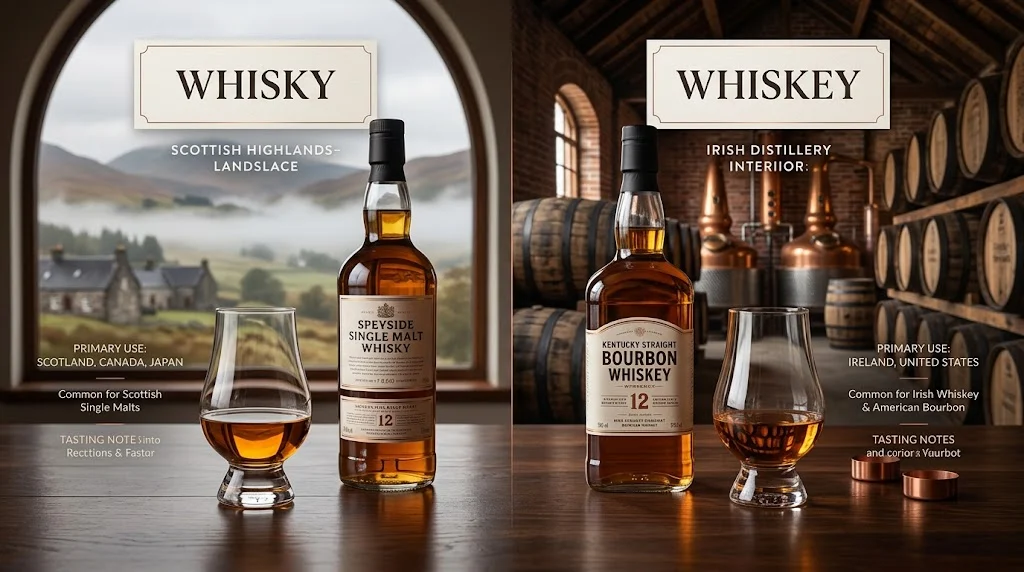
Whisky or whiskey are two accepted spellings for the same broad category of distilled grain spirits. “Whisky” is standard for Scotch and is also common in Canada and Japan, while “whiskey” is standard for Irish and American products.
If you have ever wondered whether to write whisky or whiskey, you are not alone. Both terms describe distilled spirits made from fermented grain, yet their spelling often changes according to geographic tradition. Scotch Whisky normally uses “whisky,” while Irish Whiskey and American whiskey normally use “whiskey.”
This is not simply a matter of personal preference because product names, legal definitions, labels, menus, journalism, and educational writing can all depend on the correct regional form. The confusion becomes especially important when writing about a particular drink, distillery, country, or brand. Understanding the distinction helps you write accurately and avoid an error that can make otherwise polished content look careless.
Whisky vs Whiskey: What’s the Difference?
Whisky is a noun referring to a distilled alcoholic spirit traditionally produced from fermented grain and matured according to the rules of its producing region. The spelling is strongly associated with Scotland, where Scotch Whisky is legally defined and protected. It is also commonly used for whisky produced in countries such as Japan and Canada.
Whiskey is also a noun referring to the same broad category of distilled grain spirit. The spelling is especially associated with Ireland and the United States. Irish law specifically defines Irish Whiskey, while American regulations recognize both “whisky” and “whiskey” as acceptable spellings for the broader American category.
| Feature | Whisky | Whiskey |
| Part of speech | Noun | Noun |
| General meaning | Distilled grain spirit | Distilled grain spirit |
| Strongest association | Scotland | Ireland and United States |
| Common example | Scotch Whisky | Irish Whiskey |
| American usage | Accepted but less common | Standard in many contexts |
| Meaning difference | Usually regional spelling | Usually regional spelling |
| Main distinction | Geographic and traditional convention | Geographic and traditional convention |
Quick recap
The two words generally refer to the same type of spirit.
The spelling often tells you where the product comes from.
Use “whisky” for Scotch and usually for Japanese and Canadian products.
Use “whiskey” for Irish and American products unless a specific brand uses another form.
Is Whisky vs Whiskey a Grammar, Vocabulary, or Usage Issue?
The difference between whisky or whiskey is primarily a usage and vocabulary issue, rather than a basic grammar problem. Both words function as nouns and can appear in the same grammatical positions.
For example:
“Scotch whisky has a distinctive character.”
“Irish whiskey is produced under specific regulations.”
The grammar of both sentences is essentially identical. What changes is the conventional spelling associated with the product being discussed.
The words can sometimes appear interchangeable when someone is discussing the category generally. American federal regulations, for example, explicitly recognize both spellings. However, replacing the established spelling of a specific regional product is usually a poor choice. Writing “Scotch whiskey” may be understood, but “Scotch whisky” is the established form. Likewise, “Irish whisky” does not follow the conventional spelling used in the legal name Irish Whiskey.
How to Use Whisky Correctly
Use whisky when writing about Scotch Whisky and many whisky traditions that follow the spelling without the letter “e.” The Scotch Whisky Association states that Scotch Whisky is made in Scotland from cereals, water, and yeast and must meet specific production and maturation requirements.
Workplace example
“Our company is preparing a presentation about the Scotch whisky market.”
This is appropriate because the sentence refers specifically to Scotch.
Academic example
“The development of Scotch whisky contributed significantly to Scotland’s international food and drink identity.”
The spelling is appropriate because the subject is Scottish production.
Technology example
“The whisky recommendation app categorizes Scotch products according to region and age.”
Here, “whisky” remains appropriate because the technology is discussing Scotch products.
Whisky usage recap
Choose whisky when the context is Scotch or another producing tradition that conventionally uses that spelling. Always check the official product name when discussing a particular brand.
How to Use Whiskey Correctly
Use whiskey when writing about Irish Whiskey or when following the standard American spelling. Irish law uses the spelling “Irish Whiskey,” while American regulatory materials commonly use “whisky” or “whiskey” depending on the labeling context.
Workplace example
“Our report examines the growth of American whiskey exports.”
The spelling fits the American context.
Academic example
“Irish whiskey developed through a distinctive history of grain production, distillation, and maturation.”
The spelling is appropriate because the subject is Irish Whiskey.
Technology example
“The database stores whiskey brands according to country, distillery, and production method.”
Here, “whiskey” works as a broad American style of the word.
Whiskey usage recap
Choose whiskey for Irish and American products in most contexts. If you are writing about a particular producer, reproduce the spelling used by that producer rather than changing it according to a general rule.
When You Should NOT Use Whisky or Whiskey
There are several situations where choosing the wrong spelling can weaken otherwise accurate writing.
- Do not automatically write “whiskey” when discussing Scotch Whisky.
- Do not automatically write “whisky” when discussing Irish Whiskey.
- Do not change a brand’s established spelling merely because another regional convention seems more familiar.
- Do not assume the spelling determines the quality, age, flavor, or production method of the spirit.
- Do not treat “whisky” and “whiskey” as completely different categories.
- Do not use the spelling alone to identify every production rule associated with a spirit.
- Do not assume every country follows the Scottish or American convention.
- Do not correct someone’s spelling without first checking the geographic context.
The important point is that spelling is useful evidence of tradition and origin, but it is not a complete definition of the drink.
Common Mistakes and Decision Rules
| Correct sentence | Incorrect sentence | Explanation |
| Scotch whisky is produced in Scotland. | Scotch whiskey is the standard spelling. | Scotch conventionally uses “whisky.” |
| Irish whiskey has a distinctive spelling. | Irish whisky is the usual legal spelling. | Irish law uses “Irish Whiskey.” |
| American whiskey is widely recognized. | American whisky is always wrong. | American regulations recognize both forms. |
| Japanese whisky has become internationally recognized. | Japanese whiskey is always required. | Japanese producers commonly use “whisky.” |
| Canadian whisky is a recognized category. | Canadian whiskey is the only correct form. | Canadian usage commonly favors “whisky.” |
Decision Rule Box
When you mean Scotch, Scottish whisky, or a product whose official name uses the spelling without “e,” use “whisky.”
If you mean Irish Whiskey or the conventional American spelling, use “whiskey.”
If you mean a specific brand, follow the brand’s official spelling.
This simple rule prevents most errors.
Whisky or Whiskey in Modern Technology and AI Tools
Modern search engines, databases, language models, grammar checkers, and AI writing tools increasingly rely on context rather than treating one spelling as universally correct.
For example, an AI system should recognize that “Scotch whisky” is conventional while “Irish Whiskey” follows a different regional tradition. A good content workflow should therefore provide geographic context whenever the word appears in a title, product description, article, or database.
This is particularly important for ecommerce websites. Product data can contain country, distillery, category, age statement, and brand information. Changing the spelling automatically can create inaccurate product descriptions or inconsistent catalog entries.
American regulations also demonstrate why automated systems should not simply flag one spelling as incorrect. The United States has explicitly maintained recognition of both “whisky” and “whiskey.”
The Etymology of Whisky and Whiskey
Both spellings ultimately trace back to Gaelic expressions related to uisge beatha, meaning “water of life.” The Scotch Whisky Association identifies this Gaelic origin and explains that the modern term developed from earlier forms of the expression.
The difference between the modern spellings developed through historical and regional usage rather than because the two words originally represented entirely different beverages.
This explains why the words are so similar. Their shared history is also why treating them as unrelated vocabulary items is misleading.
An Expert Perspective
The Scotch Whisky Association summarizes the distinction particularly well: “Production and maturations of whisk(e)y is governed by law, not the word.”
That observation captures an important principle. The spelling helps identify regional tradition, but production standards are determined by the laws and regulations governing the spirit.
Case Study 1: Scotch Whisky and Global Recognition
Scotch provides one of the clearest examples of why spelling matters. Scotch Whisky must meet defined requirements concerning production, maturation, ingredients, and alcohol strength. It must be produced and matured in Scotland for at least three years and bottled at a minimum strength of 40 percent alcohol by volume.
The concrete result is substantial international reach. The Scotch Whisky Association reports that 43 bottles of Scotch Whisky are exported every second.
For writers, the lesson is simple. When discussing this internationally recognized Scottish category, preserving the established spelling supports both linguistic accuracy and product identity.
Case Study 2: American Regulation and Both Spellings
The United States offers an interesting contrast. In its modernization of distilled spirits labeling rules, the Alcohol and Tobacco Tax and Trade Bureau finalized the position that whisky may be spelled either “whisky” or “whiskey.” The agency described this as consistent with longstanding policy.
The concrete result was regulatory confirmation rather than a forced change to one spelling. This demonstrates why a blanket rule such as “whiskey is correct and whisky is wrong” cannot accurately describe American usage.
For content writers, the practical result is equally important: context and official naming should take priority over simplistic spelling rules.
Error Prevention Checklist
Always use whisky when
You are writing about Scotch Whisky.
• You are referring to a Scottish distillery or Scotch category.
The official name of a product uses “whisky.”
• You are discussing a whisky tradition that conventionally uses the spelling without “e.”
Never use whiskey when
•You are deliberately following the official spelling “whisky.”
You are writing a product name that is officially spelled with “whisky.”
• You are correcting someone merely because you assume “whiskey” is universally preferred.
Always use whiskey when
• You are writing about Irish Whiskey.
You are discussing an American product where “whiskey” is the established spelling.
• A specific producer officially uses “whiskey.”
Related Grammar Confusions You Should Master
If you want to improve your English usage, whisky or whiskey is only one of many spelling and vocabulary distinctions worth mastering.
Other useful topics include:
- Practice or practise
- License or licence
- Advice or advise
- Affect or effect
- Further or farther
- Traveling or travelling
- Realise or realize
- Toward or towards
- Program or programme
- Theater or theatre
These pairs often reflect regional English, grammatical function, pronunciation, or differences in meaning. Learning the underlying rule is more useful than memorizing isolated spellings.
FAQs
Is Scotch whisky or whiskey?
The standard spelling is Scotch whisky. Scotch Whisky is a legally protected category produced in Scotland under defined requirements.
Is Irish whiskey spelled with an e?
Yes. The established form is Irish Whiskey. Irish legislation specifically uses that spelling when defining the category.
Is American whiskey spelled whisky or whiskey?
Both spellings are recognized by United States federal regulations. However, “whiskey” is the spelling commonly encountered in American consumer and brand contexts.
Why does whisky sometimes have no e?
The spelling reflects regional linguistic tradition. Scotland commonly uses “whisky,” while Ireland and the United States commonly use “whiskey.” The two spellings share the same historical roots.
Is whisky and whiskey the same drink?
Broadly, yes. Both terms describe distilled spirits made from grain, but the production rules, ingredients, maturation requirements, and traditions can differ substantially by country and category.
Should I write whisky or whiskey in an article?
Write the form appropriate to the geographic or product context. Use “whisky” for Scotch, “whiskey” for Irish products and most American contexts, and check the official spelling for individual brands.
Is Japanese whisky or whiskey correct?
“Japanese whisky” is the conventional spelling used by many Japanese producers and industry sources. The spelling without “e” is therefore generally appropriate when referring to Japanese whisky.
Which spelling is more correct, whisky or whiskey?
Neither spelling is universally more correct. Both are legitimate. The correct choice depends primarily on regional convention, product identity, and official usage.
Conclusion
The answer to whisky or whiskey is straightforward once you connect spelling with geography. Whisky is the established form for Scotch and is also widely used in Canada and Japan. Whiskey is the established form for Irish products and is common in the United States. American regulations recognize both spellings, so context remains essential.
The best rule is not to memorize one spelling as universally correct. Instead, identify the country, category, or brand you are discussing and follow its established convention. That approach is accurate, professional, and reliable for academic writing, business content, product descriptions, journalism, and everyday English.

Margaret Atwood is an American writer who contributes to LingRoya.com creating clear and engaging content about the English language and everyday communication. She enjoys helping readers build confidence in their writing through simple, practical guidance.