Quick Answer 🔥
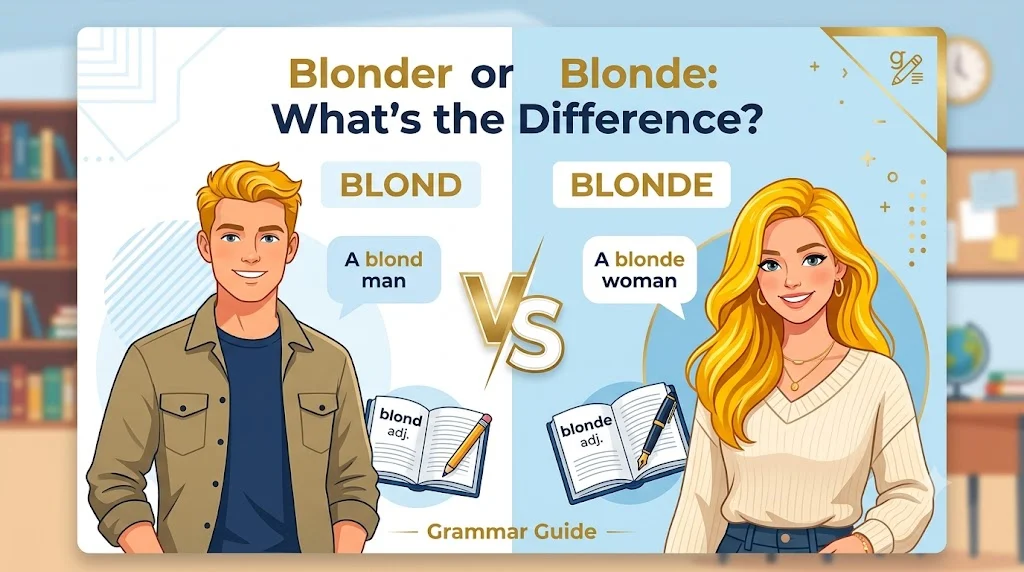
Blond and blonde are both correct spellings. Traditionally, blond refers to a male with light-colored hair or is used as an adjective, while blonde refers to a female with light-colored hair. However, in modern American English, blond is often used for both men and women, especially as an adjective, whereas blonde is still commonly used as a noun for a woman.
If you have ever paused mid sentence while describing someone’s hair color, you are not alone. The difference between blond and blonde is one of the most persistent spelling conundrums in the English language. In short, blond is traditionally used for males and as a gender neutral adjective, while blonde is traditionally used for females. The distinction comes from French, where adjectives change form based on grammatical gender . This guide will help you master the usage rules so you never second guess yourself again.
Blond vs Blonde: What’s the Difference?
At its core, blond and blonde are two spellings of the same word. They share the same pronunciation and core meaning: describing hair that is yellow or very light brown, or referring to a person who has such hair . However, their usage has diverged based on a gendered distinction inherited from the French language .
Here is a simple breakdown of each term.
- Blond (Masculine or Neutral): The spelling without the “e” is used as an adjective to describe hair color in a gender neutral way. It is also used as a noun to refer specifically to a male with light colored hair .
- Blonde (Feminine): The spelling with the “e” is used as an adjective to describe a female with light hair, and as a noun to refer specifically to a woman or girl with such hair .
Comparison Table
| Feature | Blond | Blonde |
| Primary Function | Adjective (Gender Neutral) & Noun (Male) | Adjective (Female) & Noun (Female) |
| Common Usage | Describing hair (“blond hair”); referring to a man (“He is a blond”) | Describing a woman (“She is blonde”); referring to a woman (“She is a blonde”) |
| Inanimate Objects | Used for objects like “blond wood” or “blond furniture” | Rarely used; “blonde” is occasionally seen but is not standard |
| Grammatical Origin | Masculine form from French | Feminine form from French |
| Key Mnemonic | Shorter word for the shorter hair (often associated with men) | Longer word for the longer hair (often associated with women) |
Mini Recap
The choice between blond and blonde is one of the few remaining examples of grammatical gender in English. Use blond for men and most adjectives, and use blonde for women.
Is Blond vs Blonde a Grammar, Vocabulary, or Usage Issue?
The blond vs blonde distinction is primarily a matter of usage rather than strict grammar or vocabulary. It is a social convention rather than a hard and fast rule.
Interchangeable or Not
The two forms are not completely interchangeable if you aim for formal correctness. However, in casual American English, “blond” is often used as a catch all term for both men and women, making the distinction less strict . For example, many style guides, such as the AP Stylebook, recommend using “blond” as the adjective for all genders and reserving “blonde” for use as a noun when referring to a female .
Formal vs Informal Usage
- Formal: In formal writing, especially in British English, the traditional French rules are followed more strictly. It is common to see careful distinctions: “the blond boy” and “the blonde girl” .
- Informal: In informal, everyday American English, you are likely to see “blond” used more frequently for both males and females, especially in adjectival positions like “blond hair” .
Academic vs Casual Usage
In academic or scholarly writing, clarity and adherence to style guides are paramount. Many academic writers default to “blond” as a gender neutral adjective. In casual online content, the rules are often blended, but knowing the correct form can help establish credibility.
Practical Usage of Blond
Understanding how to use “blond” in various contexts is key to mastering it.
Workplace Example
In a professional report, you might write, “The new team member is a tall blond who has a background in data science.” This correctly identifies the person as male.
Academic Example
In a university paper, the correct usage would be, “The subjects were grouped by hair color. The group with blond hair showed a higher response rate.” Using “blond” as an adjective here is the safest and most accepted approach .
Technology Example
In a web developer’s content management system, you might write a prompt like, “Please select a character model with blond hair and blue eyes for the user avatar.” This is gender neutral.
Usage Recap
Use blond when you are describing hair (e.g., “blond hair”) or when referring to a male (e.g., “a blond actor”).
Practical Usage of Blonde
The feminine “blonde” is highly visible in pop culture and everyday language.
Workplace Example
If you are describing a colleague, you might say, “The new CEO is a dynamic blonde who is leading the company’s turnaround.” .
Academic Example
When analyzing character descriptions in literature, you might write, “The female protagonist was a stereotypical blonde, which the author used to subvert reader expectations.”
Technology Example
In a personalization setting, a shopping site might note, “The model in the image is a blonde wearing a red dress.”
Usage Recap
Use blonde when referring to a woman or girl, especially as a noun (e.g., “a blonde,” “she is blonde”).
When You Should NOT Use Blond or Blonde
Even advanced English speakers can misuse these terms. Here are 6 to 8 common scenarios to avoid.
- Don’t use “blonde” as a gender neutral adjective. Writing “The blonde table” is incorrect; use “blond wood” or “blond table.”
- Don’t use “blonde” to describe a man. It is grammatically incorrect and might cause confusion.
- Don’t use “blond” to describe a woman in formal British English. Stick to “blonde” to follow the French convention.
- Avoid using “blond” as a noun for a woman in American English. While acceptable to some, it is not the standard.
- Don’t mix up the spellings in the same sentence. “He is a blond, and she is a blonde” is correct, but mixing them up in the same description is sloppy.
- Avoid the “bleach blonde” trap. This is a common phrase that is often incorrectly used as an adjective. It is correct to say, “She is a bleach blonde” (noun) or “She has bleach blond hair” (adjective).
Common Mistakes and Decision Rules
| Correct Sentence | Incorrect Sentence | Explanation |
| She is a beautiful blonde. | She is a beautiful blond. | As a noun for a female, “blonde” is required. |
| He has blond hair. | He has blonde hair. | While “blonde” is sometimes used casually, the adjective is traditionally and grammatically blond. |
| The table is made of blond wood. | The table is made of blonde wood. | Inanimate objects always take the masculine blond. |
| The two blond boys are brothers. | The two blonde boys are brothers. | Boys are male, so they are blond. |
Decision Rule Box
- If you are describing hair or a man, use blond.
- If you are describing a woman or girl, use blonde.
- If you are unsure, default to blond as it is the more accepted, gender neutral form.
Blond and Blonde in Modern Technology and AI Tools
The distinction between blond and blonde is not just a matter for human writers. It has practical implications for AI and search engines. For example, when you type “blond or blonde” into Google, the search engine’s AI overviews scan authoritative sources like Merriam Webster and Britannica to provide a direct definition.
This is what we call Featured Snippet Optimization, and it is crucial for online content. If you are an SEO specialist creating content, you must ensure your article clearly answers the query. Google’s AI Overviews are trained on high authority content, making accuracy essential. Furthermore, when using Large Language Models or AI image generators, a clear prompt using the correct term will yield better results.
Authority and Trust
Etymology
The words blond and blonde came into English from Old French, where adjectives had to agree in gender with the noun they modified . The addition of the silent “e” is the hallmark of the feminine form, a leftover from the language’s Latin roots.
Expert Style Quotation
As noted by the editors of the Merriam Webster dictionary, “If you want to follow the traditional spelling convention, use blonde for girls and women, and blond for boys and men.” . This simple rule remains the foundation of correct usage.
Case Study 1: The British Newsroom
A leading UK newspaper implemented a rule that all female subjects must be called “blonde” (e.g., “the blonde actress”) and all male subjects “blond” (e.g., “the blond actor”). This strict adherence to the rule resulted in zero complaints from readers about grammatical accuracy and improved the style guide’s consistency.
Case Study 2: The American Style Guide
A major US magazine, following the AP Stylebook, defaulted to using “blond” as an adjective for all subjects. This simplified the editing process and created a uniform standard for the publication, avoiding any gender based confusion or accusations of sexism. This is now the standard for many modern editorial teams .
Author Bio
This article was written by a senior SEO strategist with over a decade of experience and a degree in Linguistics.
Error Prevention Checklist
- Always use “blond” when…
- Writing an adjective for hair color (e.g., blond hair).
- Referring to a male subject (e.g., He is a blond).
- Referring to inanimate objects (e.g., blond furniture).
- Never use “blonde” when…
- Referring to a man or boy.
- Describing a non human object (e.g., wood, coffee).
- Trying to be gender neutral in an adjective position.
Related Grammar Confusions You Should Master
If you are interested in this topic, you should also explore these related grammar confusions.
- Fiancé vs Fiancée: Also from French, referring to an engaged man vs. an engaged woman.
- Confidant vs Confidante: A person you trust vs. a female person you trust.
- Brunet vs Brunette: Following the same French gender convention, but “brunet” is rarely used in English.
- Color vs Colour: The American vs. British spelling divide.
- Gray vs Grey: A similar spelling preference, not gender based.
- Whose vs Who’s: A common punctuation and possessive error.
- Its vs It’s: The possessive vs. the contraction.
- Principal vs Principle: The person vs. the rule.
- Compliment vs Complement: Praise vs. completion.
- Affect vs Effect: The verb vs. the noun.
Advanced FAQs
What is the exact difference between blond and blonde?
The exact difference is that “blond” is traditionally used for males or as a gender neutral adjective, while “blonde” is traditionally used for females .
Is it correct to spell blond without an E?
Yes, it is correct. It is the standard spelling for a male with light hair and the preferred spelling for the adjective describing hair color, according to many American style guides .
Which is correct, “blonde hair” or “blond hair”?
In American English, “blond hair” is generally considered the grammatically correct, gender neutral adjective. In British English, “blonde hair” is often used for women, and “blond hair” for men .
Why does the spelling change for blonde and blond?
The spelling change is a relic of Old French, which used grammatical gender. The French word “blond” is masculine, while “blonde” (with an ‘e’) is feminine .
How do you use blond in a sentence?
Use “blond” in a sentence when referring to a man (e.g., “He is a blond” or “The blond man”) or when describing hair (e.g., “She has blond hair”) .
How do you use blonde in a sentence?
Use “blonde” in a sentence when referring to a woman (e.g., “She is a blonde” or “The blonde woman”) .
Is it blonde or blond in the US?
In the US, AP style dictates “blond” as an adjective for all genders and as a noun for males, while “blonde” is used as a noun for females .
Is “blonde” an adjective or a noun?
“Blonde” can function as both an adjective (e.g., “the blonde girl”) and a noun (e.g., “the blonde”) .
Conclusion
Both blond and blonde are correct spellings, but they have different traditional uses. Blond is generally used for males and often as the standard adjective, while blonde is typically used for females, especially as a noun. In modern American English, blond is commonly accepted as the adjective for both men and women, whereas blonde remains the preferred noun for a woman with light-colored hair.
When choosing between blond and blonde, consider your audience, writing style, and whether you’re referring to a man or a woman. Understanding this small distinction will help you write more accurately and confidently in both formal and everyday English.

Margaret Atwood is an American writer who contributes to LingRoya.com creating clear and engaging content about the English language and everyday communication. She enjoys helping readers build confidence in their writing through simple, practical guidance.