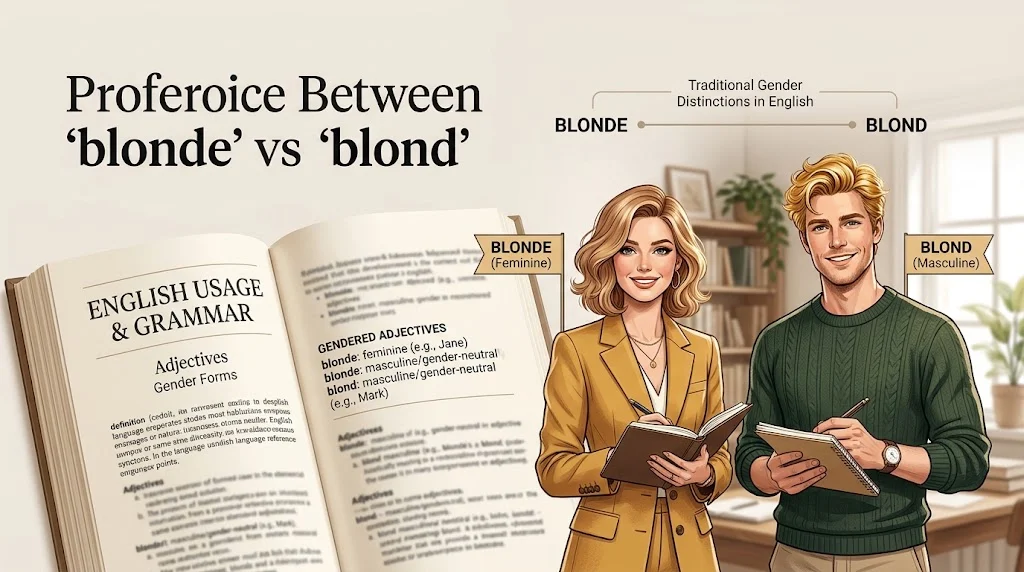
Quick Answer: Blonde and blond both describe a person or thing with light yellowish or golden hair. Traditionally, blonde is the feminine form and blond is the masculine form, especially in traditional English usage. Modern English often uses blond as a gender neutral form, so the choice can depend on style, context, and the person being described.
Have you ever wondered whether you should write “blonde hair” or “blond hair,” or whether a man should be called blond rather than blonde? The confusion comes from the fact that English borrowed these words from French, where grammatical gender influenced their spelling. In traditional English, blonde is generally associated with a woman or girl, while blond is traditionally associated with a man or boy.
However, contemporary English increasingly treats blond as a gender neutral spelling. Understanding this distinction helps writers avoid unnecessary spelling errors and choose wording that fits modern usage.
Blonde vs Blond: What’s the Difference?
The simplest distinction is based on traditional grammatical gender.
Blonde is traditionally a noun or adjective referring to a woman or girl with fair, golden, or light colored hair. For example, “She is blonde” uses blonde as an adjective describing the woman.
Blond is traditionally an adjective or noun associated with a man or boy with fair or golden hair. For example, “He has blond hair” follows the traditional masculine form.
In modern English, however, blond is increasingly used as the standard gender neutral spelling. This is particularly common when referring to hair itself rather than a specific person.
| Word | Traditional meaning | Modern usage | Example |
| Blonde | Feminine form | Often used for women | She has blonde hair. |
| Blond | Masculine form | Also widely used as gender neutral | He has blond hair. |
| Blond hair | Hair with a light golden color | Common regardless of gender | The child has blond hair. |
| Blonde woman | Woman with light colored hair | Traditional and common | A blonde woman entered the room. |
| Blond man | Man with light colored hair | Traditional and common | A blond man was waiting outside. |
Quick Recap
Blonde traditionally refers to a woman or girl.
Blond traditionally refers to a man or boy.
Modern English increasingly uses blond as a gender neutral form.
Both spellings can be correct depending on context and style.
Is Blonde vs Blond a Grammar, Vocabulary, or Usage Issue?
The difference between blonde and blond is mainly a vocabulary and usage issue, rather than a grammar rule that determines whether an entire sentence is correct or incorrect.
The distinction originated partly from French, where adjectives can change according to grammatical gender. English retained both spellings, although English does not generally mark adjectives for gender in the same way French does.
Traditional English usage therefore developed a useful distinction. A woman could be described as blonde, while a man could be described as blond.
Modern usage is less rigid.
Many contemporary writers, editors, publications, and dictionaries recognize blond as a gender neutral spelling. This means that saying “blond hair” does not necessarily indicate the gender of the person who has that hair.
In casual conversation, both forms are widely understood. In academic or professional writing, consistency is more important than mechanically following the traditional distinction. If a publication follows a particular style guide, writers should follow that guide.
Formal vs Casual Usage
In formal writing, choose a consistent convention. If you distinguish between masculine and feminine forms, use blond for males and blonde for females.
In casual writing, blond is increasingly accepted as gender neutral.
Academic vs Casual Usage
Academic writing usually benefits from precision and consistency. If the gender of the person matters, the traditional distinction may provide additional information. If gender is irrelevant, blond can function as a neutral description of hair color.
How to Use Blonde Correctly
Blonde is traditionally used when describing a woman or girl with fair, golden, or light colored hair.
Workplace Example
“The new manager is blonde and has blue eyes.”
Here, blonde describes the manager’s hair color and follows the traditional feminine form.
Academic Example
“The study included photographs of blonde and brunette participants.”
In this sentence, blonde describes female participants under the traditional convention.
Technology Example
“A blonde character appears in the game’s opening sequence.”
Here, blonde functions as an adjective describing a female character.
Usage Recap
Use blonde when following the traditional feminine convention. It is especially familiar when describing a woman or girl directly.
How to Use Blond Correctly
Blond is traditionally used for a man or boy with fair or golden hair. It is also increasingly used as a gender neutral adjective, particularly when describing hair itself.
Workplace Example
“The company hired a tall blond man for the position.”
Blond follows the traditional masculine convention.
Academic Example
“The researchers examined images of people with blond hair.”
Here, blond is neutral because the sentence focuses on hair rather than the gender of the people.
Technology Example
“The application allows users to create a character with blond hair.”
Blond works naturally here because the hair color option is not necessarily connected to gender.
Usage Recap
Use blond for a man or boy under the traditional convention. You can also use blond as a gender neutral description, especially when referring to hair color.
When You Should NOT Use Blonde or Blond
Understanding when these spellings are less appropriate can prevent awkward or unclear writing.
- Do not assume blond automatically means male. Modern English frequently uses blond as a gender neutral term.
- Do not assume blonde is always grammatically wrong for hair. Phrases such as “blonde hair” are extremely common and accepted.
- Do not switch between conventions randomly. If your article uses blond as a gender neutral form, maintain that choice throughout.
- Do not describe someone as blonde solely to identify them. Hair color may be a useful description, but it should be relevant to the context.
- Do not treat the distinction as an absolute grammar rule. Usage varies between speakers, publications, dictionaries, and regions.
- Do not correct every occurrence of blonde to blond. The traditional feminine spelling remains established English usage.
- Do not assume modern usage has completely eliminated the traditional distinction. Both conventions remain visible in contemporary English.
- Do not use gendered spelling when the context calls for neutral language. Blond may be preferable when the person’s gender is unknown or irrelevant.
Common Mistakes and Decision Rules
| Correct sentence | Incorrect or less suitable sentence | Explanation |
| She has blonde hair. | She has blond hair. | The first follows the traditional feminine convention. The second is also acceptable in modern gender neutral usage. |
| He has blond hair. | He has blonde hair. | Blond is the traditional masculine spelling. |
| The character has blond hair. | The character has blonde hair. | Blond can be useful as a neutral form when gender is not relevant. |
| She is a blonde. | She is a blond. | Blonde is traditionally the noun used for a woman. |
| He is a blond. | He is a blonde. | Blond is traditionally the masculine noun. |
Decision Rule Box
If you are following traditional gender based usage, use blonde for a woman or girl and blond for a man or boy. If gender is irrelevant or unknown, blond can be used as a gender neutral form, especially when describing hair.
This is more useful than treating one spelling as universally correct. Context determines which convention makes the most sense.
Blonde and Blond in Modern Technology and AI Tools
Modern technology makes this distinction especially interesting because digital systems often need to describe people, characters, photographs, and hair colors without making assumptions about gender.
Image generation tools, character creation systems, photo tagging software, and artificial intelligence assistants may use blond hair as a general description. This wording can cover a broad range of people and characters.
For example, a prompt might request a character with “short blond hair.” The phrase does not necessarily indicate whether the character is male or female.
AI writing systems may also encounter both blonde and blond in training data. As a result, both spellings can appear in generated text. For professional content, writers should decide which usage convention they want and apply it consistently.
Blonde or Blond: Which One Is More Correct?
Neither spelling is universally more correct.
If you follow the traditional English distinction, blonde is feminine and blond is masculine.
If you are using contemporary gender neutral English, blond can describe hair or a person without specifying gender.
The important point is that modern English usage is broader than the traditional rule. A writer should consider audience, context, publication style, and whether gender information is actually relevant.
Etymology of Blonde and Blond
Both words ultimately trace back to French blond and blonde, which developed from earlier European forms associated with a light or golden color.
French has grammatical gender, so adjectives can change according to whether the noun is masculine or feminine. English borrowed both forms and retained part of that distinction.
Over time, English gradually moved toward a less rigid system. Because English adjectives normally do not change according to the gender of the person they describe, many speakers now treat blond as a gender neutral adjective.
This historical background explains why both spellings exist today.
Expert Style Explanation
“The distinction between blond and blonde reflects a traditional gender based convention, while contemporary English increasingly permits blond as a neutral description of hair color.”
The practical lesson is simple: understand the traditional distinction, recognize modern usage, and choose one convention consistently.
Two Practical Case Studies
Case Study 1: Professional Editing
Imagine an editor reviewing an article about actors. The original draft alternates between “blond actress,” “blonde actress,” and “blond hair.”
The editor applies the traditional convention consistently: blonde for female subjects, blond for male subjects, and blond for neutral references to hair.
Result: The article becomes internally consistent, and readers no longer encounter unexplained spelling changes.
Case Study 2: Character Description
Consider a video game guide that describes characters without discussing gender. The writer repeatedly uses “blonde hair,” even when the character’s gender is not relevant.
The writer changes the neutral references to “blond hair” while retaining blonde when specifically discussing female characters under the traditional convention.
Result: The guide uses a clearer neutral style while preserving the traditional distinction where it provides useful information.
These examples demonstrate a practical editing principle: consistency and context often matter more than choosing one spelling for every situation.
Blonde or Blond Error Prevention Checklist
Always use blonde when
☐ You are following the traditional feminine convention.
☐ You are describing a woman or girl and want to preserve the traditional distinction.
☐ You are using blonde as a noun for a woman under traditional usage.
Always use blond when
☐ You are following the traditional masculine convention.
☐ You are describing a man or boy.
☐ You want a gender neutral term for hair color.
☐ The person’s gender is unknown or irrelevant.
☐ Your chosen publication style specifically prefers blond as the neutral form.
Related Grammar Confusions You Should Master
Once you understand blonde and blond, several other commonly confused English terms are worth studying:
- Gray vs grey: Two standard spellings with regional preferences.
- Color vs colour: American and British English spelling differences.
- Theater vs theatre: Regional spelling preferences and usage.
- Toward vs towards: Both forms are accepted, with regional variation.
- Affect vs effect: A common distinction involving grammatical function and meaning.
- Advice vs advise: A noun and verb that differ in pronunciation and usage.
- Compliment vs complement: Similar sounding words with different meanings.
- Everyday vs every day: An adjective versus an expression referring to frequency.
- Further vs farther: Words with overlapping meanings but different traditional uses.
- Lay vs lie: Verb forms that create frequent confusion in everyday English.
FAQs
Is blonde or blond correct?
Both are correct. Traditionally, blonde is used for women and girls, while blond is used for men and boys. Modern English also commonly uses blond as a gender neutral form.
Should I say blonde hair or blond hair?
Both expressions are used. Blonde hair follows the traditional feminine association, while blond hair is increasingly used as a gender neutral description of hair color.
Is blond only for men?
No. Traditionally, blond was associated with men, but modern English increasingly uses blond as a gender neutral adjective, especially when referring to hair.
Is blonde only for women?
Not necessarily in every modern usage. Blonde is traditionally feminine, but contemporary usage can vary. Writers should follow the convention and style appropriate to their audience.
Why are there two spellings of blonde?
The two forms reflect the historical influence of French grammatical gender. English borrowed both blond and blonde and retained the distinction in traditional usage.
Which is more common, blonde or blond?
Usage depends on context and region. Blonde remains very common, particularly when referring to women, while blond is widely used for men and increasingly used as a gender neutral form.
Can you say blond for a woman?
Yes. In contemporary English, blond can function as a gender neutral adjective, particularly when describing hair rather than directly labeling a woman.
Is blonde a noun or an adjective?
Blonde can function as an adjective, as in “blonde hair,” and traditionally as a noun referring to a woman with fair or golden hair.
Is blond a noun or an adjective?
Blond can function as an adjective, as in “blond hair,” and traditionally as a noun referring to a man with fair or golden hair. It can also serve as a neutral adjective in modern usage.
Conclusion
The choice between blonde or blond depends largely on whether you are following the traditional gender based distinction or a more modern gender neutral convention. Traditionally, blonde refers to a woman or girl, while blond refers to a man or boy. Modern English increasingly uses blond as a neutral description of hair.
For everyday and professional writing, the best approach is to understand both conventions, consider whether gender is relevant, and remain consistent. Once you know the historical reason behind the two spellings, the distinction becomes much easier to remember and apply accurately.

Margaret Atwood is an American writer who contributes to LingRoya.com creating clear and engaging content about the English language and everyday communication. She enjoys helping readers build confidence in their writing through simple, practical guidance.