Quick Answer
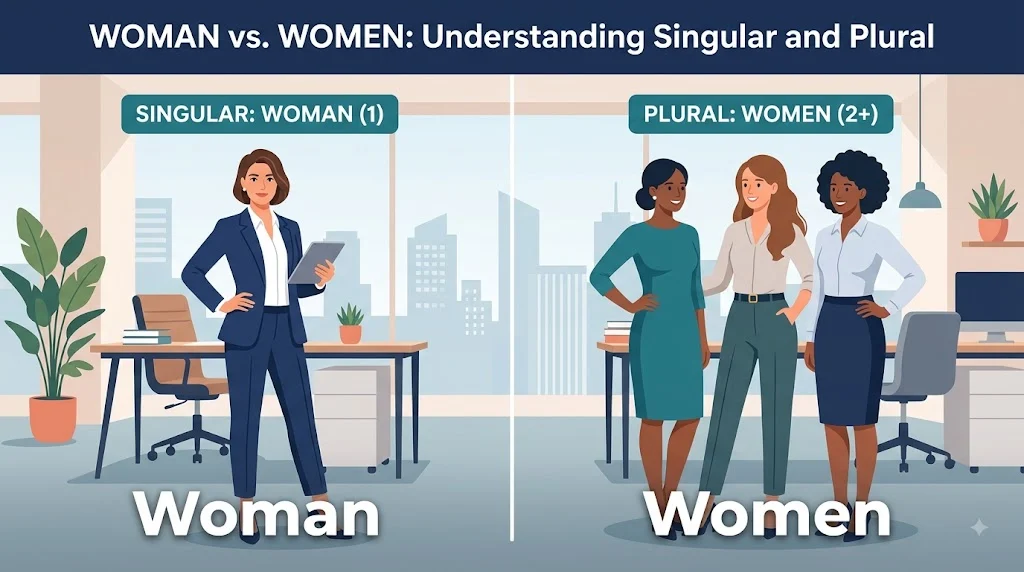
The difference between woman and women is simply one of number: woman is the singular form referring to one adult female person, while women is the plural form referring to two or more adult female people. Both words are nouns, and they are not interchangeable.
Woman ka use ek single female ke liye hota hai, jabke women ka use ek se zyada females ke liye hota hai. Yani, woman singular form hai aur women uski plural form hai.
Example ke taur par, “She is a woman” ka matlab hai “Woh ek aurat hai,” jabke “They are women” ka matlab hai “Woh auratein hain.” Dono words ka pronunciation bhi different hota hai.
Woman vs Women: What is the Difference?
Here is a quick comparison to make the difference crystal clear:
| Aspect | Woman | Women |
| Number | Singular (one) | Plural (more than one) |
| Part of Speech | Noun | Noun |
| Pronunciation | WUH muhn (/ˈwʊm.ən/) | WIH min (/ˈwɪm.ɪn/) |
| Verb Agreement | Singular verb (e.g., “She is”) | Plural verb (e.g., “They are”) |
| Example | That woman is my mentor. | Those women are my mentors. |
Is Woman vs Women a Grammar, Vocabulary, or Usage Issue?
This question touches on something important. The woman versus women distinction is primarily a grammar issue because it involves subject verb agreement and correct noun number. However, it also has a vocabulary component since these are two distinct words with different meanings, and it is definitely a usage issue because choosing the wrong form can change the entire meaning of your sentence.
These words are absolutely not interchangeable. Using women when you mean one person is just as incorrect as using woman when you mean a group. The error is similar to saying “I have one children” or “She has two child.” It violates basic grammatical rules about singular and plural forms.
In formal writing, such as academic papers, business reports, and professional correspondence, using the correct form is non negotiable. Academic journals and style guides expect precision, and errors like “a women” or “many woman” will be marked as mistakes. In casual writing, like text messages or social media posts, the stakes are lower, but the error can still make you look less educated or less attentive than you intend. In both formal and informal contexts, getting this right signals that you have a solid command of English grammar.
Practical Usage: Woman
When you use the word woman, you are referring to exactly one adult female person. This could be a specific individual you know, a hypothetical person in an example, or a generic reference to any single female adult.
Workplace Example
The new woman in the marketing department has already impressed everyone with her strategic thinking. She presented a campaign that increased engagement by forty percent in just one month.
In this sentence, woman is singular because we are talking about one specific employee. The verb has agrees with the singular subject, and the pronoun she later refers back to this one woman.
Academic Example
In her groundbreaking study, the researcher interviewed every woman who had participated in the program over the past five years. Each woman provided detailed accounts of her experiences.
Here, woman is used twice in the singular because the researcher spoke to individuals one at a time. Even though there were many participants, the sentence structure focuses on each woman as an individual.
Technology Example
The woman who developed that open source software project received widespread recognition for her innovative approach to encryption.
Again, we have one person, one woman, one developer. The singular form is correct because we are highlighting an individual achievement.
Usage Recap for Woman
Use woman whenever your sentence refers to a single adult female. Look for singular markers like a, one, this, that, each, every, or the when it points to one person. Remember that woman takes singular verbs and singular pronouns.
Practical Usage: Women
Women is the plural form, and you use it whenever you are talking about two or more adult female people. This could be a specific group, a general category, or any collection of females.
Workplace Example
The women in our software engineering team have collectively filed twelve patents this year. They are among the most productive engineers in the company.
Women is plural here because we are talking about multiple team members. The verb have agrees with the plural subject, and the pronoun they refers back to the group.
Academic Example
Women in STEM fields continue to face unique challenges, but recent studies show that mentorship programs significantly improve retention rates among women in technical roles.
This sentence uses women to refer to a broad category of people, not a single individual. The plural form is appropriate because the statement applies to many women.
Technology Example
Many women are now leading major tech companies, and the number of women founding startups has grown substantially over the last decade.
Once again, women is plural because we are discussing multiple people in leadership and entrepreneurial roles.
Usage Recap for Women
Use women whenever your sentence refers to more than one adult female. Look for plural markers like two, many, several, these, those, all, or numbers greater than one. Women takes plural verbs and plural pronouns.
When You Should NOT Use Woman or Women
Knowing when not to use these words is just as important as knowing when to use them. Here are some common scenarios where writers often go wrong:
- Do not use women when you mean one person. This is the most frequent error. Phrases like “a women” or “one women” are always incorrect. The singular form is always woman.
- Do not use woman when you mean more than one person. Saying “two woman” or “many woman” is just as wrong as saying “a women.” The plural is always women.
- Do not use womans as a plural. The plural of woman is women, not womans.
- Do not use womens as a plural. There is no such word as womens in standard English. The correct plural is women.
- Do not use woman as an adjective before a plural noun. You should say women drivers, not woman drivers, because drivers is plural.
- Do not use women with a singular verb. Women is plural, so it requires plural verbs like are, have, and were. “The women is” is incorrect.
- Do not use woman with a plural verb. Woman is singular, so it requires singular verbs like is, has, and was. “The woman are” is incorrect.
- Do not mix singular and plural pronouns. If you use women, follow it with they or them, not she or her. If you use woman, follow it with she or her, not they or them.
Common Mistakes and Decision Rules
To help you see these errors in action, here is a table of common mistakes with their corrections:
| Correct Sentence | Incorrect Sentence | Explanation |
| She is a strong woman. | She is a strong women. | Women is plural, but she is singular. Use woman. |
| Three women attended the conference. | Three woman attended the conference. | Three is plural, so use women. |
| The woman who called is my sister. | The women who called is my sister. | The verb is is singular, so the subject must be singular: woman. |
| Women are leading the initiative. | Women is leading the initiative. | Women is plural, so use are, not is. |
| I saw a woman at the store. | I saw a women at the store. | A is singular, so use woman. |
| Many women work in healthcare. | Many woman work in healthcare. | Many is plural, so use women. |
Decision Rule Box
If adult female person, use woman.
For more than one adult female person, use women.
If you are unsure, ask yourself: am I talking about one person or multiple people? Count them. If the answer is one, choose woman. If the answer is two or more, choose women. This simple counting test will solve ninety nine percent of your doubts.
Woman and Women in Modern Technology and AI Tools
The rise of artificial intelligence and automated writing tools has made the woman versus women distinction more relevant than ever. Grammar checking software like Grammarly and LanguageTool can detect incorrect usage and suggest corrections. These tools are trained on vast amounts of English text, and they flag errors like “a women” or “many woman” with high accuracy.
However, AI tools are not perfect. They can sometimes miss context dependent errors, especially in complex sentences where the number is not immediately obvious. That is why it still pays to understand the rule yourself rather than relying entirely on software. When you are dictating to a voice assistant or using speech to text, pronunciation differences between woman and women can lead to transcription errors. Saying “wuh muhn” versus “wih min” might not always be recognised correctly, so proofreading remains essential.
In the world of search engine optimisation and content creation, using the correct form of woman or women affects how your content is perceived by both readers and algorithms. Search engines reward clear, accurate, and authoritative content. Repeated grammatical errors can hurt your credibility and your rankings. If you are writing about topics related to women in business, women in technology, or any other subject involving female adults, getting this basic distinction right is a small but meaningful signal of quality.
The Origins of Woman and Women
Understanding where these words come from can make the spelling and pronunciation easier to remember. The word woman has a fascinating history. It comes from the Old English wifmann, which combined wif meaning female or wife and mann meaning human being. In Old English, mann did not specifically mean male; it meant person or human. So a wifmann was literally a female person.
The plural form in Old English was wifmenn, following the same vowel change pattern we see in man becoming men. Over time, wifmann became wuman and eventually woman, while wifmenn became wimin and eventually women. This is why the plural changes the vowel in the second syllable rather than adding an s. The word has been in use for nearly fourteen hundred years, and its meaning has remained remarkably stable throughout that time.
Expert Insight
Linguist and author Steven Pinker once observed that irregular plurals like woman and women are linguistic fossils that preserve the older patterns of English grammar. They are not random exceptions but remnants of a system that once made perfect sense. Understanding their history helps us see that they follow internal logic, even if that logic is not immediately obvious to modern speakers.
Case Studies
Case Study One: The Job Application
A hiring manager at a large technology company received two hundred applications for a senior engineering position. One candidate submitted a cover letter that contained the phrase “I am a women with ten years of experience.” Another candidate submitted a letter that read “I am a woman with ten years of experience.” The first letter was flagged by the recruiter as containing a basic grammatical error. While this single mistake did not disqualify the candidate, it created an initial impression of carelessness that the candidate had to overcome in the interview. The second candidate, whose letter was error free, started the process with a stronger first impression. This real world example shows how a small grammatical choice can influence perceptions in high stakes situations.
Case Study Two: The Academic Paper
A graduate student submitted a research paper on gender dynamics in the workplace to a peer reviewed journal. The paper was otherwise well researched and well written, but it contained multiple instances of “a women” and “many woman” throughout the text. The peer reviewers noted these errors in their feedback, describing them as “distracting” and “unprofessional.” The student was asked to revise the paper before it could be accepted for publication. The revision process added several weeks to the timeline and created unnecessary stress. This case illustrates that even in academic contexts, where content is paramount, grammatical precision still matters.
Error Prevention Checklist
Before you hit send or publish, run through this quick checklist:
Always use woman when:
- You are referring to one adult female person
- You see singular markers like a, one, this, that, each, every
- The verb in your sentence is singular (is, has, was, does)
- The pronoun referring back is she or her
Never use woman when:
- You are referring to more than one person
- You see plural markers like two, many, several, all, these, those
- The verb in your sentence is plural (are, have, were, do)
- The pronoun referring back is they or them
Always use women when:
- You are referring to two or more adult female people
- You see plural markers like two, many, several, all, these, those
- The verb in your sentence is plural (are, have, were, do)
- The pronoun referring back is they or them
Never use women when:
- You are referring to one person
- You see singular markers like a, one, this, that, each, every
- The verb in your sentence is singular (is, has, was, does)
- The pronoun referring back is she or her
Related Grammar Confusions You Should Master
Once you have mastered woman versus women, here are other similar grammar topics that often trip up writers:
- Man versus men the same singular plural pattern
- Child versus children an irregular plural with a different ending
- Person versus people singular and plural forms
- Female versus woman noun versus adjective usage
- Lady versus woman formality and connotation
- Girl versus woman age distinction
- She versus her pronoun case confusion
- Who versus whom relative pronoun usage
- Its versus it is possessive versus contraction
- Their versus there versus they are homophone confusion
- Your versus you are possessive versus contraction
- Affect versus effect verb versus noun distinction
FAQs
1. Is “women” singular or plural?
Women is always plural and refers to more than one adult female.
2. Is “a women” grammatically correct?
No. The correct form is “a woman” because “a” is used with singular nouns.
3. What is the plural of woman?
The plural of woman is women, not “womans.”
4. How do you pronounce woman and women?
Woman sounds like “wuh-muhn,” while women sounds like “wih-min.”
5. What is the singular form of women?
The singular form of women is woman.
6. What is the possessive form of women?
The plural possessive form is women’s, such as “women’s rights.”
7. Is woman used in British and American English?
Yes. Woman and women are used the same way in both British and American English
Conclusion
Woman & women both are correct words ,woman stands for one female lady and women is its plural form.

Margaret Atwood is an American writer who contributes to LingRoya.com creating clear and engaging content about the English language and everyday communication. She enjoys helping readers build confidence in their writing through simple, practical guidance.