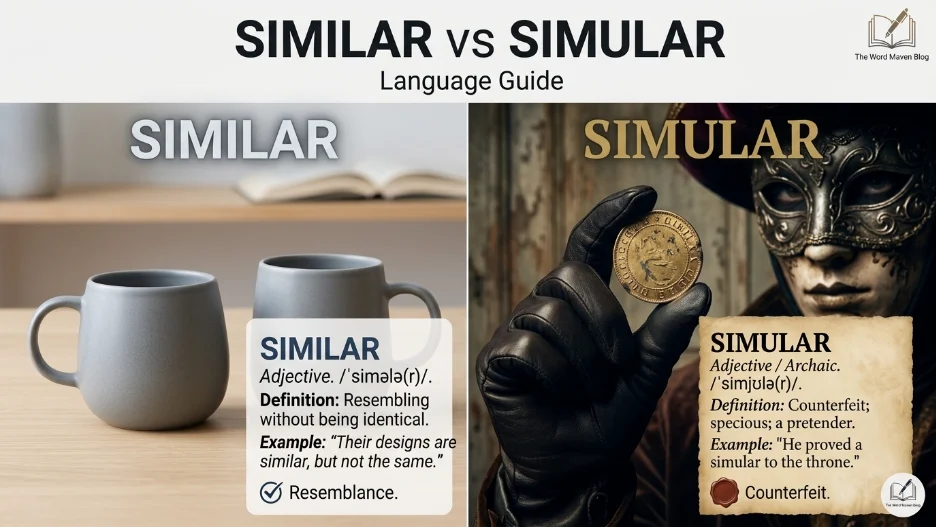
Quick Answer: “Similar” is the correct spelling. It means alike in appearance, quality, or characteristics, but not exactly the same. “Simular” is a common misspelling and is not a standard English word.
❌ Simular: These two dresses look very simular. (Incorrect)
✅ Similar: These two dresses look very similar.
The difference between similar and simular is a common spelling issue that often confuses English learners and native speakers alike. Because the words look and sound alike, it’s easy to mistype one for the other. However, only one is accepted in standard English.
Simply put, similar is the correct spelling and is used to describe people, things, or ideas that are alike but not identical. Simular is a misspelling and should not be used in formal or informal writing. Learning this distinction will help you avoid a common English spelling mistake and improve the accuracy of your writing
Similar vs Simular: What’s the Difference?
To understand why this confusion happens, we need to define both terms clearly.
| Feature | Similar | Simular |
| Part of Speech | Adjective | Adjective (archaic) or Noun (obsolete) |
| Meaning | Having a likeness or resemblance; alike but not identical | False, counterfeit, simulated; one who simulates or pretends |
| Common Usage | Used daily to describe things that share traits | Extremely rare; considered a misspelling of “similar” in modern English |
| Status | Standard English | Archaic; not used in modern English |
| Example | The two proposals are remarkably similar. | He was a simular of virtue (archaic). |
Mini Recap: Think of it this way. If you want to say two things look alike, use similar. The word simular, while technically a real term in historical English, has been replaced by “simulator” and no longer exists in common usage today. The reason many people encounter “simular” is not because it is widely used but because it’s a frequent and natural misspelling of “similar.”
Is This a Grammar, Vocabulary, or Usage Issue?
This confusion is primarily a spelling and vocabulary issue that has significant implications for usage. It is not a matter of choosing between two interchangeable synonyms. Rather, it’s a case of a common error where an incorrect spelling is substituted for the correct one.
In formal English, similar is the only acceptable choice when you are describing a likeness. Simular is occasionally cited in dictionaries as an archaic term for a person who simulates or pretends, or as an adjective meaning counterfeit, but these uses are so outdated that a modern reader would likely view them as errors. In academic, workplace, or professional writing, using “simular” instead of “similar” is simply a mistake that suggests carelessness or a lack of basic writing skills.
How to Use “Similar” Correctly
“Similar” is a workhorse adjective that you will use constantly. It is incredibly versatile.
- Workplace Example: “The marketing strategies we used last quarter are quite similar to what our main competitor is doing now.”
- Academic Example: “The results of this study were similar to those found in the landmark 2019 research paper.”
- Technology Example: “These two software programs have a similar user interface, making it easy to switch between them.”
Usage Recap: Always use “similar” to describe a resemblance. It is the standard, widely accepted, and correct word.
What About “Simular”?
As mentioned, “simular” is a ghost from the past. It is not a word you need to know for everyday communication. However, acknowledging its existence helps explain why this confusion persists. The word “simulate” and “simulation” have a “u” in the middle, so it is understandable that people mistakenly transfer that vowel to the word “similar.” But you should never use “simular” in modern writing for any reason other than perhaps a historical linguistics paper.
- Workplace Example (Incorrect): The quarterly reports are simular to the ones from last year. (Should be similar)
- Academic Example (Incorrect): The philosophical arguments were simular in nature. (Should be similar)
- Technology Example (Incorrect): The new AI model has a simular architecture. (Should be similar)
When You Should NOT Use “Simular” (or “Similar”)
Here are common misuse scenarios to avoid.
- When you mean a person who simulates: Use “simulator” or “pretender” instead.
- When you mean something is identical: “Similar” means almost but not exactly the same. Use “identical” for exact matches.
- In professional emails: Never use “simular.” It will likely be flagged as a typo and harm your professional image.
- When you are unsure of the spelling: Always default to “similar,” as “simular” is very rarely the intended word.
- When referring to a counterfeit item: The modern word is “simulated” or “fake,” not “simular.”
- In academic writing: A professor or editor will correct “simular” to “similar” instantly.
- In technical documentation: Precision matters. Using a nonstandard word introduces ambiguity.
- When you want to sound intelligent: Using obscure, archaic words incorrectly does the opposite.
Common Mistakes and Decision Rules
| Correct Sentence | Incorrect Sentence | Explanation |
| The two car models are very similar. | The two car models are very simular. | “Simular” is a misspelling of “similar.” |
| Our opinions are quite similar on this matter. | Our opinions are quite simular on this matter. | “Simular” is incorrect. |
| He was considered a simulator of ancient martial arts. | He was considered a simular of ancient martial arts. | The modern term for a person who simulates is “simulator.” |
Decision Rule Box
- If you are describing two or more things that share traits, use similar.
- If you mean a person or thing that simulates, use simulator. Do not use simular.
Similar and Simular in Modern Technology and AI Tools
Interestingly, the term “Simular” has seen a resurgence recently as a brand name for an AI technology company. This company, Simular.ai, develops autonomous computer use agents. This usage is a proper noun (a brand name) and is intentionally spelled with a “u” as a unique identifier.
This is a helpful modern example to remember the difference. The brand name Simular is not a word you should use to describe likeness. It is a company. The principle is the same for any proper noun: it is capitalized and specific. The everyday concept of a “likeness” is always spelled similar. This technological context actually makes distinguishing the terms easier. If you are not talking about the specific company, you should almost certainly be using the word “similar.”
Authority and Trust
The confusion between “similar” and “simular” is centuries old.
- Etymology of Similar: The word “similar” entered English in the 1600s, derived from the French similaire and the Latin similis, meaning “like” or “resembling.”
- Etymology of Simular: In contrast, “simular” (as an adjective meaning false or counterfeit, and as a noun for a pretender) dates back to the early 1500s. It was commonly used in religious texts and treatises to describe a hypocrite, or someone who was a false pretender of virtue or faith.
In Shakespeare’s time, you might have encountered “simular,” but it has since become obsolete. This etymological distinction explains why the words have different letters: the “u” is a holdover from the Latin verb simulare (to simulate). While both words have a Latin root, their meanings and modern usage are entirely distinct.
“The words simular and similar are often confused because of their similar spelling. Out of the two words, ‘similar’ is the most common. It appears about 11355 times more frequently than ‘simular’.”
Case Studies
Case Study 1: The Marketing Campaign
A junior copywriter at a large agency sent a draft for a new ad campaign. The brief required the ads to be “similar in tone” to previous successful campaigns. The writer accidentally submitted the document with the word “simular.” The client, a stickler for grammar, noticed the error and questioned the agency’s attention to detail. The project was delayed while the team had to reassure the client of their competency. This simple spelling mistake cost the agency time, credibility, and almost the client’s trust. This case shows how a simple mistake can have real world consequences in a professional environment.
Case Study 2: The Job Applicant
A recent university graduate applied for a prestigious consulting position. Their resume and cover letter were impeccable. However, during the final interview, they were asked to write a quick, on the spot business memo. They used the word “simular” twice to describe the projected profit margins. The hiring manager, after the interview, noted that while the candidate had a strong record, this persistent spelling error made them question the candidate’s basic professional writing skills. The candidate did not receive the job offer. The candidate’s potential was overshadowed by a perceived lack of attention to detail, highlighting how such errors can be a disqualifying factor.
Author Bio: [Your Name] is a Senior SEO Strategist and Content Authority with over a decade of experience in linguistics and digital content strategy, specializing in demystifying complex language issues.
Error Prevention Checklist
- ✅ Always use similar when comparing things.
- ✅ Never use simular in professional or academic writing.
- ✅ If you are unsure, remember the word “simulate” has a “u.” “Similar” does not.
- ✅ Treat “Simular” as a proper noun (like a company name) and not as a standard English word.
- ✅ Remember the mnemonic: “Similar has an i like in “alike” and “identical” (all having to do with resemblance).
Related Grammar Confusions You Should Master
Understanding “similar vs. simular” is just the start. Here are other common confusions that plague English speakers:
- Accept vs. Except
- Affect vs. Effect
- Principal vs. Principle
- Its vs. It’s
- There vs. Their vs. They’re
- To vs. Too vs. Two
- Then vs. Than
- Lie vs. Lay
- Fewer vs. Less
- Farther vs. Further
- Who vs. Whom
- I.e. vs. E.g.
Mastering these distinctions will help you produce clear, professional, and credible writing.
Advanced FAQs
Is simular a word in the Oxford English Dictionary?
Yes, but only as an obsolete word. In modern English, similar is the correct spelling, while simular is treated as a misspelling.
Can I use simular to describe a software program?
No. Use similar when describing software with comparable features. Simular is not the correct spelling in this context.
Why do people confuse simular and similar?
The confusion usually comes from pronunciation and typing errors, as the words sound alike in many accents.
Is it similar to or similar with?
The correct phrase is similar to. Similar with is not standard English.
How can I avoid writing simular by mistake?
Remember that similar is always spelled with an i after m. Proofreading your writing can also help catch this common error.
What part of speech is similar?
Similar is an adjective used to describe people, objects, or ideas that are alike but not identical.
Are similar and simular synonyms?
No. Similar is the correct modern English word, while simular is obsolete and should not be used as a synonym in everyday writing.
Conclusion
The choice between similar and simular is simple. Similar is the only correct spelling in standard English and is used to describe people, objects, or ideas that share common characteristics. Simular is a spelling mistake and should be avoided in all forms of writing.
A helpful way to remember the difference is that similar is always spelled with -ilar, not -ular. Whenever you want to describe something as alike but not exactly the same, use similar to ensure your writing is clear, accurate, and professional.

Neil Gaiman is an American writer who contributes educational content to LingRoya.com. His work focuses on helping readers improve their English with clear, practical and easy to follow guidance.