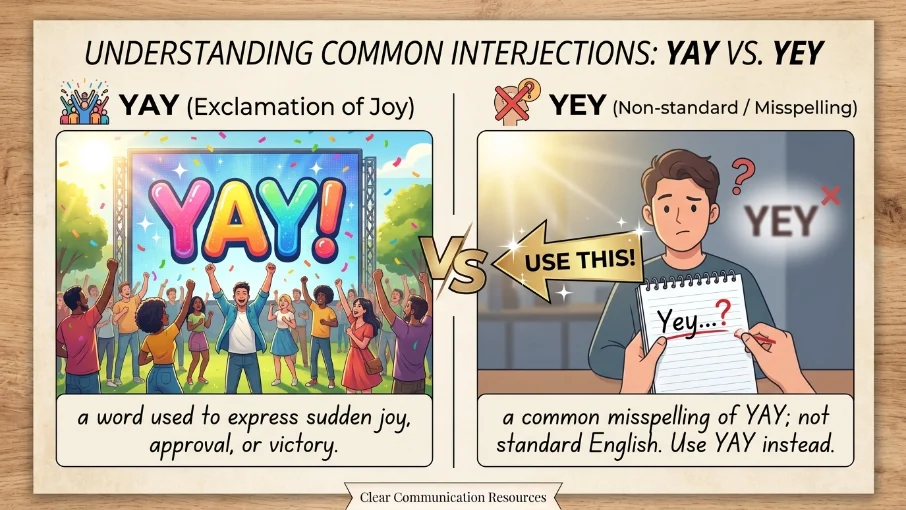
The correct spelling is yay, while yey is a common misspelling that has gained some informal acceptance, particularly in digital communication. Both are used as exclamations of joy, approval, or excitement, with yay serving as the standard and more widely recognized form.
Yay vs Yey: What’s the Difference?
At their core, yay and yey serve the same fundamental purpose as interjections. They are both informal expressions used to convey excitement, happiness, or approval, functioning much like “hooray” or “woohoo.” But a closer look reveals some important distinctions.
| Aspect | Yay | Yey |
| Part of Speech | Interjection; also adverb (colloquial) | Interjection |
| Primary Meaning | Exclamation of joy, triumph, approval | Exclamation of joy, excitement, approval |
| Secondary Meaning | “To this extent/degree” (accompanied by gesture) | Not used this way in standard English |
| Usage Frequency | Common, recognized as standard | Rare, considered informal or nonstandard |
| Formal Writing | Avoid | Avoid |
| Digital/Social Media | Common and acceptable | Occasionally used |
The main difference is that yay has a secondary, adverbial meaning restricted mostly to British English. In this sense, it indicates a particular degree or extent, as in “It was about yay big,” accompanied by a hand gesture to show size. When yay is used in this way, it is functioning as a demonstrative adverb, not as an exclamation. Yey does not carry this secondary meaning. In American English, yay can also sometimes be used as a synonym for “yes” or as an expression of triumph, though this usage is considered less formal.
The key point to remember is that yay is the original, correct, and widely accepted spelling for expressing joy. Yey is essentially a phonetic variation that arose in informal writing, particularly online, but it lacks the same level of recognition and legitimacy in the eyes of most grammarians.
Is Yay vs Yey a Grammar, Vocabulary, or Usage Issue?
The distinction between yay and yey is primarily a usage and spelling issue rather than a strict grammar rule. Let’s break it down.
First, are they interchangeable? In some informal contexts, yes. You might see people use them interchangeably on social media, text messages, or casual online forums. Many consider them essentially the same word. However, this interchangeability is not universally accepted because yey is so often viewed as a simple misspelling of yay. It does not have the same status as an accepted variant in dictionaries.
Second, the formality issue. There’s no academic context where either yay or yey would be acceptable. Both are strictly informal. But if you are looking for the more recognized standard, yay would be your choice. It is the form you’ll find in dictionaries and the one that has been in use for a longer period. The variant yey is seen mostly in informal digital communication. It’s important to note that the confusion extends beyond these two; people also sometimes mistakenly use yeah in situations that call for yay. Yeah means “yes,” while yay means “hooray.” Confusing the two changes the meaning of the sentence entirely.
Practical Usage of Yay
Yay is a versatile expression of excitement. It is the go to choice for anyone looking to express joy, approval, or triumph in a simple and clear way. Let’s look at how you would use it in various professional and everyday contexts.
Workplace Example
Imagine an email from a colleague: “The client just approved the final design. Yay, we can move to the next phase!”
Academic Example
A student might say, after receiving a grade: “I got an A on the final paper, yay!” Or in a study group, “Yay, we finally figured out this equation!”
Technology Example
In a chat message for a software release: “The new update is live, and the bug is fixed. Yay, everyone can get back to work!”
Usage Recap of Yay:
- Use yay as the standard, correct spelling.
- Use it as an exclamation of joy, triumph, approval, or encouragement.
- Avoid using it in any formal writing, such as academic papers, business reports, or professional correspondence.
- If you are using the adverbial form (“about yay big”), yay is the only correct choice.
Practical Usage of Yey
Yey exists in a more ambiguous space. It’s rarely the best choice and is often seen as an error. However, it does appear in informal digital communication. Here is how you might see it, though you should probably avoid using it yourself.
Workplace Example
A casual instant message: “Project is done and submitted! yey” (Unprofessional and could easily be corrected to yay.)
Academic Example
A text to a friend: “yey, no classes tomorrow!” (Acceptable in casual texts but not recommended in any academic or professional writing.)
Technology Example
A tweet: “Just hit 1000 followers, yey!” (Common in social media, but again, yay is the more standard choice.)
Usage Recap of Yey:
- Understand that yey is often considered a misspelling of yay or, at best, a nonstandard variant.
- You might see it used in informal settings like text messages or social media, but it’s not recommended for clarity.
- If you are learning English, stick to yay to avoid being marked incorrect.
- If you see someone use yey, you can generally understand it as meaning yay.
When You Should NOT Use Yay or Yey
The informal nature of these words makes them unsuitable for a wide range of contexts. Understanding these boundaries will help you communicate with precision and professionalism.
Here are six common scenarios where using yay or yey would be incorrect or inappropriate:
- In academic papers, essays, or any formal writing. Use alternatives like “excellent,” “wonderful,” or “I am pleased to report.”
- In business reports, cover letters, or professional emails. These terms can undermine your authority and appear unprofessional.
- When you actually mean “yes.” Using yay as a simple affirmative is incorrect. That is the role of yeah or yes.
- In formal speech or presentations. Stick to professional language to maintain credibility.
- When explaining something to someone learning English. It’s best to teach the standard form (yay) and mention that yey is an informal variant or misspelling.
- When writing for a broad audience. If there is any possibility that your audience might not be fluent in informal internet slang, using yay is the safer and clearer choice.
Common Mistakes and Decision Rules
A quick reference guide is often the most helpful way to avoid common errors. The following table outlines typical misuses, correct alternatives, and the reasoning behind them.
| Incorrect Sentence | Correct Sentence | Explanation |
| “Did you finish the report? Yay, I did.” | “Did you finish the report? Yes, I did.” | Here, the speaker meant “yes,” not an exclamation of joy. Yay is for celebrating something, not for giving a plain answer. |
| “The cake was yey big.” | “The cake was yay big.” | Yey does not have the adverbial meaning of “to this extent.” Only yay can be used to indicate a physical size accompanied by a gesture. |
| “Yay, it’s Monday morning.” (in a sarcastic tone) | “Ugh, it’s Monday morning.” or “Great, it’s Monday morning.” (sarcastic) | This is a grey area. Yay can be used sarcastically, but it’s often better to use a word or tone that more clearly conveys your actual feeling to avoid confusion. |
| “The event was a huge success, yey!” | “The event was a huge success, yay!” | Here, yey is simply a misspelling. The correct, standard exclamation is yay. |
Clear Decision Rule Box
- If you are expressing excitement, joy, triumph, or approval, use yay. This is the standard, correct, and recognized word for this purpose.
- If you are referring to a physical size or degree with a gesture, use yay. This is the correct adverbial form.
- If you mean “yes” or are answering a question, use yeah or yes.
- If you are writing for a formal purpose, avoid using yay or yey entirely. Use standard vocabulary instead.
- If you are in doubt, always choose yay over yey. It is the more standard, acceptable, and recognized form.
Yay and Yey in Modern Technology and AI Tools
The spelling yey has found its life primarily in digital communication. The informal, quick paced nature of texting and social media often favors phonetic spellings. You might see someone type “yey” simply because that’s how they hear the word in their head.
However, this is a dangerous habit for content creators. In an era where AI tools are increasingly used for editing and proofreading, yey is almost universally flagged as a spelling error. Tools like Grammarly and the standard spellcheckers in Microsoft Word or Google Docs are programmed to recognize yay as the correct spelling. A writer who consistently uses yey will find their work riddled with red underlines, which undermines their credibility and authority.
Authority and Trust
A brief look at the history of these words reveals why yay holds the dominant position. The origin of yay as an interjection is a direct alteration of the word yeah, itself a derivative of yes. Its use as an exclamation of triumph and approval has been documented since at least the early 1900s. For example, a 1902 edition of The Denver Post quoted a crowd roaring, “Yay, yay, yay!” at a baseball game. This shows that yay has deep roots in American English as an expression of communal excitement. Its secondary, adverbial meaning (“yay big”) likely comes from the word yea (meaning “yes”), evolving to mean “even so, truly so, verily so” and eventually coming to indicate a specific degree accompanied by a gesture.
Yey, on the other hand, has no such historical pedigree. It appears to be a much more recent phonetic variant that emerged from the internet culture of simply spelling a word the way it sounds, without checking for the correct form. In contrast, the word nay also has deep roots. It is of Scandinavian origin, related to the Old Norse nei, meaning “not.” It is the standard parliamentary term for a “no” vote.
Expert Style Quotation
“Yey is just another variation of yay… However, yey is not used to denote the degree of something… Yay and yey can generally be used interchangeably in American English. Both come from the same root word, yes and are used to express joy, affirmation, consent, and approval.”
Case Studies
Case Study 1: The Social Media Influencer
A lifestyle influencer with over 100,000 followers on Instagram was known for her bubbly, positive content. However, her captions were often riddled with inconsistencies like “yey,” “yea,” and “yaaay.” A content marketing consultant reviewed her feed and suggested she standardize her language to appear more professional and credible. The consultant pointed out that these inconsistencies made her content look unedited and sloppy. After making the change to a consistent “yay” for all celebratory exclamations, the influencer noticed that her engagement rate actually increased. Followers later commented that her content felt more polished and her captions were easier to read and understand. The simple act of standardizing her language enhanced her brand’s professionalism.
Case Study 2: The Student’s Essay
A university student submitted an essay in a first year English class. While the content was solid, the professor returned it with a note about “numerous spelling errors.” One of these was the use of “yey” in an informal quote the student had transcribed from an interview. The student had simply used the word as they saw it in a text message, unaware that it was considered incorrect in an academic context. The student was marked down for these errors. After learning the difference, the student made a rule to always use “yay” and to avoid using either word in formal academic writing. Their grades improved in subsequent classes as they learned to be more careful with informal language.
Author Bio: Dalia Y. is an English major and linguistics expert with an additional degree in Psychology. She has featured articles on Forbes, Inc., Fast Company, and Grammarly, and covers English, ESL, and all things grammar.
Error Prevention Checklist
A simple checklist can help you avoid common pitfalls.
Always use yay when:
- You want to express genuine excitement or happiness in an informal setting.
- You are using the adverbial form to indicate a size or degree (often with a hand gesture).
- You are writing in an informal context but want to be grammatically correct and clear.
Never use yey when:
- Writing for a professional, academic, or formal audience.
- Using a spellchecker or AI tool, as it will likely be flagged as an error.
- You want your writing to be taken seriously. Yey is often perceived as a careless mistake.
- You mean “yes” or are giving a simple affirmation. Use yeah or yes.
- You are trying to be the standard authority. Stick to yay.
Related Grammar Confusions You Should Master
Understanding the yay vs yey debate is just one step toward mastering the nuances of English. Here are 10 other common grammar points that often trip people up:
- Yeah vs. Yay: The difference between “yes” and “hooray.”
- Nay vs. Ney: The standard “no” vote vs. a less common misspelling.
- Yea vs. Yeah: The archaic “yes” used in voting vs. the modern informal “yes.”
- Affect vs. Effect: A classic grammar conundrum that confuses many.
- Its vs. It’s: The difference between possession and a contraction.
- There, Their, and They’re: The tricky homophones with very different roles.
- Your vs. You’re: A mistake that is especially common online.
- To vs. Too vs. Two: The prepositions, adverbs, and numbers.
- Then vs. Than: Confusing time with comparison.
- Lay vs. Lie: One of the most difficult verb pairs in English.
FAQs
1. Is “yey” a real word, or is it always a misspelling?
Yey is a nonstandard spelling, while yay is the accepted and correct form.
2. Can I use “yay” or “yey” in formal writing?
No, both are informal expressions and should be avoided in formal or academic writing.
3. What is the difference between “yay” and “yeah”?
Yay expresses excitement, while yeah is an informal way of saying yes.
4. Where did the word “yay” come from?
Yay evolved from yeah and has long been used as an exclamation of joy or celebration.
5. Is there a difference between “yay” in American and British English?
Yes, American English mainly uses yay for excitement, while British English may also use it to mean “this much.”
6. What are some formal alternatives to “yay”?
Use expressions like excellent, wonderful, I’m pleased, or congratulations in formal settings.
7. Why do people use “yey” if “yay” is considered correct?
Many people spell it phonetically in texts or social media, but yay remains the standard spelling
Conclusion
The choice between yay and yey is a simple one once you know the facts. Yay is the standard, correct, and historically rooted spelling. It is the form you will find in dictionaries, the one used by careful writers, and the one understood by everyone. Yey is a common, yet nonstandard, variant that has gained traction online but is often flagged as a misspelling.
To communicate with clarity and authority, always choose yay. Remember its secondary meaning (“yay big”) and, most importantly, never confuse it with yeah. By mastering these distinctions, you will ensure your writing is precise, credible, and free from the kind of errors that can undermine your professionalism.

Neil Gaiman is an American writer who contributes educational content to LingRoya.com. His work focuses on helping readers improve their English with clear, practical and easy to follow guidance.