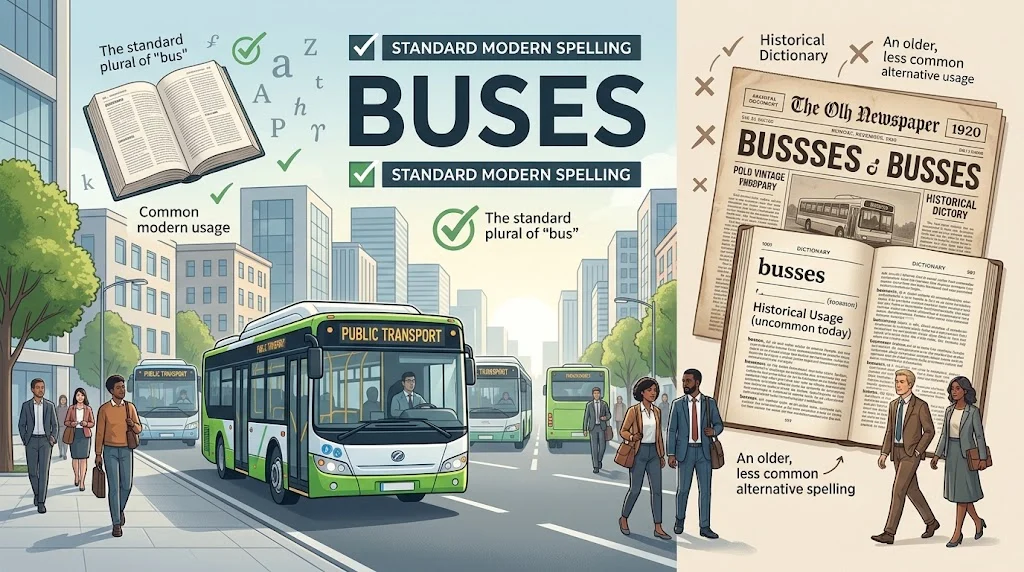
Quick Answer: Buses is the standard plural of bus in modern English and is the preferred spelling in most writing. Busses is also a legitimate word, but it is uncommon as the plural of bus and can instead be associated with the verb buss, meaning to kiss.
Few spelling questions look as simple as buses or busses yet cause surprising uncertainty, especially because English sometimes forms plurals by adding es after words ending in s. The noun bus means a large vehicle that carries passengers, while buses is its standard plural form. Busses can technically occur as a plural of bus, but it is far less common and may create confusion because buss is also an English verb meaning to kiss.
This distinction matters in school assignments, professional writing, transportation information, journalism, and digital content where clarity is essential. Understanding the spelling rule, pronunciation, history, and modern usage makes the correct choice much easier.
Buses vs Busses: What’s the Difference?
The primary difference is frequency and clarity rather than a completely different dictionary meaning.
Buses is the standard modern plural of bus. It refers to two or more buses.
Busses can appear as an alternative plural spelling of bus, although it is uncommon in contemporary standard English. The spelling is also associated with forms of buss, a word meaning to kiss.
Mini Recap
Buses is the normal plural spelling of bus.
Busses can technically be found as an alternative plural.
Busses is much less common in modern writing.
For clarity, consistency, and contemporary usage, buses is usually the best choice.
Is Buses vs Busses a Grammar, Vocabulary, or Usage Issue?
This is primarily a spelling and usage issue, rather than a grammar problem.
Both forms can be encountered in dictionaries and published texts, but they don’t have equal status in everyday modern English. Buses is overwhelmingly the safer choice when you need the plural of bus.
The confusion comes partly from English pluralization rules. Many nouns ending in certain consonant sounds take es in the plural. Since bus already ends in s, learners may wonder whether adding another s is necessary.
Historically, spelling conventions have varied. Older texts may contain busses, and some dictionaries continue to record it. That doesn’t mean contemporary writers should automatically choose it.
In modern formal writing, academic work, transportation reports, news articles, websites, and business communication, buses is the clearest and most recognizable spelling.
The two forms aren’t equally interchangeable in practical usage. If your goal is to communicate naturally with a modern English speaking audience, buses is the sensible default.
How to Use Buses Correctly
Buses is a plural noun referring to more than one bus.
A bus is a road vehicle designed to transport multiple passengers. When the noun becomes plural, the standard spelling is buses.
Workplace Example
“The company arranged buses to transport employees to the conference.”
Here, buses clearly indicates multiple passenger vehicles.
Academic Example
“Researchers examined how buses influence public transportation patterns in large cities.”
This is the expected spelling in formal research writing.
Technology Example
“The transportation application shows users where nearby buses are located in real time.”
Again, buses is the natural modern spelling.
The word appears frequently in contexts involving public transportation, school transportation, tourism, commuting, urban planning, and fleet management.
Usage Recap for Buses
Use buses when referring to more than one bus.
It is the standard modern plural.
It is appropriate in casual, professional, academic, and technical writing.
If you’re unsure which spelling to choose, buses is almost always the better option.
How to Use Busses Correctly
Busses deserves a little more explanation because it isn’t simply a spelling mistake.
Some dictionaries recognize busses as an alternative plural of bus. Therefore, calling it completely impossible would be inaccurate.
However, its modern frequency is considerably lower than buses. A reader may also momentarily interpret busses as a form related to buss, meaning to kiss.
The verb buss is itself uncommon and somewhat old fashioned or literary. Its forms can include busses and bussed, depending on grammatical context.
Workplace Example
A sentence such as:
“The transportation department replaced several old busses.”
can be understood as referring to multiple buses. However, most modern editors would change busses to buses.
Academic Example
An older historical source might contain:
“The city purchased several busses for public transportation.”
If you’re quoting or discussing historical material, preserving the original spelling may be appropriate.
Technology Example
A transportation database may contain legacy records using busses. Modern software documentation, however, would generally standardize the plural as buses.
Usage Recap for Busses
Busses can occur as an alternative plural of bus.
It is uncommon in contemporary standard writing.
It may create ambiguity because buss is also a word.
For most modern content, buses is preferable.
When You Should NOT Use Buses or Busses
Understanding context prevents unnecessary spelling errors.
- Don’t use busses simply because bus ends in s. The standard plural is buses.
- Don’t assume every English plural requires two final s letters. Plural formation depends on established spelling conventions.
- Don’t replace buses with busses in modern professional writing without a reason. The latter can look like a spelling error to many readers.
- Don’t use busses when discussing kissing unless the grammatical context actually requires a form of buss. The intended meaning should be obvious from the sentence.
- Don’t change a historical quotation simply to modernize its spelling. If you’re reproducing an original source, preserve the source accurately.
- Don’t treat spelling frequency and dictionary validity as identical concepts. A word can be recorded in dictionaries without being the most natural modern choice.
- Don’t use inconsistent spelling throughout the same document. Choose the standard form and maintain it.
- Don’t rely entirely on spellcheck. Some software may recognize both forms without telling you which is more appropriate for your audience.
Common Mistakes and Decision Rules
Decision Rule Box
If you mean more than one bus, use buses.
If you’re reproducing an older source that uses busses, preserve the original spelling when appropriate.
If the word relates to buss, meaning to kiss, determine the intended grammatical form from the sentence.
For modern general writing, buses is the safest and clearest choice.
Buses and Busses in Modern Technology and AI Tools
Digital technology has made spelling consistency more important than ever. Transportation applications, mapping platforms, fleet management systems, school transportation portals, and public transit websites commonly use the spelling buses.
AI writing tools may recognize both buses and busses, but recognition does not necessarily mean that both forms are equally suitable for the context. A language model may identify busses as a possible plural while still recommending buses for contemporary general writing.
This is an important lesson for AI assisted writing. Automated tools can identify technically possible words, but writers should also consider frequency, audience expectations, clarity, and current editorial standards.
For a transportation application, for example, “Nearby buses” is immediately recognizable. “Nearby busses” may cause some readers to pause and wonder whether the text contains a spelling mistake.
Etymology and History of Bus
The word bus developed as a shortened form of omnibus, a Latin word meaning “for all.” The term became associated with public passenger transportation during the nineteenth century.
As bus became established as an independent English noun, its plural forms developed according to changing English spelling conventions. Both buses and busses have appeared historically, but modern English has strongly favored buses.
This history explains why busses isn’t necessarily an invented spelling. It has genuine historical usage. Nevertheless, language evolves, and contemporary frequency is a major factor in determining which form is best for modern communication.
An Expert Perspective on the Spelling
“The best spelling is not always the one that can be found in a dictionary. Good usage also considers frequency, clarity, audience, and modern convention.”
For editors and professional writers, this principle is particularly valuable. English contains many words that are technically possible but uncommon. Choosing the familiar standard form usually creates a smoother reading experience.
Two Practical Case Studies
Case Study 1: Public Transportation Website
Imagine a city transportation authority preparing a webpage about its fleet.
Original wording:
“Our busses operate throughout the city.”
An editor changes it to:
“Our buses operate throughout the city.”
The second version aligns with modern transportation terminology and removes the possibility that readers will interpret busses as an unusual spelling.
Result: The content becomes more immediately recognizable and consistent with contemporary usage.
Case Study 2: Historical Research
A researcher is analyzing a newspaper from an earlier period. The newspaper repeatedly uses the spelling busses.
In this situation, changing every instance to buses could distort the historical evidence.
Result: The researcher retains busses when quoting the original material and explains the historical spelling where necessary.
These examples show why context matters. Modern writing generally favors buses, while historical documentation may require preservation of the original spelling.
Error Prevention Checklist
Always use Buses when
- Writing modern general English.
- Referring to multiple passenger buses.
- Creating website content.
- Writing academic papers.
- Preparing business communication.
- Producing transportation information.
- Writing news or informational content.
- Creating educational materials.
Never use Busses when
- You simply want the standard modern plural of bus.
- You’re writing ordinary professional content.
- You’re creating modern transportation instructions.
- You’re writing for a broad international audience and want maximum clarity.
- You’re using a style guide that specifies buses.
- The spelling isn’t being preserved from a historical source.
Related Grammar Confusions You Should Master
If you’re building stronger English spelling and usage skills, these commonly confused pairs are worth studying:
- Buses or busses
- Canceled or cancelled
- Traveling or travelling
- Labeled or labelled
- Color or colour
- Realize or realise
- Practice or practise
- License or licence
- Center or centre
- Theater or theatre
Many of these differences involve regional spelling conventions, while buses and busses involve a preferred modern form alongside a less common alternative.
Frequently Asked Questions
What is the correct plural of bus?
The standard modern plural of bus is buses. It is the spelling preferred in most contemporary English writing, including academic, professional, educational, and transportation content.
Is busses ever acceptable?
Yes. Busses can appear in older writing or historical sources and may be recorded as an alternative plural of bus. It should not automatically be treated as an invented or impossible word.
Are buses and busses pronounced differently?
When busses is used as an alternative plural of bus, it is generally pronounced similarly to buses. Context and spelling therefore become important for determining the intended meaning.
Should I write school buses or school busses?
Write school buses in modern standard English. This is the conventional and widely preferred spelling.
Should I write two buses or two busses?
The standard choice is two buses. Although busses has historical support as an alternative spelling, buses is much more common and clearer in contemporary writing.
Why does Microsoft Word or another spellchecker accept busses?
Some dictionaries and language databases recognize busses as a legitimate word or alternative plural. Spellcheckers often identify whether a form exists rather than deciding which form is best for your particular audience and context.
Conclusion: Buses or Busses Explained
The choice between buses or busses becomes simple once modern usage and historical spelling are separated. Buses is the standard plural of bus and should be your default choice in contemporary English. Busses is not necessarily an impossible spelling, but it is uncommon and can create confusion because buss is also an English word.
For school assignments, business communication, academic writing, websites, transportation content, and everyday English, buses is the clear winner. If you’re working with an older historical source, however, busses may need to be retained to preserve the original wording accurately.

Neil Gaiman is an American writer who contributes educational content to LingRoya.com. His work focuses on helping readers improve their English with clear, practical and easy to follow guidance.