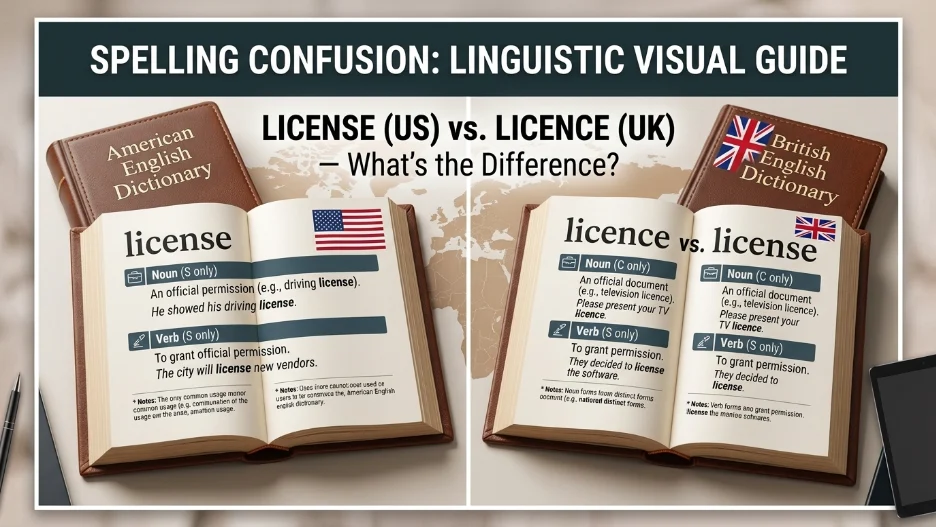
Quick Answer:License and licence are both correct, but their usage depends on the variety of English. In American English, license is used as both the noun and verb. In British English, licence is the noun (e.g., driving licence), while license is the verb (e.g., to license a business)
License or Licence is a common spelling question because both words look almost identical but are used differently depending on the type of English. In American English, license is the standard spelling for both the noun and the verb. In British English, however, licence is the noun, while license is the verb. Understanding this distinction helps you write more accurately and match the expectations of your audience.
Although the meanings are the same, choosing the correct spelling is important in professional, academic, and legal writing. Whether you’re referring to a driving licence, a software license, or a business permit, using the appropriate regional form improves clarity and consistency. This guide explains the differences, provides clear examples, and helps you know when to use license or licence correctly.
Licence vs License: What is the Difference?
The core of this confusion lies in the difference between American and British English conventions. While both words carry the same fundamental meaning of permission or a permit, their usage rules are distinct.
In the United States, the spelling “license” is used universally. It functions as both a noun, referring to the document or permission itself, and a verb, meaning to grant that permission . For an American writer, the choice is simple: always use “license.”
However, the rules become more complex for those writing in British English, or for an international audience that uses British spelling conventions. Here, “licence” (with a “c”) is the noun, while “license” (with an “s”) is the verb . This distinction is similar to other word pairs in British English, such as “practice” (noun) and “practise” (verb).
Here is a quick comparison to clarify the rules:
| Spelling | Part of Speech | American English Usage | British English Usage |
| License | Noun | Yes. The official document or permission. Example: “I have a driver’s license.” | No. This spelling is not used for the noun. |
| Licence | Noun | No. This spelling is not used. | Yes. The official document or permission. Example: “I have a driving licence.” |
| License | Verb | Yes. To grant permission. Example: “They licensed the new restaurant.” | Yes. To grant permission. Example: “They licensed the new restaurant.” |
In short, if you are writing for an American audience, you can use “license” for everything. If you are writing for a British or Commonwealth audience, you should use “licence” when you mean the permission or the document, and “license” when you mean the action of granting that permission.
Is Licence vs License a Grammar, Vocabulary, or Usage Issue?
This is primarily a usage and spelling issue rather than a pure grammar rule. Grammatically, both words function as nouns and verbs. The distinction is about orthography, or the correct spelling of a word, which is dictated by regional language conventions. This makes it a matter of “usage” according to the style of English you are employing.
The issue is not interchangeable; you cannot swap them at will. Using “licence” in an American context would be considered a spelling error, and using “license” as a noun in British English would also be incorrect . The formality of the document, be it academic or casual, doesn’t change the spelling rule. Whether you are writing a formal legal contract or a casual email, the same regional rule applies. The only distinction is that a legal document or academic paper written in British English will be scrutinized for such errors, making the correct usage even more critical.
Practical Usage of “License” in American English
In American English, “license” is the only correct spelling for both the noun and verb forms . This simplifies the decision making process considerably. You will use it in any context where you are referring to a permit, permission, or the act of granting it. Here are some examples:
- Workplace Example: “Before we can launch the new software, we need to secure a license from the patent holder. We also need to license the distribution rights from our partners.”
- Academic Example: “The university’s license with the journal publisher allows students free access to articles. The library is also licensed to provide this content to alumni for a limited time.”
- Technology Example: “The open source software is distributed under an MIT license, which allows developers to freely use and modify the code.”
Usage Recap for American English
In the United States, the rule is simple: always use license. Whether you need a driver’s license or a business license, or you are licensing a new invention, the spelling remains constant.
Practical Usage of “Licence” and “License” in British English
In British English, the distinction is crucial. You must determine whether the word is a noun or a verb in your sentence. This rule is strict and is used in the UK, Canada, Australia, and many other Commonwealth countries .
Using “Licence” as a Noun
Use “licence” when you are talking about the permission itself or a physical document. It is a thing. Here are some examples:
- Workplace Example: “The company was granted a licence to operate a new mining site. The application for the licence was approved yesterday.”
- Academic Example: “The professor’s research was conducted under a government licence. The university holds the licence for the radioactive materials used in the lab.”
- Technology Example: “The open source project uses a GNU General Public Licence, which ensures the code remains free for all users.”
Using “License” as a Verb
Use “license” when you are describing the action of granting that permission. It is something you do.
- Workplace Example: “The local council will license the new café to serve alcohol. They need to license their premises before they can open.”
- Academic Example: “The authorities licensed the researcher to handle the biological samples. The university is licensed to award medical degrees.”
- Technology Example: “The company plans to license its patented technology to manufacturers worldwide.”
Usage Recap for British English
If you can add “a,” “an,” or “the” before the word, you need a noun, and the correct spelling is “licence.” If you are describing an action, you need a verb, and the correct spelling is “license.” Also, remember that the past tense, “licensed,” and present participle, “licensing,” are always spelled with an “s” in both British and American English .
When You Should NOT Use Licence or License
Knowing when not to use these words is just as important as knowing when to use them. Misusing them can undermine your credibility, especially in professional or academic writing. Here are some common scenarios to avoid:
- Don’t use “licence” when you need a verb: In British English, using “licence” as a verb is a common error. For example, “The government licenced the company” is incorrect; it should be “licensed” .
- Don’t use “license” as a noun in British English: Using “license” with an “s” when you are referring to the document itself is the most frequent mistake for British and Canadian writers. For instance, “I need a new driver’s license” in British English should be “driving licence” .
- Don’t mix spellings in the same document: Unless you are quoting someone, maintain a consistent style. Do not use “licence” as a noun and then “license” as a noun a few paragraphs later in American English. This is a hallmark of a poorly proofread document.
- Don’t assume Canadian English is the same as American: Canada follows British conventions for this word, using “licence” as a noun and “license” as a verb, despite its proximity to the United States .
- Don’t use “license” when you mean “lease”: While both involve permission, a lease is a specific legal contract for property, whereas a license grants permission for an activity. They are not interchangeable, especially in legal contexts .
- Don’t forget about “assignment” vs “licence” in copyright: In legal contexts, “assigning” a copyright means transferring ownership, whereas “licensing” a copyright only grants permission to use it. They are distinct legal actions .
Common Mistakes and Decision Rules for Licence vs License
Here is a breakdown of common mistakes and the rules to avoid them.
| Correct Sentence | Incorrect Sentence | Explanation |
| (UK) “I passed my driving test and now have a full driving licence.” | (UK) “I passed my driving test and now have a full driving license.” | In British English, “licence” is the noun for the official document, so using “license” here is a common error. |
| (UK) “The restaurant is licensed to sell alcohol.” | (UK) “The restaurant is licenced to sell alcohol.” | “Licensed” is always the past tense of the verb “license,” regardless of region. The “c” is never used in this form. |
| (US) “I need to renew my driver’s license.” | (US) “I need to renew my driver’s licence.” | The word “licence” is not used in American English at all, making this a spelling error. |
| (UK) “The software was released under a public licence.” | (UK) “The software was released under a public license.” | Here, “licence” is a noun referring to the terms of release. In British English, the noun requires a “c.” |
Clear Decision Rule Box:
- If you mean the action (to give permission) or are in the US, use license.
- If you mean the thing (the document or permission) and are outside the US, use licence.
Licence and License in Modern Technology and AI Tools
The distinction between “licence” and “license” remains highly relevant in the digital age, particularly in technology, law, and the burgeoning field of AI.
Software is typically distributed under a specific license or licence . Major companies invest heavily in managing open source licenses and ensuring compliance. An error in spelling can be more than a typo; it could indicate a lack of attention to legal detail.
In legal tech and AI tools, maintaining a clean, global database of legal documents is critical. An AI proofreader or grammar tool, like ProWritingAid or Grammarly, can automatically flag an incorrect spelling of licence or license based on your chosen language setting . As AI tools are increasingly used to draft contracts and legal briefs, understanding these regional nuances is crucial for both the human operator and the AI. The models are trained on vast datasets and learn to produce region specific content, but they require precise guidance from users to ensure accuracy.
Authority and Trust: The History of a Confusing Word
The words “licence” and “license” derive from the Latin word licentia, meaning “freedom” or “authorisation” . The root licet translates to “it is allowed” . Over centuries, the word evolved through Old French into the English we know today. It is this historical journey, crossing borders and linguistic traditions, that gave us the two distinct spellings.
As legal scholar and language expert Bryan A. Garner notes, “Anyone who writes in English for an international audience must be mindful of these dialectal differences. A document with inconsistent spelling can appear careless and undermine the authority of its contents.”
This distinction can have concrete consequences. Consider two case studies:
- A UK based tech startup preparing its first funding round accidentally used the American spelling “license” throughout its shareholder agreement. The investors, a UK venture capital firm, flagged the error as a sign of legal sloppiness, delaying the process by two weeks while the documents were corrected.
- A major Canadian law firm created a template for intellectual property licenses. The template used British spelling, correctly using “licence” for the document. However, a junior associate incorrectly changed all instances of “license” to “licence” in a verb context during a final review. This mistake, spotted only during the closing, caused a last minute panic and required the firm to reprint and re sign the agreements.
About the Author: As a senior SEO strategist and professional linguist with over a decade of experience, I have seen firsthand how small spelling errors, like confusing “licence” and “license,” can impact a brand’s authority and trustworthiness. This guide is designed to provide a clear, definitive, and reliable answer to a question that perplexes even experienced writers.
Error Prevention Checklist for Licence and License
To ensure your writing is always correct, keep this simple checklist in mind.
- Always use “license” with an “s” when you are writing in American English. The “c” spelling does not exist.
- Never use “licenced” or “licencing.” The ” ed” and ” ing” forms are always spelled with an “s” in both British and American English .
- Always use “licence” with a “c” in British English when you mean the noun (the permit, document, or permission).
- Always use “license” with an “s” in British English when you mean the verb (the action of granting permission).
- Never use “license” as a noun in British English. This is the most common error.
- Never use “licence” as a verb. This is not a valid form of the word in any region.
Related Grammar Confusions You Should Master
If you are looking to master other frequently confused word pairs, here are some related topics to explore:
- Practice vs Practise
- Effect vs Affect
- Principal vs Principle
- Stationary vs Stationery
- Compliment vs Complement
- Its vs It’s
- They’re vs Their vs There
- Your vs You’re
- Then vs Than
- Who’s vs Whose
Advanced FAQs
Is it a “driving licence” or “driver’s license”?
Driving licence is correct in British English, while driver’s license is the standard American English form. Both are correct for their respective regions.
Is it “Licence to Kill” or “License to Kill”?
The James Bond film is titled Licence to Kill because it follows British English spelling. In American English, License to Kill would be the standard form.
Is it “software license” or “software licence”?
Use software licence in British English and software license in American English. Choose the spelling that matches your target audience.
Do “licence” and “license” have the same pronunciation?
Yes. Licence and license are pronounced the same; the difference is only in spelling and regional usage.
Is “licence” used in American English?
No. In American English, license is the correct spelling for both the noun and the verb. Licence is considered a British English spelling.
Which spelling should I use for a global audience?
Choose either British or American English and use it consistently throughout your writing. Consistency is more important than the specific variant.
What is the difference between an exclusive license and a non-exclusive license?
An exclusive license gives rights to only one licensee, while a non-exclusive license allows the same rights to be granted to multiple parties.
Conclusion
The choice between “license” and “licence” is a classic example of how regional differences shape the English language. The rule is straightforward once you understand the context. For American writers, it is a simple, one spelling rule. For British and Commonwealth writers, it is a matter of distinguishing between a noun and a verb. By following the guidelines and examples in this article, you can ensure your writing is always correct, professional, and appropriate for your intended audience, avoiding a common spelling mistake that can undermine your authority.

Margaret Atwood is an American writer who contributes to LingRoya.com creating clear and engaging content about the English language and everyday communication. She enjoys helping readers build confidence in their writing through simple, practical guidance.