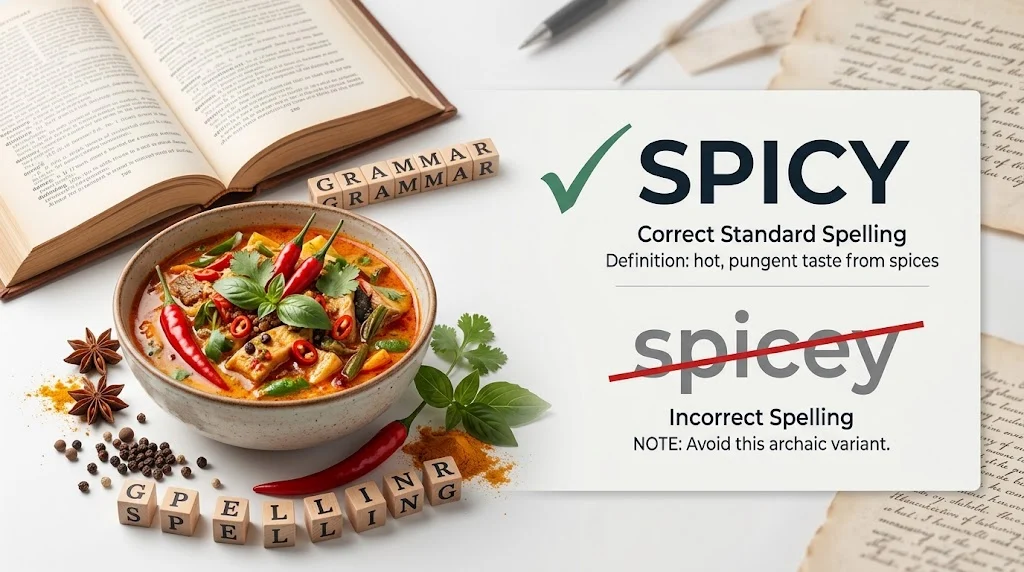
Quick Answer: The correct spelling is spicy, not spicey. Spicy is the standard English adjective used to describe food with strong heat or seasoning, and it can also describe something exciting or provocative. Spicey is a common spelling mistake caused by adding the ending y to the noun spice without applying the usual spelling pattern.
If you have ever hesitated before writing “spicy” because “spicey” seems logical, you’re not alone. This spelling confusion happens because the noun spice already ends in e, making the adjective formation less obvious. As an English language and usage guide, this article explains the standard spelling, pronunciation, grammar, origin, common mistakes, and practical examples so you can choose the correct form confidently in professional, academic, and everyday writing.
Spicey or Spicy: What’s the Difference?
The difference is simple: spicy is the correct standard spelling, while spicey is generally considered a misspelling.
Spicy is an adjective. It describes food containing spices or having a strong, hot, or pungent flavor. It can also be used figuratively for something lively, provocative, or exciting.
Spicey is not the standard spelling of this adjective in modern English. People sometimes write it because they assume the word should be formed by keeping the complete spelling of spice and adding y. English spelling does not always work that way.
<table> <thead> <tr> <th>Feature</th> <th>Spicy</th> <th>Spicey</th> </tr> </thead> <tbody> <tr> <td>Standard spelling</td> <td>Yes</td> <td>No</td> </tr> <tr> <td>Part of speech</td> <td>Adjective</td> <td>Usually a misspelling</td> </tr> <tr> <td>Meaning</td> <td>Having a strong or hot flavor; exciting or provocative</td> <td>No standard independent meaning</td> </tr> <tr> <td>Common use</td> <td>Food, descriptions, figurative language</td> <td>Informal spelling error</td> </tr> <tr> <td>Recommended in formal writing</td> <td>Yes</td> <td>No</td> </tr> </tbody> </table>
The important point is that spicy is the form you should use in standard English.
If you are writing an essay, article, menu, email, product description, or social media post, choose spicy.
The spelling spicey may appear online, but its appearance does not make it the accepted standard form.
Is Spicey or Spicy a Grammar, Vocabulary, or Usage Issue?
This is primarily a spelling and word formation issue, rather than a difference in meaning.
Both forms are intended to represent the same adjective, but they do not have equal status in standard English. Spicy is the established adjective derived from spice. Spicey is normally treated as an incorrect spelling.
The two forms therefore aren’t interchangeable in careful writing.
In formal communication, academic writing, journalism, business documents, educational material, and edited publications, spicy is the appropriate choice. In casual online writing, you may occasionally encounter spicey, especially when someone is typing quickly or is unfamiliar with the conventional spelling.
This distinction matters because spelling errors can affect perceived credibility. A single misspelling might not change the meaning of a sentence, but repeated errors can make otherwise strong writing appear less polished.
Why Does the Correct Spelling Change?
English has many spelling patterns in which a final e disappears before another suffix or ending is added.
The noun is spice.
The adjective is spicy.
The final e is not retained before y in the standard spelling.
This is similar to several other English word formation patterns where spelling changes occur as a word moves from one grammatical form to another.
How to Use Spicy Correctly
Spicy functions as an adjective, so it normally modifies a noun or appears after a linking verb.
Consider these examples:
The restaurant serves spicy noodles.
She ordered a spicy curry.
This sauce is extremely spicy.
The chef prepared a spicy vegetable dish.
The word can describe different degrees of heat. A dish might be mildly spicy, moderately spicy, or extremely spicy.
Workplace Example
Imagine writing a restaurant review for a business website:
“The new menu includes several spicy dishes inspired by South Asian cuisine.”
Here, spicy directly describes the dishes.
Another workplace example might appear in marketing:
“Our spicy chicken sandwich is one of the restaurant’s most popular menu items.”
Using the standard spelling gives the description a professional appearance.
Academic Example
A student writing about food culture might say:
“Spicy foods are common in many culinary traditions around the world.”
This is appropriate because spicy is the accepted adjective in standard English.
Technology Example
Technology companies can also use the word figuratively:
“The platform introduced a spicy new feature designed to encourage discussion.”
In this context, spicy does not describe physical heat. Instead, it suggests that the feature is bold, controversial, unusual, or exciting.
Usage Recap
Use spicy when describing food, flavor, personality, content, ideas, or anything figuratively bold or provocative.
Avoid spicey in edited or formal writing.
How to Use Spicy in Different Contexts
The word has a surprisingly broad range of uses.
Food and Cooking
This is the most common meaning.
“The soup is too spicy for me.”
“The recipe calls for several spicy peppers.”
“She enjoys spicy Mexican food.”
Here, the adjective refers to flavor or heat.
Figurative Language
English speakers sometimes use spicy metaphorically.
“That was a spicy comment.”
“The interview became spicy when the two guests disagreed.”
In these examples, the word suggests something provocative, intense, entertaining, or controversial.
Social Media
The figurative meaning has become particularly common online.
Someone might describe a controversial opinion as a “spicy take.” This means the opinion is bold, provocative, or likely to generate disagreement.
For example:
“That’s a spicy opinion about modern movies.”
The meaning depends heavily on context.
When You Should NOT Use Spicey or Spicy
There are several situations where writers commonly make mistakes.
1. Do Not Use Spicey in Formal Writing
If you’re writing an academic paper, business report, article, application, or professional email, use spicy.
2. Do Not Assume the Noun Keeps Its Entire Spelling
The noun spice does not automatically become spicey when transformed into an adjective.
3. Do Not Treat Spicey as a Separate Standard Word
In ordinary modern English, there is no standard distinction in meaning between spicey and spicy.
4. Do Not Copy an Incorrect Online Spelling
Search results, comments, product listings, and social media posts can contain spelling errors.
5. Do Not Use Spicy When You Mean Spiced
These words can have slightly different meanings.
“Spicy food” generally suggests heat or a strong flavor.
“Spiced tea” means tea prepared with spices.
6. Do Not Assume Spicy Always Means Hot
A spicy flavor can involve pungency, strong seasoning, or heat, but the exact experience depends on the food and context.
7. Do Not Confuse Spicy With Spiciness
Spicy is an adjective.
Spiciness is a noun.
For example:
“The curry is spicy.”
“The spiciness of the curry was intense.”
8. Do Not Use Spicey Because It Looks More Logical
English spelling is based on established usage, not always on the most obvious combination of letters.
Decision Rule
If you are describing something with strong flavor, heat, or a provocative quality, use “spicy.”
If you are tempted to write “spicey,” replace it with “spicy.”
There is no standard situation in ordinary English where choosing spicey instead of spicy improves correctness.
Spicy in Modern Technology and AI Tools
Modern digital communication has expanded the figurative use of spicy.
Social media users frequently describe controversial opinions, unexpected comments, bold predictions, and provocative discussions as “spicy.”
AI systems may also encounter both spellings in training data or user prompts. Because incorrect spellings can appear online, language technology needs to distinguish between a word that is genuinely recognized and a frequent misspelling.
For example, a user might type:
“Is spicey the correct spelling?”
A language assistant should identify spicy as the standard form while explaining why the error is common.
This is an important distinction between frequency and correctness. A misspelling can occur thousands of times online and still remain a misspelling.
The Etymology of Spicy
The word spicy comes from spice, which entered English through Old French and ultimately traces back to Latin species, referring to a particular kind or substance.
The noun spice developed its culinary meaning over centuries. The adjective spicy developed from the noun to describe something containing or resembling spice.
The spelling eventually became standardized as spicy, rather than spicey.
Understanding this history reinforces an important lesson about English: modern spelling is shaped by historical development and conventional usage rather than simple mechanical word formation.
An Expert Perspective on Spelling
A useful principle for English learners is:
“When two spellings appear to have the same meaning, standard usage determines which form belongs in polished English.”
That principle is especially valuable when dealing with words that seem logically constructed but have developed conventional spellings over time.
Two Practical Case Studies
Case Study 1: Restaurant Marketing
Consider two menu descriptions:
Version A: “Our spicey chicken is prepared with fresh peppers.”
Version B: “Our spicy chicken is prepared with fresh peppers.”
Both communicate the intended idea, but Version B follows standard English spelling and therefore presents a more polished brand image.
The practical result is straightforward: changing the misspelling to spicy removes an avoidable language error without changing the message.
Case Study 2: Student Writing
Imagine a student writes the following sentence:
“The dish was too spicey for the participants.”
Correcting it to:
“The dish was too spicy for the participants.”
preserves the student’s original meaning while improving spelling accuracy.
The concrete result is one fewer spelling error and a sentence that conforms to standard English usage.
These examples are illustrative rather than statistical research studies. They demonstrate how the distinction works in real writing situations.
Error Prevention Checklist
Always Use Spicy When
- Describing food with strong heat or flavor
- Describing a dish containing strong spices
- Describing a provocative or bold comment
- Writing academic or professional material
- Creating restaurant or food related content
- Writing educational material
- Describing figurative “spicy” opinions
- Checking standard English spelling
Never Use Spicey When
- You want the standard adjective
- You are writing a formal document
- You are submitting academic work
- You are publishing edited content
- You are creating professional marketing copy
- You are writing a dictionary style definition
- You are correcting someone else’s spelling
- You want to follow conventional English usage
Related Grammar Confusions You Should Master
English contains many spelling and usage pairs that create similar confusion. Learning them together can significantly improve writing accuracy.
- Affect or effect
- Advice or advise
- Their or there
- Your or you’re
- Its or it’s
- Then or than
- Accept or except
- Further or farther
- Compliment or complement
- Practice or practise
These pairs demonstrate why context, grammar, spelling conventions, and established usage all matter when selecting the right form.
Frequently Asked Questions
Is spicey or spicy correct?
Spicy is the correct standard spelling. Spicey is generally a misspelling and should be avoided in formal, academic, professional, and edited writing.
Why do people spell spicy as spicey?
People often spell it spicey because they start with the noun spice and add y without removing the final e. The conventional adjective spelling is spicy.
Is spicy an adjective?
Yes. Spicy is an adjective. It can describe food with a strong or hot flavor and can also describe something figuratively provocative, exciting, or bold.
Is spicy used figuratively?
Yes. In modern informal English, spicy can describe an opinion, comment, debate, story, or situation that is bold, provocative, controversial, or exciting.
Conclusion
When deciding between spicey or spicy, the correct choice is spicy. It is the standard adjective for describing food with strong flavor or heat and can also be used figuratively for provocative or exciting ideas. The spelling spicey is generally a mistake, so writers should avoid it in professional, academic, and published content.
Once you remember that the established adjective is spicy, this common spelling confusion becomes easy to avoid. When in doubt, choose the conventional form used in standard English: spicy.

Margaret Atwood is an American writer who contributes to LingRoya.com creating clear and engaging content about the English language and everyday communication. She enjoys helping readers build confidence in their writing through simple, practical guidance.