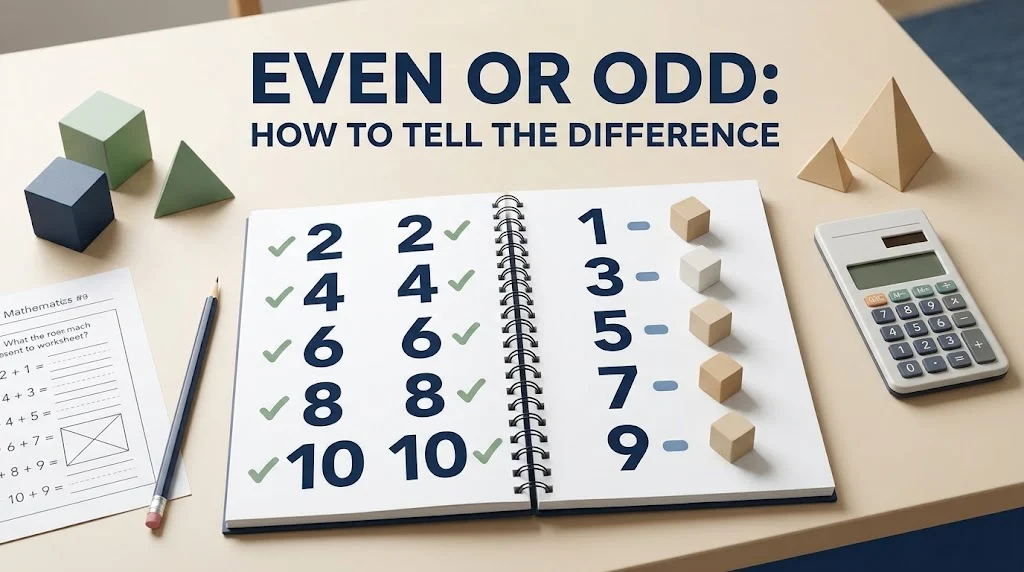
Even or odd refers to the two categories of whole numbers based on whether they can be divided by 2 without leaving a remainder. An even number is divisible by 2, such as 4, 12, or 100, while an odd number leaves a remainder of 1, such as 3, 9, or fifteen.
Have you ever wondered how to tell whether a number is even or odd without using a calculator? The rule is simpler than it looks. Even numbers divide exactly by 2, while odd numbers leave a remainder of 1. For example, 18 is even, but 19 is odd. This basic mathematical concept is essential for students, teachers, and anyone working with numbers. Learning a few simple rules can help you identify even and odd numbers quickly, solve arithmetic problems accurately, and recognize number patterns in everyday situations.
Even vs Odd: What’s the Difference?
Even and odd are mathematical classifications used to describe integers. They help determine how numbers behave when divided by 2.
An even number is an integer that can be divided by 2 without a remainder. Examples include 0, 2, 4, 6, 8, 10, and 12.
An odd number is an integer that cannot be divided evenly by 2. When an odd integer is divided by 2, the remainder is 1. Examples include 1, 3, 5, 7, 9, and 11.
Both words are adjectives in this mathematical context. They describe the properties of numbers rather than the numbers themselves.
| Feature | Even Number | Odd Number |
|---|---|---|
| Definition | Divisible by 2 without a remainder | Leaves a remainder of 1 when divided by 2 |
| Examples | 0, 2, 4, 6, 8, 10 | 1, 3, 5, 7, 9, 11 |
| Last digit | 0, 2, 4, 6, 8 | 1, 3, 5, 7, 9 |
| Division by 2 | Produces an integer | Produces a noninteger result |
| Adding two numbers of the same type | Even plus even gives even | Odd plus odd gives even |
| Adding different types | Even plus odd gives odd | Odd plus even gives odd |
| Negative integers | Negative even integers are even | Negative odd integers are odd |
Quick Recap
Even numbers are divisible by 2 without a remainder.
Odd numbers leave a remainder of 1 when divided by 2.
The last digit can help you identify whether an integer is even or odd.
Zero is even, and negative integers can also be even or odd.
What Is an Even Number?
An even number is an integer that can be expressed as twice another integer. In mathematical notation, an integer \(n\) is even if it can be written as:
\[ n=2k \]
Here, \(k\) represents any integer.
For example, 14 is even because:
\[ 14=2\times7 \]
Similarly, 24 is even because \(24=2\times12\).
Even numbers include positive numbers, negative numbers, and zero. Therefore, numbers such as 0, 8, 36, and negative 10 are all even.
Workplace Example
An event coordinator has 24 guests and wants to seat them in pairs. Since 24 is divisible by 2, everyone can be paired without leaving anyone alone.
Academic Example
A student identifies 48 as an even number because dividing it by 2 produces 24, a whole number.
Technology Example
A programmer checks whether a number is even by testing whether its remainder after division by 2 equals zero.
Usage recap: A number is even when dividing it by 2 leaves no remainder. Its final digit is always 0, 2, 4, 6, or 8.
What Is an Odd Number?
An odd number is an integer that cannot be divided by 2 without a remainder. It can be expressed mathematically as:
\[ n=2k+1 \]
Here, \(k\) is any integer.
For example:
\[ 15=2\times7+1 \]
Because 15 leaves a remainder of 1 when divided by 2, it is odd.
Other odd numbers include 1, 5, 13, 27, 101, and negative 7.
Workplace Example
A manager has 17 employees and wants to arrange them into pairs for an activity. Eight pairs can be formed, with one employee left without a partner.
Academic Example
A student divides 31 by 2 and obtains 15 with a remainder of 1. Therefore, 31 is an odd number.
Technology Example
A computer program identifies 27 as odd because the remainder of 27 divided by 2 is 1.
Usage recap: An integer is odd when it leaves a remainder of 1 after division by 2. Its final digit is 1, 3, 5, 7, or 9.
Is Even or Odd a Grammar, Vocabulary, or Usage Issue?
The difference between even and odd is primarily a mathematical concept, not a grammar problem. Both words are ordinary English adjectives, but in mathematics, they have precise definitions.
Are Even and Odd Interchangeable?
No. Even and odd describe opposite categories of integers.
For example, 16 is even because it divides exactly by 2. The number 17 is odd because it leaves a remainder of 1.
Using the wrong label can lead to incorrect answers in mathematics homework, programming logic, and statistical exercises.
Formal vs Informal Usage
In formal mathematics, even and odd have exact definitions. In everyday conversation, people may also use even to mean level or equal and odd to mean unusual or strange.
For instance, “The floor is even” describes a level surface, while “That is an odd idea” means the idea is unusual.
These meanings differ from the mathematical definitions.
Academic vs Casual Usage
Students should use the mathematical definitions when answering questions about integers. In casual speech, context determines the intended meaning.
A teacher asking whether 42 is even or odd expects a mathematical classification, not a description of whether the number seems unusual.
When You Should NOT Use Even or Odd
Although even and odd are simple concepts, several mistakes can cause confusion.
1. Don’t classify a number by its size. Large numbers can be even or odd. For example, 1,000,000 is even, while 1,000,001 is odd.
2. Don’t assume zero is odd. Zero is even because \(0=2\times0\).
3. Don’t forget negative numbers. Negative 8 is even, while negative 9 is odd.
4. Don’t classify fractions as even or odd in the usual integer sense. Numbers such as \(3/4\) and \(5/2\) are not integers, so the standard even and odd classifications do not apply to them.
5. Don’t confuse decimal notation with integer classification. A number such as 12.0 represents the integer 12, which is even, but 12.5 is not an integer.
6. Don’t assume every number can be classified as even or odd. Under the standard definition, parity applies to integers, not all real numbers.
7. Don’t judge parity from the first digit. The last digit determines whether an integer is even or odd in base ten.
8. Don’t confuse the everyday meaning of odd with its mathematical meaning. An unusual event is not necessarily related to an odd integer.
Common Even and Odd Mistakes
The following examples show correct classifications and common errors.
| Correct sentence | Incorrect sentence | Explanation |
|---|---|---|
| 18 is an even number. | 18 is an odd number. | 18 divides exactly by 2. |
| 23 is an odd number. | 23 is an even number. | 23 leaves a remainder of 1 when divided by 2. |
| Zero is even. | Zero is odd. | Zero is divisible by 2. |
| Negative 12 is even. | Negative 12 is odd. | Negative 12 equals 2 multiplied by negative 6. |
| 45 is odd. | 45 is even because it is divisible by 5. | Divisibility by 5 does not determine parity. |
| 100 is even. | 100 is odd because it has three digits. | The number of digits does not determine parity. |
Decision Rule
If the integer divides by 2 with no remainder, it is even.
If the integer leaves a remainder of 1 when divided by 2, it is odd.
For a quick check, look at the final digit. The digits 0, 2, 4, 6, and 8 indicate even numbers. The digits 1, 3, 5, 7, and 9 indicate odd numbers.
Even or Odd in Modern Technology and AI Tools
Even and odd numbers play an important role in computer programming, data processing, and mathematical algorithms.
Programmers often use the modulo operator to determine whether a number is even or odd. The expression n % 2 calculates the remainder when an integer is divided by 2. A remainder of zero indicates an even number, while a remainder of one indicates an odd number for nonnegative integers.
For example, the following Python code checks a number’s parity:
number = 17if number % 2 == 0: print("Even")else: print("Odd")The output is Odd.
AI systems can also use parity rules when solving arithmetic problems, explaining mathematical concepts, or generating educational exercises. However, generated answers should still be checked against the mathematical definition, particularly when negative numbers, fractions, or decimals are involved.
Etymology: Where Do Even and Odd Come From?
The English word even has historical roots in Old English and Germanic languages. Its earlier meanings were associated with equality, evenness, or being level. In mathematics, the concept developed into the idea of numbers that can be divided into equal groups of two.
The word odd also comes from older English usage, influenced by the Old Norse word oddi, which referred to a point or odd item. Over time, odd came to describe something remaining over or not paired, which connects naturally to the mathematical idea of an integer that leaves one item unpaired when grouped in twos.
These historical connections help explain why the words are used both in everyday English and in mathematics.
Expert Insight: Understanding Parity
“Parity is determined by divisibility by two, not by a number’s size, appearance, or practical importance.”
This principle is central to elementary number theory. Once students understand parity, they can apply it to arithmetic, algebra, mathematical proofs, and computer programming.
Two Practical Case Studies
Case Study 1: Organizing Students into Pairs
Imagine a teacher preparing a classroom activity with 29 students. The teacher wants every student to have a partner.
Because 29 is odd, the teacher can form 14 pairs, leaving one student without a partner. If one additional student joins the class, the total becomes 30, allowing 15 complete pairs.
Result: Recognizing that 29 is odd helps the teacher anticipate the need for an additional participant or an alternative group arrangement. These figures illustrate the mathematical result rather than a documented experiment.
Case Study 2: Checking Numbers in a Software Application
Imagine a developer building a tool that categorizes integers as even or odd. The application receives the numbers 42, 57, and 100.
The program checks each number’s remainder after division by 2. It identifies 42 and 100 as even and 57 as odd.
Result: Applying a consistent parity test allows the application to classify the three integers correctly. The example is illustrative, but the underlying calculation follows the standard mathematical rule.
Error Prevention Checklist
Always Use the Even Classification When
- An integer ends in 0, 2, 4, 6, or 8.
- Dividing the integer by 2 produces another integer.
- The integer can be divided into two equal groups without leftovers.
- The integer is zero or a negative integer divisible by 2.
Never Use the Odd Classification When
- The integer divides exactly by 2.
- The integer ends in 0, 2, 4, 6, or 8.
- You’re classifying a fraction or noninteger real number under the standard definition of parity.
- You’re relying only on the number’s size or the number of digits it contains.
Related Grammar Confusions You Should Master
Understanding mathematical vocabulary can also help you distinguish between related terms.
- Greater than vs less than: Comparing numerical values.
- Positive vs negative: Understanding the sign of a number.
- Integer vs whole number: Learning how different number sets are defined.
- Factor vs multiple: Distinguishing numbers that divide another number from numbers produced by multiplication.
- Prime vs composite: Classifying integers by their positive factors.
- Mean vs median: Understanding two measures of central tendency.
- Area vs perimeter: Distinguishing the space inside a shape from the distance around it.
- Ratio vs proportion: Comparing quantities and equivalent relationships.
- Fraction vs decimal: Expressing parts of a whole in different forms.
- Equality vs equivalence: Understanding when mathematical expressions have equal values or equivalent meanings.
Frequently Asked Questions
1. What does even or odd mean in mathematics?
Even or odd describes whether an integer is divisible by 2 without a remainder. Even integers divide exactly by 2, while odd integers leave a remainder of 1.
2. How do you know if a number is even or odd?
Look at the final digit of the integer. If it is 0, 2, 4, 6, or 8, the number is even. If it is 1, 3, 5, 7, or 9, it is odd.
3. Is zero even or odd?
Zero is even because it can be divided by 2 without a remainder. Mathematically, zero equals 2 multiplied by zero.
4. Are negative numbers even or odd?
Yes. Negative integers can be even or odd. For example, negative 4 is even, while negative 5 is odd.
5. Is 1 an even or odd number?
One is odd because dividing it by 2 leaves a remainder of 1. It cannot be expressed as twice an integer.
6. Is 100 even or odd?
One hundred is even because its last digit is zero and it divides exactly by 2, producing 50.
7. Can decimals be even or odd?
The standard mathematical definitions of even and odd apply to integers. A decimal such as 7.5 is not an integer, so it is neither even nor odd under these definitions. A value such as 8.0 represents the integer 8 and is even.
8. What happens when you add two even numbers?
The sum of two even integers is always even. For example, 8 plus 12 equals 20, which is divisible by 2.
9. What happens when you add an even number and an odd number?
The sum is always odd. For example, 10 plus 7 equals 17, an odd integer.
10. How do computers check whether a number is even or odd?
Computers can use the modulo operator to calculate the remainder after division by 2. A remainder of zero indicates an even integer, while a remainder of one indicates an odd integer for nonnegative integers.
Conclusion
Understanding even or odd is a fundamental mathematical skill that makes arithmetic, number patterns, and programming easier. An even integer divides by 2 without a remainder, while an odd integer leaves a remainder of 1. You can quickly identify positive and negative integers by checking their final digits, and remember that zero is even.
These rules apply in classrooms, workplaces, and technology. With a little practice, you’ll be able to classify integers accurately and avoid common mistakes. Whether you’re completing homework or writing a computer program, understanding parity provides a reliable foundation for more advanced mathematical concepts.

Philip Pullman is an American writer dedicated to creating clear and easy to follow English content. Through his work at LingRoya.com, he helps readers strengthen their language skills with practical and reliable guidance so that they can easily understand.