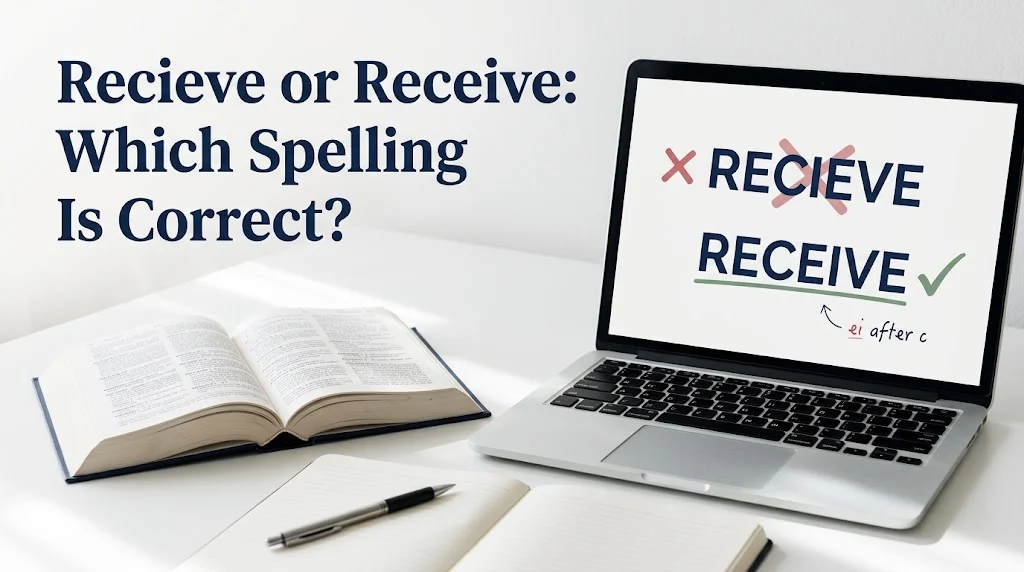
Receive is the correct spelling in standard English, while recieve is a common misspelling. The word receive is a verb meaning to get, accept, or be given something. Remember the spelling rule “i before e, except after c”: in receive, the letters e and i appear in that order after c.
Have you ever typed recieve in an email and wondered why your spellchecker marked it as incorrect? The correct spelling is receive, not recieve. This mistake is common because English spelling rules can be confusing, especially when familiar words follow different letter patterns.
Whether you’re writing a professional email, completing an academic assignment, or publishing online content, spelling receive correctly helps your writing look polished and credible. Understanding the difference also makes it easier to remember related words such as receipt, receiver, and received. With a simple spelling trick and a few practical examples, you can avoid this mistake confidently.
Recieve vs Receive: What’s the Difference?
The main difference between recieve and receive is correctness. Receive is the accepted spelling of the English verb, whereas recieve is a misspelling that should be avoided in standard writing.
| Feature | Recieve | Receive |
|---|---|---|
| Spelling status | Incorrect | Correct |
| Part of speech | Intended as a verb | Verb |
| Meaning | No standard meaning as written | To get, accept, or be given something |
| Formal writing | Avoid | Recommended |
| Academic writing | Incorrect | Correct |
| Professional emails | Incorrect | Correct |
| Example | I will recieve your message. | I will receive your message. |
Quick Recap
Receive is the correct spelling in standard English.
Recieve is a spelling error, not an alternative regional spelling.
The word receive means to get or accept something.
The spelling rule “i before e, except after c” helps you remember the correct order.
What Does Receive Mean?
Receive is a verb that means to get, accept, collect, or be given something from another person or source. It can describe physical objects, information, communication, payments, and experiences.
For example, you might receive a letter from a friend, receive payment for your work, or receive feedback from a teacher.
Here are more examples:
- I expect to receive your email by tomorrow.
- She received a certificate for her excellent performance.
- The company will receive the payment next week.
- Students receive feedback after completing the assignment.
The word can also describe how someone is treated or how an action is experienced. For instance, “The proposal received strong support from the committee.”
Understanding the meaning helps you use receive naturally in everyday communication and formal writing.
What Does Recieve Mean?
Recieve is not the standard spelling of an English word. It is a common typographical or spelling error made when writers reverse the letters i and e.
For example:
Incorrect: I hope to recieve your reply soon.
Correct: I hope to receive your reply soon.
Although readers can usually understand the intended meaning, the incorrect spelling can make a message appear careless. Word processors and online spellcheckers often identify recieve as an error and suggest receive as the correction.
You should not use recieve in academic papers, professional documents, business correspondence, website content, or other standard English writing.
Usage recap: Use receive whenever you mean to get, accept, or be given something. Treat recieve as a misspelling rather than an alternative form.
Is Recieve vs Receive a Grammar, Vocabulary, or Usage Issue?
The difference between recieve and receive is primarily a spelling issue. It isn’t a grammatical distinction because only receive is accepted as the standard spelling of the intended word.
Are Recieve and Receive Interchangeable?
No. Although people may understand recieve from context, it isn’t an accepted alternative to receive in standard English.
For example:
Correct: The customer will receive a confirmation email.
Incorrect: The customer will recieve a confirmation email.
The meaning is clear in both sentences, but only the first uses correct spelling.
Formal vs Informal Usage
Receive is correct in both formal and informal English. You can use it in a casual text message, a business email, a report, or a formal letter.
Recieve should be avoided in all these contexts. Informal communication doesn’t make the misspelling correct, even if readers can understand it.
Academic vs Casual Usage
In academic writing, correct spelling matters because it supports clarity and demonstrates attention to detail. A misspelling in an assignment or research paper may distract readers from the actual argument.
The same principle applies to casual writing. Although a typo in a quick message may not cause a serious problem, learning the correct form helps prevent repeated mistakes.
When to Use Receive
Use receive whenever you want to describe getting, accepting, or being given something. It works in a wide range of situations, from everyday conversations to specialized professional communication.
Workplace Example
“Please confirm when you receive the updated contract.”
This sentence is suitable for a professional email because it clearly communicates when the recipient gets the document.
Academic Example
“Participants will receive their results after the assessment has been completed.”
Here, receive describes the delivery of information to participants.
Technology Example
“Your device will receive a notification when the software update is available.”
In technology, receive commonly describes incoming messages, data, alerts, and digital information.
Usage recap: Receive is the correct choice whenever you describe getting something, whether physical, digital, financial, or informational.
When to Use Recieve
There is no standard English context in which recieve should replace receive. The spelling is incorrect, so the best approach is to correct it whenever you encounter it.
Workplace Example
Incorrect: “You will recieve the invoice shortly.”
Correct: “You will receive the invoice shortly.”
Academic Example
Incorrect: “All students recieve a final grade.”
Correct: “All students receive a final grade.”
Technology Example
Incorrect: “The application will recieve a security alert.”
Correct: “The application will receive a security alert.”
In each case, changing the spelling fixes the error without changing the sentence’s meaning.
Usage recap: Don’t use recieve as a spelling variant. Correct it to receive in every standard English context.
When You Should NOT Use Recieve or Receive
Although receive is correct, it isn’t suitable for every sentence. Choose the word according to its meaning, and avoid the incorrect spelling entirely.
1. Don’t use recieve in published writing. Correct the spelling to receive before submitting or publishing your work.
2. Don’t use receive when you mean to give something. For example, “I will send the documents” is more appropriate than “I will receive the documents” when you are the person sending them.
3. Don’t use receive when you mean to purchase something specifically. You can receive a product after ordering it, but purchase is the more precise verb when you want to emphasize the act of buying.
4. Don’t confuse receive with accept. Receive means to get something, while accept emphasizes agreeing to take it or approving it.
5. Don’t replace receive with receipt. Receive is a verb, while receipt is generally a noun referring to proof of payment or the act of receiving.
6. Don’t assume spellcheck catches every mistake. Automated tools can miss errors in some contexts, so proofreading remains important.
7. Don’t assume pronunciation determines spelling. Even if a word sounds familiar, its accepted written form must be learned and remembered.
8. Don’t overlook derived words. Received, receiving, receiver, and receipt have related meanings but different spelling patterns that deserve attention.
Common Mistakes and Decision Rules
The following table shows how to correct frequent errors involving receive.
| Correct sentence | Incorrect sentence | Explanation |
|---|---|---|
| I will receive the package tomorrow. | I will recieve the package tomorrow. | The correct spelling places e before i after c. |
| She received your message. | She recieved your message. | Received follows the spelling pattern used in receive. |
| We are receiving new applications. | We are recieveing new applications. | Receiving retains the correct spelling of receive. |
| The receiver accepted the delivery. | The reciever accepted the delivery. | Receiver is spelled with ei after c. |
| Did you receive the payment? | Did you recieve the payment? | Receive is the accepted spelling of the verb. |
| I received a receipt for the purchase. | I recieved a reciept for the purchase. | Both received and receipt have established spellings. |
Decision Rule Box
If you mean to get, accept, or be given something, use receive.
If you have written recieve, correct it to receive.
Remember that receive is a verb, while receiver usually refers to a person or device that receives something. Receipt is a separate word commonly used for proof of payment.
Receive and Recieve in Modern Technology and AI Tools
Modern writing tools can help identify spelling mistakes in emails, reports, articles, and digital messages. Applications such as word processors, browser spellcheckers, and AI writing assistants commonly recognize receive as the correct spelling.
For example, if you type “I will recieve the file,” a spelling checker may suggest “I will receive the file.”
AI tools can also help explain why the correction is necessary and identify related mistakes throughout a document. However, writers shouldn’t depend entirely on automated suggestions. A spellchecker may overlook an error or offer an unsuitable replacement when a sentence is unusual.
For best results, combine spelling tools with careful proofreading. Learning the correct spelling yourself will make your writing more accurate, even when automated assistance isn’t available.
Etymology: Why Is Receive Spelled This Way?
The word receive entered English through Anglo French and Old French, ultimately deriving from the Latin verb recipere, meaning to take back, accept, or take in.
Its historical development helps explain the spelling pattern. In receive, the letter c is followed by ei, which is why the word doesn’t follow the commonly repeated “i before e” portion of the spelling mnemonic.
The familiar rule is incomplete because English contains many exceptions. Words such as ceiling, receipt, and perceive also use ei after c.
Instead of relying on a simplified rule alone, remember receive as a complete word and recognize its related forms, including received, receiving, and receiver.
Expert Insight: The Best Way to Remember Receive
A useful spelling principle is to learn commonly confused words through repeated exposure and meaningful examples rather than relying on a single mnemonic.
For receive, remember this pattern: r e c e i v e.
You can also connect the word with receipt, receiver, and received. Seeing these forms together helps reinforce the correct sequence of letters and makes it easier to recognize the misspelling recieve.
Two Practical Case Studies
The following illustrative examples show how a small spelling correction can improve written communication. They are teaching scenarios, not reports of measured experiments.
Case Study 1: A Professional Email
An employee writes an email to a client:
“I will recieve the signed agreement by Friday.”
Before sending it, the employee’s spellchecker flags recieve. The employee replaces it with receive and rereads the sentence.
The final version reads:
“I will receive the signed agreement by Friday.”
Result: The email contains the correct spelling and communicates the expected action clearly. The correction also prevents an avoidable distraction in professional correspondence.
Case Study 2: An Educational Website
A vocabulary website publishes an article containing the misspelling recieve in its heading and several examples. During an editorial review, the writer searches the draft for every occurrence of the incorrect spelling.
The writer replaces each instance with receive, checks related forms such as received and receiving, and runs a final spelling review.
Result: The article follows standard English spelling and provides more reliable learning material. This example illustrates an editorial improvement, not a claim about a specific increase in search rankings.
Error Prevention Checklist
Use this checklist whenever you write receive in an assignment, email, article, or report.
Always Use Receive When
- You mean to get or be given something.
- You’re describing incoming messages, payments, information, or products.
- You’re writing in formal or informal standard English.
- You’re using related forms such as received, receiving, or receiver.
Never Use Recieve When
- Writing an academic assignment or examination.
- Preparing a professional email or business report.
- Publishing website content or educational material.
- Editing a document that must follow standard English spelling.
Before submitting your writing, search for the exact string “recieve.” This simple proofreading step can catch errors that you might otherwise overlook.
Related Grammar Confusions You Should Master
Learning receive correctly can help you build better proofreading habits. These related topics address commonly confused spellings and word forms.
- Believe vs Beleive: Remembering the spelling of believe.
- Achieve vs Acheive: Understanding the correct letter order.
- Receipt vs Reciept: Avoiding a common spelling mistake.
- Ceiling vs Ceilling: Recognizing the correct spelling of ceiling.
- Separate vs Seperate: Avoiding a frequent vowel error.
- Definitely vs Definately: Remembering the correct spelling of definitely.
- Occasion vs Ocassion: Understanding consonant placement.
- Successful vs Succesful: Recognizing the correct double consonant.
- Their vs There: Distinguishing commonly confused words.
- Accept vs Except: Understanding differences in meaning and usage.
These comparisons show why English learners benefit from studying both spelling patterns and word meanings. A little practice with frequently confused forms can prevent many recurring writing mistakes.
Frequently Asked Questions
1. Is it recieve or receive?
Receive is correct. Recieve is a common misspelling that reverses the letters e and i.
2. Why is receive spelled with ei instead of ie?
Receive follows the spelling pattern in which i comes after e when the letters follow c. The pattern also appears in words such as receipt and perceive.
3. How do you spell receive correctly?
Spell it r e c e i v e. A useful way to remember it is to associate receive with receipt and receiver.
4. What does receive mean in English?
Receive means to get, accept, collect, or be given something, such as a message, payment, package, or piece of information.
5. Is recieve ever correct in British or American English?
No. Recieve is not the standard spelling in either British or American English. Receive is correct in both varieties.
6. What is the past tense of receive?
The past tense is received. For example, “I received your letter yesterday.”
7. Is it receiving or recieveing?
Receiving is correct. The final e in receive is dropped before adding ing, producing receiving.
8. What is the difference between receive and receipt?
Receive is a verb meaning to get something. Receipt is a noun commonly referring to a document that confirms payment or a transaction.
9. How can I stop spelling receive incorrectly?
Practice writing receive, connect it with words such as receipt and receiver, and use spellcheck when proofreading. Searching for recieve before publishing can also help catch mistakes.
Conclusion
When choosing between recieve or receive, always use receive in standard English. Recieve is a common spelling mistake, not an accepted alternative. The correct word means to get, accept, or be given something, and it appears regularly in professional emails, academic writing, everyday conversations, and technology related content.
To remember the spelling, focus on the letters ei after c and practise related forms such as received, receiving, and receiver. Although the familiar “i before e” rule can be helpful, it doesn’t cover every English word. Learning the correct form through examples and proofreading is a more dependable strategy. With regular practice, you’ll be able to spell receive accurately and confidently.

Neil Gaiman is an American writer who contributes educational content to LingRoya.com. His work focuses on helping readers improve their English with clear, practical and easy to follow guidance.