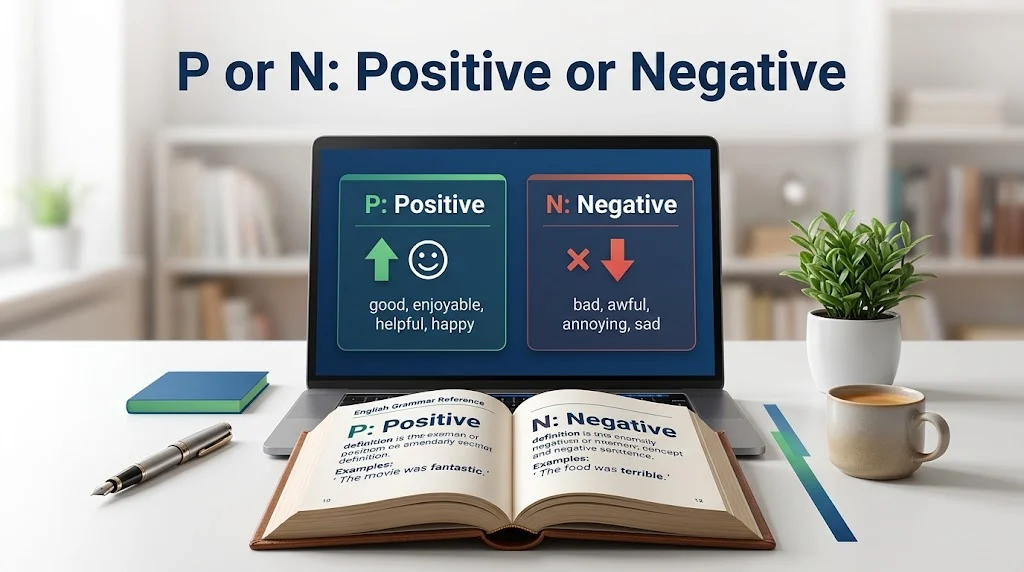
P or N is a shorthand expression for positive or negative. “Positive” can describe something favorable, affirmative, above zero, or showing the presence of something, while “negative” can describe something unfavorable, contrary, below zero, or showing absence. The correct interpretation depends on the subject and situation.
You may have seen P or N on forms, test results, surveys, technical documents, messages, or workplace communication and wondered what the letters mean. In most contexts, P stands for positive and N stands for negative, but those words can represent very different ideas depending on how they are being used.
A positive result might mean that something was detected, an answer is affirmative, or a situation is favorable. A negative result might mean that something wasn’t detected, an answer is contrary, or an outcome is unfavorable. Linguistically, the two words are broad adjectives with meanings that shift according to context.
P or N: What’s the Difference?
The main difference between positive and negative is the direction or meaning they communicate. Positive generally signals affirmation, presence, increase, benefit, or a favorable quality. Negative generally signals denial, absence, decrease, disadvantage, or an unfavorable quality.
Both words can function as adjectives, nouns, and, in some contexts, other parts of speech. Their interpretation depends heavily on the field in which they appear.
| Term | Part of speech | Common meaning | Typical use |
| Positive | Adjective, noun | Favorable, affirmative, present, above zero | Results, opinions, numbers, responses |
| Negative | Adjective, noun | Unfavorable, contrary, absent, below zero | Results, opinions, numbers, responses |
A positive response often communicates agreement or approval.
A negative response can communicate disagreement or rejection.
In mathematics, positive numbers are greater than zero.
In testing, positive and negative may indicate whether something was detected.
The important point is that positive does not always mean good, and negative does not always mean bad. Context determines the intended meaning.
Is P or N a Grammar, Vocabulary, or Usage Issue?
The difference between positive and negative is primarily a vocabulary and usage issue, although grammar determines how each word fits into a sentence.
They aren’t interchangeable because they generally communicate contrasting meanings. However, their relationship isn’t always a simple good versus bad distinction.
In casual conversation, people often use positive to mean optimistic or favorable and negative to mean pessimistic or unfavorable. In academic, scientific, and professional contexts, the meanings can become much more precise.
For example, a researcher may describe a “positive correlation” without suggesting that the relationship is morally good. Similarly, a “negative result” in a scientific context may simply mean that the tested condition wasn’t detected.
This distinction is especially important for English learners because dictionary definitions alone don’t always reveal how these terms operate in specialized contexts.
How to Use Positive Correctly
Positive is commonly used when describing something affirmative, favorable, present, increasing, or greater than zero.
Workplace Example
The manager gave positive feedback after reviewing the employee’s presentation.
Here, positive means favorable or encouraging.
Academic Example
The researchers found a positive relationship between regular practice and test performance.
In academic writing, positive describes a relationship in which one variable tends to increase as another increases.
Technology Example
The system returned a positive match for the requested search.
In technology, positive can indicate that a condition, match, or confirmation has been detected.
Usage Recap
Use positive when the context involves affirmation, favorable evaluation, presence, increase, or a value greater than zero. Always check the field because technical meanings may differ from everyday meanings.
How to Use Negative Correctly
Negative commonly describes something unfavorable, contrary, absent, decreasing, or less than zero.
Workplace Example
The company received negative feedback about the new customer service policy.
Here, negative means unfavorable or critical.
Academic Example
The study found a negative relationship between stress and sleep quality.
In this context, negative describes the direction of a relationship rather than suggesting that the study itself is bad.
Technology Example
The security system returned a negative result for the requested condition.
Here, negative can indicate that the system did not detect the specified condition.
Usage Recap
Use negative when you mean opposition, unfavorable evaluation, absence, decrease, or a value below zero. Don’t automatically interpret it as “bad,” particularly in scientific or technical writing.
When You Should NOT Use Positive or Negative
There are several situations where choosing positive or negative without considering context can create confusion.
- Don’t use positive to mean good in every situation. A positive test result may indicate the presence of something undesirable.
- Don’t use negative to mean bad in every technical context. A negative number is simply less than zero.
- Don’t describe disagreement as negative when “incorrect” is more precise. Context may require a more specific word.
- Don’t use positive when you mean approval without checking the sentence. “Affirmative” may be more accurate in formal communication.
- Don’t use negative when you mean absence in every context. Words such as “absent,” “missing,” or “undetected” may communicate the idea more clearly.
- Don’t assume a positive result is desirable. Scientific and medical contexts often use positive simply to indicate detection.
- Don’t assume a negative result is undesirable. A negative test can sometimes be a favorable outcome.
- Don’t rely on P and N without defining them in formal documents. Spell out positive and negative when readers may not know the abbreviation.
Common Mistakes and Decision Rules
| Correct sentence | Incorrect sentence | Explanation |
| The test produced a positive result. | The test produced a good result. | Positive indicates the result detected the relevant condition. |
| The company received negative feedback. | The company received bad feedback. | Negative is more neutral and appropriate in professional writing. |
| The temperature is negative five degrees. | The temperature is bad five degrees. | Negative describes a value below zero. |
| The student gave a positive response. | The student gave a negative response. | The correct word depends on whether the response was affirmative or contrary. |
| The correlation is positive. | The correlation is good. | Positive has a specific statistical meaning. |
Decision Rule Box
If you mean affirmation, favorable direction, presence, increase, or a value above zero, use “positive.”
If you mean opposition, unfavorable direction, absence, decrease, or a value below zero, use “negative.”
If the context is technical, scientific, or mathematical, use the specialized meaning rather than assuming good or bad.
P or N in Modern Technology and AI Tools
The distinction between positive and negative appears frequently in modern technology and artificial intelligence.
AI systems may classify text as having a positive or negative sentiment. A positive classification can indicate favorable language, while a negative classification can indicate unfavorable language.
Search systems, security software, diagnostic tools, and automated classification systems can also use positive and negative labels. In these environments, the terms usually represent the output of a defined classification process.
For example, a sentiment model may classify “I love this product” as positive and “I dislike this product” as negative. The labels describe the system’s classification rather than making an independent judgment about the person who wrote the statement.
Because AI systems rely heavily on classification, understanding these terms is increasingly useful for students, professionals, writers, and technology users.
The Etymology of Positive and Negative
The word positive comes through French from Latin positivus, related to the idea of something placed, established, or affirmed. Over time, its meanings expanded into ideas involving certainty, affirmation, favorable qualities, and mathematical values above zero.
Negative comes from Latin negativus, derived from negare, meaning “to deny.” Its meanings developed around denial, refusal, absence, opposition, and later mathematical values below zero.
Their historical connection explains why the words often function as conceptual opposites while still having specialized meanings in different disciplines.
An Expert View of Positive and Negative
A useful linguistic principle is that meaning comes from context rather than from a single dictionary definition.
“Positive and negative are opposites in direction or evaluation, but context determines exactly what each one means.”
This principle is particularly important when the same vocabulary appears in everyday conversation, mathematics, science, medicine, technology, and academic writing.
Case Study 1: Workplace Communication
Consider a company reviewing employee feedback after introducing a new scheduling system.
Employees may provide positive comments such as praising flexibility and convenience. Others may provide negative comments about communication problems.
If a manager reports that the survey contained “positive and negative feedback,” the statement doesn’t mean that some employees were morally good and others were bad. It simply identifies two contrasting evaluations.
The result is clearer, more professional communication because positive and negative describe the direction of the feedback rather than exaggerating it.
Case Study 2: Technology and Data Classification
Imagine an AI system analyzing customer reviews.
A review saying, “The software is fast and easy to use” may receive a positive classification. A review saying, “The application crashes frequently” may receive a negative classification.
The system uses positive and negative as classification labels. This demonstrates why the words shouldn’t always be interpreted emotionally. In data analysis, they can represent categories established by the system or researcher.
Author Expertise
This article was prepared from a language focused perspective, combining English usage, grammar, vocabulary, semantic context, and modern communication practices to clarify how positive and negative function across everyday and specialized writing.
Error Prevention Checklist
Always use Positive when
You mean affirmation or agreement.
You mean a favorable evaluation.
You mean something present or detected.
You mean an increase or upward relationship.
You mean a number greater than zero.
Never use Negative when
You actually mean approval or agreement.
You are describing a value above zero.
You mean something favorable.
You are using a technical term without checking its specific definition.
You want to describe absence when a more precise term such as “undetected” is available.
Related Grammar Confusions You Should Master
Understanding positive and negative becomes easier when you also learn other commonly confused language pairs and concepts.
- Accept vs Except
- Advice vs Advise
- Affect vs Effect
- Compliment vs Complement
- Ensure vs Insure
- Then vs Than
- Your vs You’re
- There vs Their vs They’re
- Fewer vs Less
- Further vs Farther
These distinctions show why English meaning often depends on context, grammatical function, and conventional usage.
Frequently Asked Questions About P or N
What does P or N mean?
P or N usually means positive or negative. The exact interpretation depends on the context, such as testing, mathematics, surveys, technology, or everyday communication.
Is P positive or negative?
P normally stands for positive. However, abbreviations can vary between organizations or systems, so the surrounding instructions should be checked.
Is N positive or negative?
N normally stands for negative. It can indicate opposition, absence, an unfavorable classification, or a value below zero depending on context.
What does positive mean?
Positive can mean affirmative, favorable, present, increasing, or greater than zero. Its exact meaning depends on the subject being discussed.
What does negative mean?
Negative can mean contrary, unfavorable, absent, decreasing, or less than zero. Technical fields may give the word a more specific meaning.
Does positive always mean good?
No. Positive does not always mean good. For example, a positive test result can mean that a particular condition was detected, which may not be desirable.
Does negative always mean bad?
No. Negative does not always mean bad. A negative mathematical number or a negative test result is not automatically unfavorable.
What is the difference between positive and negative?
Positive generally communicates affirmation, favorable direction, presence, increase, or a value above zero. Negative generally communicates opposition, unfavorable direction, absence, decrease, or a value below zero.
Should I write P or N in formal writing?
In formal writing, it is usually clearer to write “positive or negative” unless the abbreviation has already been defined and is commonly understood by your audience.
Conclusion
Understanding P or N means recognizing that positive and negative have broader meanings than simply good and bad. Positive can communicate affirmation, presence, favorable direction, increase, or a value above zero. Negative can communicate opposition, absence, unfavorable direction, decrease, or a value below zero.
The most reliable way to choose between them is to consider the context. Everyday conversations may use the words to describe attitudes or evaluations, while mathematics, science, academic research, and AI systems often use them as precise classification terms. Once you understand that distinction, choosing the right word becomes much easier.

Margaret Atwood is an American writer who contributes to LingRoya.com creating clear and engaging content about the English language and everyday communication. She enjoys helping readers build confidence in their writing through simple, practical guidance.