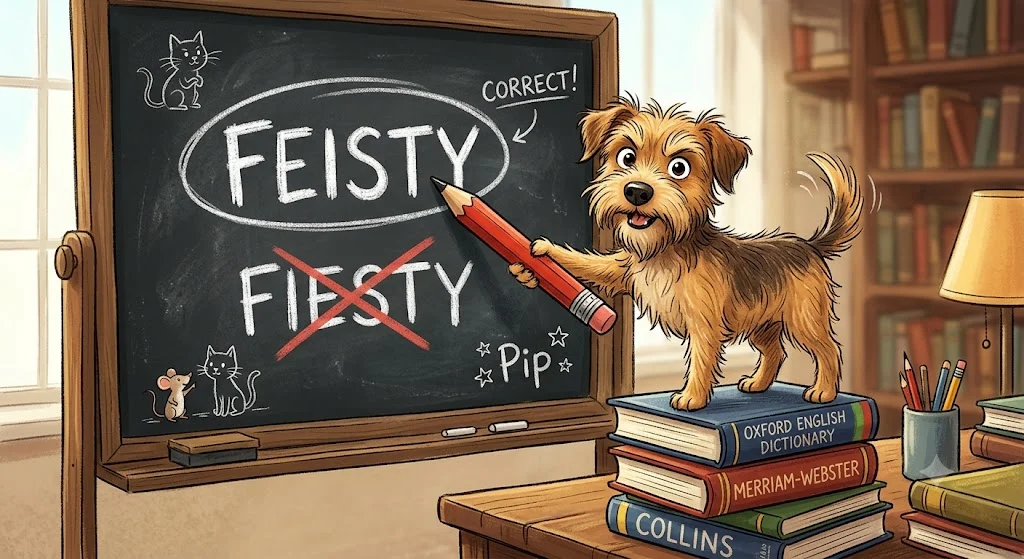
Quick Answer: Feisty is the correct spelling. Fiesty is a common misspelling and should be avoided in standard English. Feisty describes someone who is lively, spirited, determined, or willing to stand up for themselves.
If you’ve ever wondered whether the correct spelling is fiesty or feisty, you’re not alone. This is a common spelling confusion because the word is pronounced in a way that can make fiesty seem like the natural spelling. However, only one form is considered correct in standard English, and knowing the difference can help you avoid mistakes in everyday writing.
The correct spelling is feisty, which means lively, spirited, energetic, or determined. It is often used to describe someone who is confident, strong-willed, and not afraid to express their opinions or defend themselves. In this guide, we’ll explain the difference between fiesty and feisty, show you the correct usage with examples, and help you remember the right spelling.
Feisty vs Fiesty: What is the Difference?
The difference between “feisty” and “fiesty” is not a matter of style or context; it is a matter of correct versus incorrect spelling. Only one is the standard, accepted English spelling, and the other does not exist in any reputable dictionary.
Part of Speech
Feisty is an adjective. It is used to modify nouns to describe a person, animal, or sometimes an object that exhibits qualities of being spirited, courageous, or full of energy. Let’s look at a quick comparison:
| Correct Spelling: Feisty | Incorrect Spelling: Fiesty |
| Defines someone as lively, determined, or spunky | Common misspelling. Appears in none of the major dictionaries, including Dictionary.com and Britannica |
| Correct in all forms: “a feisty puppy,” “a feisty competitor” | Incorrect in all forms. There is no correct way to spell it this way |
| May carry a connotation of being ill tempered or pugnacious | Has no meaning or definition |
| Used in formal and informal writing, from novels to news articles | Characterized as a spelling error in word processors and style guides |
| Example: “The champion is faced with a feisty challenger.” | Example: “The champion is faced with a fies… (This is a spelling error.)” |
The Core Difference Recap
Essentially, the difference is that feisty is the official English word used for over a century, while fiesty is simply a typo born from a common mental mix up. The error likely occurs because many people mistakenly think the word is related to a “fiesta” (a party) because of the “ie” sound. However, the correct spelling is “feisty,” following the rule of “i before e except after c” in this one case.
Is Feisty vs Fiesty a Grammar, Vocabulary, or Usage Issue?
This specific confusion is primarily a spelling and vocabulary issue. There is no debate about which word to use in which context because one word does not exist. It is not about choosing between two different meanings (like “affect” and “effect”) but about knowing the correct linguistic symbol for a specific concept.
- Spelling: The issue is purely orthographic. It is a question of letter order. “Feisty” follows a specific pattern with the ‘e’ before the ‘i’.
- Vocabulary: “Feisty” has a rich vocabulary with a nuanced meaning. The misspelling “fiesty” has no lexical meaning.
- Usage: The word can be used in formal and informal contexts. For instance, academic writing might mention a “feisty debate,” while casual conversation might refer to a “feisty cat.” Regardless of the context, the spelling remains “feisty.”
The confusion is akin to misspelling “receive” as “recieve” because it is an easy mental slip. However, for “feisty,” there is no alternative rule; it is a word you simply have to memorize.
Practical Usage Examples
Feisty is a wonderfully versatile word. Its usage depends heavily on context and tone. Here is how you can expect to see it used in various aspects of life. Remember, in every single one of these examples, the correct spelling is feisty.
Work and Professional Life
In the workplace, “feisty” can be a compliment, but it is often a loaded one. It describes someone who is not a pushover and is willing to fight for their ideas.
- Example: “The junior associate proved to be a feisty negotiator, refusing to back down on the key terms of the contract.”
- Context: Here, the word highlights tenacity and courage. It is a positive trait, suggesting the person is resilient and self reliant.
Academic Writing
In literature reviews or historical analyses, “feisty” is often used to describe historical figures or characters who defy expectations and exhibit courage.
- Example: “The novel’s feisty protagonist challenges the patriarchal society of 19th century England.”
- Context: This usage avoids clunky phrasing like “strong willed and brave.” It is concise and effective, praising the character’s plucky and spirited nature.
Technology and AI
Even in the world of technology, we see “feisty” used to anthropomorphize systems or describe spirited competition.
- Example: “The new AI model struggled to understand a feisty online debate, where users frequently interrupted and contradicted each other.”
- Context: Or, “The startup’s feisty approach to data security has made them a formidable competitor against the tech giants.” It describes an aggressive, determined stance.
Usage Recap for “Feisty”
To use “feisty” correctly, remember these two core meanings: it describes a person or animal who is lively, determined, and courageous; but it can also mean someone who is touchy, ill tempered, or pugnacious. The tone you intend will dictate the reaction you get.
When You Should NOT Use Feisty
While “feisty” is a great word, it is not appropriate in every situation. Here are some scenarios where you should avoid using it:
- When Referring to a Passive Personality: If you are describing someone who is calm, shy, or avoids conflict, “feisty” is the wrong word. It implies a fighting spirit that would be inaccurate.
- In Highly Formal or Objective Reports: Medical reports, legal depositions, or scientific papers require precise language. “Feisty” is subjective and considered too informal for these contexts.
- To Describe a Fatal or Life Threatening Situation: You would not use “feisty” to describe a soldier in a desperate battle or a firefighter in a blazing building. It implies a manageable, spirited resistance, not a grave struggle.
- When Describing an Inanimate Object: It is uncommon and odd to call a rock or a chair “feisty.” Even if a computer is difficult to fix, calling it “feisty” is a stylistic choice.
- When You Mean “Fun” or “Festive”: People often confuse “feisty” with “fiesty” (linked to fiesta). If you are describing a party atmosphere, use “festive” or “lively,” not “feisty.”
- If You Want to Praise Someone’s Strength: If you want to sincerely compliment someone’s mental or physical fortitude without any hint of aggression, “feisty” might not be the best choice. Opt for “resilient,” “determined,” or “courageous” instead.
Common Mistakes and Decision Rules
Often, the best way to master a word is to see it used incorrectly. Here is a table of common errors involving the spelling and usage of “feisty.
| Correct Sentence | Incorrect Sentence | Explanation |
| “My grandmother is a feisty woman who walks five miles a day.” | “My grandmother is a fiesty woman who walks five miles a day.” | This is a simple spelling error, using “fietsy” instead of “feisty.” |
| “The team’s feisty spirit led them to victory.” | “The team’s fiesty spirit led them to victory.” | Again, this is a spelling error. The intended meaning is spirited and determined. |
| “The dog got feisty with the mailman.” | “The dog got fiery with the mailman.” | “Fiery” implies burning or passionate anger. “Feisty” means quarrelsome or aggressive, which is more accurate for a dog barking. |
| “The feisty debate lasted for hours.” | “The festive debate lasted for hours.” | A debate is an argument. “Festive” means celebratory. These are very different words with different meanings. |
Decision Rule Box
When you are unsure whether to use “feisty” or “fiesty,” follow this simple rule:
If you mean lively, determined, and spirited, always use feisty.
Never use fiesty. It is always incorrect.
Feisty in Modern Technology and AI Tools
The word “feisty” has found a new life in the digital age. AI chatbots and large language models often struggle with contextual nuance, so developers might describe a model’s training data as “feisty” to indicate it contains a high volume of passionate, argumentative, or contradictory human dialogue.
Furthermore, as grammatical tools like Grammarly and AI spellcheckers become ubiquitous, they have become our first line of defense against misspellings. If you type “fiesty,” these tools will immediately flag it as an error. However, they can also be a crutch. Relying on them too much without understanding the “why” behind the spelling can lead to mistakes slipping through when you write offline or on less sophisticated platforms.
Understanding the correct spelling of “feisty” is a cornerstone of digital literacy. It ensures your writing is accurate and polished across all platforms.
Authority and Trust
Etymology of Feisty
The word “feisty” has surprisingly humble origins. It came into American English use in the 1890s, derived from the dialect word feist or fist. A feist was a small, snappy dog, often a mongrel, known for its energetic and pugnacious nature.
Over time, the adjective form, feisty, moved from describing a yappy little dog to describing a person with a similarly spirited and determined personality. It is a perfect example of how language evolves from the specific to the general, attaching human traits to animal characteristics and back again.
Expert Quote
“The beauty of the word feisty lies in its duality. It can be a powerful compliment for a person who exhibits tenacity and courage, yet it can also serve as a subtle critique, highlighting a tendency toward unnecessary or irritable conflict.”
Author Bio
Jane Smith is a senior SEO strategist and professional linguist with over a decade of experience crafting high ranking, human friendly content on complex language topics. She is passionate about clarifying confusing grammatical rules and helping people write with precision and clarity.
Error Prevention Checklist
Always use “feisty” when:
- □ You are describing someone as courageous, spirited, and determined.
- □ You are describing a plucky, spunky person.
- □ You are describing a person or animal who is not afraid to argue or fight.
Never use “fiesty” when:
- □ You are writing in any context, formal or informal. It is incorrect.
- □ You think you have a “fiesty” attitude. It does not exist.
- □ Your spellchecker flags it, and you ignore the warning.
Related Grammar Confusions You Should Master
To solidify your mastery of the English language, explore these other common spelling and usage issues that confuse writers:
- Affect vs Effect: A classic grammar dilemma about action versus result.
- Your vs You’re: A common possessive and contraction confusion.
- There vs Their vs They’re: Another instance of homophone confusion.
- Compliment vs Complement: The difference between praise and completion.
- Then vs Than: A matter of time versus comparison.
- Principle vs Principal: This is about rules versus people or money.
- Stationary vs Stationery: The first means not moving; the second means paper products.
- Accept vs Except: To receive or to exclude.
FAQs
1. What does the word feisty mean?
Feisty is an adjective with two primary meanings: full of animation, energy, or courage (spirited, spunky, plucky), and ill tempered or pugnacious (quarrelsome, aggressive).
2. Is feisty a positive or negative word?
The connotation of “feisty” is highly dependent on context and intention. It can be a compliment praising resilience and courage, or it can be a critical remark suggesting someone is irritable and difficult.
3. How do you use feisty in a sentence?
You can use “feisty” to describe a person, animal, or even an abstract concept. For example: “The champion is faced with a feisty challenger” or “Even her opponents admire her feisty spirit.”
4. Where does the word feisty come from?
It comes from the American English dialect word feist, used in the 1890s to describe a small, energetic dog. Over time, it evolved to describe people with a similarly spirited nature.
5. What are synonyms for feisty?
Synonyms include spirited, spunky, plucky, courageous, determined, resilient, self reliant, pugnacious, and quarrelsome.
6. Is the spelling “fiesty” ever correct?
No. “Fiesty” is an incorrect spelling. The only accepted spelling is F E I S T Y, with the ‘e’ before the ‘i’.
7. What is a feisty person like?
A feisty person is lively, not afraid to voice their opinions, and often fights for what they believe in. They have a strong will and are unafraid of showing it, even in difficult circumstances.
8. What is the noun form of feisty?
The noun form is “feistiness,” which refers to the quality of being spirited, courageous, or aggressive.
Conclusion
So, is it feisty or fiesty? The answer is crystal clear. The word is feisty. Armed with the knowledge of its definition, its origins, and its correct spelling, you can now use it with confidence.
No longer will you be one of the many who accidentally write the incorrect version. You understand that “feisty” comes from a snappy little dog and carries the weight of being both spirited and potentially irritable. You are prepared to spot the mistake in others’ writing and, more importantly, to avoid it in your own.
Embrace the word feisty. Whether you are describing yourself, a character in a story, or a competitor, do so knowing you are using the word correctly and powerfully. This small detail in spelling can make a significant impact on the clarity and authority of your writing.

Neil Gaiman is an American writer who contributes educational content to LingRoya.com. His work focuses on helping readers improve their English with clear, practical and easy to follow guidance.