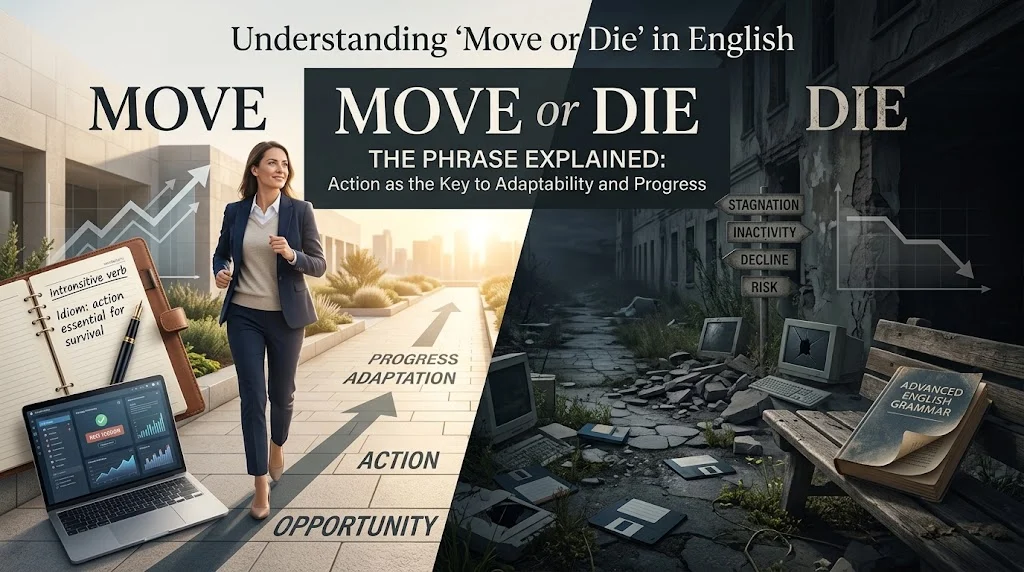
Quick Answer: Move or die is a phrase that presents movement as necessary for survival, progress, or success. Move means to change position, location, or situation, while die means to stop living or cease to function. The two words are not interchangeable, but together they create a strong expression about urgency, adaptation, and action.
Have you ever heard someone say “move or die” and wondered whether it should be taken literally? The phrase is usually figurative, meaning that a person, business, organization, or system must adapt and take action instead of remaining still. Move is a verb describing physical or figurative change, whereas die is a verb describing the end of life or, figuratively, the end of activity or usefulness.
Confusing their meanings can lead to awkward sentences or misunderstandings, especially when the phrase appears in business, sports, technology, motivational writing, or everyday conversation. Understanding move or die therefore requires more than knowing the dictionary definitions. You also need to understand context, tone, grammar, and the difference between literal and figurative language.
Move vs Die: What’s the Difference?
Although move and die are both verbs, they express completely different actions.
Move means to change position, location, condition, or situation. It can describe physical movement, such as moving a chair, or a figurative change, such as moving forward with a project.
Die means to stop living. It can also be used figuratively for something that stops operating, developing, growing, or attracting attention.
The expression move or die combines these opposite ideas to communicate urgency. It suggests that remaining inactive may lead to failure, decline, or disappearance.
Mini recap
Move describes change, action, or progress.
Die describes the end of life, activity, or function.
They have different meanings and cannot normally replace each other.
Together, they can form a powerful expression about urgency and adaptation.
Is Move vs Die a Grammar, Vocabulary, or Usage Issue?
The difference between move and die is primarily a vocabulary and usage issue rather than a difficult grammar rule. Both words function as verbs, but their meanings are fundamentally different.
They are not interchangeable. You cannot replace move with die simply because both describe actions.
For example:
The team needs to move quickly.
This means the team needs to act or change position quickly.
The team needs to die quickly.
This has an entirely different literal meaning and could sound disturbing or nonsensical depending on context.
The phrase move or die is therefore a usage question involving context and figurative meaning.
Formal and Informal Usage
The phrase can appear in both formal and informal communication, but its tone changes according to context.
In casual speech, someone might say:
“Move or die. We don’t have much time.”
In business writing, a softer alternative might be:
“Organizations must adapt or risk becoming irrelevant.”
The second version is more appropriate for formal reports because it communicates the same general idea without sounding dramatic.
Academic and Casual Usage
Academic writing generally favors precise language. If you use move or die in an essay, explain what the phrase means in the specific context.
For example:
The phrase “move or die” illustrates the pressure organizations face to adapt to technological change.
This makes the figurative meaning clear.
How to Use Move Correctly
Move can refer to physical movement, a change in location, a decision, progress, or strategic action.
Workplace Example
The marketing team needs to move quickly before the competitor launches its campaign.
Here, move means to take action.
Another example is:
She moved to a new department after receiving the promotion.
Here, it refers to a change in position within an organization.
Academic Example
The researcher moved from observation to analysis after collecting the data.
In this sentence, move describes a transition from one stage to another.
Technology Example
The company plans to move its data to a cloud based system.
Here, move describes transferring something from one environment to another.
Usage Recap
Use move when you mean physical movement, progress, transition, relocation, or action. The word can be literal or figurative, which makes it extremely versatile.
How to Use Die Correctly
Die normally refers to the end of life, but it also has several figurative uses.
Workplace Example
The project could die without additional funding.
The project is not literally alive. Die means that it may stop developing or operating.
Academic Example
Languages can die when they are no longer passed from one generation to another.
Here, die describes the disappearance of a language from active use.
Technology Example
The outdated software may die if developers stop supporting it.
Again, the meaning is figurative. The software may stop functioning or cease to be maintained.
Usage Recap
Use die when referring to the end of biological life or, figuratively, the disappearance, failure, or cessation of something.
When You Should NOT Use Move or Die
The phrase move or die is memorable, but it isn’t appropriate in every situation.
- Do not use it when discussing actual medical emergencies. A serious situation requires precise language rather than a motivational slogan.
- Do not use it in sensitive conversations about death. The expression can sound insensitive when literal death is being discussed.
- Do not use it when a neutral tone is required. Formal reports may benefit from words such as adapt, respond, change, or improve.
- Do not assume it always means physical movement. In business and technology, the phrase is often figurative.
- Do not use it simply to mean “work harder.” Its meaning is broader and usually involves movement, adaptation, or avoiding decline.
- Do not replace every use of adapt with move. The two words overlap in some contexts but are not complete synonyms.
- Do not interpret die literally when the context is figurative. A business or technology system can “die” without being alive.
- Do not use the phrase without considering your audience. Its dramatic tone may be suitable for motivational content but inappropriate in professional communication.
Common Mistakes and Decision Rules
Decision Rule Box
Use MOVE when you mean changing position, direction, condition, location, or strategy.
Use DIE when you mean the end of life, activity, development, operation, or relevance.
Use “MOVE OR DIE” when the context suggests that action or adaptation is necessary to avoid failure or decline.
This rule works better than trying to treat the two words as interchangeable alternatives.
Move or Die in Modern Technology and AI Tools
The phrase has become particularly relevant to technology because digital systems change rapidly. Businesses that fail to update products, processes, or strategies can lose relevance.
For example:
In the AI industry, companies often face a “move or die” environment.
The sentence does not suggest literal death. It means companies may need to innovate and respond to technological changes or risk falling behind.
The same idea can apply to software development, cybersecurity, digital marketing, artificial intelligence, and online publishing.
However, professional technology writing often uses more precise expressions such as adapt or decline, innovate or fall behind, or change or become obsolete.
Etymology of Move and Die
The word move has a long history connected to ideas of changing position or being influenced to take action. English received the word through Anglo French and Old French forms related to movement and changing position.
Die is an ancient Germanic word. It has cognates in several Germanic languages and has retained its fundamental connection with the end of life throughout the history of English.
The combination move or die is not a grammatical construction in which the two verbs have similar meanings. Instead, it creates a contrast between action and an undesirable consequence.
Expert Style Explanation
“The force of ‘move or die’ comes from contrast: movement represents adaptation and possibility, while death represents the final consequence of remaining unchanged.”
This explains why the expression can feel stronger than simply saying “adapt.”
Two Practical Case Studies
Case Study 1: A Traditional Retail Business
Imagine a small retailer that relies entirely on physical customers. As shopping habits change, the owner introduces online ordering, digital payments, and delivery services.
In this situation, move represents adaptation. Die can describe the figurative decline of the old business model.
The practical result is not literal survival versus death. Instead, the business moves from an outdated operating model toward a more flexible one.
Case Study 2: An Aging Technology Platform
Consider a software platform that receives no meaningful updates while competing products continue adding new features. Users gradually leave the platform.
A development team that introduces modern tools, improves performance, and responds to user needs is choosing to move. If development stops completely, the platform may eventually die in the figurative sense by becoming obsolete.
These examples demonstrate how the phrase works as a metaphor for adaptation rather than a literal statement about life and death.
Error Prevention Checklist
Always Use Move When
☑ You mean changing physical position.
☑ You mean progressing toward a goal.
☑ You mean changing a strategy or approach.
☑ You mean relocating something.
☑ You mean taking action.
Never Use Die When
☑ You simply mean physical movement.
☑ You mean transferring something from one place to another.
☑ You mean making progress.
☑ You mean changing direction.
☑ You mean beginning an action.
Use die only when the context genuinely involves the end of life or the figurative ending of activity, function, development, or relevance.
Related Grammar Confusions You Should Master
Once you understand move or die, several other commonly confused expressions are worth studying:
- Adapt or adopt
- Affect or effect
- Advice or advise
- Breathe or breath
- Lie or lay
- Lose or loose
- Further or farther
- Accept or except
- Rise or raise
- Then or than
Learning these distinctions can improve accuracy in academic, workplace, and everyday English.
Frequently Asked Questions
What does move or die mean?
Move or die means that action, change, or adaptation is necessary to avoid failure, decline, or becoming irrelevant. It is usually a figurative expression rather than a literal statement.
Is move or die a literal expression?
Usually, no. In business, sports, technology, and motivational contexts, it is generally metaphorical. It emphasizes urgency and the need to take action.
What is the difference between move and die?
Move means to change position, location, direction, or condition. Die means to stop living or, figuratively, to stop functioning, developing, or remaining relevant.
Are move and die synonyms?
No. They have completely different meanings. Move describes change or action, while die describes the end of life or activity.
Is move or die grammatically correct?
Yes. The phrase uses two verbs connected by or. Its grammatical structure is straightforward, although its appropriateness depends on context and tone.
Can move or die be used in business writing?
Yes, but it is relatively dramatic. Formal business writing may instead use expressions such as adapt or decline or innovate or fall behind when a more professional tone is preferred.
What does die mean in technology?
In technology, die can be figurative. It may describe software, platforms, services, or systems that stop operating, developing, receiving support, or attracting users.
What is another way to say move or die?
Depending on the context, alternatives include adapt or decline, change or fall behind, innovate or become obsolete, and act or risk failure.
Why is move or die so powerful?
Its impact comes from contrast. Move suggests action, progress, and adaptation, while die represents an extreme negative consequence. This creates a strong sense of urgency.
Conclusion
The phrase move or die is a powerful expression about action, adaptation, and the consequences of remaining unchanged. Move is a verb associated with physical or figurative change, while die describes the end of life or, in figurative contexts, the end of activity, development, or relevance.
The simplest rule is this: use move for action, change, progress, or movement, and use die for the end of life or the figurative end of something’s function or relevance. When the two appear together, move or die communicates a strong choice between adaptation and decline.

Philip Pullman is an American writer dedicated to creating clear and easy to follow English content. Through his work at LingRoya.com, he helps readers strengthen their language skills with practical and reliable guidance so that they can easily understand.