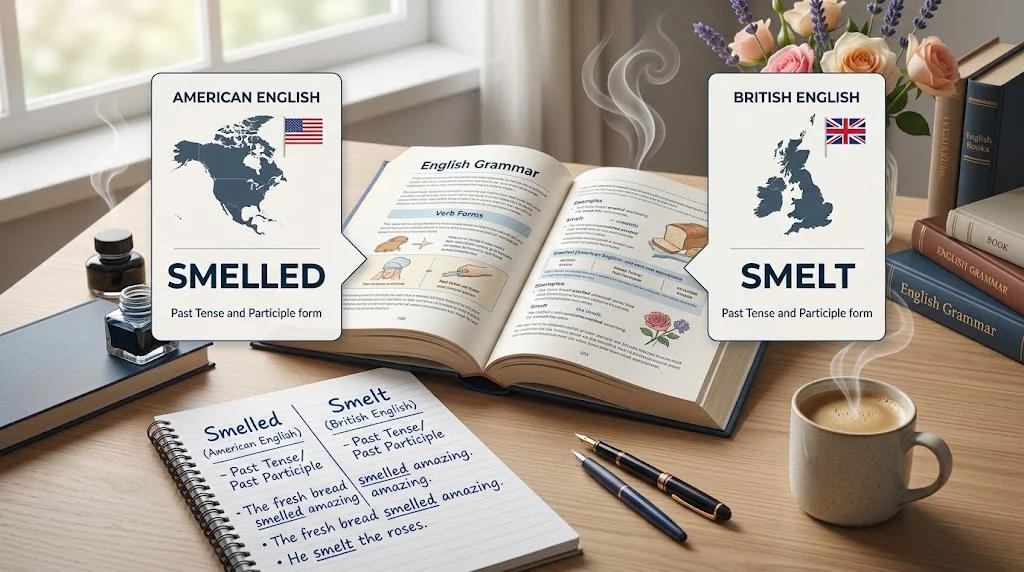
Smelled is the more common past tense and past participle in American English, while smelt is widely used in British English and some other varieties. Both can describe noticing an odor or producing an odor, so context and regional preference usually determine the better choice.
Have you ever written smelled and wondered whether smelt would be more correct? You aren’t alone. The confusion comes from the fact that English has two accepted forms of the past tense of smell, with regional preferences shaping which one readers expect. Smelled is especially common in American English, whereas smelt has a strong tradition in British English.
Understanding this small vocabulary difference can help students avoid unnecessary corrections, help writers maintain regional consistency, and make professional or academic writing sound more natural. The important point is simple: both forms are legitimate, but your choice should reflect the variety of English you’re using.
Smelled vs Smelt: What’s the Difference?
Smelled and smelt are both past tense and past participle forms of the verb smell. The verb smell can mean to notice an odor, detect something through the sense of smell, or produce a particular odor.
The key difference isn’t meaning. It is primarily a matter of regional preference.
In American English, smelled is generally the more common form. In British English, smelt is widely used alongside smelled. Other English varieties may follow either pattern depending on local conventions.
| Form | Part of speech | Basic meaning | Common usage |
| Smelled | Verb, past tense and past participle | Detected or produced an odor | Especially common in American English |
| Smelt | Verb, past tense and past participle | Detected or produced an odor | Common in British English and other varieties |
| Smell | Verb, base form | Detect or produce an odor | Used in present and infinitive constructions |
Mini Recap
Smelled and smelt have the same basic meaning.
Smelled is particularly common in American English.
Smelt is particularly common in British English.
Neither form is automatically wrong.
Regional consistency is the most useful decision rule.
Is Smelled vs Smelt a Grammar, Vocabulary, or Usage Issue?
This is primarily a usage and regional vocabulary issue rather than a difference in grammatical meaning.
Both forms can be grammatically correct when used as the past tense or past participle of smell. For example, both of these sentences can be correct:
I smelled smoke coming from the kitchen.
I smelt smoke coming from the kitchen.
The difference becomes more noticeable when you consider the intended variety of English.
American readers will generally encounter smelled more often. British readers may find smelt completely natural. In formal writing, either form can work as long as it fits the selected variety of English and is used consistently.
For academic writing, consistency matters more than choosing one form universally. If your institution, publication, or target audience follows British English, smelt may be appropriate. If the audience is primarily American, smelled is usually the safer choice.
How to Use Smelled Correctly
Smelled is the regular past tense and past participle form preferred by many American English speakers and writers.
It can describe an action in which someone detected an odor.
Workplace example:
The technician smelled gas near the equipment and reported the problem immediately.
Here, smelled means that the technician detected the odor of gas.
Academic example:
Participants smelled each sample before recording their observations.
In this sentence, smelled describes an action performed during a study or experiment.
Technology example:
The smart sensor detected an odor that the human operator had already smelled.
This example also shows that technology can detect odor without changing the grammar of the sentence.
Smelled can also describe something producing an odor.
The old refrigerator smelled unpleasant.
In this construction, the refrigerator itself is associated with an unpleasant odor.
Smelled Usage Recap
Use smelled when writing for an American English audience or when your chosen style guide prefers it. It works naturally in everyday conversation, workplace communication, academic writing, journalism, and technical contexts.
How to Use Smelt Correctly
Smelt is an established past tense and past participle form of smell. It is especially familiar in British English.
For example:
I smelt fresh bread as soon as I entered the bakery.
Here, smelt means that the speaker detected the smell of fresh bread.
Workplace example:
The engineer smelt something unusual near the electrical panel.
Academic example:
The students smelt each substance and described its characteristics.
Technology example:
The operator smelt smoke before the monitoring system issued an alert.
These sentences are grammatically sound, particularly in British English.
One important point is that smelt can have another meaning as well. It can refer to the process of extracting metal from ore. That meaning is different from the past tense of smell.
The company smelted the ore to extract the metal.
The verb smelt meaning to process metal is therefore worth distinguishing from smelt meaning the past tense of smell.
Smelt Usage Recap
Use smelt naturally when following British English conventions or another variety in which the form is common. It is not an old fashioned mistake or an incorrect spelling. It is a legitimate English form with a long history of usage.
When You Should NOT Use Smelled or Smelt
There are several situations where writers choose the wrong form or create confusion.
1. Do not use smelt simply because it looks more sophisticated
A less familiar word isn’t automatically more formal. If your audience uses American English, smelled may sound more natural.
2. Do not treat smelt as incorrect
British English commonly uses smelt as the past tense of smell. Correctness depends partly on the variety of English being used.
3. Do not switch varieties without a reason
Using American spelling throughout an article and suddenly choosing British forms can make the writing feel inconsistent.
4. Do not confuse smelt with metal processing
The verb related to metal extraction is also spelled smelt, but its meaning comes from a different verb.
5. Do not replace the present form with either past form
You should write:
I smell smoke.
Not:
I smelled smoke.
when you are describing something happening in the present.
6. Do not assume pronunciation determines spelling
English spelling and pronunciation do not always provide a simple one to one relationship. Regional pronunciation can vary as well.
7. Do not mix regional conventions in formal work without purpose
Students, researchers, and professional writers should follow the English variety required by their institution or publication.
8. Do not confuse smelt with smelled as different meanings
When both words refer to the sense of smell, their basic meaning is the same. The major distinction is regional preference.
Common Mistakes: Smelled or Smelt
| Correct sentence | Incorrect sentence | Explanation |
| I smelled smoke in the hallway. | I smellled smoke in the hallway. | Smelled has one final double letter pattern before the ending. |
| I smelt fresh coffee. | I smelted fresh coffee. | Smelt is the correct past form when referring to detecting an odor. |
| The room smelled strange. | The room smelt strange in American style. | Smelt is not grammatically impossible, but smelled is generally more natural for American English. |
| The room smelt strange. | The room smelled strange in British style. | Smelled is possible in British English, but smelt is also widely preferred. |
Decision Rule Box
If you are writing American English: choose smelled in most situations.
If you are writing British English: smelt is a natural and widely accepted choice.
If you are writing for an international audience: either can work, but consistency is essential.
If you mean metal processing: check whether you actually need smelt or the related form smelted.
Smelled and Smelt in Modern Technology and AI Tools
Modern technology has introduced new ways of discussing smell and odor detection.
Electronic noses, chemical sensors, environmental monitoring systems, and other technologies can detect compounds associated with odors. However, these developments do not change the traditional grammar of smell.
For example:
The researcher smelled the sample before the sensor analyzed it.
Here, smelled refers to human sensory perception.
By contrast:
The sensor detected the chemical compound.
Technology may detect an odor related substance, but writers should choose verbs according to what the subject actually does.
AI writing tools can also create confusion by mixing American and British English. If an AI generated document uses smelled in one paragraph and smelt in another, the problem may not be grammar. It may simply be inconsistent regional style.
For professional content, writers should establish a preferred variety of English before editing AI assisted text.
Etymology of Smell, Smelled, and Smelt
The verb smell has a long history in English and is related to older Germanic forms. Over time, English developed multiple ways of forming past tense verbs.
The form smelt follows an older pattern in which certain verbs developed past forms ending in a sound represented by t. Smelled follows the regular pattern of adding the past tense ending to the verb.
Both forms survived into modern English, with regional preferences helping shape their distribution.
This is one reason English contains pairs such as learned and learnt, spelled and spelt, and burned and burnt. The patterns aren’t always identical across regions, but they demonstrate how English can preserve alternative past tense forms.
An Expert Style Explanation
A useful way to understand this distinction is:
“When two forms share the same grammatical function and meaning, regional consistency often matters more than choosing one form as universally correct.”
In practical terms, don’t ask only, “Which word is correct?” Ask, “Which variety of English am I writing?”
That question usually resolves the problem quickly.
Two Practical Case Studies
Case Study 1: American Academic Writing
Imagine a student writing a laboratory report for an American university:
The students smelled three samples and recorded their observations.
The form smelled fits the expected American English convention. Changing it to smelt would not necessarily make the sentence grammatically wrong, but it could introduce an unnecessary British English form into an otherwise American document.
Result: The writer maintains consistent American English throughout the report.
Case Study 2: British Professional Writing
Now consider a British workplace report:
The engineer smelt smoke near the machine and immediately stopped the inspection.
Here, smelt is a natural British English choice. Replacing it with smelled would also be understood and can be grammatically acceptable, but the original form fits the regional style more closely.
Result: The report maintains a consistent British English voice.
These examples demonstrate that the practical issue is usually style consistency rather than grammatical correctness.
Error Prevention Checklist
Always use smelled when
☐ You are writing primarily in American English.
☐ Your publication follows American English conventions.
☐ Your audience expects American vocabulary and spelling.
☐ You want the most familiar American form of the past tense of smell.
Use smelt when
☐ You are following British English conventions.
☐ Your publication specifically prefers British English.
☐ Your surrounding text consistently uses British forms.
☐ You are discussing the past tense of smell in a context where smelt is the established regional choice.
Never confuse
☐ Smelt meaning detected an odor.
☐ Smelt meaning processed metal.
☐ Smelled as a past form with smell as the present form.
Related Grammar Confusions You Should Master
English learners often encounter similar regional or usage based pairs. Understanding them can make writing much more consistent.
- Spelled vs spelt
- Learned vs learnt
- Burned vs burnt
- Dreamed vs dreamt
- Leaped vs leapt
- Canceled vs cancelled
- Color vs colour
- Realize vs realise
- Traveled vs travelled
- Theater vs theatre
These examples show that English frequently offers alternative forms based on regional standards, historical development, or differences in editorial style.
Frequently Asked Questions
Is smelled or smelt correct?
Both are correct forms of the past tense and past participle of smell. Smelled is especially common in American English, while smelt is widely used in British English.
Is smelt British or American English?
Smelt is strongly associated with British English, although it can occur in other varieties. American English generally favors smelled.
Is smelled grammatically correct?
Yes. Smelled is a standard past tense and past participle form of smell and is especially common in American English.
Is smelt a proper word?
Yes. Smelt is a proper English word. It can be the past tense of smell, and it can also refer to the process of extracting metal from ore depending on context.
Should I use smelled or smelt in American English?
In American English, smelled is generally the more familiar choice. It is particularly suitable for American academic, professional, and general writing.
Should I use smelled or smelt in British English?
Both forms are possible, but smelt is a very familiar British English form. Choose according to the style of the publication and maintain consistency.
What is the past tense of smell?
Both smelled and smelt can serve as the past tense of smell. Regional usage determines which form is more common.
Is smelt more formal than smelled?
Not necessarily. Smelt is not automatically more formal. The difference is mainly associated with regional English usage rather than formality.
What is the difference between smell, smelled, and smelt?
Smell is the base form, while smelled and smelt can both be past tense or past participle forms. Their difference is primarily regional rather than semantic.
Conclusion
The choice between smelled or smelt is much simpler once you understand regional English. Both forms can correctly describe the past of smell. American English generally favors smelled, while British English commonly uses smelt. Neither should automatically be labeled wrong.
For students and professional writers, the best approach is to identify your target variety of English and remain consistent. If you’re writing for an American audience, smelled will usually feel most natural. If you’re following British English conventions, smelt is an established choice. The important thing isn’t memorizing one supposedly correct answer. It’s understanding how English actually works and choosing the form that fits your context.

Margaret Atwood is an American writer who contributes to LingRoya.com creating clear and engaging content about the English language and everyday communication. She enjoys helping readers build confidence in their writing through simple, practical guidance.