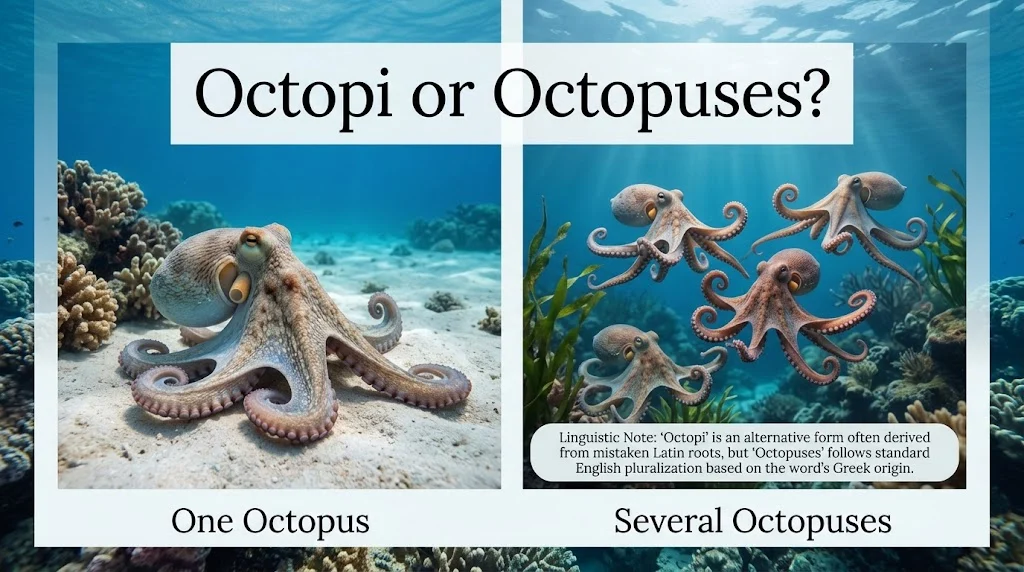
Octopi or octopuses are both used as plural forms of octopus, but octopuses is the standard English plural and the clearest choice for most writing. Octopi comes from applying a Latin plural pattern to a word that ultimately comes from Greek.
Few English plurals create as much hesitation as octopus. The confusion comes from the word’s classical history and the assumption that every word ending in us should form its plural according to Latin rules. In everyday English, however, words do not always retain the plural patterns of their original languages. Modern dictionaries recognize octopuses as a plural form, while some also recognize octopi. Cambridge Dictionary, for example, lists both forms in its American English entry and provides numerous examples of octopuses in actual English usage.
This distinction matters because writers may choose octopi believing it is automatically more grammatically correct, while others may incorrectly assume it is always wrong. Understanding the history and present day usage of these forms makes the choice much easier.
X vs Y: What’s the Difference?
Octopus
Octopus is a singular countable noun. It refers to a marine animal belonging to the cephalopod group and known for its eight arms.
Example:
The octopus disappeared beneath the rocks.
When referring to more than one, English commonly forms the plural by adding es.
Several octopuses were observed near the reef.
Octopuses
Octopuses is the regular English plural of octopus. It follows a familiar English pattern in which a noun receives an es ending.
Example:
Scientists studied several octopuses in their natural habitat.
This form is especially straightforward for general readers because it follows ordinary English plural formation.
Octopi
Octopi is an alternative plural form that developed from the idea that octopus should follow a Latin plural pattern. It is widely recognizable, and some dictionaries list it as an accepted plural. However, the classical explanation behind it is more complicated than simply saying that octopus is a Latin word with a Latin plural.
The word octopus is ultimately based on Greek elements. That history is one reason the traditional Latin style plural does not perfectly reflect the word’s actual linguistic origin.
Comparison Table
| Feature | Octopus | Octopuses | Octopi |
| Word type | Noun | Plural noun | Plural noun |
| Meaning | One octopus | More than one octopus | More than one octopus |
| Number | Singular | Plural | Plural |
| Standard modern English | Yes | Yes | Recognized alternative |
| Most straightforward plural | No | Yes | No |
| Formal writing | Correct | Preferred in most contexts | Acceptable in some contexts |
| Everyday usage | Singular | Very common | Less common |
Mini Recap
Octopus means one animal.
Octopuses is the regular English plural.
Octopi is an established alternative plural.
For clear modern English, octopuses is usually the safest choice.
Is Octopi vs Octopuses a Grammar, Vocabulary, or Usage Issue?
The difference is primarily a usage and word formation issue, rather than a simple case of one form being grammatical and the other being ungrammatical.
English has borrowed thousands of words from other languages. When those words become part of English, speakers often adapt them to English pronunciation, spelling, and plural patterns. This process explains why some borrowed words retain older plural forms while others develop regular English plurals.
In this case, octopuses follows the ordinary English tendency to create a plural with an appropriate ending. Octopi reflects an older attempt to treat the word as though it belonged to a Latin noun pattern.
Neither form causes a basic grammatical problem when used as a plural noun. The more important question is which form best suits the context.
In academic and scientific writing, clarity is often more important than displaying an unusual classical plural. In general communication, octopuses is therefore a very natural choice.
Cambridge Dictionary explicitly lists octopuses and octopi as plural forms in its American English entry, demonstrating that both forms are recognized.
How to Use Octopuses Correctly
Workplace Example
Imagine a marine research company preparing a report for a client:
The research team observed twelve octopuses during the survey.
Here, octopuses clearly communicates that the report concerns multiple animals.
Another example:
The aquarium recently received three young octopuses.
This form sounds natural in professional communication because it follows ordinary English plural formation.
Academic Example
In academic writing, clarity and consistency matter greatly:
Researchers examined how octopuses respond to changes in their environment.
The form octopuses works naturally in scientific prose and appears in published English usage. Cambridge’s corpus examples include scientific discussions that use octopuses.
Technology Example
The word can also appear in technology and artificial intelligence discussions when an octopus is used as a metaphor:
The software architecture resembles an octopus because several systems connect to a central process.
If the sentence refers to multiple systems using the metaphor, you might write:
Several platforms use octopuses as visual symbols for complex interconnected systems.
Usage Recap
Use octopuses when you want a familiar, natural, and easily understood plural in modern English.
It works well in professional documents, educational material, journalism, websites, and everyday conversation.
How to Use Octopi Correctly
Workplace Example
Octopi can appear in informal or stylistically playful workplace writing:
The design team joked that the office contained a few octopi because everyone was managing several projects at once.
The form is understandable, although octopuses would usually be more conventional in a formal document.
Academic Example
An academic writer may encounter octopi in older sources or in discussions about English word formation. It can also appear when an author deliberately discusses the traditional plural form.
For example:
The term octopi has traditionally been used as an alternative plural of octopus.
Here, the word is being discussed as a linguistic form rather than simply used to identify several animals.
Technology Example
In technology writing, octopi may occasionally be used in product names, creative metaphors, software projects, or informal technical communities.
For example:
The developers referred to the network’s many connected services as octopi.
This is stylistically possible, but it does not mean octopi is required simply because the context is technical.
Usage Recap
Octopi is recognizable and established enough to appear in English dictionaries.
However, it has a more marked or traditional feel for many readers.
When clarity and broad acceptance are the priorities, octopuses is usually the simpler choice.
When You Should NOT Use Octopi or Octopuses
There are several situations where writers can avoid the confusion altogether or choose the form more carefully.
- Do not use octopi merely because the word ends in us. English plural formation depends on the history and usage of each individual word.
- Do not assume that every classical looking plural is automatically more correct.
- Do not replace a singular noun with octopuses. One animal is an octopus.
- Do not use octopuses when you are deliberately discussing the historical or linguistic form octopi itself.
- Do not switch between the two forms randomly within the same article unless there is a specific reason.
- Do not assume that octopi is the only educated or formal option.
- Do not mark octopuses as incorrect simply because it is a regular English plural.
- Do not choose the unusual form if your audience may find it distracting or unclear.
Common Mistakes and Decision Rules
| Correct sentence | Incorrect sentence | Explanation |
| I saw three octopuses. | I saw three octopus. | A plural noun is needed. |
| The octopus moved quickly. | The octopuses moved quickly. | Use the singular when discussing one animal. |
| Several octopuses live here. | Several octopi lives here. | A plural subject requires a plural verb. |
| Researchers observed octopuses. | Researchers observed octopuseses. | Do not add an unnecessary ending. |
| The term octopi appears in some dictionaries. | The term octopi are a singular noun. | Octopi is plural, not singular. |
Decision Rule Box
If you mean one animal, use: octopus
If you mean multiple animals in standard modern English, use: octopuses
If you are referring to the recognized alternative plural, you may use: octopi
For the clearest general English choice: octopuses
Octopi and Octopuses in Modern Technology and AI Tools
Modern technology has not created a new grammatical distinction between these forms. Search engines, grammar tools, dictionaries, educational platforms, and AI writing systems may recognize both octopi and octopuses.
The important point is that recognition does not necessarily mean that both forms are equally natural in every context. A writing assistant may accept octopi because dictionaries recognize it, while an editor may prefer octopuses for consistency with contemporary general English.
AI generated text can also reproduce unusual plural forms because they occur in training data. Writers should therefore judge the form according to context rather than assuming that an automated suggestion is automatically the preferred style.
Etymology: Where Did Octopus Come From?
The history of octopus explains much of the confusion.
The word is built from Greek elements associated with the meanings of eight and foot. The animal’s name therefore reflects its physical structure. English adopted the term through scientific and learned usage.
The important point is that octopus is not simply an ordinary Latin noun that must follow a Latin plural rule. The word has Greek roots, while its English plural history has developed through actual English usage.
That makes octopi an interesting example of what happens when speakers apply a familiar classical pattern to a borrowed word.
Cambridge Dictionary recognizes both octopuses and octopi in its American English entry, while its English corpus includes examples of octopuses in scientific contexts.
An Expert Style Principle
A useful principle for editors and language learners is:
When a borrowed word has more than one established plural, choose the form that best matches modern usage, audience, and clarity.
This principle explains why octopuses is often the practical choice even though octopi remains recognizable.
Two Practical Case Studies
Case Study One: The Student Essay
Consider a student writing:
Marine biologists studied several octopi near the coastline.
The sentence is understandable, and the plural form is recognized. However, changing it to:
Marine biologists studied several octopuses near the coastline.
makes the wording more immediately familiar to a broad English speaking audience.
The practical result is greater consistency with contemporary general usage and less distraction from the student’s scientific point.
Case Study Two: The Educational Website
Imagine an educational website explaining marine animals to young English learners. The page repeatedly uses octopi.
A content editor changes the wording to octopuses throughout the lesson. The meaning does not change, but the plural now follows a familiar English pattern that learners can connect with other regular plural forms.
The concrete editorial result is a simpler teaching example: one octopus, several octopuses.
These examples are illustrative editing cases rather than reports of a specific published study.
Error Prevention Checklist
Always use octopus when:
- You mean one animal.
- The noun follows a singular determiner such as an or the when referring to one animal.
- You are describing a single species member.
Always consider octopuses when:
- You mean two or more animals.
- You are writing for a general audience.
- You want the most straightforward modern English plural.
- You are preparing educational or professional content.
- You want to avoid unnecessary classical word formation.
Never use octopi when:
- You believe it is mandatory simply because octopus ends in us.
- Your style guide specifically requires octopuses.
- You are correcting someone who used octopuses as though it were automatically wrong.
Related Grammar Confusions You Should Master
Understanding octopus and its plural also opens the door to other English word formation questions. Writers and English learners should study these commonly confused forms:
- Cactus or cactuses
- Focus or foci
- Fungus or fungi
- Formula or formulae
- Indexes or indices
- Appendix or appendices
- Criterion or criteria
- Phenomenon or phenomena
- Datum or data
- Medium or media
These examples demonstrate an important fact about English: borrowed words can preserve traditional plural patterns, develop regular English plurals, or allow both.
Frequently Asked Questions
What is the correct plural of octopus?
The most straightforward modern English plural is octopuses. Octopi is also a recognized alternative plural in some dictionaries.
Is octopi grammatically correct?
Yes, octopi is a recognized plural form in English, although it is not necessary to use it. Octopuses is a regular and widely understandable English plural.
Is octopuses more correct than octopi?
Rather than treating one as absolutely grammatical and the other as absolutely incorrect, it is more accurate to describe octopuses as the straightforward modern English plural and octopi as an established alternative.
Why do people say octopi instead of octopuses?
The form octopi developed from applying a Latin style plural pattern to octopus. The word itself has Greek roots, which makes the simple Latin explanation misleading.
Can I use octopi in academic writing?
You can encounter octopi in academic and formal writing, but octopuses is often the clearer choice for a broad contemporary audience.
What is the singular of octopi?
The singular form is octopus. Octopi refers to more than one octopus.
Is octopuses accepted in English?
Yes. Octopuses is an established English plural and is widely used in dictionaries and English language sources. Cambridge provides examples of the form in its English corpus.
Why is octopuses considered a normal English plural?
English commonly forms plurals by adding an appropriate plural ending. Octopuses follows this modern English approach rather than attempting to preserve a classical plural pattern.
Conclusion
When choosing between octopi or octopuses, the safest general answer is octopuses. It is the regular English plural and is easy for modern readers to understand. Octopi is also recognized and remains common enough to be familiar, but its formation comes from a traditional Latin style pattern applied to a word with Greek roots.
For everyday communication, professional writing, educational content, and most modern articles, octopuses provides a clear and natural choice. If you encounter octopi, however, there is no need to assume that the writer has made a grammatical error. Both forms have a place in English, but context and audience should guide the final choice.

Neil Gaiman is an American writer who contributes educational content to LingRoya.com. His work focuses on helping readers improve their English with clear, practical and easy to follow guidance.