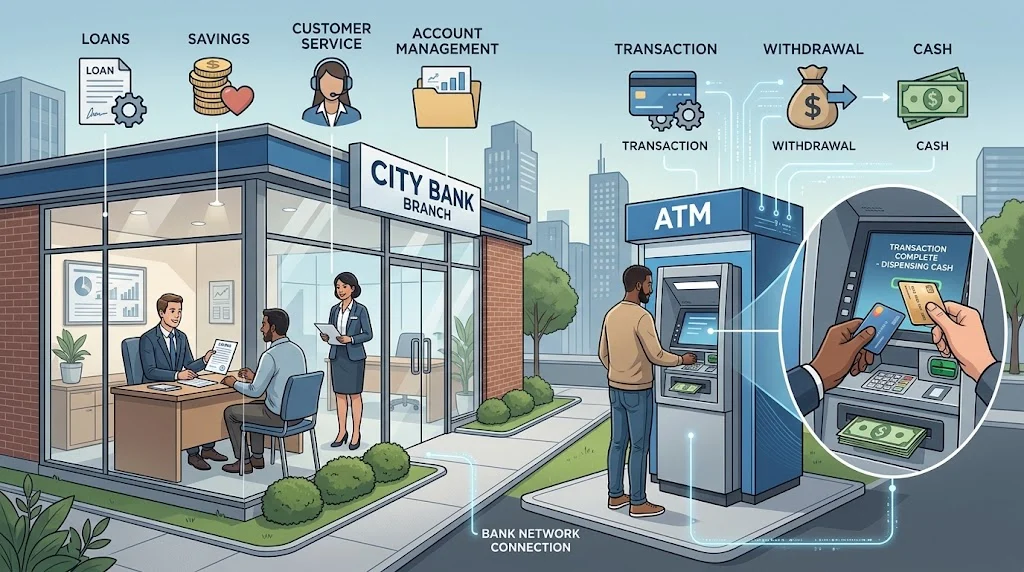
Quick Answer: A bank is a financial institution that provides a wide range of services, including accounts, loans, deposits, transfers, and customer support. An ATM is a self service machine used for tasks such as withdrawing cash, checking balances, and sometimes making deposits.
When you need cash, check your balance, or solve a banking problem, knowing whether to visit a bank or use an ATM can save time and prevent unnecessary mistakes. A bank is an institution that manages financial accounts and provides services through employees, branches, websites, and apps, while an ATM is a machine designed to perform selected banking transactions automatically.
The confusion matters because an ATM cannot handle every service a bank provides. Understanding the difference between bank or atm starts with recognizing that one is a financial institution and the other is a self service banking device. This guide explains the distinction in practical, everyday terms so you can choose the right option confidently.
Bank vs ATM: What’s the Difference?
The most important distinction is simple: a bank is an institution, while an ATM is a machine that provides limited banking services.
| Feature | Bank | ATM |
| Part of speech | Noun | Noun |
| Basic meaning | Financial institution | Automated banking machine |
| Main purpose | Provides comprehensive financial services | Provides selected self service transactions |
| Cash withdrawal | Yes | Yes |
| Deposits | Yes | Often, depending on the machine |
| Account opening | Yes | Generally no |
| Loans | Yes | No |
| Financial advice | Yes | No |
| Customer service | Yes | No |
| Cash availability | Depends on branch hours and services | Often available beyond branch hours |
| Identification | Staff may request identification | Usually requires a card and PIN or another approved method |
Mini Recap
A bank is the organization that provides financial services.
An ATM is a machine connected to a banking network.
An ATM can perform only certain transactions.
For complex financial needs, a bank branch, website, app, or customer service channel is usually more appropriate.
Is Bank vs ATM a Grammar, Vocabulary, or Usage Issue?
This distinction is primarily a vocabulary and usage issue, rather than a grammar problem.
Both bank and ATM are nouns, but they refer to completely different things.
The word bank can refer to a financial institution where people maintain accounts, borrow money, deposit funds, transfer money, and receive assistance. It can also have other meanings in English, such as the side of a river or a place where something is stored. Context determines which meaning applies.
ATM stands for Automated Teller Machine. It is a physical device that allows customers to perform selected banking tasks without speaking directly with a bank employee.
The two terms aren’t interchangeable.
In casual conversation, people sometimes say things such as “I’m going to the bank” when they actually mean they are going to an ATM located outside a bank. That usage can be understandable because the ATM may be physically associated with the bank, but the terms still have different meanings.
In academic and professional writing, precision is more important. If you’re describing a cash withdrawal machine, ATM is the more accurate term. If you’re referring to the institution providing financial services, bank is appropriate.
When Should You Go to a Bank?
A bank is the better choice when your needs involve services, decisions, documentation, or assistance that an automated machine cannot provide.
For example, imagine a workplace situation in which an employee needs to open a business account. An ATM cannot perform that task. The employee may need to communicate with bank staff, submit documentation, discuss account requirements, and complete verification.
A bank is also appropriate when you need to discuss a loan. Loan applications can involve financial records, eligibility requirements, repayment terms, and other information that cannot normally be handled through an ATM.
Workplace Example
“The company representative visited the bank to discuss opening a business account.”
Here, bank refers to the financial institution and its employees or services.
Academic Example
“The study examined how banks provide credit to small businesses.”
In this sentence, bank refers to financial institutions as part of an economic system.
Technology Example
“The bank’s mobile application allows customers to transfer money without visiting a branch.”
The institution remains the bank even when its services are delivered digitally.
Usage Recap for Bank
Use bank when referring to the financial institution.
Choose bank when you need professional assistance, account services, loans, documentation, or broader financial support.
A bank can provide services through branches and digital platforms.
When Should You Use an ATM?
An ATM is useful when you need a quick, routine transaction that the machine is designed to handle.
The most familiar ATM function is cash withdrawal. Insert or tap an eligible card, authenticate yourself, select the transaction, and receive cash if the transaction is approved.
Many modern ATMs can also provide account balances, transaction histories, cash deposits, and other services. However, available features vary by institution and machine.
Workplace Example
“I stopped at an ATM before going to the office because I needed cash for a business expense.”
The machine is being used for a straightforward cash withdrawal.
Academic Example
“Researchers surveyed consumers about their use of ATMs for routine banking transactions.”
Here, ATM refers specifically to the self service technology.
Technology Example
“The ATM uses encrypted communication to process transactions through the banking network.”
In this context, the machine itself is the subject.
Usage Recap for ATM
Use ATM when you mean the automated machine.
ATMs are ideal for routine transactions.
Their functions are limited compared with the complete range of banking services.
Available features can differ between machines and financial institutions.
When You Should NOT Use Bank or ATM
Knowing what not to say can make the distinction much easier.
1. Don’t call every banking service an ATM
An ATM is only one channel through which certain banking transactions can occur. A mortgage consultation, for example, is not an ATM service.
2. Don’t call the machine a bank
Saying “The bank gave me cash” can be perfectly natural when you’re talking about the institution generally. But if you’re identifying the specific machine, ATM is more precise.
3. Don’t use ATM for online banking
A mobile banking application and an ATM are different forms of technology.
4. Don’t assume every ATM offers deposits
Some machines accept deposits, while others don’t. Never assume that an ATM provides a particular service without checking.
5. Don’t use bank when the machine is the focus
If you’re explaining how a customer withdraws cash from a machine, ATM is the more precise word.
6. Don’t use ATM when discussing financial institutions
A sentence about interest rates offered by financial institutions should refer to banks or other relevant institutions, not ATMs.
7. Don’t assume an ATM can solve account problems
A declined transaction, frozen account, disputed charge, or identity verification issue may require customer service.
8. Don’t confuse physical location with institutional identity
An ATM may be located inside or outside a bank branch, but its physical location doesn’t change what it is.
Common Mistakes and Decision Rules
| Correct sentence | Incorrect sentence | Explanation |
| I went to the bank to apply for a loan. | I went to the ATM to apply for a loan. | Loan applications require services beyond normal ATM functions. |
| I withdrew cash from the ATM. | I withdrew cash from the bank machine institution. | ATM is the natural term for the machine. |
| The bank manages my savings account. | The ATM manages my savings account. | The financial institution maintains the account. |
| The ATM displayed my balance. | The bank machine displayed my balance. | ATM is the standard concise term. |
| I contacted the bank about the disputed transaction. | I contacted the ATM about the disputed transaction. | An ATM cannot provide customer support. |
| The bank opened a new branch. | The ATM opened a new branch. | A bank can operate branches. An ATM cannot. |
Decision Rule Box
If you mean the financial institution, use bank.
When you mean the automated machine, use ATM.
If you need professional assistance, account management, lending, or advice, think bank.
If you need a routine self service transaction, think ATM.
Bank and ATM in Modern Technology and AI Tools
Banking has changed dramatically through digital technology. Customers can now check balances, transfer money, deposit checks, pay bills, and communicate with financial institutions without physically entering a branch.
ATMs have also evolved. Modern machines may use contactless technology, biometric authentication, cardless withdrawal systems, touchscreen interfaces, and advanced security features.
Artificial intelligence is increasingly used behind the scenes in banking. Financial institutions can use automated systems for fraud detection, customer support, transaction monitoring, personalization, and risk analysis. However, an AI banking assistant is not itself a bank, and an ATM remains a physical self service device even when sophisticated software controls its operation.
This distinction is useful when writing about financial technology because different systems perform different roles.
Etymology and Origin of the Terms
The word bank has a long history. Its financial sense is associated with the Italian word banco, referring to a bench or counter used by money changers. Over time, the word developed into its modern financial meaning.
ATM is very different. It is an acronym formed from Automated Teller Machine. The term describes a machine that automates selected tasks traditionally performed by a teller.
Understanding these origins reinforces the central distinction. Bank identifies an institution, while ATM identifies a technological device.
Two Practical Case Studies
Case Study 1: Cash Withdrawal
Imagine a customer who needs cash before attending an event. They already have a functioning debit card and know their PIN.
Visiting a full bank branch may be unnecessary. An ATM can usually handle the withdrawal quickly.
Result: The ATM is the more efficient option because the customer needs a simple self service transaction rather than professional assistance.
Case Study 2: Account Problem
Now imagine another customer whose account contains an unfamiliar transaction. They need to understand what happened and possibly dispute the charge.
An ATM isn’t designed for detailed account investigations or customer support.
Result: Contacting the bank is the appropriate choice because the issue requires institutional assistance rather than a routine machine transaction.
These cases demonstrate that the right term depends not only on location but also on the service required.
Expert Perspective on Clear Financial Language
“Precise financial language begins with identifying whether you mean the institution, the technology, or the transaction.”
This distinction matters because financial writing needs clarity. Confusing an institution with one of its service channels can make instructions ambiguous, especially for customers who are learning how banking works.
Error Prevention Checklist
Always use Bank when
- Referring to a financial institution.
- Discussing loans or credit.
- Talking about account management.
- Referring to bank employees or customer support.
- Discussing financial products.
- Describing the institution’s policies or services.
Never use ATM when
- You mean the entire financial institution.
- You are discussing a loan application.
- You are referring to bank employees.
- You are discussing customer support.
- You are describing financial advice.
- You are referring to an institution’s overall operations.
Always use ATM when
- Referring specifically to the automated machine.
- Discussing cash withdrawal from a machine.
- Explaining machine based account access.
- Describing ATM technology or security.
Related Grammar Confusions You Should Master
Building strong vocabulary involves learning other commonly confused terms as well. Consider these distinctions:
- Bank or branch
- Loan or borrow
- Lend or borrow
- Deposit or withdraw
- Debit or credit
- Account or balance
- Cash or currency
- Affect or effect
- Advice or advise
- Practice or practise
These pairs aren’t all identical in structure, but each demonstrates why precise word choice matters.
Frequently Asked Questions
What is the difference between a bank and an ATM?
A bank is a financial institution that provides services such as accounts, loans, deposits, transfers, and customer support. An ATM is a machine that provides selected automated banking services, particularly cash withdrawals.
Is an ATM considered a bank?
No. An ATM is not a bank. It is a machine operated by or connected to a financial institution that allows customers to perform certain banking transactions.
What can you do at a bank that you cannot do at an ATM?
Depending on the institution, a bank can provide services such as account opening, loan assistance, financial advice, complex transaction support, identity verification, and customer service that an ATM generally cannot provide.
What does ATM stand for?
ATM stands for Automated Teller Machine. It is an electronic machine that allows customers to perform selected banking transactions without direct assistance from a teller.
Is it correct to say I am going to the bank when I am only using an ATM?
Yes, this can be natural in everyday conversation if the ATM is associated with the bank. However, if you specifically mean the machine, saying “I am going to the ATM” is more precise.
Is an ATM part of a bank?
An ATM can be owned or operated by a bank, but the machine itself is not the bank. It is one channel through which certain banking services are delivered.
Conclusion
The difference between bank or atm is ultimately a difference between an institution and a machine. A bank provides a broad range of financial services, while an ATM handles selected transactions through automated self service technology. If you need cash quickly, an ATM may be the easiest option.
If you need a loan, account assistance, financial advice, or help with a complicated transaction, the bank is the appropriate choice. Once you connect bank with the institution and ATM with the machine, the distinction becomes easy to remember and much harder to misuse.

Philip Pullman is an American writer dedicated to creating clear and easy to follow English content. Through his work at LingRoya.com, he helps readers strengthen their language skills with practical and reliable guidance so that they can easily understand.