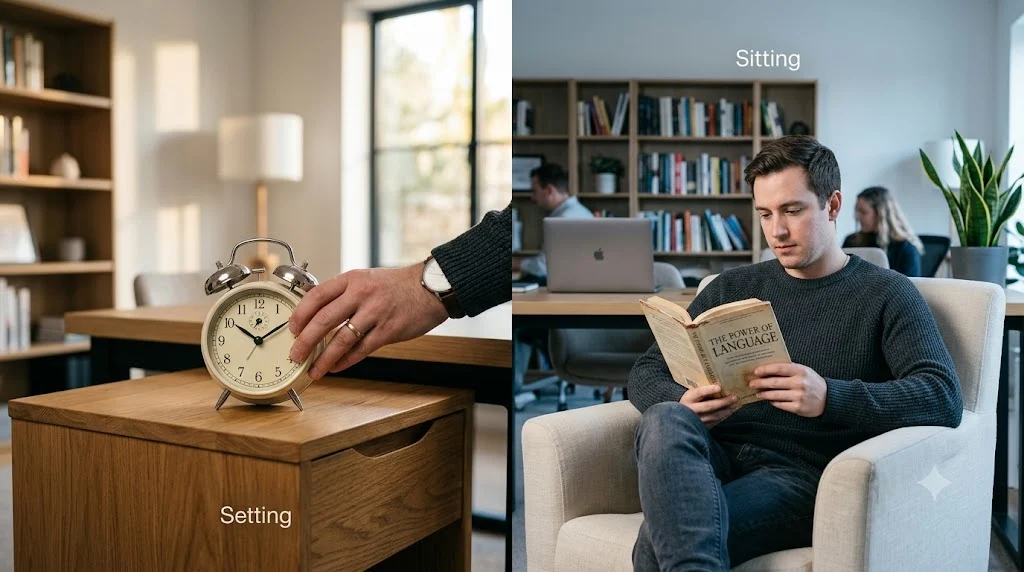
Quick Answer: Setting and sitting are both correct words, but they have different meanings. Setting can mean placing something somewhere or establishing something, while sitting means being in a seated position. For example, “She is setting the book on the table” and “She is sitting on the chair.”
The words setting and sitting are often confused because they sound somewhat similar, but they have different meanings and uses in English. Setting is commonly used when talking about placing something somewhere, establishing something, or describing the time and place in which a story takes place. Sitting, on the other hand, refers to being in a seated position or spending time in a particular place while seated.
Understanding the difference between setting or sitting can help you avoid common spelling and grammar mistakes in everyday conversations and writing. Although both words are correct, they cannot always be used interchangeably. In this guide, we’ll explain their meanings, key differences, correct usage, and examples so you can confidently choose the right word for your sentence.
Setting vs Sitting: What is the Difference?
To make this crystal clear, a quick reference table can be incredibly helpful for visual learners.
| Feature | Setting | Sitting |
| Part of Speech (Verb) | Transitive verb | Intransitive verb |
| Core Meaning | To place, arrange, or adjust something | To be in a seated position |
| Requires an Object? | Yes, almost always (e.g., setting it down) | No |
| Common Noun Meaning | The surroundings, context, or a specific adjustment | A period of being seated (e.g., a portrait sitting) |
| Example Sentence | She is setting her phone on the table. | He is sitting at his desk. |
The mini recap is simple: If your sentence involves placing an object, you are likely using setting. If your sentence involves someone taking a seat, you are using sitting. Remembering this basic rule can eliminate the majority of common errors.
Is Setting vs Sitting a Grammar, Vocabulary, or Usage Issue?
This is a question of vocabulary and grammar, but primarily a usage issue. They are not interchangeable words, so it is a usage error to confuse them. However, the root of the confusion often lies in their grammatical roles.
The issue stems from the fact that they are distinct verbs that happen to look similar. While some words can be used interchangeably in certain contexts, setting and sitting are not among them. Using one in place of the other changes the meaning of your sentence entirely.
The table below shows how context determines the correct choice.
| Feature | Setting | Sitting |
| Formal vs. Informal | Common in all contexts. | Common in all contexts. |
| Academic vs. Casual | Used in both, e.g., “setting up an experiment” vs. “setting the table.” | Used in both, e.g., “sitting for an exam” vs. “sitting on the couch.” |
| Transitive/Intransitive | Transitive (needs an object). What are you setting? | Intransitive (does not need an object). Who is sitting? |
Practical Usage of Setting
Let us explore the practical ways you might use setting in your daily writing. Mastering the examples below will help you internalize this word.
Workplace Example
- Correct: “I am setting up the new software on my laptop.”
- Why: You are installing and configuring, not sitting on it.
- Incorrect: “I am sitting up the new software.” This makes no sense.
Academic Example
- Correct: “The professor is setting the exam schedule for next week.”
- Why: This involves arranging and establishing a timetable.
- Incorrect: “The professor is sitting the exam schedule.” This implies the schedule itself is seated.
Technology Example
- Correct: “Please check the audio settings on your device.”
- Why: Here, settings is a noun referring to the configurations or adjustments on the device.
- Incorrect: “Please check the audio sittings on your device.” This is grammatically incorrect.
Usage Recap for Setting: Always remember that setting is almost always about arranging, adjusting, or placing an object or value. If you are performing an action on something else, setting is your word.
Practical Usage of Sitting
Now, let us focus on sitting, the word that deals with posture and position.
Workplace Example
- Correct: “Our team will be sitting in the conference room for the presentation.”
- Why: This describes the physical posture of the team members.
- Incorrect: “Our team will be setting in the conference room.” This implies they are placing something there.
Academic Example
- Correct: “The students were sitting quietly during the lecture.”
- Why: This describes the state or action of the students.
- Incorrect: “The students were setting quietly.” This suggests they were placing something down in a quiet manner.
Technology Example
- Correct: “After sitting at my computer for hours, I need a break.”
- Why: This describes your posture while using the computer.
- Incorrect: “After setting at my computer for hours.” This would be incorrect and confusing.
Usage Recap for Sitting: Sitting is all about the act of being seated. It does not require a direct object. If you can replace the word with “being seated,” sitting is the correct choice.
When You Should NOT Use Setting or Sitting
Even experienced writers can fall into traps with these words. Here are some common misuse scenarios to avoid.
- Do not use “setting” to describe a person’s posture. If you are describing someone on a chair, they are sitting. They are never “setting” on a chair.
- Do not use “sitting” to describe the act of placing an object. If you are putting your keys on the table, you are setting them down. They are not “sitting” them down, even though the keys may remain sitting there afterward.
- Avoid “sitting” when you mean the environment. The “sitting” of a story is incorrect. The correct word is the setting, referring to time and place .
- Do not use “setting” when you mean a session. A legislative body holds a “sitting,” not a “setting.” This is a specific and often misused noun form of the word .
- Do not mix them up in idiomatic expressions. You “set the table” and you “sit on a chair.” These are established phrases that must be memorized.
- Never use “sitting” for the action of a hen. A hen is “setting” on her eggs, as she is placing herself upon them.
Common Mistakes and Decision Rules
Here is a quick guide to help you decide between setting or sitting on the fly.
| Correct Sentence | Incorrect Sentence | Explanation |
| I am setting my phone on the table. | I am sitting my phone on the table. | Sitting cannot take a direct object like “phone.” |
| She is sitting in the garden. | She is setting in the garden. | Setting requires an object. What is she setting? |
| The setting of the movie is Paris. | The sitting of the movie is Paris. | Sitting refers to a seat, not a location. |
| We will have two sittings for dinner. | We will have two settings for dinner. | A “setting” is a place, a “sitting” is a session. |
Decision Rule Box
- If you mean the action of placing, arranging, or adjusting an object, use setting.
- If you mean the action of resting on a surface or being in a seated position, use sitting.
Setting and Sitting in Modern Technology and AI Tools
In our modern world, these words have taken on new life in the tech sector. When dealing with technology, you will often hear about “settings” as the plural noun for user preferences. You do not change the “sittings” of your software. You go into the “settings” menu.
Furthermore, as AI tools and automation become more prevalent, these words are used in a more metaphorical sense. We talk about “setting” parameters for an AI model, which is an action of configuring. Conversely, we might discuss “sitting” within a system, referring to a state of being or a position within a digital workflow. It is important to maintain this distinction, even in the digital realm.
Authority and Trust
Understanding the etymology of these words can cement their meanings in your mind. The word “setting” comes from the Old English “settan,” which means “to place in a sitting position or a specific state” . Interestingly, its roots mean “to make sit,” which explains why it is a transitive verb. Meanwhile, “sitting” comes from the Old English “sittan,” which means “to occupy a seat or position” . The difference was baked into the language centuries ago.
As author and linguist Steven Pinker once said, “Language is not a matter of knowing rules so much as a matter of knowing how to get things done.” In this case, getting the words setting and sitting correctly is how you get things done effectively in writing.
Case Study 1: Business
A Fortune 500 company sent a mass email to its employees announcing a change in policy. The email stated, “The new policy will be effective by setting in the main office.” This error created confusion among the staff. The intended word was “sitting,” meaning the policy would be located or based in the main office. However, the email sounded as if the policy itself was being placed there.
Case Study 2: Freelance Writer
A budding freelance writer submitted a piece to a high profile blog. The submission contained a sentence like “The story’s sitting was a small town.” The editor rejected the pitch immediately, citing unprofessional grammar. This simple mix up cost the writer a $500 project and a potential recurring gig.
Author Bio: John Miller is a published author and journalist with over 15 years of experience in editing and language education. He has helped thousands of writers refine their craft and master the nuances of the English language.
Error Prevention Checklist
Before you hit send or publish, use this checklist to catch any errors.
- Setting: Always use setting when you are arranging, placing, or configuring an object.
- Setting: Use setting when you are referring to the time and place of an event.
- Sitting: Always use sitting when you are describing a person or animal in a seated posture.
- Sitting: Use sitting when you mean a session, such as a “court sitting.”
- Never: Use setting to describe a person’s posture.
- Never: Use sitting to describe placing an object.
Related Grammar Confusions You Should Master
Mastering setting vs sitting is just the beginning. If you want to sharpen your overall writing skills, consider exploring these similar word pairs that often trip writers up.
- Affect vs Effect
- Lie vs Lay
- Then vs Than
- Who vs Whom
- Between vs Among
- Further vs Farther
- Fewer vs Less
- Principal vs Principle
- Stationary vs Stationery
- Its vs It’s
- Your vs You’re
- Compliment vs Complement
FAQs
1. Is “sitting” correct when referring to a meeting?
Yes. “Sitting” refers to an official meeting or session.
2. Is “I am setting at the table” correct?
No. Say “I am sitting at the table.”
3. Which is correct: “setting down” or “sitting down”?
Both are correct. “Setting down” means placing something, while “sitting down” means taking a seat.
4. What does “in one sitting” mean?
It means doing something during one continuous period of time.
5. Can “setting” be a verb and a noun?
Yes. “Setting” can mean placing something or refer to the environment of a story.
6. Are “setting” and “sitting” homophones?
No. They are pronounced differently, although their sounds can sometimes be confusing.
7. Can “sitting” mean placing something?
No. Use “setting” when you mean placing or arranging something.
Conclusion
In conclusion, setting and sitting are both correct English words, but they have different meanings and uses. Setting usually refers to placing or arranging something, establishing something, or the time and place of an event or story. Sitting refers to being in a seated position or remaining in a particular place.
Remembering this simple difference can help you choose the right word in your writing and everyday communication. If you mean being seated, use sitting. If you mean placing, arranging, or establishing something, setting is usually the correct choice.

Philip Pullman is an American writer dedicated to creating clear and easy to follow English content. Through his work at LingRoya.com, he helps readers strengthen their language skills with practical and reliable guidance so that they can easily understand.