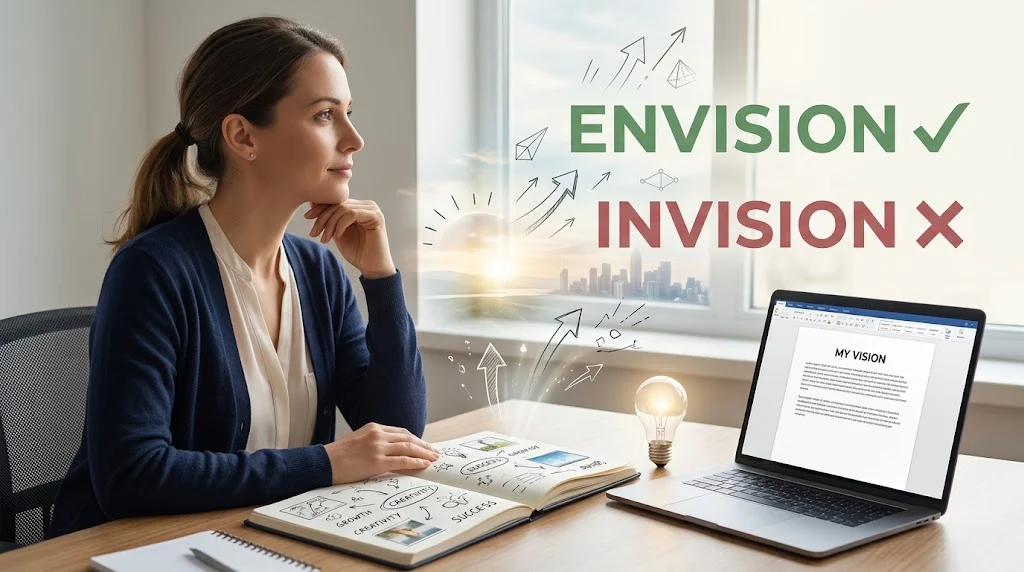
Envision is the correct standard English word when you mean to imagine, visualize, or form a mental picture of something. Invision is not generally accepted as a standard English verb with this meaning, although it appears as a proper name and in brand names.
Have you ever wondered whether to write invision or envision in an email, essay, or professional document? Although the two spellings look similar, they aren’t interchangeable in standard English. Envision means to imagine a future possibility or picture something in your mind, while invision is usually a misspelling when used with that meaning. As an English usage principle, choosing the established spelling makes your writing clearer and more credible. Whether you’re describing career goals, planning a project, or discussing future technology, understanding when to use envision will help you avoid a common spelling mistake.
Invision vs Envision: What’s the Difference?
The main difference between invision and envision is that envision is a standard English verb, while invision is generally a nonstandard spelling when used to mean imagine or visualize.
| Feature | Envision | Invision |
|---|---|---|
| Part of speech | Verb | Not generally a standard verb in this sense |
| Standard English status | Correct and widely accepted | Usually a misspelling |
| Meaning | To imagine or visualize something | No established general meaning equivalent to envision |
| Example | I envision a successful future. | I invision a successful future. |
| Formal writing | Appropriate | Avoid as a substitute for envision |
| Academic writing | Accepted | Usually considered a spelling error |
| Brand usage | Can appear in names | May appear as a proper name or brand |
Quick Recap
- Envision is the correct spelling when you mean imagine or visualize.
- Invision is usually a spelling mistake in ordinary sentences.
- Envision works in professional, academic, and casual writing.
- A proper name or brand may legitimately use Invision.
- Remember the initial letter e in envision.
What Does Envision Mean?
Envision is a verb meaning to imagine something that may happen in the future or to form a mental picture of a person, place, event, or situation.
The word often appears when people discuss plans, ambitions, possibilities, and expected outcomes. It can describe a personal dream or a practical plan for an organization.
Examples:
- I envision a future where everyone has access to quality education.
- The architect envisions a modern home with large windows.
- Our team envisions a more efficient way to serve customers.
In each example, envision communicates an idea that someone pictures mentally.
The word is particularly useful when you want to express more than a simple wish. It can suggest that you’re imagining a particular outcome or considering what something could become.
For instance, “I want a better career” expresses a desire. “I envision a career that combines creativity and leadership” presents a clearer picture of that ambition.
What Does Invision Mean?
Invision is not the standard spelling of the verb envision in contemporary general English. If you want to describe imagining a possibility, you should normally write envision.
For example:
Incorrect: I invision myself working as a successful writer.
Correct: I envision myself working as a successful writer.
The incorrect version may appear in informal messages, online searches, or drafts written without proofreading. However, frequent online use doesn’t automatically make a spelling standard.
There is one important exception. InVision has been used as a brand name for a digital product design and collaboration platform. Proper names retain their official spelling, even when they don’t follow ordinary spelling conventions.
Therefore, context matters. Use envision for the ordinary English verb, but preserve InVision when referring to a specific brand or organization that uses that name.
Is Invision vs Envision a Grammar, Vocabulary, or Usage Issue?
The difference between invision and envision is primarily a spelling issue, not a grammatical distinction. The confusion arises because both forms look plausible, particularly to people who already know words such as inside, invisible, and imagine.
Are Envision and Invision Interchangeable?
No, not in standard English when the intended meaning is to imagine or visualize.
Envision is the established verb. Invision is generally an incorrect substitute unless it appears in a proper name or a context that explicitly defines it as a specialized term.
Formal vs Informal Usage
Envision is suitable for both formal and informal communication.
In a professional proposal, you might write, “We envision expanding our services next year.” In a casual conversation, you could say, “I envision us living near the beach someday.”
The intended meaning remains the same.
Although readers may understand invision when you use it accidentally, it’s better to correct the spelling rather than rely on readers to infer your meaning.
Academic vs Casual Usage
In academic essays, research papers, and formal reports, use envision whenever you mean to imagine or anticipate a possible outcome.
Casual writing also benefits from the standard spelling. Social media posts and text messages may contain spelling variations, but those variations don’t establish a preferred form for edited English.
When to Use Envision
Use envision when describing a mental picture, a possible future, a proposed outcome, or a situation that someone imagines.
Workplace Example
A project manager might write:
“We envision launching the new service during the next quarter.”
This sentence communicates the team’s intended future direction without claiming that the launch is already guaranteed.
Academic Example
A researcher could write:
“Scientists envision new methods for reducing energy consumption in urban environments.”
Here, envision describes possible developments that researchers imagine or hope to achieve.
Technology Example
A software developer might say:
“We envision an application that helps users manage complex tasks with fewer steps.”
The verb communicates a proposed product experience or long term design goal.
Usage recap: Use envision when describing a mental image, an ambition, a plan, or a potential future. It works across professional, academic, and everyday contexts.
When to Use Invision
In ordinary writing, you generally shouldn’t use invision as a substitute for envision. However, the spelling may be appropriate when you’re reproducing an official name.
Workplace Example
Correct: “Our company envisions a more sustainable business model.”
Incorrect: “Our company invisions a more sustainable business model.”
The first sentence uses the standard verb. The second uses a nonstandard spelling.
Academic Example
Correct: “The author envisions a society built on equal opportunities.”
Incorrect: “The author invisions a society built on equal opportunities.”
The correct form is necessary for standard academic writing.
Technology Example
When discussing the design platform named InVision, preserve its official spelling if that is the name intended by your source.
For example: “The team previously used InVision for design collaboration.”
This sentence uses the word as a proper name, not as a substitute for the verb envision.
Usage recap: Avoid invision in ordinary sentences about imagining or planning. Use it only when the context specifically requires a proper name or another clearly established name.
When You Should NOT Use Invision or Envision
Understanding the difference also means knowing when each form is inappropriate.
1. Don’t use invision to mean imagine. Write “I envision a better future,” not “I invision a better future.”
2. Don’t assume that a plausible spelling is correct. The fact that invision resembles other English words doesn’t make it the standard form.
3. Don’t use envision when you mean a completed event. If something has already happened, words such as remembered, observed, or witnessed may be more precise.
4. Don’t confuse envision with ensure. Envision means to imagine, while ensure means to make certain that something happens.
5. Don’t replace an official brand name with envision. If a sentence refers to the product named InVision, retain the name when appropriate.
6. Don’t use envision when you mean a guaranteed outcome. Envisioning a goal doesn’t mean that the goal will definitely be achieved.
7. Don’t assume envision always means predict. Imagining a possibility is not the same as forecasting an outcome based on evidence.
8. Don’t ignore context in editing. A spelling checker may flag a proper name, so confirm whether the word is a name or an ordinary verb before changing it.
Common Mistakes and Decision Rules
These examples show how the correct spelling changes the quality of a sentence.
| Correct sentence | Incorrect sentence | Explanation |
|---|---|---|
| I envision a bright future. | I invision a bright future. | Envision is the standard spelling. |
| She envisions becoming a doctor. | She invisions becoming a doctor. | The correct third person singular form is envisions. |
| We envisioned a successful project. | We invisioned a successful project. | The past tense is envisioned. |
| They are envisioning a new solution. | They are invisioning a new solution. | The correct present participle is envisioning. |
| The team envisions better results. | The team envision better results. | In this sentence, the singular subject team takes envisions. |
| The company used InVision for design work. | The company used Envision for design work. | The second sentence changes the intended brand name. |
Decision Rule
If you mean to imagine or visualize something, use envision.
If you mean a specific brand or proper name, preserve its official spelling, such as InVision.
When you’re unsure, replace the word with imagine. If the sentence still makes sense, envision is probably the word you need.
Envision and Invision in Modern Technology and AI Tools
In technology, envision often appears in discussions about product development, artificial intelligence, digital transformation, and future applications.
For example, “We envision AI tools that help teachers personalize learning” describes a possible future use of technology. The verb expresses a concept or ambition rather than a confirmed result.
AI writing assistants can help identify invision when it’s used as an ordinary verb. However, automated spelling tools may not always distinguish an error from a proper name.
If you’re editing a document about the InVision design platform, a blanket replacement could introduce a new mistake. Review the surrounding sentence and confirm the intended meaning before accepting an automated correction.
For writers, the most reliable approach is to use envision consistently for the ordinary English verb and retain official names where necessary.
Etymology: Where Does Envision Come From?
Envision developed from the word vision, which relates to seeing or the ability to see. The prefix en contributes the sense of causing or bringing something into a particular state.
Over time, envision acquired the meaning of forming a mental picture of something, especially a possible future situation.
The connection to vision makes the spelling easier to remember. Just as vision relates to seeing, envision involves mentally seeing an idea or possibility.
Invision may look logical to some writers, but resemblance alone isn’t enough to establish a standard spelling. English spelling depends on historical development and accepted usage, not simply on which letter combination appears most intuitive.
Expert Insight: How to Remember the Correct Spelling
A useful editorial rule is: “Envision a vision of the future.”
Both envision and vision contain the letter sequence associated with seeing or imagining. This simple connection provides a reliable memory aid.
For example, when writing about a career goal, ask yourself whether you’re describing something you can picture in your mind. If so, envision is the appropriate verb.
The principle also applies to proofreading. Rather than memorizing a long list of spelling rules, connect the word to its meaning and check whether it fits the sentence.
Two Practical Case Studies
Case Study 1: A Professional Project Proposal
Imagine a marketing specialist preparing a proposal for a new digital campaign. The first draft states, “We invision a stronger connection with our customers.”
During editing, the specialist checks the spelling and replaces invision with envision. The revised sentence becomes, “We envision a stronger connection with our customers.”
The corrected version follows standard English and presents a more polished professional message.
Result: The sentence is corrected and ready for formal review. This is an illustrative example, not a measured business outcome.
Case Study 2: An Academic Essay
Consider a student writing an essay about future developments in renewable energy. The student writes, “Researchers invision a world powered by cleaner energy.”
A proofreader identifies the spelling problem and changes the sentence to, “Researchers envision a world powered by cleaner energy.”
The revision preserves the student’s intended meaning while correcting the nonstandard spelling.
Result: The sentence meets standard spelling expectations for academic writing. This illustrative scenario does not represent a documented research result.
Error Prevention Checklist
Use this quick checklist before publishing or submitting your work.
Always Use Envision When
- You mean imagine or visualize.
- You describe a future possibility or ambition.
- You discuss a proposed plan or potential outcome.
- You write an academic paper, professional report, or everyday message using standard English.
- You need the past tense, envisioned, or the present participle, envisioning.
Never Use Invision When
- You’re using it as a substitute for the ordinary verb envision.
- You’re writing a formal essay and haven’t verified the spelling.
- You’re describing a mental picture and have no specific proper name in mind.
Remember that this rule applies to the ordinary English verb. A proper name such as InVision can legitimately retain its own spelling.
Related Grammar Confusions You Should Master
These common spelling and vocabulary comparisons can help strengthen your English writing.
- Imply vs Infer: Understand the difference between suggesting and drawing a conclusion.
- Ensure vs Insure: Learn when to use each verb.
- Advice vs Advise: Distinguish a noun from a verb.
- Affect vs Effect: Identify common differences in meaning and grammatical function.
- Conscience vs Conscious: Separate moral awareness from awareness of surroundings.
- Definitely vs Defiantly: Avoid a frequent spelling and meaning confusion.
- Their vs There: Recognize possession and location.
- Principal vs Principle: Distinguish a person or main item from a rule or belief.
- Imagine vs Envision: Explore two verbs that can describe mental pictures.
- Perceive vs Conceive: Understand the differences between becoming aware of something and forming an idea.
Mastering these distinctions makes it easier to choose precise vocabulary and avoid errors that can distract readers from your message.
Frequently Asked Questions
1. Is it invision or envision?
Envision is the correct standard English spelling when you mean to imagine or visualize something. Invision is generally a misspelling in this context.
2. Is invision a real word?
Invision is not generally accepted as a standard English verb meaning imagine. However, it may appear as a proper name, brand name, or specialized term in a particular context.
3. What does envision mean in simple words?
Envision means to imagine something in your mind, especially a future event, goal, or possibility.
4. How do you use envision in a sentence?
You can write, “I envision a future where technology makes education more accessible.” Here, envision means imagine or picture a possible future.
5. Why do people spell envision as invision?
People may write invision because it sounds similar to envision and resembles other words beginning with in. However, the standard verb retains the initial letter e.
6. Is envision formal or informal?
Envision is appropriate in both formal and informal English. It is commonly used in business plans, academic writing, everyday conversations, and discussions about future possibilities.
7. What is the past tense of envision?
The past tense is envisioned. For example, “She envisioned a successful career before starting university.”
8. Is InVision a company or brand name?
InVision has been used as the name of a digital product design and collaboration platform. When referring to that specific brand, follow its official spelling rather than treating it as the ordinary verb envision.
9. What is the difference between envision and imagine?
Both words can mean forming a mental picture. Envision often emphasizes a possible future, desired outcome, or developing plan, while imagine has a broader range of uses.
Author Bio
Written by an English language and SEO content specialist focused on grammar, spelling distinctions, vocabulary development, and clear, reader friendly educational content.
Conclusion
When deciding between invision or envision, remember that envision is the standard English verb meaning to imagine, visualize, or picture a possible future. Invision is generally incorrect when used with that meaning, although it may appear in proper names such as InVision.
Whether you’re preparing a professional proposal, writing an academic essay, or publishing an online article, using envision will help you communicate clearly and follow standard spelling conventions. Connect the word with vision to remember its spelling, and check the context before correcting a possible brand name. With this simple distinction in mind, you can avoid a common spelling mistake and write with greater confidence.

Neil Gaiman is an American writer who contributes educational content to LingRoya.com. His work focuses on helping readers improve their English with clear, practical and easy to follow guidance.