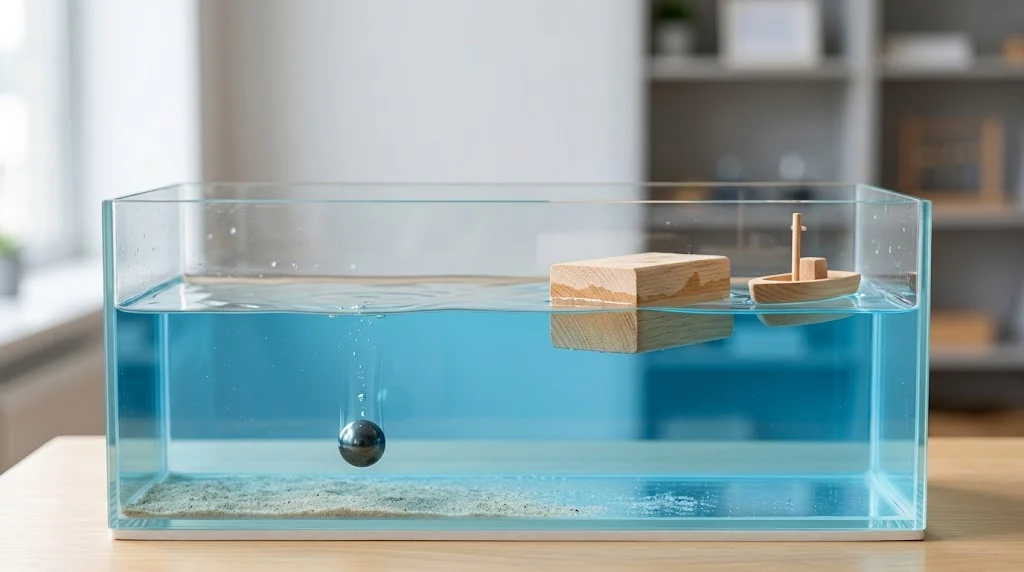
An object will sink when its average density is greater than the liquid around it, while an object will float when its average density is lower than the liquid. Buoyancy, displaced liquid, object density, and weight determine the result, so understanding these terms helps explain everyday examples such as boats, coins, ice, and balloons.
Imagine dropping a metal coin into a glass of water. It quickly moves toward the bottom. Now place a carefully designed steel ship in the same water, and it remains on the surface. This apparent contradiction is explained by density, buoyancy, volume, and water displacement. Understanding sink or float is therefore more than a simple vocabulary exercise. It is a practical science concept used in physics, engineering, education, manufacturing, and modern technology.
The basic idea is straightforward, but many people misunderstand it by assuming that heavier objects always sink and lighter objects always float. In reality, an object’s overall density and the amount of liquid it displaces are crucial. This guide explains the difference clearly and shows how the principle works in real situations.
Sink vs Float: What’s the Difference?
The words sink and float describe two different physical behaviors in a liquid.
Sink is primarily a verb. It describes the movement of an object downward through a liquid until it reaches a lower position or the bottom. For example, “The stone sinks in water.”
Float is primarily a verb as well. It describes remaining on the surface of a liquid or staying suspended without falling to the bottom. For example, “The wooden block floats in water.”
| Feature | Sink | Float |
| Part of speech | Verb | Verb |
| Basic meaning | Move downward in a liquid | Remain on or near the surface |
| Main physical factor | Greater average density than the liquid | Lower average density than the liquid |
| Buoyant force | Usually insufficient to support the object | Sufficient to support the object |
| Example | A stone sinks in water | A piece of wood floats in water |
| Common context | Physics, experiments, everyday observations | Physics, experiments, everyday observations |
Mini Recap
Sink describes downward movement through a liquid.
Float describes remaining supported by a liquid.
Density is one of the most important factors behind the difference.
Buoyancy explains why an object can remain supported by water.
An object’s total weight alone does not determine the result.
Is Sink vs Float a Grammar, Vocabulary, or Usage Issue?
The distinction between sink and float is primarily a vocabulary and meaning issue, although grammar determines how each word functions within a sentence.
Both words commonly function as verbs. They can describe physical movement or a physical state. They are not interchangeable because they express opposite outcomes.
Consider these examples:
“The apple floats in water.”
“The stone sinks in water.”
Changing one verb changes the entire meaning of the sentence.
In formal academic writing, both words are completely appropriate when discussing physics, buoyancy, density, experiments, or fluid behavior. In casual conversation, they are equally natural. There is no meaningful formal versus informal distinction between the two words.
The important issue is precision. If an object remains supported by water, use float. If it moves downward because the liquid cannot support it, use sink.
How to Use Sink Correctly
The verb sink describes movement downward through a liquid or, more generally, movement from a higher position to a lower one.
In everyday language, you might say, “The stone sank to the bottom of the pond.” In science writing, you might explain that an object sinks because its average density is greater than the density of the surrounding liquid.
Workplace Example
A manufacturing engineer might write:
“The metal component sank during the water displacement test because its average density exceeded that of the testing liquid.”
Here, sink communicates a measurable physical outcome.
Academic Example
A science student might write:
“The object sinks when the downward gravitational force exceeds the upward buoyant force.”
This usage is suitable for laboratory reports and physics assignments.
Technology Example
Computer simulations can model whether a virtual object sinks or remains supported in a fluid. Engineers can use computational fluid dynamics to examine how different materials behave in water or another liquid.
Usage Recap
Use sink when something moves downward through a liquid.
It can describe physical movement in everyday speech and technical writing.
The word is especially useful when explaining density, gravity, and buoyancy.
How to Use Float Correctly
The verb float describes an object remaining supported by a liquid rather than moving downward to the bottom.
For example, “The leaf floats on the surface of the pond.” A more technical explanation might state that an object floats when the buoyant force balances its weight.
Workplace Example
A marine engineer might explain:
“The vessel floats because its overall average density is lower than that of the surrounding water.”
The word is especially common in shipping, construction, marine engineering, and environmental science.
Academic Example
A student conducting a classroom experiment might write:
“The plastic container floats because it displaces enough water to produce an upward buoyant force equal to its weight.”
This provides a scientific explanation rather than simply describing what the eye observes.
Technology Example
Modern simulation software can calculate fluid behavior and predict whether structures, vessels, containers, and other objects will remain afloat. Such models are valuable in ship design and engineering analysis.
Usage Recap
Use float when an object remains supported by a liquid.
It can describe both ordinary observations and scientific behavior.
The term is especially important in discussions involving buoyancy and fluid mechanics.
When You Should NOT Use Sink or Float
There are several situations where choosing the wrong word can create confusion.
- Do not use sink when an object remains on the surface.
Incorrect: “The wooden block sinks on the water.”
Better: “The wooden block floats on the water.”
- Do not use float when an object clearly moves toward the bottom.
Incorrect: “The coin floats to the bottom.”
Better: “The coin sinks to the bottom.”
- Do not assume that heavy always means sink.
A large ship may weigh thousands of tons and still float because its overall design allows it to displace a large amount of water.
- Do not assume that small always means float.
A small metal object can sink if its average density is greater than that of the surrounding liquid.
- Do not confuse floating with simply being light.
Buoyancy depends on the relationship between an object and the liquid surrounding it.
- Do not use the words interchangeably in scientific writing.
They describe opposite physical outcomes.
- Do not judge only by the material.
A solid piece of steel can sink, while a hollow steel ship can float because the ship’s overall volume changes its average density.
Common Mistakes and Decision Rules
Decision Rule Box
If an object moves downward through a liquid, use sink.
If an object remains supported on or near the surface, use float.
For scientific explanations, also consider density, displaced liquid, gravity, and buoyant force rather than judging only by weight.
Sink or Float in Modern Technology and AI Tools
The basic principle remains important in modern engineering technology. Computer simulations can represent fluid behavior and calculate forces acting on objects placed in water or other liquids.
Artificial intelligence can also assist engineers by analyzing large amounts of design data, identifying patterns, and helping optimize structures for buoyancy and stability. For example, computational systems can compare different hull shapes and estimate how they may behave under changing conditions.
However, AI does not replace the underlying physical principles. Density, gravity, volume, displacement, and buoyancy remain the foundation of the analysis.
Why Objects Sink or Float: The Science Behind the Words
The key concept is buoyancy.
When an object is placed in a liquid, the liquid exerts an upward force on it. This upward force is called buoyant force.
If the object’s weight is greater than the buoyant force available to support it, the object sinks.
If the buoyant force balances the object’s weight while the object remains at the surface, the object floats.
Density is particularly useful for making predictions. Water has a density of approximately 1 gram per cubic centimeter under common reference conditions. Objects with an average density below this value tend to float in water, while objects with an average density above it tend to sink.
Shape also matters indirectly because it affects volume and the amount of water displaced.
This is why a steel nail sinks while a large steel ship can float.
Etymology of Sink and Float
The word sink comes from Old English roots associated with descending or going beneath a surface. Its meaning has remained closely connected with downward movement.
The word float also has very old Germanic origins and has long been associated with remaining on the surface of water or another liquid.
Both words developed from practical descriptions of movement in water and later became important technical terms in physics and engineering.
An Expert Style Explanation
A useful way to remember the distinction is:
“The important question is not simply how heavy an object is, but how its weight compares with the buoyant support produced by the liquid.”
This principle explains many situations that initially appear surprising.
Practical Case Study One: The Steel Ship
Consider a steel ship weighing 1,000 metric tons. Steel itself is much denser than water, so a solid block of steel with the same mass would sink.
The ship, however, contains a large volume of air and has a carefully designed hull. As it enters the water, it displaces a large quantity of water. When the displaced water produces enough buoyant force to balance the ship’s weight, the ship remains afloat.
The concrete result is simple: the ship can support a total weight of 1,000 metric tons when it displaces enough water to generate an equivalent upward force.
This example demonstrates why material alone does not determine whether something floats.
Practical Case Study Two: A Steel Ball
Now consider a compact steel ball. Steel has a density far greater than water. Because the ball has a relatively small volume compared with its mass, it cannot displace enough water to produce sufficient buoyant force before moving downward.
The concrete result is that the ball sinks.
The contrast between the steel ship and the steel ball demonstrates the importance of average density and volume rather than material name alone.
Error Prevention Checklist
Always use sink when:
The object moves downward through a liquid.
The object reaches the bottom of a container.
You are describing downward movement caused by insufficient buoyant support.
The physical outcome is movement beneath the surface.
Never use float when:
The object is clearly moving downward.
The object is reaching the bottom because its weight is not supported.
You are describing a sinking object in a scientific experiment.
The sentence specifically means downward movement through liquid.
Related Grammar Confusions You Should Master
Understanding sink and float is useful, but English learners often encounter other word pairs that create similar problems.
- Rise vs raise
- Lie vs lay
- Sit vs set
- Bring vs take
- Learn vs teach
- Affect vs effect
- Borrow vs lend
- Say vs tell
- Fewer vs less
- Further vs farther
These pairs demonstrate an important language principle: words that appear related may still perform different grammatical or semantic functions.
Frequently Asked Questions
Why do some objects sink while others float?
The result mainly depends on the relationship between an object’s average density and the density of the surrounding liquid. Buoyant force and displaced liquid are also important.
Does a heavier object always sink?
No. Weight alone does not determine the outcome. A large ship can be extremely heavy yet float because its overall volume and design allow it to displace enough water.
Does a lighter object always float?
No. An object can be relatively light but still sink if its average density is greater than that of the surrounding liquid.
Is sink a verb or a noun?
Sink is most commonly used as a verb when describing movement downward in liquid. It can also function as a noun in other contexts, such as a kitchen sink.
Is float a verb or a noun?
Float can function as both a verb and a noun. As a verb, it describes remaining on a liquid’s surface. As a noun, it can refer to various objects or concepts depending on context.
What makes an object float in water?
An object floats when the buoyant force produced by the displaced water can support its weight. Average density, volume, shape, and weight all contribute to this relationship.
How can I remember sink and float?
Think of direction. If something moves downward, it sinks. If it stays supported by the liquid, it floats. This simple distinction works in most everyday situations.
Conclusion
The difference between sink and float is simple once the underlying science is understood. Sink describes downward movement through a liquid, while float describes remaining supported by the liquid. Density, buoyancy, volume, weight, and water displacement explain why objects behave differently.
Remembering this distinction helps with everyday English as well as science, engineering, academic writing, and technology. When describing downward movement, choose sink. When describing an object remaining supported on a liquid, choose float.

Margaret Atwood is an American writer who contributes to LingRoya.com creating clear and engaging content about the English language and everyday communication. She enjoys helping readers build confidence in their writing through simple, practical guidance.