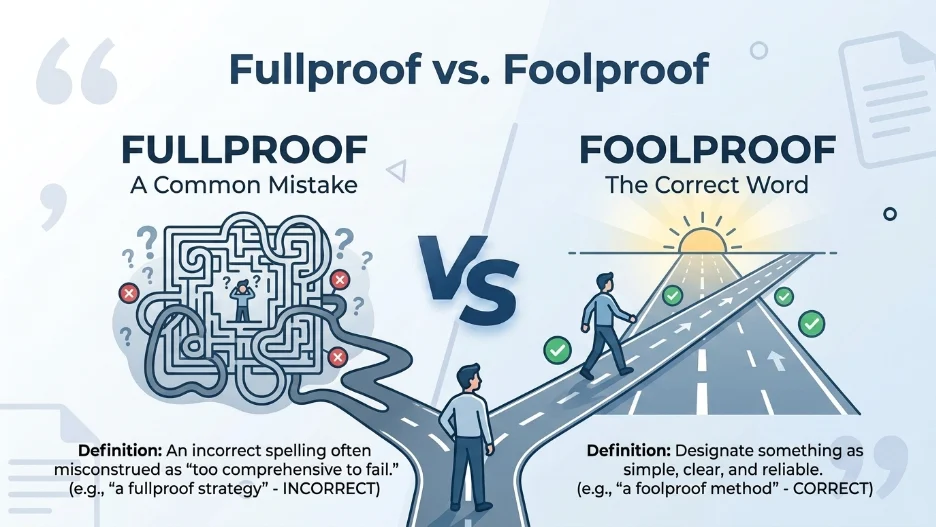
Quick Answer:”Foolproof” is the correct spelling. It means something is designed to be so simple or reliable that it is difficult to use incorrectly. “Fullproof” is a common misspelling and is not a standard English word.
❌ Fullproof: This recipe is fullproof. (Incorrect)
✅ Foolproof: This recipe is foolproof, even for beginners.
In the world of grammar and spelling, few errors are as common or as easily made as mixing up “foolproof” and “fullproof.” You might have written it yourself in a professional email, an academic paper, or a simple message to a colleague. The confusion is understandable because these two terms sound almost identical when spoken aloud. But the reality is that only one of them is a real word, and the other is a persistent mistake that can undermine your credibility.
This article settles the “foolproof or fullproof” debate once and for all. We will give you a clear answer, along with enough context and examples to ensure you never doubt yourself again. We will explore the grammar, usage, and history behind the correct term to help you communicate with authority.
Foolproof vs Fullproof: What is the Difference?
The difference between these two terms is not about subtle shades of meaning or formal versus informal usage. The difference is that one is a standard English word, and the other is a spelling error.
Foolproof is an adjective. It describes something that is designed to be so easy to use or so well constructed that it cannot fail or be misused, even by a person of limited ability or knowledge.
Fullproof, on the other hand, is not a recognized word in standard English dictionaries. It is a common misspelling of “foolproof,” born from the similar pronunciation of the words “fool” and “full,” especially in some dialects. To be clear, “fullproof” is a mistake you should avoid.
To help visualize the difference, consider this comparison table:
| Feature | Foolproof | Fullproof |
| Status | A correct, standard English word | A common spelling error |
| Part of Speech | Adjective | Not applicable |
| Meaning | Immune to failure or misuse, even by fools | No standard meaning; suggests “resistant to being full” |
| Correct Usage | “Our foolproof plan will succeed.” | Incorrect: “Our fullproof plan will succeed.” |
| Synonyms | Infallible, reliable, guaranteed, sure fire | None |
In short, when you want to say something is reliable and fail safe, the word you are looking for is foolproof. The term “fullproof” offers no alternative meaning and should always be replaced with the correct spelling. It is a simple concept, but as you will see, it is a very common trap.
Is Foolproof vs Fullproof a Grammar, Vocabulary, or Usage Issue?
Understanding this distinction is primarily a vocabulary and spelling issue. It is not a grammatical rule, like subject verb agreement. It is also not a matter of choosing the right word for a formal or informal context. One option is simply incorrect.
You cannot interchange these words because one of them does not exist in the English lexicon. There is no formal context where “fullproof” is acceptable, nor is there a casual situation where it would be considered correct. If you were to write “fullproof” in an academic paper or a casual email, it would be marked as a spelling error. It is a vocabulary problem because you are using a non standard word. By understanding the definition and etymology of “foolproof,” you will always be able to choose the correct spelling.
Practical Usage of “Foolproof”
Now that we have established that “foolproof” is the correct term, let us look at how it is used in various contexts. The word conveys reliability, simplicity, and a guarantee of success. Here is how you can use it effectively.
Workplace Example
Imagine you are in a project meeting. You want to propose a system for tracking deliverables that will make it easy for everyone to stay on schedule. You would say, “I have developed a foolproof system for managing our project timeline.” This assures your team that the system is designed to be clear and effective, minimizing the risk of human error. It signals that you have put thought into creating a process that works for everyone, regardless of their level of experience.
Academic Example
In an academic context, a professor might say, “This method is not completely foolproof, but it is the most reliable approach we have.” This is a precise and cautious use of the word. It acknowledges that while the method is robust and easy to apply correctly, it might have limitations. This use shows a nuanced understanding, which is highly valued in scholarly writing.
Technology Example
In the tech world, the word is frequently used to describe user interfaces. A developer might claim, “The new interface update is foolproof, even for beginners.” This means the design is so intuitive that new users can navigate it without needing extensive instructions or technical support. The goal is to remove barriers to usability.
When You Should NOT Use “Foolproof”
While “foolproof” is a powerful and positive adjective, there are situations where it is wise to avoid it, even if it is a convenient way to describe a plan or system.
- When Discussing Complex Systems with High Stakes: In fields like aviation or medicine, calling a system “foolproof” can create a dangerous false sense of security. For example, you would avoid saying, “This new surgical robot is foolproof,” as it might lead to complacency.
- When Describing Unpredictable Events: You cannot apply “foolproof” to areas involving human emotion or market volatility. For instance, you would not say, “My foolproof plan to win her heart,” or “A foolproof strategy for stock market success.” These domains are too unpredictable to be guaranteed.
- In Formal Legal or Contractual Documents: Legal language demands precision and avoids absolute claims that could be challenged. A contract would not state a solution is “foolproof,” as it is an absolute claim that could be legally problematic if it fails.
- When You Are Uncertain of Your Audience: If your reader or listener is a non native English speaker, they might misinterpret “foolproof” or be confused by its spelling. Using clearer, more universal words like “reliable” might be more effective.
- When the Plan Has Not Been Tested: It is unwise to label a new, untested plan “foolproof.” The term implies proven reliability. You should only use it for systems or processes with a track record of success.
- When Overconfidence is a Risk: If you are leading a team, calling your plan “foolproof” can sound arrogant and might discourage team members from offering valuable feedback or identifying potential flaws.
Common Mistakes and Decision Rules
Let’s examine the most frequent errors people make and establish a clear rule for using “foolproof” correctly.
| Correct Sentence | Incorrect Sentence | Explanation |
| This recipe is foolproof; anyone can bake this cake. | This recipe is fullproof; anyone can bake this cake. | “Fullproof” is a misspelling. The word needed is “foolproof.” |
| I’ve created a foolproof study plan for the exam. | I’ve created a full proof study plan for the exam. | The phrase is always one word, “foolproof.” “Full proof” is incorrect. |
| The new software is foolproof and requires no training. | The new software is fool proof and requires no training. | “Fool proof” is sometimes used as two words, but the standard and preferred form is the closed compound, “foolproof.” |
| This is not a foolproof solution, but it is our best option. | This is not a fullproof solution, but it is our best option. | Again, “fullproof” is a common error and has no meaning. |
Decision Rule Box
If you are describing something that is reliable and resistant to failure, use the word foolproof. There is no other decision to be made. When in doubt, remember that “fullproof” is always wrong. If you are tempted to use “fullproof,” stop and replace it with “foolproof.”
Foolproof in Modern Technology and AI Tools
In the age of artificial intelligence and rapid technological development, the term “foolproof” is more relevant than ever. Software designers, AI developers, and user experience experts strive to create products that are as “foolproof” as possible.
This often involves removing unnecessary steps, simplifying interfaces, and adding robust error handling. The goal is to design interactions that are so intuitive that they require no prior knowledge or training. For example, many AI tools are marketed as making complex tasks, like coding or data analysis, “foolproof” for the average user. However, it is important to remember that no technology is entirely foolproof. A system can still fail due to unforeseen circumstances, new types of user error, or malicious misuse. The pursuit of a “foolproof” design is a noble goal, but absolute perfection remains an ideal.
Authority and Trust
The word “foolproof” has a surprisingly short history. According to sources like Dictionary.com and the American Heritage Dictionary, it is an Americanism that emerged around 1900 1905. It is a combination of the word “fool,” which in this context means a silly or incompetent person, and “proof,” which means resistant, as seen in words like “waterproof.” So, the literal meaning of “foolproof” is “resistant to fools.” This etymology is the key to understanding its correct spelling. It is not about being “full” of anything; it is about being impervious to mistakes.
As the linguist, researcher, and writer, John McWhorter once said in a discussion on linguistic evolution: “Words are not carved in stone; they are alive, and their spelling is often a fossil of a meaning that has shifted over time.” The spelling of “foolproof” is a perfect example of this. Its spelling preserves its original, now slightly humorous, literal meaning.
Case Studies
Case Study 1: Reducing Customer Support Tickets at a Software Company
A SaaS company was receiving a high volume of support tickets regarding a complex setup process for their new software. They invested in a UX overhaul to make the process more intuitive by adding clearer labels, tooltips, and error messages. They also created a simple step by step guide. After this redesign, which they termed a “foolproof” onboarding experience, their support tickets for setup issues dropped by 40%. The positive feedback was significant, as users began to describe the process themselves as “foolproof.” This demonstrates how robust, human friendly design can simplify a complex system and improve user satisfaction.
Case Study 2: A University’s Online Exam System
A university introduced a new online exam system that was supposed to be easy for all students to use. During the first midterm, there were numerous issues. Students could not find the submit button, the timer was confusing, and there were problems with file uploads. The system was clearly not “foolproof.” The university’s IT department then made several changes. They redesigned the interface to be more simplistic, tested it with a student focus group, and created simple instructional videos. On the next exam, the number of technical support calls dropped by 70%. The user friendly design was the key difference between a stressful and a smooth experience.
Error Prevention Checklist
Use this simple checklist to ensure you are always using “foolproof” correctly.
- Always use “foolproof” when:
- Describing a plan that is certain to succeed.
- Explaining that a system is easy to use, even for novices.
- Wanting to convey reliability and fail safe design.
- Writing it as one closed compound word.
- Remembering the double “o”: foolproof.
- Never use “fullproof” when:
- You are trying to describe a reliable plan or system.
- Writing in any professional or academic context.
- It is a simple misspelling. There is no correct context for “fullproof.”
- Thinking “full” means “complete.” “Foolproof” means “immune to fools.”
Related Grammar Confusions You Should Master
To truly master English spelling and vocabulary, it helps to be aware of other common traps. The confusion between “foolproof” and “fullproof” is just one example of how pronunciation can trick us into spelling errors. Here are some other common confusions to be aware of.
- A lot vs. Alot: “A lot” is the correct phrase; “alot” is a common misspelling.
- Accept vs. Except: “Accept” means to receive, while “except” means to exclude.
- Affect vs. Effect: “Affect” is usually a verb, and “effect” is usually a noun.
- Their vs. There vs. They’re: A classic set of homophones with distinct meanings.
- Your vs. You’re: “Your” is possessive, while “you’re” is a contraction of “you are.”
- Its vs. It’s: “Its” is possessive, while “it’s” is a contraction of “it is.”
- Who’s vs. Whose: “Who’s” is a contraction, and “whose” is possessive.
- Then vs. Than: “Then” relates to time, while “than” is used for comparisons.
- To vs. Too vs. Two: These have entirely different meanings and uses.
- Principle vs. Principal: “Principal” can mean a primary figure or a sum of money, while “principle” is a fundamental truth or rule.
Advanced FAQs
Is it fullproof or foolproof?
Foolproof is the correct spelling. Fullproof is a common misspelling and is not accepted in standard English.
What does foolproof mean?
Foolproof describes something that is so simple, reliable, or well designed that it is difficult to use incorrectly.
Why is fullproof incorrect?
Fullproof is incorrect because the word is derived from fool + proof, meaning resistant to mistakes made by inexperienced users.
Can foolproof be used as a verb?
Yes, although it is uncommon. As a verb, foolproof means to make something safer or less likely to fail or be misused.
What are some synonyms for foolproof?
Common synonyms include fail-safe, reliable, dependable, infallible, and surefire.
Is full proof written as two words?
No. When referring to something reliable or easy to use, the correct form is the single word foolproof.
Where did the word foolproof come from?
Foolproof originated in American English in the early 1900s by combining fool and proof.
Is fullproof ever correct?
No, fullproof is not a standard English word. In nearly all writing, foolproof is the correct choice.
Conclusion
The “foolproof or fullproof” debate is a classic example of a spelling error that is perpetuated by the way we speak. While the words sound alike, their meanings, and more importantly, their spellings, are fundamentally different. The correct word is foolproof, a reliable adjective that describes a plan or system that is so well designed it cannot be derailed by incompetence. The word “fullproof” is simply a mistake and has no place in your professional or personal writing.
By remembering the etymology of the word, that it is “proof” against “fools,” you can permanently fix this spelling in your memory. Using “foolproof” correctly is a simple way to make your writing clearer, more professional, and more accurate.
Meta Description
Is it fullproof or foolproof?
Foolproof is the correct spelling. Fullproof is a common misspelling and is not accepted in standard English.
What does foolproof mean?
Foolproof describes something that is so simple, reliable, or well designed that it is difficult to use incorrectly.
Why is fullproof incorrect?
Fullproof is incorrect because the word is derived from fool + proof, meaning resistant to mistakes made by inexperienced users.
Can foolproof be used as a verb?
Yes, although it is uncommon. As a verb, foolproof means to make something safer or less likely to fail or be misused.
What are some synonyms for foolproof?
Common synonyms include fail-safe, reliable, dependable, infallible, and surefire.
Is full proof written as two words?
No. When referring to something reliable or easy to use, the correct form is the single word foolproof.
Where did the word foolproof come from?
Foolproof originated in American English in the early 1900s by combining fool and proof.
Is fullproof ever correct?
No, fullproof is not a standard English word. In nearly all writing, foolproof is the correct choice.
Conclusion
The choice between foolproof and fullproof is straightforward. Foolproof is the only correct spelling in standard English and describes something that is easy to use, reliable, or designed to prevent mistakes. Fullproof is simply a misspelling and should be avoided in all types of writing.
A simple way to remember the difference is that foolproof literally means “proof against fools,” or difficult to use incorrectly. Whenever you want to describe a system, method, or process that is highly reliable and easy to follow, always choose foolproof. This will ensure your writing is accurate, professional, and grammatically correct.

Margaret Atwood is an American writer who contributes to LingRoya.com creating clear and engaging content about the English language and everyday communication. She enjoys helping readers build confidence in their writing through simple, practical guidance.