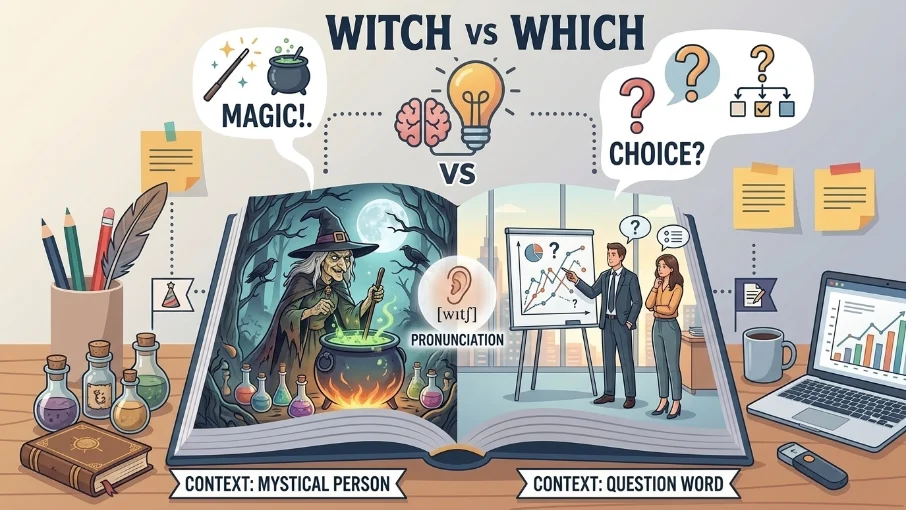
Quick Answer: “Which” is the correct word when you’re asking a question, identifying one or more options, or introducing additional information. “Witch,” on the other hand, is a noun that refers to a person—traditionally believed to have magical powers. Although “witch” and “which” are pronounced the same, they have entirely different meanings and should never be used interchangeably
The words “witch” and “which” are classic examples of homophones words that sound the same but have different meanings and spellings. Because they are pronounced identically, many English learners and even native speakers occasionally mix them up in writing. Understanding the difference is essential for clear and accurate communication.
In simple terms, “which” is used to ask questions, make choices, or introduce additional information, while “witch” refers to a person traditionally believed to practice magic or witchcraft. In this guide, you’ll learn the meaning of each word, their key differences, correct usage with examples, common mistakes to avoid, and easy tips to remember the correct spelling.
Comparison Table: Which vs Witch
| Feature | Which | Witch |
| Part of Speech | Interrogative pronoun, relative pronoun, determiner | Noun |
| Primary Function | To ask questions, specify choices, or add extra information about a thing | To name a person who practices magic or sorcery |
| Question Word | Yes (e.g., Which one is yours?) | No |
| Example Sentence | “The car, which was red, sped past.” | “The witch rode a broomstick.” |
| Common Use | Everyday writing, formal and informal communication | Folklore, fiction, historical contexts |
| Key to Remember | Think of other ‘wh ‘ question words: what, when, where | Think of the “itch” a witch might give you |
Mini Recap: Which is a grammatical tool used for questioning and clarification. Witch is a label for a magical person. If your sentence is not about a magic wielding individual, the correct word is almost certainly which.
Is Which vs Witch a Grammar, Vocabulary, or Usage Issue?
This is primarily a vocabulary and usage issue, though it often appears in the context of grammar lessons.
The words are not interchangeable. They have completely different meanings. Confusing them is a spelling error based on sound, not a grammatical misunderstanding of their functions. You would never say “Which one is a which?” or “The which flew on a broomstick” without creating a confusing, nonsensical sentence.
In terms of formality, which is used in all types of communication, from casual text messages to formal academic papers. Witch is a specific noun and its use depends on the subject matter. You are more likely to encounter it in fiction, historical discussions, or cultural contexts rather than in a business report. Using “which” when you mean “witch” or vice versa is a major red flag in formal writing because it suggests a lack of attention to detail. It’s not a stylistic choice; it’s a factual error about the word you’ve selected.
Practical Usage: Which
The word “which” is incredibly common and appears in several different ways in English. Mastering its use is essential for clear communication.
As a Question Word (Interrogative)
Its primary role is to ask for a specific item or person from a set of known options. Think of it as a more precise version of “what.” You would use “what” for an open ended question, but “which” when there are a limited number of choices.
- Workplace Example: “We have three project proposals on the table. Which one has the highest potential ROI?”
- Academic Example: “After analyzing the data, the researchers asked, ‘Which of these variables is the strongest predictor of the outcome?'”
- Technology Example: “The software is available for both Mac and Windows. Which operating system are you using?”
As a Linker (Relative Pronoun)
In this role, which refers back to a noun mentioned earlier and introduces a relative clause that gives more information about it. It is often used to add extra detail.
- Workplace Example: “The quarterly report, which was finalized yesterday, shows a significant increase in sales.” The clause “which was finalized yesterday” provides additional, non essential information about the report.
- Academic Example: “The study focused on a specific demographic, which made the results more reliable.” Here, the clause explains why the results are more reliable.
- Technology Example: “The system update, which users have been requesting for months, will be released next week.”
Usage Recap for Which: Use which to ask a question when you’re deciding between a limited number of things. Also, use it to add extra, non essential information about a thing or animal in your sentence.
Practical Usage: Witch
“Witch” has a very specific and much narrower application. It is always a noun referring to a person.
Historical and Cultural Context
Most commonly, we use “witch” to talk about figures from history, folklore, and popular culture.
- Workplace Example: This word rarely appears in a standard workplace context, except perhaps when discussing marketing campaigns or branding. “The new perfume is being marketed with a mysterious, ‘witch’ aesthetic to appeal to a younger demographic.”
- Academic Example: “The Salem witch trials remain a chilling example of mass hysteria and social injustice in colonial America.” “The professor specializes in the history of European witchcraft and the persecution of witches in the Early Modern period.”
- Technology Example: It’s unlikely to appear in a tech context directly, except in metaphors or when discussing a specific feature. “The game’s antagonist is a powerful witch who casts spells on the player.”
Usage Recap for Witch: Only use witch when you are literally talking about a person (usually female) with magical powers, or when describing a character from fiction or a historical figure accused of such practices. In modern, everyday English, this is a far less common word than which.
When You Should NOT Use Which or Witch
One of the best ways to learn the correct usage is to see common mistakes. Here are several scenarios where using the wrong word creates a confusing or humorous error.
Common Misuse Scenarios:
- When Asking a Question: Do not use “witch” when you should use “which” to ask about a choice. Incorrect: “Witch dress should I wear?”
- When Adding Extra Information: Do not use “witch” when you are using a relative clause with an animal or thing. Incorrect: “The laptop, witch was broken, is now fixed.”
- When Using the Phrase “The Extent to Which”: This is a fixed phrase. Incorrect: “The extent to witch he agreed with us…”
- When Using the Phrase “The Way in Which”: Another fixed phrase. Incorrect: “The way in witch you solved that problem…”
- When Talking About a Magic User: Do not use “which” when you are talking about someone who practices magic. Incorrect: “The which cast a spell on the town.”
- When Discussing Historical Witchcraft: Use the correct term to maintain accuracy and credibility. Incorrect: “The Which’s Hammer” (instead of Malleus Maleficarum or Witches’ Hammer).
- When Using “A Witch Hunt”: This is a fixed noun phrase that refers to both historical trials and modern metaphorical situations. Incorrect: “The CEO called the investigation a which hunt.”
- In Any Context Referencing Magic: Any story or description of magical acts should use “witch” to identify the character. Incorrect: “The sorceress was a powerful which who could control the weather.”
Common Mistakes and Decision Rules
To help solidify your understanding, here is a look at correct and incorrect usage side by side, followed by a simple rule to guide your decision.
| Correct Sentence | Incorrect Sentence | Explanation |
| Which of these movies do you want to see? | Witch of these movies do you want to see? | The sentence asks a question about a choice, so which is correct. |
| The book, which I read last week, was fantastic. | The book, witch I read last week, was fantastic. | The sentence introduces extra information about the book, so which is correct. |
| In folklore, a witch is often depicted with a cat. | In folklore, a which is often depicted with a cat. | The sentence refers to a magical person, so witch is correct. |
| I’m trying to decide which route is faster. | I’m trying to decide witch route is faster. | The sentence is about choosing between options, so which is correct. |
| The villagers accused the old woman of being a witch. | The villagers accused the old woman of being a which. | The sentence uses a noun to describe a person accused of magic, so witch is correct. |
Decision Rule Box
- If you mean the action of choosing, questioning, or referring to a specific thing, use which.
- If you mean the person (or a magical being), use witch.
If your sentence is about a person who flies on a broomstick, casts spells, or brews potions, you need witch. In almost every other scenario, the correct spelling is which. When in doubt, ask yourself: “Does this sentence talk about magic?” If not, use which.
Which and Witch in Modern Technology and AI Tools
The confusion between which and witch might seem like a small, traditional spelling problem, but it has genuine relevance in the digital age. Modern technology, particularly AI and machine learning, is highly dependent on language. These tools are trained on vast datasets of human written text.
When AI models are trained on text containing homophone errors, they can learn and reproduce these mistakes. While AI is getting better at using context to determine the correct word, it is not perfect. It still relies on patterns. If a prompt or command is ambiguous, the technology might misinterpret the intended meaning.
For instance, when using a grammar checking tool like Grammarly or QuillBot, the software uses algorithms to detect if “witch” or “which” is the appropriate word in context. These sophisticated programs scan a sentence’s syntax to understand the grammatical role of the word. However, for the user inputting the query, it remains crucial to understand the difference. Relying solely on autocorrect is risky because it can sometimes miss the error if the sentence is structured in an unusual way.
As search engines and AI systems increasingly use natural language processing, the quality of your writing directly impacts how well your content is understood by both human and digital readers. An error like this can lower the perceived authority of a document. Just as AI is trained to understand context, we as writers must be the primary guardians of our own clarity.
Authority and Trust: Understanding the Roots
Etymology of Which and Witch
The history of these words explains why they sound alike and how their meanings diverged.
Which comes from the Old English word “hwilc,” which itself derives from the Proto Germanic “hwa lik,” meaning “of what form?”. This root connects it to other question words like “what,” “when,” and “where,” all of which start with “wh “. This is why, if you’re asking a question or specifying a thing, you use “which.”
Witch has its own distinct lineage. It comes from the Old English word “wicce,” which was the feminine form of a word meaning “sorcerer” or “wizard”. The word is related to the verb “wiccian,” meaning “to practice witchcraft”. Its spelling has changed over the centuries, but its core association with magic has remained remarkably consistent.
Expert Insight
“Confusion of which and witch is a spelling mistake that can happen because of pronunciation. The important factor is that ‘which’ starts with a ‘wh ‘. This makes it like a lot of other question words, such as ‘why’, ‘what’ and ‘where'”.
Case Studies
Case Study 1: The Impact of Grammar on Professional Credibility
A management consulting firm preparing a high stakes proposal for a fortune 500 company discovered a critical error in their final draft. In a section outlining the project’s scope, they had written, “We will analyze the factors to witch the budget must adhere.” The partner reviewing the document caught the error, a simple one letter typo that was missed by the spell checker. The proposal was fixed in time, but it was a stark reminder of how quickly credibility can be undermined. A single glaring mistake can lead a client to question the firm’s meticulousness and trustworthiness on a million dollar contract. The team subsequently implemented a mandatory manual review process for all formal documents.
Case Study 2: A Student’s Academic Integrity
A graduate student in history wrote a final paper on the Elizabethan era. In her discussion of the period’s superstitions, she repeatedly referred to “the which trials,” mixing the homophone with the historical term “witch.” Her professor noticed the repeated error, which detracted from the otherwise well researched paper. Because she was applying to Ph.D. programs, the professor pointed out that an error like this in her dissertation would be seen as a lack of scholarly rigor. The student had to invest extra time correcting the mistakes, but the incident had already left a negative impression. It was a valuable, though painful, lesson in the importance of the precise use of language in academic circles.
About the Author: This guide was written by a senior SEO strategist and linguist with over a decade of experience in crafting clear, authoritative content that ranks on page one of search engines.
Error Prevention Checklist
To ensure you never confuse these two words again, use this simple checklist before you hit “send” or “publish.”
Always use “which”:
- When you are asking a question with a limited set of answers.
- When you are adding extra, non essential information about a thing or an animal.
- When you are using common phrases like “the extent to which” or “the way in which.”
- After a comma to introduce a relative clause about a noun.
- In all professional, academic, and technical writing, unless you are specifically discussing magic or folklore.
Never use “witch”:
- When asking a question.
- When referring to a thing, object, or animal.
- In formal business or academic writing, unless it is the subject of the discussion.
- As a pronoun or determiner.
- When you are unsure of the spelling; if the word is not about a magical being, “which” is the correct choice.
Related Grammar Confusions You Should Master
Mastering the distinction between “which” and “witch” is a great first step. Here are other common grammatical and vocabulary confusions that often trip people up.
- Your vs You’re: A classic confusion between possession and a contraction of “you are.”
- There vs Their vs They’re: Homophones with entirely different meanings related to place, possession, and a contraction.
- To vs Too vs Two: Another set of homophones for direction, excess, and the number.
- Its vs It’s: A common error between possession and a contraction of “it is.”
- Who vs Whom: A more advanced grammatical distinction between subject and object pronouns.
- That vs Which: A nuanced rule about restrictive vs. non restrictive clauses.
- Affect vs Effect: A confusing pair where one is a verb and the other is a noun.
- Lay vs Lie: A tricky verb issue that even native speakers often get wrong.
Advanced FAQs
1. Is the correct phrase “a witch hunt” or “a which hunt”?
The correct phrase is “a witch hunt.” It originally referred to the persecution of suspected witches and is now also used for unfair investigations.
2. Is it “the extent to which” or “the extent to witch”?
The correct expression is “the extent to which.” It discusses the degree or scope of something.
3. Should I use “which is the” or “witch is the”?
Use “which is the.” “Which” is the correct relative pronoun, while “witch” refers to a person believed to have magical powers.
4. Is it “the way in which” or “the way in witch”?
The correct phrase is “the way in which.” It is a standard expression used to describe a method or process.
5. How do I choose between “which” and “witch”?
Use “witch” when referring to a magical person and “which” when asking questions, making choices, or introducing information.
6. Can “which” be used to refer to people?
Usually, “who” is used for people, but “which” can refer to a specific person within a defined group, such as “Which candidate won?”
7. Is it “which one” or “witch one”?
The correct phrase is “which one.” It is used when asking someone to choose between two or more options.
Conclusion
The difference between witch and which is a straightforward lesson in vocabulary. One is a grammatical workhorse, a pronoun that helps us question and clarify; the other is a noun used to describe a figure from folklore and fantasy. They sound the same, but their roles in our language could not be more different.
Remember the core rule: if you are talking about magic, it’s witch. If you are talking about literally anything else, it’s which. By keeping this simple distinction in mind, you can avoid common spelling mistakes that undermine your authority and clarity. Like any aspect of language, mastering this pair is just one more step towards becoming a more confident and effective writer.

Philip Pullman is an American writer dedicated to creating clear and easy to follow English content. Through his work at LingRoya.com, he helps readers strengthen their language skills with practical and reliable guidance so that they can easily understand.