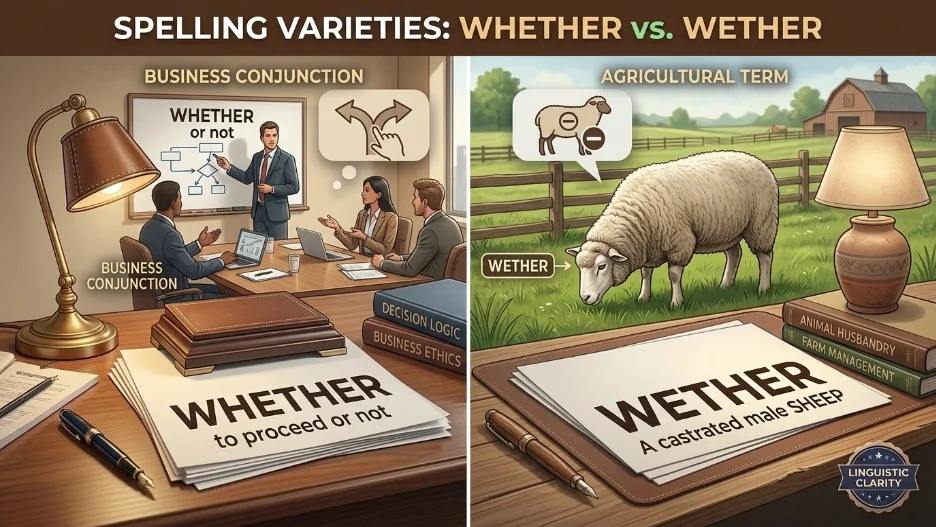
Quick Answer: The correct phrase is “whether or not,” which means “regardless of whether something happens or is true.” “Wether” is a different word referring to a castrated male sheep, so it is not correct in this phrase.
The phrase “whether or not” is a common English expression used when talking about two possibilities or conditions. It generally means “if or if not” and is used to show that something is true or will happen regardless of the outcome. For example, you might say, “I’ll go whether or not you come with me.”
Many people confuse “whether or not” with “wether or not” because the words sound similar. However, “wether” is a completely different word that refers to a castrated male sheep. In this guide, we’ll explain the difference between whether or not and wether or not, along with clear examples to help you use the correct phrase confidently.
Whether vs Wether: What’s the Difference?
Let us clear up the most fundamental confusion first. These two words are not interchangeable. They are completely different terms with unrelated meanings and origins.
Whether is a conjunction. It introduces a choice between two or more alternatives. It can also express doubt or uncertainty. For example, “I cannot decide whether to go to the party or stay home.” It is one of the most common words in the English language for expressing conditional thinking.
Wether is a noun. It refers specifically to a castrated male sheep or goat. This is a technical agricultural term that most people never need to use. Unless you work in farming or animal husbandry, you will likely never write this word. That is why using it accidentally in place of “whether” stands out as a glaring error.
Here is a simple comparison table to help you remember:
| Correct Usage | InCorrect Usage | Explanation |
| I need to decide whether to accept the job offer. | I need to decide wether to accept the job offer. | “Whether” introduces a choice; “wether” refers to a sheep. |
| She asked whether we had finished the project. | She asked wether we had finished the project. | Only “whether” works in questions about alternatives. |
| The farmer checked on the wether in the pasture. | The farmer checked on the whether in the pasture. | “Wether” is the correct term for a farm animal. |
| We discussed whether the deadline was realistic. | We discussed wether the deadline was realistic. | Professional writing requires “whether” for conditional discussion. |
| The wether grazed peacefully with the flock. | The whether grazed peacefully with the flock. | Animals cannot be described with a conjunction. |
| I wonder whether she will attend the meeting. | I wonder wether she will attend the meeting. | Doubt and uncertainty call for “whether.” |
Here is the key takeaway: if you are talking about a sheep, use “wether.” If you are talking about anything else, use “whether.” Simple, right? Yet this single distinction causes countless errors every day.
Is Whether vs Wether a Grammar, Vocabulary, or Usage Issue?
This confusion sits at the intersection of several linguistic categories. It is primarily a spelling issue, but it also involves vocabulary knowledge and usage conventions.
Spelling and Vocabulary: The problem arises because these two words sound identical in spoken English. They are homophones. When people hear the sound “wether” in conversation, they often default to the more common spelling “whether” without thinking. The rare agricultural term “wether” stays buried in their passive vocabulary, only surfacing when they see it in print.
Usage: The real challenge comes when we consider that many style guides, including the Chicago Manual of Style, suggest using “whether” without “or not” when the alternative is implied. However, in everyday writing, “whether or not” has become an accepted idiom for expressing complete uncertainty or presenting two opposing possibilities.
Formal vs Informal: In academic writing, you should generally prefer “whether” on its own. In business communication and casual writing, “whether or not” is perfectly acceptable. The key is consistency and clarity in your chosen style.
The Interchangeability Question: “Whether” and “if” are often used interchangeably in conditional sentences, but there are important distinctions. “Whether” introduces two or more alternatives, while “if” typically introduces a single condition. Understanding this difference will elevate your writing significantly.
How to Use Whether Correctly
“Whether” serves as a conjunction that introduces alternatives or expresses doubt. It appears in several common sentence structures.
In the workplace, you might write: “The team needs to decide whether we should launch the product now or wait for more data.” This sentence presents two clear options and shows decision making in action.
In academic contexts, you could say: “The study examined whether students who received tutoring performed better on standardized tests.” Here, “whether” introduces a research question that the study aims to answer.
In technology documentation, you often see: “The system checks whether the user has entered valid credentials before granting access.” This describes a conditional operation that software performs regularly.
Usage Recap: Always use “whether” when you are presenting two or more clear alternatives. Use it in formal writing, professional communication, and everyday conversation when you need to express choice or uncertainty. Remember that “whether” works in both simple and complex sentence structures.
How to Use Wether Correctly
Honestly, you will probably never need to use “wether” in your daily writing. This is a specialized agricultural term that belongs on farms and in veterinary contexts.
In agricultural writing, you might see: “The farmer separated the wether from the breeding stock.” This is a practical observation about herd management.
In historical or cultural contexts: “Sheep farmers traditionally used wethers for wool production since they produce finer fleece.” This shows how the term appears in discussions of farming practices.
In veterinary contexts: “The vet examined the wether and found it in good health.” This is straightforward medical language for animal care.
Usage Recap: Use “wether” only when you are specifically writing about castrated male sheep or goats. In all other contexts, use “whether.” If you are unsure, ask yourself: “Am I talking about an animal?” If the answer is no, go with “whether.”
When You Should NOT Use Whether or Wether
Understanding when not to use these terms is just as important as knowing when to use them. Here are common scenarios where writers mistakenly reach for “whether” or “wether.”
Do not use “whether” when you are presenting a single condition. For example, “Let me know if you are coming” is correct, while “Let me know whether you are coming” implies an alternative that is not stated.
Avoid using “wether” in any professional or academic writing unless you are specifically discussing sheep. This mistake is so obvious that it will undermine your credibility immediately.
Do not use “whether” after prepositions like “about” or “regarding.” Instead, use “whether” in the clause itself. For example, say “They discussed whether the plan would work,” not “They discussed about whether.”
Never use “whether or not” when “whether” alone is sufficient. In sentences where the alternative is clearly implied, adding “or not” is redundant.
Do not use “whether” in casual conversation when “if” is more natural. Both are grammatically correct, but “if” often sounds more conversational.
Avoid using “whether” in negative constructions like “I don’t know whether he didn’t come.” This can be confusing; “I don’t know if he came” is clearer.
Skip “whether” when you are asking a direct question. “Do you want to go?” is preferable to “Do you want whether to go?” which is grammatically incorrect.
Do not use “wether” in any context involving weather conditions or climate. Many people confuse all three terms; “weather” refers to atmospheric conditions, and it is a completely separate word.
Common Mistakes and Decision Rules
Here is a quick reference table showing common mistakes and their corrections:
| Correct Sentence | Incorrect Sentence | Explanation |
| The committee will decide whether to approve the budget. | The committee will decide wether to approve the budget. | “Whether” introduces a choice; “wether” is an animal. |
| I asked whether she had completed the assignment. | I asked wether she had completed the assignment. | Questions about completion require “whether.” |
| We need to know whether the software is compatible. | We need to know wether the software is compatible. | Technical writing demands correct usage. |
| Please confirm whether you will attend the conference. | Please confirm if you will attend the conference. | Both are acceptable, but “whether” is more formal. |
| The farmer noticed the wether was limping. | The farmer noticed the whether was limping. | Only “wether” describes farm animals. |
| I cannot decide whether to stay or leave. | I cannot decide if to stay or leave. | “If” does not work with “to” infinitives. |
| She wondered whether he was telling the truth. | She wondered if he was telling the truth. | Both work, but “whether” emphasizes the alternatives. |
| The study investigated whether exercise improves mood. | The study investigated if exercise improves mood. | “Whether” is preferred in academic contexts. |
Decision Rule Box
If you mean the action of choosing or expressing doubt, use “whether.” This is the term for introducing alternatives, asking questions, and discussing uncertainty. If you mean the animal, use “wether.” The odds are overwhelming that you will use “whether” in your lifetime. Think of “whether” as your go to word for almost every situation, and remember that “wether” is only for sheep farmers.
Whether and Wether in Modern Technology and AI Tools
Modern technology has surprisingly made this confusion worse in some ways and better in others. Autocorrect tools often assume you meant “whether” when you type “wether,” which is helpful. However, the same tools might flag “whether or not” as redundant, leading to confusion.
Artificial intelligence writing assistants like Grammarly and ChatGPT generally handle this distinction well. They correctly suggest “whether” in most contexts and identify the rare “wether” usage. Still, relying entirely on AI is not a substitute for understanding the rule yourself.
In software development, the difference can be critical. Code documentation often uses “whether” to describe conditional logic. A misplaced “wether” in technical documentation would be both confusing and embarrassing. Programmers and technical writers must pay extra attention to this distinction.
Search engines also treat these terms differently. The phrase “wether or not” appears in many search queries from confused writers. Search engines understand this and often show results for “whether or not” anyway. However, as a content creator, you want to use the correct term to appear authoritative in your writing.
The History and Etymology
Both words come from Old English, but they have different roots. “Whether” derives from the Old English word “hwæther,” meaning “which of two.” This traces back to Proto Germanic and ultimately to Proto Indo European roots expressing choice and comparison.
“Wether” comes from the Old English “wether,” meaning a male sheep. This word appears across Germanic languages, including the modern Dutch “weder” and German “Widder.” It is one of the oldest agricultural terms in the English language.
The similarity in sound is purely coincidental, but it has caused confusion for centuries. Both words were used in medieval texts, and scribes occasionally mixed them up. Today, with written communication more important than ever, the distinction matters more than it did in the past.
Expert Insight
Dr. Anne Curzan, a linguist at the University of Michigan and author of numerous books on the English language, emphasizes that these distinctions matter for professional credibility. As she notes, “When you misuse a common word like ‘whether,’ readers may question your attention to detail. The English language is full of such pitfalls, but mastering them signals that you are a careful and thoughtful communicator.” Her research shows that grammatical errors in professional contexts can significantly impact how others perceive your competence.
Case Studies in Real World Writing
Case Study 1: Marketing Email Blunder
A marketing manager sent a company wide email announcing a new policy. She wrote, “Please let me know wether you can attend the training session.” Several employees responded with jokes about sheep. The mistake went viral within the company, and the manager had to send a follow up apology. Her professional reputation took a hit, and she learned to proofread more carefully. The lesson: a tiny spelling error can become a major distraction from your message.
Case Study 2: Academic Publication Error
A graduate student submitted a research paper to a prestigious journal. The peer reviewers caught two instances of “wether” instead of “whether” in the introduction. While the research was sound, the reviewers noted that the errors made the paper appear less professional. The student had to revise the manuscript, delaying publication by several weeks. This case demonstrates that even brilliant writing suffers when basic grammar errors slip through.
Error Prevention Checklist
- Always use “whether” when you are presenting choices or expressing uncertainty. This covers 99% of your writing needs.
- Never use “wether” in professional, academic, or business writing unless you are specifically discussing sheep.
- Think “whether” for choices, “wether” for animals.
- When in doubt, replace the word with “if” and see if the sentence makes sense. If it does, “whether” is a good choice. If it does not, you may have the wrong word.
- Write “whether or not” when you need to emphasize that both possibilities exist. Use “whether” alone when the alternative is clear from context.
- Proofread carefully for this specific error. It is easy to overlook because spell check often accepts both spellings, albeit with different meanings.
- Ask a colleague to review important documents. A fresh pair of eyes often catches mistakes you have missed.
- Read your writing aloud. The sound “wether” should make you pause and ask yourself if you mean a sheep.
Related Grammar Confusions You Should Master
Mastering “whether” and “wether” is just the beginning. Here are related topics that will strengthen your grammar knowledge:
- Its vs It’s: The possessive versus the contraction confusion
- Your vs You’re: Another common homophone error
- There vs Their vs They’re: Three words, three meanings
- Affect vs Effect: Verb versus noun confusion
- Then vs Than: Time comparison versus comparison of degree
- To vs Too vs Two: Preposition, adverb, and number
- Who vs Whom: Subject versus object pronouns
- Which vs That: Restrictive versus nonrestrictive clauses
- Lay vs Lie: Transitive versus intransitive verbs
- Accept vs Except: Verb versus preposition
- Principal vs Principle: Person or thing versus fundamental truth
- Stationary vs Stationery: Not moving versus writing materials
- Compliment vs Complement: Praise versus completion
- Ensure vs Insure: Guarantee versus insurance
- Farther vs Further: Physical distance versus metaphorical extension
Each of these confusions can undermine your writing in subtle ways. By mastering the “whether” vs “wether” distinction, you are taking an important step toward polished, professional communication.
Advanced FAQs
Is “whether or not” formal English?
Yes, “whether or not” is grammatically correct and suitable for both formal and informal contexts.
Can “whether” be used without “or not”?
Yes, “whether” can stand alone when the alternative is already clear from the context.
Is “whether or not” a conjunction?
Yes, “whether” is a conjunction that introduces alternatives, while “whether or not” emphasizes two possible outcomes.
Can I use “whether” with “or”?
Yes, you can use “whether” with “or” to present two alternatives, such as “whether to stay or leave.”
What is the difference between “whether” and “wether”?
“Whether” relates to choices or possibilities, while “wether” refers to a castrated male sheep or goat.
Is “wether or not” ever correct?
No, “wether or not” is incorrect when you mean “if or if not.” The correct phrase is “whether or not.”
Conclusion
The battle between “whether,” “wether,” and “weather” is one of the oldest grammar confusions in the English language. While it might seem trivial, getting it right matters more than you might think. In professional writing, every word counts, and a simple mistake can undermine your credibility.
Remember the golden rule: if you are talking about a sheep, use “wether.” For everything else, use “whether.” And when you are describing the sky, use “weather.” These three words sound identical but have completely different meanings. Master them, and you will avoid one of the most embarrassing grammar errors in the English language.r

Neil Gaiman is an American writer who contributes educational content to LingRoya.com. His work focuses on helping readers improve their English with clear, practical and easy to follow guidance.