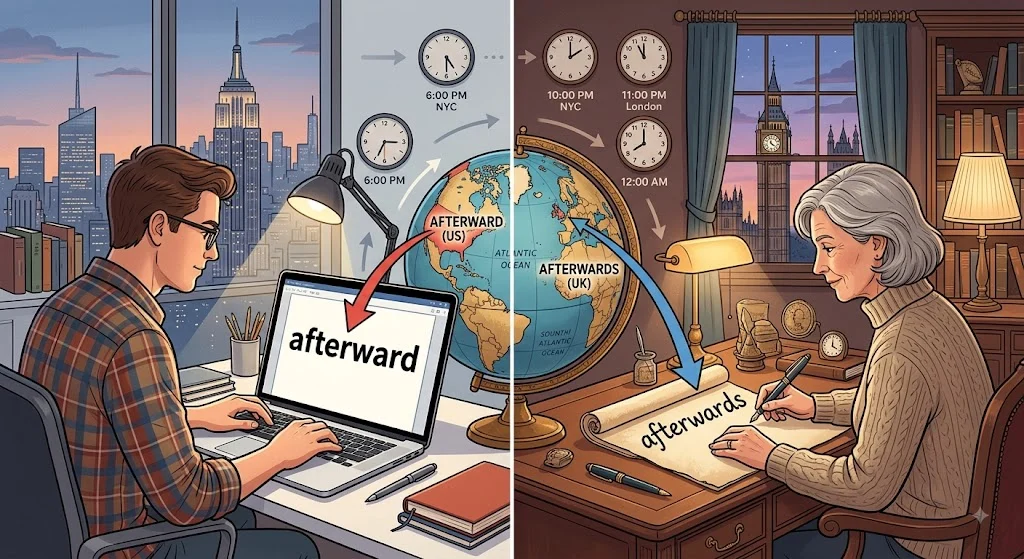
Quick Answer:Afterward and afterwards both mean “later” or “at a later time,” and both are grammatically correct.
Afterward is more common in American English, while afterwards is more common in British English.
“Afterward” and “afterwards” both mean “at a later time” or “later.” They are often used in the same way, so choosing between them can be confusing for English learners.
The main difference is regional preference rather than meaning. “Afterward” is more common in American English, while “afterwards” is widely used in British English. Both forms are correct.
Afterward vs Afterwards: What’s the Difference?
The short answer is that there is no difference in meaning or grammatical function. Both words are adverbs, and both mean “at a later time” or “after something has happened”. The distinction is entirely regional:
- Afterward is the preferred spelling in American English and Canadian English.
- Afterwards is the preferred spelling in British English, Australian English, and other Commonwealth varieties.
Both forms are listed in major dictionaries, including Merriam Webster and Oxford, and both are considered grammatically correct. The table below summarises the key differences:
| Feature | Afterward | Afterwards |
| Part of speech | Adverb | Adverb |
| Meaning | At a later time; subsequently | At a later time; subsequently |
| Regional preference | American English, Canadian English | British English, Australian English, Commonwealth English |
| Formality | Neutral | Neutral (slightly more common in formal British writing) |
| Interchangeable? | Yes | Yes |
Mini recap: Both words are adverbs with identical meanings. Afterward is the American spelling; afterwards is the British spelling. You can use either one, but consistency matters.
Is Afterward vs Afterwards a Grammar, Vocabulary, or Usage Issue?
This is a usage issue rather than a strict grammar or vocabulary problem. The words are not grammatically different—they are both adverbs that modify verbs, adjectives, or other adverbs. They are not nouns, adjectives, or prepositions, so their function in a sentence remains identical regardless of which spelling you choose.
Interchangeable or Not?
Yes, afterward and afterwards are completely interchangeable in meaning. You can use either one in any context without changing the meaning of your sentence. The only consideration is regional appropriateness and consistency.
Formal vs Informal Usage
Both forms work in formal and informal settings. In American English, afterward is the standard choice for academic writing, business communication, and casual conversation alike. In British English, afterwards serves the same role across all registers. Neither form is inherently more formal or informal than the other.
Academic vs Casual Usage
In academic writing, the key is consistency. If you are following American English conventions (such as APA or Chicago style for US publications), use afterward. If you are following British English conventions (such as Oxford or Cambridge style), use afterwards. In casual writing, such as emails, text messages, or social media, you have more freedom—just pick one and stick with it.
Practical Usage of Afterward
Afterward is the go to choice for American and Canadian writers. It appears in everything from business reports to novels to everyday conversation.
Workplace example: The meeting ended at three o’clock, and afterward we finalised the budget projections.
Academic example: Participants completed the initial survey, and afterward they were asked to complete a follow up questionnaire.
Technology example: The system will perform a security scan, and afterward it will generate a detailed report of any vulnerabilities found.
Usage recap for afterward: Use this form when writing for American or Canadian audiences. It is concise, widely accepted, and the preferred choice in US style guides like the AP Stylebook.
Practical Usage of Afterwards
Afterwards is the standard choice for British, Australian, and Commonwealth writers. It carries the same meaning and function as its American counterpart.
Workplace example: We held the strategy session, and afterwards the team circulated the minutes to all stakeholders.
Academic example: The lecture concluded at noon, and afterwards the students gathered for a seminar discussion.
Technology example: The software update will install automatically, and afterwards the device will restart to apply the changes.
Usage recap for afterwards: Opt for this spelling when your audience is based in the UK, Australia, New Zealand, or other Commonwealth nations. It is the preferred form in British style guides and Oxford dictionaries.
When You Should NOT Use Afterward or Afterwards
While afterward and afterwards are versatile adverbs, there are situations where they are not the right choice. Here are common scenarios where you should avoid them:
- When you need a preposition: Use after instead. Afterward and afterwards are adverbs, not prepositions. You cannot say “afterward the meeting”—you must say “after the meeting”.
- When referring to a specific point in time: If you are referring to a precise time or sequence, later or subsequently might be more appropriate.
- When you mean “following in position”: These words refer to time, not physical location. Use behind or following for spatial relationships.
- When you mean “afterword”: Do not confuse afterward with afterword—the latter is a concluding section of a book.
- When writing for a mixed audience without a clear regional preference: If your readers include both Americans and Britons, choose one form and remain consistent throughout.
- When you have already used the other form in the same document: Switching between afterward and afterwards within a single piece of writing can appear inconsistent and unprofessional.
- When a style guide specifies otherwise: Always follow the style guide required by your publisher, institution, or employer.
- When you need to emphasise immediacy: If one event follows another very closely, immediately afterward or soon afterwards works, but sometimes then or next is clearer.
Common Mistakes and Decision Rules
Many writers make avoidable errors when choosing between afterward and afterwards. The table below highlights common mistakes and their corrections:
| Correct Sentence | Incorrect Sentence | Explanation |
| Afterward, we went to dinner. | Afterward dinner, we went to the movies. | Afterward is an adverb, not a preposition. Use after before a noun. |
| She called me afterwards. | She called me afterwards the event. | Again, afterwards cannot precede a noun. Use after or following. |
| The team celebrated afterward. | The team celebrated afterwardsly. | There is no such word as afterwardsly. |
| I will see you afterward. | I will see you after. | Both are correct, but after is more common as a preposition or conjunction. |
| He arrived shortly afterwards. | He arrived shortly after. | Both are correct, but afterwards is an adverb; after can be a preposition. |
Decision Rule Box
If you mean the action happens at a later time, use afterward (American English) or afterwards (British English). Both are adverbs and are used in the same way.
If you mean a person, a tool, or a thing, you are probably looking for a different word altogether—afterward and afterwards are never nouns. They only describe timing.
Afterward and Afterwards in Modern Technology and AI Tools
In the age of artificial intelligence and automated writing assistants, the distinction between afterward and afterwards has taken on new relevance. Many AI writing tools and grammar checkers default to American English spellings, often flagging afterwards as a suggestion for afterward even when the user is writing for a British audience. This can lead to unnecessary corrections and confusion.
For instance, popular tools like Grammarly and Microsoft Editor allow users to select their preferred English dialect. If you set your language to US English, the tool will recommend afterward; if you set it to UK English, it will recommend afterwards. Understanding this regional difference helps you override incorrect suggestions and maintain your intended voice.
Moreover, search engines and voice assistants are increasingly sophisticated in recognising regional variations. A user searching for “afterwards meaning” in the UK will see different results than a user searching for “afterward meaning” in the US. As content creators, knowing which form to use can improve your search visibility for specific geographic audiences.
The Origins of Afterward and Afterwards
The history of these two words sheds light on why both exist today. Afterward traces its roots to Old English æfterwearde, a combination of æft (meaning “after”) and weard (a directional suffix meaning “toward” or “in the direction of”). Originally, it meant “behind” or “in the rear,” but over time it shifted to mean “at a later time.”
The form afterwards emerged around the early 1300s, formed by adding the adverbial genitive suffix “s” to afterward. This extra “s” was a standard way in Middle English to build adverbs from existing words. Both forms coexisted for centuries, but American English gradually dropped the “s” in most directional adverbs, while British English retained it. This pattern appears across many word pairs: toward/towards, forward/forwards, backward/backwards, inward/inwards, and outward/outwards.
As the linguist David Crystal once observed, “American English tends to favour shorter, more economical forms, while British English often preserves older, more elaborate spellings.” This explains why afterward became the standard in the US while afterwards remained common in Britain.
Case Study: Global Publishing Consistency
A major international publishing house based in New York found that its editors were inconsistently using afterward and afterwards across its various imprints. Some editors preferred the American form, while others—particularly those working with UK based authors—used the British form. This inconsistency created confusion during the copyediting process and led to delays in publication.
The solution was simple: the publishing house adopted a style guide that specified afterward for all US editions and afterwards for all UK and Commonwealth editions. Within six months, editorial disputes over this issue dropped by nearly 90 percent, and the company reported faster turnaround times for manuscript editing.
Case Study: Academic Writing and International Students
A university in Australia surveyed its international students and found that many were unsure whether to use afterward or afterwards in their essays. Students from the US naturally used afterward, while students from the UK, India, and other Commonwealth countries used afterwards. This inconsistency occasionally led to markdowns from strict graders who expected a single, consistent style throughout each paper.
The university responded by including a brief section on regional spelling differences in its academic writing guide. Students were advised to choose one form and use it consistently, regardless of their personal background. After the guide was published, the number of errors related to afterward/afterwards dropped significantly, and student confidence in their writing improved.
Error Prevention Checklist
Before you hit publish or submit your next piece of writing, run through this quick checklist:
Always use afterward when:
- Writing for an American or Canadian audience
- Following US style guides like AP Stylebook or Chicago Manual of Style
- Your spellchecker is set to US English
- You are submitting to a US based publisher or institution
Never use afterward when:
- Writing for a British, Australian, or Commonwealth audience
- Following UK style guides like Oxford or Cambridge
- Your spellchecker is set to UK English
- You have already used afterwards elsewhere in the same document
Always use afterwards when:
- Writing for a British, Australian, or Commonwealth audience
- Following UK style guides
- Your spellchecker is set to UK English
- You are submitting to a UK based publisher or institution
Never use afterwards when:
- Writing for an American or Canadian audience
- Following US style guides
- Your spellchecker is set to US English
- You have already used afterward elsewhere in the same document
Related Grammar Confusions You Should Master
If you found the afterward versus afterwards distinction helpful, you might also want to explore these related topics:
- Toward vs Towards – Same regional distinction as afterward/afterwards
- Forward vs Forwards – Another directional adverb pair
- Backward vs Backwards – Same pattern
- Inward vs Inwards – Yet another example
- Outward vs Outwards – You get the idea
- Among vs Amongst – Regional variation with a similar pattern
- While vs Whilst – Another British/American difference
- After vs Afterward – Understanding the preposition versus adverb distinction
- Later vs Afterwards – Nuanced differences in timing and usage
- Subsequently vs Afterwards – Formal versus everyday alternatives
FAQs
- Is “afterward” or “afterwards” correct in American English?
“Afterward” is the more common form in American English, though “afterwards” is also correct. - Is “afterward” or “afterwards” correct in British English?
“Afterwards” is more common in British English, but “afterward” is also understood and accepted. - Can “afterward” and “afterwards” be used interchangeably?
Yes, both have the same meaning and can generally be used interchangeably. - Do “afterward” and “afterwards” mean “later”?
Yes, both mean “at a later time” or “subsequently.” - Which spelling should I use in formal writing?
Choose the form that matches your variety of English and keep your usage consistent. - What is the difference between “afterward” and “afterword”?
“Afterward” is an adverb meaning “later,” while “afterword” is a noun meaning a concluding section of a book.
Conclusion
In conclusion, afterward and afterwards have the same meaning and can generally be used interchangeably. Neither form is grammatically incorrect.
The choice mainly depends on your preferred style of English. Use afterward more often in American English and afterwards in British English, while keeping your usage consistent.

Philip Pullman is an American writer dedicated to creating clear and easy to follow English content. Through his work at LingRoya.com, he helps readers strengthen their language skills with practical and reliable guidance so that they can easily understand.