Quick Answer:
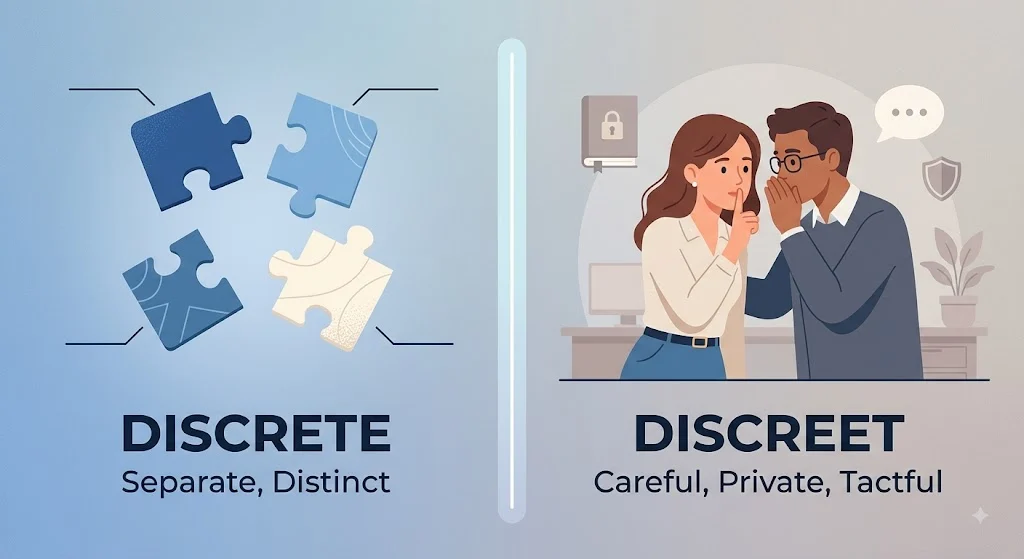
The difference between discrete or discreet is simple: discrete means separate, distinct, or individual (like discrete categories or discrete parts), while discreet means careful, tactful, or unobtrusive (like a discreet whisper or a discreet inquiry).
Discrete and discreet are two commonly confused English words because they sound almost the same, but their meanings are quite different. Discrete means separate, distinct, or individual, while discreet describes someone or something that is careful, private, or avoids attracting attention.
Understanding the difference between discrete vs. discreet can help you avoid common spelling and usage mistakes. In this guide, we’ll explain both words in simple terms, along with clear examples to show when to use discrete and when to use discreet.
Featured Snippet Optimization (Before Intro)
Add a concise direct answer paragraph (40–60 words) immediately after the title.
Include focus keyword exactly once.
Provide a clear, authoritative, human-written definition or explanation of the main query.
Format it as plain text, ready for Google snippet extraction.
Discrete vs Discreet: What’s the Difference?
Let us start with the fundamentals. Both discrete and discreet are adjectives, which means they are words used to describe nouns. They are also homophones, so they sound identical when spoken. But that is where the similarities end.
Discrete (adjective) means separate, distinct, individual, or consisting of unconnected parts. When something is discrete, it stands alone and is not joined to anything else. Think of it as describing things that can be counted or divided into clear categories.
Discreet (adjective) means careful, prudent, tactful, or unobtrusive. When someone is discreet, they are cautious about what they say or do, especially to avoid embarrassment or to keep something private. It can also describe something that is modest and not likely to attract attention.
Here is a comparison table to make the difference crystal clear:
| Discrete | Discreet |
| Means separate, distinct, individual | Means careful, tactful, private, unobtrusive |
| Describes things, categories, parts, or units | Describes people, behaviour, actions, or objects |
| Used in technical, academic, and scientific contexts | Used in social, professional, and personal contexts |
| Example: “The data was divided into discrete categories.” | Example: “She made a discreet inquiry about the job.” |
| Noun form: discreteness | Noun form: discretion |
| The two ‘e’s are separated by the ‘t’ | The two ‘e’s are together |
Mini Recap: Discrete is about separation and distinctness. Discreet is about privacy and tact. One describes how things are arranged; the other describes how people behave. Remember that discrete has its ‘e’s kept apart, just like the things it describes, while discreet keeps its ‘e’s together, like two people sharing a secret.
Is Discrete vs Discreet a Grammar, Vocabulary, or Usage Issue?
This is an excellent question because it helps us understand exactly what we are dealing with. The confusion between discrete or discreet is primarily a vocabulary and usage issue, though it does have grammatical implications since both words are adjectives.
Are they interchangeable? Absolutely not. Using one when you mean the other changes the meaning of your sentence completely. You cannot swap them and hope for the best.
Formal versus informal usage: Both words are perfectly acceptable in formal and informal contexts, but discrete appears much more frequently in formal, technical, and academic writing. You will encounter discrete in mathematics, computer science, statistics, and scientific research. Discreet, on the other hand, is common in both formal and informal settings, from business communications to everyday conversation.
Academic versus casual usage: In academic writing, discrete is the workhorse. You will see it in phrases like “discrete variables,” “discrete categories,” and “discrete data points.” Discreet appears less often in academic contexts unless the subject matter involves social behaviour, ethics, or professional conduct. In casual writing and speech, discreet is actually more common because people frequently talk about being discreet in social situations. You are far more likely to hear someone say “please be discreet” than “please be discrete.”
The bottom line is that this is a usage problem born from identical pronunciation and a shared Latin root. The words drifted apart in meaning over centuries, but our ears still hear them as one. Your job as a writer is to let your eyes and your brain do the work that your ears cannot.
Understanding “Discrete” in Depth
Let us dive deeper into discrete because this is the word that often trips people up, especially in professional and academic settings.
Workplace example: “The project manager broke the initiative down into five discrete phases, each with its own budget and timeline.” In this sentence, discrete tells us that the phases are separate and distinct from one another. Phase one is not phase two; they are individual units that can be managed independently.
Academic example: “The researchers identified three discrete categories of consumer behaviour: impulse buyers, brand loyalists, and price sensitive shoppers.” Here, discrete emphasises that each category is clearly defined and does not overlap with the others. A shopper belongs to one category or another, not to multiple categories at once.
Technology example: “The software architecture consists of several discrete microservices that communicate through APIs.” In the tech world, discrete is everywhere. It describes components that are separate, modular, and independently deployable. Each microservice is a discrete unit that can be updated without breaking the entire system.
Usage recap for discrete: Use discrete whenever you are talking about things that are separate, individual, distinct, or not connected. If you can replace discrete with “separate” or “individual” and the sentence still makes sense, you have chosen the right word.
Understanding “Discreet” in Depth
Now let us turn our attention to discreet, the word that deals with behaviour, privacy, and tact.
Workplace example: “The HR manager was discreet when handling the sensitive personnel matter, ensuring that no confidential information was shared with unauthorized staff.” In a professional environment, being discreet is a highly valued quality. It means you can be trusted with sensitive information and that you know how to handle delicate situations without causing embarrassment or conflict.
Academic example: “The researcher conducted discreet interviews with participants who wished to remain anonymous.” In academic research, especially in fields like sociology or psychology, discretion is essential for protecting participant privacy. A discreet researcher respects boundaries and maintains confidentiality.
Technology example: “The messaging app includes a discreet notification feature that displays alerts without showing message content on the lock screen.” In technology, discreet often describes features that are subtle, unobtrusive, or privacy preserving. A discreet notification does not broadcast your private information to anyone who happens to glance at your phone.
Usage recap for discreet: Use discreet whenever you are talking about careful, tactful, or private behaviour. If you can replace discreet with “careful,” “tactful,” or “unobtrusive” and the sentence still works, you have made the right choice. Also remember that the noun form of discreet is discretion, which is a word you already know and use correctly.
When You Should NOT Use Discrete or Discreet
Knowing when to use each word is important, but knowing when NOT to use them is just as valuable. Here are some common scenarios where writers get into trouble:
- Do not use discrete when you mean careful or private. Saying “he was discrete about the surprise party” is incorrect because you are describing behaviour, not separation. The correct word is discreet.
- Do not use discreet when you mean separate or distinct. Saying “the report was divided into discreet sections” is wrong because you are describing categories that are separate from each other. The correct word is discrete.
- Do not use discrete to describe a person’s personality. People are not “discrete” in the sense of being separate from others (unless you are making a philosophical point about individuality). People can be discreet, meaning careful and tactful.
- Do not use discreet in mathematical or statistical contexts. Mathematics deals with discrete variables, discrete data, and discrete distributions. Using discreet in these contexts would be a serious error.
- Do not assume the noun discretion relates to discrete. This is a surprisingly common mistake. The noun form of discreet is discretion. The noun form of discrete is discreteness. They are not interchangeable.
- Do not use discrete when describing something subtle or modest. A “discrete necklace” would mean a necklace made of separate parts, not a modest or understated piece of jewellery. The correct word for understated is discreet.
- Do not use discreet when discussing computer science concepts like “discrete mathematics” or “discrete structures.” These are fixed terms that use discrete exclusively.
- Do not rely on spellchecker to catch this error. Spellcheckers will not flag either word because both are correctly spelled. You must catch this mistake with your own knowledge and careful proofreading.
Common Mistakes and Decision Rules
Let us look at some real examples of correct and incorrect usage. This table will help you see the difference clearly:
| Correct Sentence | Incorrect Sentence | Explanation |
| “The data was divided into discrete categories.” | “The data was divided into discreet categories.” | Categories are separate from each other, so discrete is correct. |
| “Please be discreet about the surprise party.” | “Please be discrete about the surprise party.” | The request is for careful, private behaviour, so discreet is correct. |
| “The company operates three discrete divisions.” | “The company operates three discreet divisions.” | Divisions are separate business units, so discrete is correct. |
| “She made a discreet inquiry about the position.” | “She made a discrete inquiry about the position.” | The inquiry was quiet and careful, not separate, so discreet is correct. |
| “The study identified discrete patterns in the data.” | “The study identified discreet patterns in the data.” | Patterns are distinct and separate, so discrete is correct. |
| “He wore a discreet grey suit to the interview.” | “He wore a discrete grey suit to the interview.” | The suit was understated and modest, so discreet is correct. |
Decision Rule Box:
If you mean the action of being careful, private, or tactful, use discreet.
If you mean the state of being separate, distinct, or individual, use discrete.
Here is a simple way to think about it: Discreet is about how you act. Discrete is about how things are arranged.
Discrete and Discreet in Modern Technology and AI Tools
The distinction between discrete or discreet has taken on new relevance in the age of artificial intelligence and modern technology.
In the world of AI and machine learning, discrete is a fundamental concept. Discrete data consists of separate, distinct values that can be counted. For example, the number of users who click a button is a discrete value, while the time they spend on a page is continuous. AI models often work with discrete variables in classification tasks, where inputs are sorted into distinct categories.
Meanwhile, discreet has become increasingly important in discussions about privacy, data protection, and user experience. Discreet AI refers to systems that operate without being intrusive or obvious. A discreet virtual assistant responds to voice commands without broadcasting your private conversations. Discreet notifications appear without revealing sensitive content. In an era of constant surveillance and data collection, the demand for discreet technology is growing rapidly.
Even search engines like Google care about this distinction. When you search for information about discrete or discreet, the algorithm must understand which meaning you intend. This is why search results often include definitions and clarifications for both words. As content creators, we must be precise in our language so that our work ranks for the right queries and reaches the right audience.
The Etymology and Authority Behind the Words
Understanding where these words come from adds depth to our knowledge and helps cement the difference in our minds.
Both discrete and discreet trace their origins to the Latin word discretus, which means “separated” or “distinct.” Discretus itself comes from the verb discernere, meaning “to separate” or “to discern.” The words entered English in the 14th century, with discrete arriving slightly earlier. For a long time, the spellings were used interchangeably. But by the 16th century, the spellings diverged and the meanings became fixed.
Here is an interesting twist: Discrete stayed closer to the original Latin meaning of “separate.” Meanwhile, discreet developed a secondary meaning connected to discernment and good judgment, which is why it came to mean “careful” and “tactful.” This is also why the noun discretion belongs to discreet and not to discrete.
As the linguist and lexicographer Kory Stamper once observed, “The English language is a magnificent mess, and words like discreet and discrete are perfect examples of how meaning and spelling can drift apart over time, leaving us with twin words that share a birth but not a destiny.
Case Study One: The Corporate Email That Cost a Promotion
A mid level manager at a financial services firm sent an email to senior leadership describing his team as “discreet units” rather than “discrete units.” He meant to say that his team members operated as separate, specialised groups. Instead, he implied that they were secretive and untrustworthy. The error was noticed by a sharp eyed executive, and the manager was passed over for a promotion. This true story illustrates how a single word choice can shape perceptions in a professional setting.
Case Study Two: The Academic Paper That Lost Credibility
A graduate student submitted a research paper on statistical methods, using the word discreet repeatedly instead of discrete. Phrases like “discreet variables” and “discreet data points” appeared throughout the manuscript. The paper was returned with extensive corrections and a note from the supervisor about the importance of precision in academic writing. The student had to spend an entire weekend revising the paper, and the experience taught a lasting lesson about the value of mastering commonly confused words.
Error Prevention Checklist
Use this checklist every time you write discrete or discreet:
Always use discrete when:
- You are describing separate or distinct items, categories, or parts
- You are writing about mathematics, statistics, or computer science
- You can replace the word with “separate” or “individual”
- The noun form would be discreteness
- The two ‘e’s are separated in your mind by the ‘t’
Never use discreet when:
- You are describing categories, data, or variables
- You are writing in a technical or scientific context
- You mean “separate” or “distinct”
- The word discretion would not make sense as the noun form
Always use discreet when:
- You are describing careful, tactful, or private behaviour
- You are talking about someone keeping a secret
- You can replace the word with “careful,” “tactful,” or “unobtrusive”
- The noun form would be discretion
- The two ‘e’s are together, like two people whispering
Never use discrete when:
- You are describing how someone behaves
- You mean “careful” or “private”
- You are talking about keeping something confidential
- The word discretion would be the appropriate noun
Related Grammar Confusions You Should Master
Once you have mastered the difference between discrete or discreet, you might want to tackle these other commonly confused word pairs:
- Affect vs Effect – One is usually a verb, the other a noun
- Complement vs Compliment – One completes, the other praises
- Principal vs Principle – One is a person or primary thing, the other is a rule
- Stationary vs Stationery – One means not moving, the other is writing paper
- Accept vs Except – One means to receive, the other means to exclude
- Advice vs Advise – One is a noun, the other is a verb
- Practice vs Practise – One is a noun, the other is a verb (in British English)
- Elicit vs Illicit – One means to draw out, the other means illegal
- Imply vs Infer – One suggests, the other deduces
- Farther vs Further – One is for physical distance, the other for metaphorical
FAQs
1. What is the difference between discrete and discreet?
Discrete means separate or distinct, while discreet means careful, private, or tactful.
2. When should I use discrete instead of discreet?
Use discrete when describing something separate, individual, or distinct from others.
3. When should I use discreet in a sentence?
Use discreet when referring to careful, private, or unobtrusive behaviour.
4. Are discrete and discreet interchangeable?
No. They have different meanings: discrete means separate, while discreet means careful or private.
5. What is an easy way to remember discrete vs. discreet?
Think of discrete as “separate” and discreet as “private” or “careful.”
6. Is discretion the noun form of discreet?
Yes. Discretion is related to discreet, while discreteness is the noun form of discrete.
7. Why do discrete and discreet sound the same?
They are homophones, meaning they have the same pronunciation but different meanings and spellings
Conclusion
Mastering the difference between discrete or discreet is a mark of a careful and confident writer. These two words may sound identical, but their meanings could not be more different. One is about separation and distinctness, the other about privacy and tact. By understanding their definitions, practising with real world examples, and using the memory tricks and decision rules in this guide, you can avoid the common pitfalls that trip up even experienced writers.
Remember that language is a tool, and using it precisely is how we build trust, credibility, and authority. Whether you are writing a business report, an academic paper, or a simple email, choosing the right word matters. The next time you pause over discrete or discreet, you will know exactly which one to choose.

Margaret Atwood is an American writer who contributes to LingRoya.com creating clear and engaging content about the English language and everyday communication. She enjoys helping readers build confidence in their writing through simple, practical guidance.