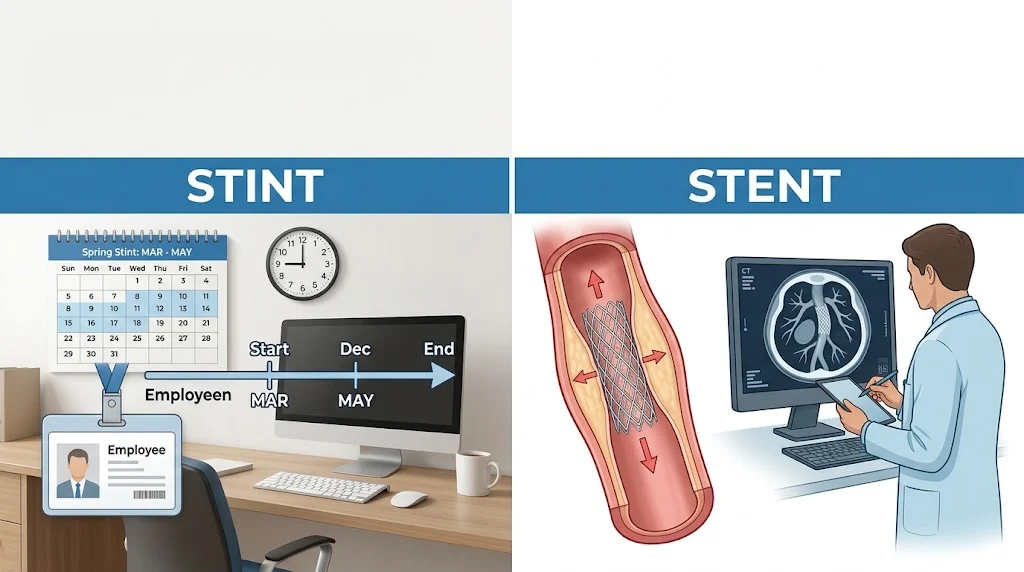
Quick Answer: Stint means a limited period of work, activity, or service, while stent is a small medical device, usually a tube or mesh structure, placed inside a bodily passage to keep it open. The words sound similar, but their meanings are completely different.
Stint is primarily a noun meaning a limited period of time spent doing a particular job, activity, or role. It can also function as a verb meaning to restrict, limit, or be sparing with something.
Stent is primarily a noun in medical English. It refers to a small tube or mesh device inserted into a bodily passage, such as an artery or airway, to help keep it open. The National Heart, Lung, and Blood Institute describes a stent as a small mesh tube used to hold open passages in the body, including narrowed blood vessels.
| Feature | Stint | Stent |
| Part of speech | Noun and verb | Noun, with related verb usage |
| Main meaning | A limited period or amount | A medical device that helps keep a passage open |
| Common context | Work, service, activity, time | Medicine, cardiology, surgery |
| Example | “She had a two year stint at the company.” | “The patient received a coronary stent.” |
| Related expression | A stint of work | Stent placement |
| Meaning connected to medicine | Usually no | Yes |
Mini Recap
Stint refers to a limited period, amount, or span of activity.
Stent refers to a medical device.
A job, career, or assignment can involve a stint.
An artery or airway can receive a stent.
Is Stint or Stent a Grammar, Vocabulary, or Usage Issue?
This is mainly a vocabulary and usage issue rather than a grammar problem. Both words are legitimate English terms, but they have different meanings and appear in different contexts.
They aren’t interchangeable. Replacing one with the other can change the entire meaning of a sentence.
For example, “He completed a three year stint overseas” refers to a period of time. On the other hand, “He received a stent after an artery became narrowed” refers to a medical procedure.
The distinction matters even more in academic and professional writing. In workplace communication, stint is common when describing someone’s employment history. In medical writing, stent has a precise technical meaning.
Casual speech can sometimes make the words difficult to distinguish because their pronunciation is similar. Careful spelling is therefore essential when writing them.
How to Use Stint Correctly
The noun stint commonly describes a defined or limited period spent doing something. It can be a period of employment, military service, volunteering, study, travel, or another activity.
For example:
“After a brief stint in sales, Daniel moved into marketing.”
Here, stint means a period during which Daniel worked in sales.
The word can describe both short and relatively long periods, although it often suggests that the period has a recognizable beginning and end.
Workplace Example
“Maria completed a five year stint as a project manager before moving into executive leadership.”
This sentence uses stint naturally because it describes a defined period in someone’s career.
Academic Example
“During his stint at the university, the researcher published several papers on linguistics.”
The word works well because it refers to the period during which the researcher was associated with the university.
Technology Example
“The engineer’s first stint in software development gave him the experience needed to build an artificial intelligence platform.”
Again, stint describes a period of professional activity.
Usage Recap
Use stint when talking about a period of time, especially a limited period of work or activity.
Think about phrases such as a brief stint, a long stint, a stint in journalism, or a stint as a teacher.
How to Use Stent Correctly
A stent is a medical device designed to help keep a passage open. Stents are commonly associated with blood vessels, particularly coronary arteries, but they can also be used in other parts of the body, including certain airways and the aorta.
In coronary procedures, a healthcare professional can guide a catheter to a narrowed or blocked artery and place a stent to help maintain the opening. The NHLBI explains that stenting is a minimally invasive procedure and that stents can be used during percutaneous coronary intervention.
Workplace Example
“The hospital employee explained that the patient would require a stent, but the final treatment decision would be made by the cardiology team.”
This is a workplace example in a healthcare setting, where stent has a strictly medical meaning.
Academic Example
“The researchers compared outcomes among patients who received different types of coronary stents.”
Medical and scientific writing frequently uses stent when discussing vascular interventions.
Technology Example
“Engineers have developed advanced imaging systems that help physicians position a stent more precisely.”
This demonstrates how the word can appear in technical discussions involving medical technology.
Usage Recap
Use stent when referring to a medical device or the procedure involving its placement.
A stent is not a period of work, and a stint is not a medical implant.
When You Should NOT Use Stint or Stent
Knowing when not to use these words can prevent some of the most common mistakes.
- Don’t use stent when you mean a period of employment.
- Don’t use stint when you mean a medical tube or mesh device.
- Don’t write “a two year stent at the company.” The correct word is stint.
- Don’t write “the doctor inserted a stint into the artery.” The medical term is stent.
- Don’t use stint as a general synonym for every period of time. It usually suggests a particular period of activity, employment, or service.
- Don’t assume similar pronunciation means the words have related meanings.
- Don’t replace stent with a more familiar word such as stint in medical writing because the resulting sentence can become factually wrong.
- Don’t rely solely on spell checking. A spell checker may recognize both words even when the wrong one has been selected.
Common Mistakes and Decision Rules
| Correct sentence | Incorrect sentence | Explanation |
| “She had a two year stint in advertising.” | “She had a two year stent in advertising.” | A period of employment is a stint. |
| “The doctor inserted a stent into the artery.” | “The doctor inserted a stint into the artery.” | A medical device is a stent. |
| “His brief stint in journalism taught him valuable skills.” | “His brief stent in journalism taught him valuable skills.” | The meaning is a limited period of work. |
| “The patient received a coronary stent.” | “The patient received a coronary stint.” | Coronary treatment can involve a stent. (NHLBI, NIH) |
| “She served a short stint overseas.” | “She served a short stent overseas.” | The sentence describes a period of service. |
Decision Rule Box
If you mean a limited period of work, service, or activity, use STINT.
If you mean a medical device designed to help keep a passage open, use STENT.
A quick memory trick is simple: stint is about time, stent is about treatment.
Stint or Stent in Modern Technology and AI Tools
Artificial intelligence tools can help explain confusing word pairs, but they can also make mistakes when context is incomplete.
For example, an AI writing assistant should identify “three year stint” as a career or employment expression. It should identify “coronary stent” as medical terminology.
This distinction illustrates an important principle in AI supported writing: context matters. Both stint and stent are valid dictionary words, so a grammar application cannot simply flag one as incorrect. The system has to determine which meaning fits the sentence.
Medical AI tools require even greater caution. A system can explain what a stent is, but it should not diagnose a patient or recommend a procedure based solely on an online conversation.
Etymology: Where Did Stint and Stent Come From?
Stint has a much older history in English. Etymological evidence traces the noun to the early fourteenth century, when it referred to a pause or stopping, and later to a fixed or allotted amount of work. The verb developed meanings involving limiting, restraining, or being sparing.
Stent, by contrast, is a specialized medical term associated with medical devices used to maintain the opening of bodily passages. Today it is firmly established in medical vocabulary.
The very different histories of these words help explain why their meanings are not connected, even though their spellings are remarkably similar.
Authority and Trust: What Does a Stent Actually Do?
The National Heart, Lung, and Blood Institute explains:
“A stent is a small mesh tube that holds open passages in the body.”
For coronary disease, stents are often placed during percutaneous coronary intervention to help keep narrowed arteries open. Some coronary stents are drug eluting, meaning they release medicine intended to reduce the risk of the treated artery narrowing again.
Stent placement is not the appropriate treatment for every person with arterial disease. The NHLBI notes that healthcare providers consider the patient’s overall condition, risks, and alternative treatments before recommending a stent.
Two Specific Case Studies
Case Study One: Drug Eluting Versus Bare Metal Stents
A large randomized study of 9,013 patients compared contemporary drug eluting stents with bare metal stents over a median follow up period of six years.
The study found no significant difference in the combined outcome of death from any cause and nonfatal spontaneous heart attack. However, repeat revascularization occurred in 16.5 percent of patients receiving drug eluting stents compared with 19.8 percent receiving bare metal stents. Definite stent thrombosis occurred in 0.8 percent and 1.2 percent, respectively.
The lesson is that modern stent research evaluates several outcomes rather than simply asking whether a device works.
Case Study Two: Paclitaxel Eluting Stents After Heart Attack
Another randomized study included 3,006 patients presenting with ST segment elevation myocardial infarction. After 12 months, ischemia driven target lesion revascularization occurred in 4.5 percent of patients receiving paclitaxel eluting stents compared with 7.5 percent of those receiving bare metal stents. The researchers also found a noninferior composite safety outcome.
These findings illustrate how stent technology has been evaluated through measurable clinical outcomes.
Author Bio: Written by a professional English language and SEO content specialist with expertise in vocabulary, usage, technical terminology, search intent, and evidence based educational writing.
Error Prevention Checklist
Always use Stint when
You mean a period of employment.
Mean a defined period of service.
✓ You are describing time spent performing an activity.
Talking about a limited or allotted amount.
Never use Stent when
✓ You mean a career period.
Mean a work assignment.
✓ You are describing someone’s time at a company.
✓ You mean a period of military or public service.
Always use Stent when
✓ You mean a medical device.
Discussing coronary artery treatment.
✓ You are referring to a device used to keep a narrowed passage open.
Related Grammar Confusions You Should Master
Once you’ve learned this pair, several other easily confused words are worth studying:
Stationary or stationery
Principal or principle
Compliment or complement
Advice or advise
Practice or practise
Lose or loose
Then or than
Accept or except
Its or it’s
These pairs demonstrate the same fundamental lesson: similar spelling or pronunciation does not guarantee similar meaning.
FAQs
What is the difference between stint and stent?
A stint is a limited period of time spent doing an activity, job, or service. A stent is a medical device designed to help keep a bodily passage open.
Is stint a medical term?
Usually, no. In general English, stint refers to a limited period, amount, or activity. It should not be confused with the medical term stent.
What does stint mean in a job?
In employment contexts, stint means a period spent working in a particular role, company, profession, or field. For example, “She had a three year stint in publishing.”
What does stent mean in medical terms?
A stent is a small device used to help keep a passage in the body open. Stents are commonly used in narrowed arteries and may also be used in other passages such as certain airways.
Is it a stint or stent at a company?
The correct word is stint. A person has a stint at a company because the word describes a period of employment or activity.
Is it stint or stent in the heart?
The correct word is stent. A coronary stent can be placed in a narrowed or blocked coronary artery during an appropriate medical procedure.
Can stint be used as a verb?
Yes. As a verb, stint can mean to limit, restrict, or be sparing with something. Its older history includes meanings associated with stopping or limiting.
How can I remember stint versus stent?
Associate stint with time and stent with treatment. A stint is a period. A stent is a medical device.
Conclusion
Understanding stint or stent becomes easy once you connect each word with its core meaning. Stint describes a limited period, amount, or span of activity, especially employment or service. Stent refers to a medical device that helps keep a narrowed bodily passage open.
The difference is only one letter, but the practical distinction is substantial. A journalist might write about an athlete’s “stint with the club,” while a medical report might describe a patient’s “coronary stent.” The first concerns time and experience. The second concerns medical treatment

Neil Gaiman is an American writer who contributes educational content to LingRoya.com. His work focuses on helping readers improve their English with clear, practical and easy to follow guidance.