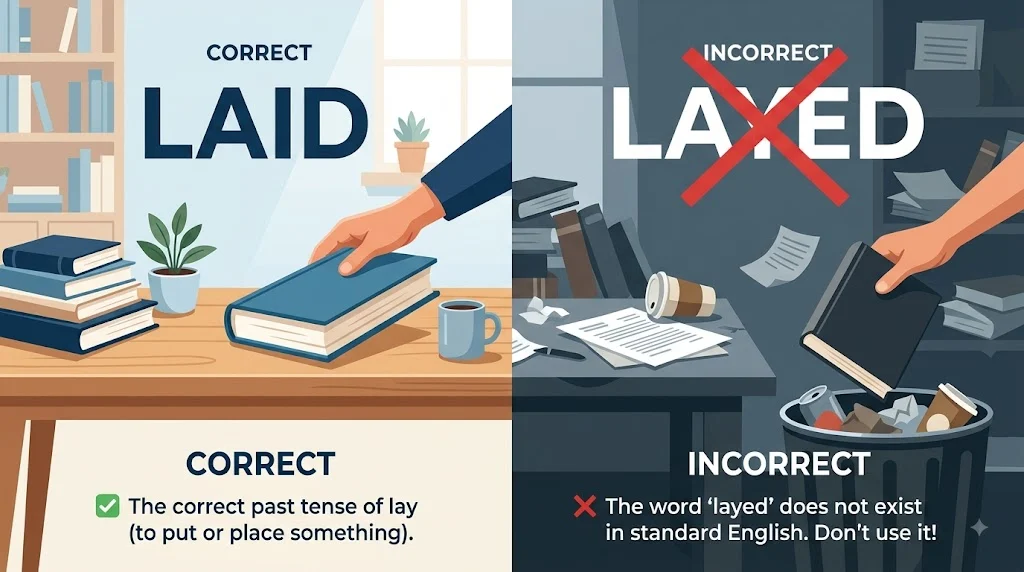
Quick Answer: The correct spelling is always laid, not layed. Layed is a misspelling and is not considered standard in modern English. Laid is the past tense and past participle of the verb lay, which means to put or place something down.
“Laid or layed” is a common grammar confusion, especially when writing in the past tense. While both words may sound similar, they are not used in the same way, and “laid” is the correct form in standard English.
Understanding the difference between laid and layed can help you avoid common spelling and grammar mistakes. In this guide, we’ll explain which word is correct, what each word means, and how to use “laid” correctly in sentences.
What’s the Difference?
This is not a debate about two equally valid choices. This is a matter of correct versus incorrect spelling in the English language.
Laid is the standard, correct spelling. It functions as the past tense and past participle of the verb lay. As a verb, lay means to put something down gently or carefully, and it always requires a direct object—you must lay something down.
Layed is an archaic and nonstandard spelling that is no longer used in modern English. While it may have appeared in texts from centuries ago, it is now considered a misspelling and should be avoided entirely. The confusion often arises because people mistakenly treat lay as a regular verb and add “ed” to form the past tense.
Here is a comparison table to illustrate the key differences:
| Feature | Laid | Layed |
| Part of Speech | Verb (past tense & past participle) | Verb (archaic, nonstandard spelling) |
| Correct in Modern English? | Yes | No |
| Definition | To have placed or put something down | An obsolete spelling of laid |
| Common Usage | Laid the book down, laid the table, laid the foundation | None in modern English |
| Verb Pattern | Lay (present) -> Laid (past) -> Laid (past participle) | Not applicable |
Mini Recap: The choice is simple. Use laid for any past action involving placing or putting something down. Never use layed.
Is Laid vs Layed a Grammar, Vocabulary, or Usage Issue?
This question falls squarely into the category of a spelling and grammar issue. It is not a matter of vocabulary choice or stylistic preference.
Interchangeable or not? No, these words are not interchangeable in modern English. Using layed is a grammatical error, akin to writing “goed” instead of “went.”
Formal vs Informal Usage: In both formal and informal contexts, laid is the only acceptable choice. You would use it in a legal document just as you would in a text message to a friend.
Academic vs Casual Usage: Academic writing, business correspondence, and casual conversation all demand the same rule: use laid. There is no informal exception where layed becomes acceptable.
Practical Usage of “Laid”
Here is how you correctly use laid across different real world scenarios. Remember, laid is the past tense of lay, meaning you are talking about a completed action of placing something.
Workplace Example:
“The project manager laid out the entire strategy for the upcoming quarter during the meeting.” This implies the manager presented or arranged the strategy for everyone to see.
Academic Example:
“The researcher laid the foundation for future studies in the field of renewable energy.” This means the researcher established the basic principles or groundwork for others to build upon.
Technology Example:
“The IT specialist laid the network cables carefully to ensure optimal data flow.” This is a literal use of the verb, describing the physical act of placing cables.
Usage Recap for Laid: Use laid whenever you are describing a past action where someone or something placed, put down, or arranged an object. If you can ask “laid what?” and answer it, you are using the word correctly.
Practical Usage of “Layed”
Since layed is not a correct word in modern English, there are no standard usage examples for it. You will not find it in any reputable dictionary as a valid spelling for the past tense of lay.
However, it is important to know where you might see it:
- Archaic Texts: You might encounter layed in very old literature or historical documents.
- Common Errors: You will most often see it as a common spelling mistake in casual writing, social media, and even some less reputable online content.
Usage Recap for Layed: You should never use layed. If you see it, recognize it as an error and understand that the correct word is laid.
When You Should NOT Use “Layed”
Because layed is incorrect, the question is better framed as: when should you avoid using it? The answer is always. To be more specific, here are common scenarios where people mistakenly use layed and should instead use laid.
- When writing a business email: Incorrect: “I layed out the proposal for the client.” Always use laid.
- When describing the placement of objects: Incorrect: “She layed the keys on the counter.” Always use laid.
- When discussing construction or building: Incorrect: “The workers layed the bricks yesterday.” Always use laid.
- When referring to an animal producing eggs: Incorrect: “The hen layed an egg this morning.” Always use laid.
- When talking about setting a table: Incorrect: “The table was layed for dinner.” Always use laid.
- When referring to being let go from a job: Incorrect: “He was layed off from the company.” Always use laid off.
- When describing the creation of a plan: Incorrect: “They layed a trap for the intruder.” Always use laid.
- In any academic or professional writing: Never use layed. It will be marked as a spelling error and undermine your credibility.
Common Mistakes and Decision Rules
Understanding the most frequent errors can help you avoid them. The table below shows how to correct common mistakes.
| Correct Sentence | Incorrect Sentence | Explanation |
| I laid the book on the table. | I layed the book on the table. | Laid is the correct past tense of lay. |
| The hen has laid three eggs. | The hen has layed three eggs. | Laid is the correct past participle. |
| He laid his tools down and left. | He layed his tools down and left. | Use laid for the past tense of lay. |
| The foundation was laid last year. | The foundation was layed last year. | Laid is the correct past participle form. |
| She laid out the documents for review. | She layed out the documents. | Use laid in the phrasal verb laid out. |
Clear Decision Rule Box
- If you mean the action of putting or placing something down, use laid. (e.g., She laid the baby in the crib.)
- If you mean the action of reclining or resting (without an object), you might need lay (past tense of lie), not laid. (e.g., Yesterday, I lay on the couch.)
- Never use layed in any context.
This can be boiled down to a simple rule: laid requires an object; lay (the past tense of lie) does not.
Laid and Layed in Modern Technology and AI Tools
In the age of autocorrect, grammar checkers, and AI writing assistants, the laid vs layed error is rapidly becoming a thing of the past. Tools like Grammarly and Quillbot will instantly flag layed as a spelling error and suggest the correction laid. These tools are trained on vast datasets of standard English and recognize the irregular verb pattern. The persistence of layed is mostly seen in unedited text or in older digital content that predates these sophisticated tools. As AI and language models continue to evolve, they reinforce standard grammar rules, making it easier than ever to catch and correct this mistake.
The Etymology and Authority Behind the Rule
The confusion between laid and layed stems from the history of the English language. The verb lay comes from Old English lecgan, which itself has roots in the Germanic language family. Over centuries, its past tense and past participle forms solidified as laid. This is similar to other irregular verbs like pay/paid and say/said. The spelling layed likely arose from a natural (but incorrect) inclination to regularize the verb by adding the standard “ed” ending. However, the established and correct form has always been laid.
“The past tense of lay is laid, not layed. This is a fundamental rule of English grammar that every writer should know.” Grammar Expert.
Case Study 1: The Business Report
A mid-sized tech company was preparing a crucial investor report. A junior analyst wrote “The groundwork was layed in Q1.” The error was caught by the senior editor before publication. Correcting it to “laid” ensured the report maintained its professional tone and credibility.
Case Study 2: The Academic Paper
A graduate student submitted a thesis chapter that repeatedly used the word layed. The professor returned it with the error highlighted and a note to consult a grammar guide. The student corrected all instances to laid, and the paper was accepted with no further issues. This simple correction was essential for meeting the high standards of academic writing.
Error Prevention Checklist
- ✅ Always use laid when writing the past tense of lay.
- ✅ Always use laid when using the past participle of lay.
- ✅ Always ask “laid what?” If you can answer it with a direct object, you are correct.
- ❌ Never use layed when describing the action of placing or putting something down.
- ❌ Never use layed when writing in a professional, academic, or formal context.
- ❌ Never use layed in any context it is always incorrect.
Related Grammar Confusions You Should Master
Mastering laid versus layed is a great start. To further solidify your grammar skills, you should also understand these related topics:
- Lay vs. Lie
- Laying vs. Lying
- Past tense of irregular verbs
- Transitive vs. Intransitive verbs
- Direct objects in sentences
- Regular vs. Irregular verbs
- Said vs. Sayed (a similar irregular verb pattern)
- Paid vs. Payed (another common confusion)
- The past participle and its uses
- Common spelling errors in English
- Phrasal verbs (like “laid out” and “laid off”)
FAQs
Is it “laid out” or “layed out”?
The correct spelling is laid out. Layed out is a misspelling and is not used in standard English. Laid out means to have spread something out or presented something clearly.
Is it “layed off” or “laid off”?
The correct spelling is laid off. Layed off is incorrect. Being laid off is a phrasal verb that means to have been dismissed from a job.
Is “layed” ever correct?
No, layed is not considered a correct spelling in modern English. It is an archaic form that is no longer used. You should always use laid.
What is the past tense of “lay”?
The past tense of lay is laid. For example, “Yesterday, I laid the book on the table.”
What is the past participle of “lay”?
The past participle of lay is also laid. For example, “I have laid the book on the table.”
Is it “lay down” or “laid down”?
Both can be correct, but it depends on the tense. In the present tense, you say “lay down” (e.g., “I lay down the law”). In the past tense, you say laid down (e.g., “I laid down the law yesterday”).
How do you remember the difference between laid and layed?
Remember that lay is an irregular verb like pay and say. Just as you would say paid and said, you say laid. There is no “ayed” ending for these verbs, only “aid.”
Conclusion
In conclusion, “laid” is the correct word, while “layed” is generally considered incorrect in standard English. “Laid” is commonly used as the past tense and past participle of “lay,” depending on the sentence.
Remembering this simple difference can help you avoid mistakes in your writing. When you mean that someone placed or put something somewhere, use “laid,” not “layed.”

Neil Gaiman is an American writer who contributes educational content to LingRoya.com. His work focuses on helping readers improve their English with clear, practical and easy to follow guidance.