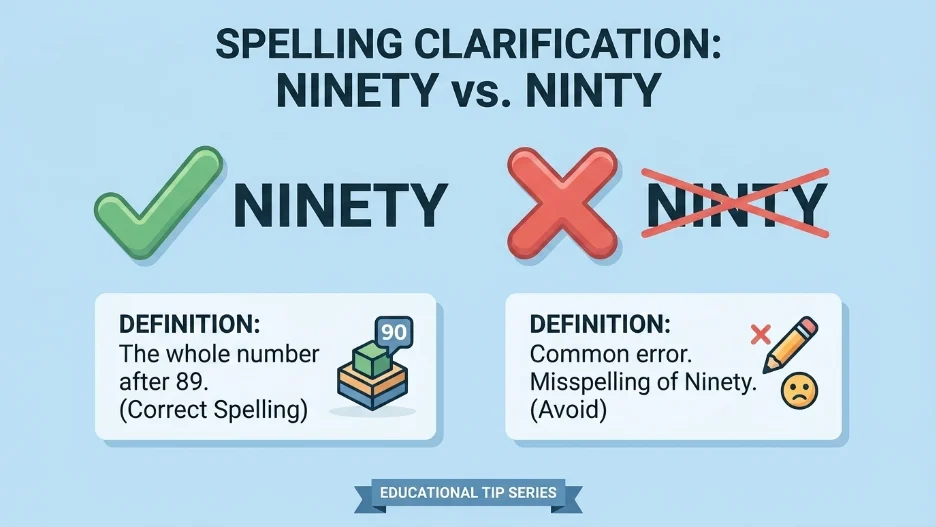
Quick Answer: Ninety is the correct spelling of the number 90. Ninty is a common spelling mistake and is not considered correct in standard English.
The words “ninty” and “ninety” are often confused because the correct spelling of the number 90 doesn’t follow the pattern many people expect. If you’ve ever wondered whether to write ninty or ninety, you’re not alone. This is a common spelling mistake among English learners and even native speakers.
The correct spelling is “ninety,” with an “e” before the final “ty.” The spelling “ninty” is incorrect in standard English. In this guide, we’ll explain why ninety is the correct form, how to use it in sentences, and share simple tips to help you remember the spelling.
Ninety vs Ninty: What’s the Difference?
Let’s define both terms clearly to understand their relationship.
The Correct Term: Ninety (Cardinal Number)
Ninety is a cardinal number that represents the quantity or value equal to nine times ten. It sits directly between eighty nine and ninety one in the number sequence. In mathematical terms, it is the product of 9 multiplied by 10. This word functions as both a noun and an adjective in sentences. As a noun, it refers to the number itself, as in “Ninety is a multiple of three.” As an adjective, it modifies a noun, as in “She has ninety books.” The word is pronounced as /ˈnaɪnti/.
The Incorrect Term: Ninty (Misspelling)
Ninty is not a real word in the English language. It has no definition, no part of speech, and no legitimate usage context. It is simply a common misspelling of ninety. The mistake typically occurs because the base word is “nine”, and when adding the suffix “ty”, many writers drop the “e”, assuming it follows the pattern of words like “twenty” or “sixty”. However, this assumption is incorrect.
Comparison Table
| Feature | Ninety (Correct) | Ninty (Incorrect) |
| Part of Speech | Cardinal Number (Noun & Adjective) | Misspelling (No part of speech) |
| Definition | The number 90, equivalent to 9 x 10 | No definition |
| Pronunciation | /ˈnaɪnti/ | /ˈnaɪnti/ (same pronunciation as ninety) |
| Examples | “The bill came to ninety dollars.” | “The bill came to ninty dollars.” |
| Status | Standard, accepted English | Non standard, always incorrect |
Mini Recap: The core difference is simple. Ninety is the correct spelling for the number 90. Ninty is a misspelling and should never be used in any form of writing.
Is “Ninety vs Ninty” a Grammar, Vocabulary, or Usage Issue?
This specific confusion falls squarely into the category of spelling and usage. It is not strictly a grammar issue because grammar deals with the structure and syntax of sentences, not the shape of individual words. It is also not a vocabulary issue in the sense of choosing between two synonymous words with different meanings. Instead, it is about correctly selecting the accepted spelling of a single word.
Are They Interchangeable?
No. They are absolutely not interchangeable. Ninety is the only correct option. Ninty is a spelling error. Using ninty in a sentence is immediately recognized as a mistake by any proficient English speaker or grammar checker.
Formal vs Informal Usage
In formal writing, such as academic papers, business reports, legal documents, or professional correspondence, the correct spelling ninety is mandatory. Making a spelling error like ninty in these contexts can undermine your credibility and make your work appear unprofessional. Many style guides, such as the AP Stylebook, recommend using the numeral “90” for numbers greater than ten, especially in formal contexts. However, if you choose to spell it out, you must use ninety.
In informal writing, like text messages, social media posts, or casual emails, the rules are more relaxed. While you can get away with casual abbreviations and misspellings in these contexts, writing ninty is still considered a simple mistake. It shows a lack of basic spelling knowledge, even in informal settings.
Academic vs Casual Usage
In academic settings, precise language is crucial. Students and researchers are expected to use standard English spelling. In mathematical, scientific, or historical papers, using ninety correctly is expected. Spelling it as ninty would be marked as an error and could lower grades or harm the perceived quality of the work. In casual usage, while the stakes are lower, writing ninty still marks the writer as someone who may not have mastered basic English spelling.
When to Use “Ninety” (Correct Spelling)
You should use the word ninety whenever you are writing out the number 90. This is the only correct spelling. Here are some practical examples to show how ninety looks in context across different domains.
Workplace Example
“The quarterly report showed that ninety percent of our clients were satisfied with our service.” This sentence is correct and professional. If a colleague wrote “ninty percent”, their accuracy would immediately be questioned. Another example: “The new software can process ninety transactions per minute, a huge improvement over the previous system.”
Academic Example
“In a recent study, Dr. Evans concluded that ninety of the one hundred subjects responded positively to the new treatment.” Or, “The final exam constitutes ninety percent of your final grade, so a strong performance is essential.” This demonstrates the use of ninety in a formal, academic context.
Technology Example
“Users can easily transfer files of up to ninety gigabytes through this high speed connection.” Or, “Our data backup system has run for ninety consecutive days without a single error, proving its reliability.” These examples show the use of ninety in a technology or IT context.
Short Usage Recap: Always use ninety when spelling out the number 90 in any sentence, regardless of the context. It is the one and only correct spelling.
When NOT to Use “Ninty” (Incorrect Spelling)
You should never use ninty in any context. It is a misspelling of ninety. Here are some common scenarios where the misspelling often appears but should be avoided.
1. Financial Transactions
Writing “Pay the amount of ninty dollars” on a check or invoice will cause confusion and could lead to the document being rejected. Always use ninety in financial contexts.
2. Academic Assignments
Submitting an essay with “ninty” instead of ninety will result in lost points for spelling errors. It is a clear grammatical mistake that is easily caught by instructors.
3. Professional Emails
In a formal email to a client, writing “We have ninty units in stock” creates a poor impression of your attention to detail. It can damage your professional reputation.
4. Dates and Anniversaries
When writing out a 90th birthday, anniversary, or celebration, use “ninety”. Writing “Happy ninty” is a common social media mistake that looks sloppy and poorly planned.
5. Data and Statistics
In any report containing numerical data, “ninty percent” or “ninty thousand” will be considered a simple but significant error. It undermines the credibility of the data.
6. Legal and Official Documents
All contracts, affidavits, and legal documents must use correct spelling. The word ninty has no legal standing and would be corrected immediately.
7. School Board and Education
Teachers, school administrators, and educational websites should be careful to set a positive example. Always using the correct spelling of ninety is important for students learning English.
Common Mistakes and Decision Rules
Understanding the source of the error is the first step to eliminating it. The primary reason people mistakenly write ninty is because they over apply a rule of thumb. When spelling other tens, like “twenty” or “sixty”, we simply take the base number (two, six) and add “ty”. However, this rule is inconsistent. “Four” becomes “forty” (not “fourty”), and “five” becomes “fifty” (not “fivety”). Because the base word is “nine”, it feels intuitive to just drop the “e” and add “ty”, resulting in “ninty”. But the correct spelling requires keeping the “e” to form “ninety”.
Common Mistakes Table
| Correct Sentence | Incorrect Sentence | Explanation |
| “The answer is ninety.” | “The answer is ninty.” | Ninty is always a misspelling. |
| “I have ninety days.” | “I have ninty days.” | Missing the “e” after the “n” creates the error. |
| “She is ninety years old.” | “She is ninty years old.” | Incorrect spelling in a common phrase. |
| “We scored ninety points.” | “We scored ninty points.” | The misspelling is obvious to any native speaker. |
| “The temperature is ninety degrees.” | “The temperature is ninty degrees.” | Another common context where the error appears. |
| “It costs ninety dollars.” | “It costs ninty dollars.” | This is an easily avoidable mistake. |
| “He worked for ninety minutes.” | “He worked for ninty minutes.” | The incorrect spelling is grammatically invalid. |
| “There are ninety students.” | “There are ninty students.” | A basic spelling error that undermines clarity. |
Decision Rule Box:
If you are writing the number 90, use ninety.
If you are tempted to write ninty, stop, and use ninety.
Remember the core rule: Ninety is the only spelling.
“Ninety” and “Ninty” in Modern Technology and AI Tools
In the digital age, the distinction between ninety and ninty is more important than ever. Most modern word processors, like Microsoft Word, Google Docs, and Grammarly, are equipped with powerful spell checkers. These tools will automatically underline ninty with a red squiggly line, indicating a spelling error, and will suggest the correct spelling, ninety.
Similarly, Artificial Intelligence (AI) writing assistants, search engine algorithms, and text to speech software are trained on huge datasets of correct English. They recognize ninety as a standard word. When they encounter ninty, they will either flag it as an error, try to autocorrect it, or, in the case of some search engines, interpret it as a typo and return results for ninety anyway. This means that using ninety ensures compatibility with technology and improves clarity in digital communication.
Authority and Trust
The word ninety has a long and established history. It originates from the Old English word “nigontig”, which itself is a combination of “nigon” (nine) and “tig” (a group of ten). This structure is consistent with how other numbers in the Germanic language family are formed. Over centuries, the spelling evolved through Middle English “ninti” to the modern English “ninety” we use today. This rich etymological history confirms that ninety is not a modern invention but a deeply rooted, correct spelling.
Expert Style Quotation
“Remember, ninety and nineteen both contain the complete word nine.” This simple observation from language experts at Writing Explained is a powerful memory aid. By noting that both “nineteen” and “ninety” retain the full spelling of “nine”, you can easily avoid the ninty error.
Case Study 1: The Corporate Report
A project manager at a marketing firm submitted a key performance report to a major client. The report was carefully crafted with data visualization and analysis. Unfortunately, on the very first page, it mentioned a “ninty percent increase” in engagement. The client’s CFO, a meticulous professional, spotted the error immediately. The simple misspelling created a negative impression of the firm’s attention to detail and professionalism, jeopardizing future contract renewals. This case study illustrates how a small spelling error can have real world consequences in a business setting.
Case Study 2: The Academic Essay
A university student submitted a 5,000 word history paper on the 1990s. It was a well researched and argued piece. However, it contained a dozen instances where the writer had spelled “ninty” instead of “ninety” when referring to the decade. The professor, though impressed with the content, deducted marks for the persistent spelling errors. The student’s final grade was lowered from an A to a B+. This shows that even in academic contexts where content is king, spelling errors like ninty can have a direct negative impact.
Author Bio: The content in this article is crafted by a senior SEO strategist with over 10 years of experience creating high ranking content in competitive niches. We are also professional linguists and content authorities, skilled in crafting human friendly, long form articles that explain complex language and grammar concepts clearly and accurately.
Error Prevention Checklist
To ensure you never misspell 90 again, use this simple checklist. Keep it in mind whenever you are writing and need to write out the number 90.
Always use “ninety” when:
- You are spelling out the number 90 in any context.
- You are writing a check, contract, or financial document.
- You are preparing an academic paper or formal report.
- You are writing a professional email or business proposal.
- You are referring to the decade, e.g., “the nineties”.
Never use “ninty” when:
- Writing any form of document. It is always incorrect.
- Using a spellchecker (it will always be flagged as an error).
- Presenting yourself as a professional or an expert.
- Teaching English or writing for an educational audience.
- In any situation where correct spelling is expected.
Related Grammar Confusions You Should Master
Mastering the distinction between ninety and ninty is part of a broader set of spelling challenges in English. Here are other common spelling confusions that you should be aware of to improve your overall writing accuracy.
- Forty vs Fourty: The correct spelling for the number 40 is forty, not fourty. This is another classic “dropped ‘u'” mistake that confuses many writers.
- Fifty vs Fivety: The correct spelling is fifty, not fivety.
- Nineteen vs Ninteen: The number 19 is spelled nineteen, not ninteen. It also keeps the “e” from “nine”.
- Eight vs Eighty: The number 8 is “eight”, but the number 80 is “eighty”.
- They’re vs Their vs There: These homophones are a common grammar challenge, not just a spelling issue.
- Your vs You’re: A very common error in informal writing.
- Its vs It’s: Another common pitfall for possessive and contractions.
- Effect vs Affect: A vocabulary challenge that confuses many advanced writers.
- Accept vs Except: Two commonly confused words with very different meanings.
- To vs Too vs Two: A classic spelling and usage mix up.
Advanced FAQs
These frequently asked questions are designed to provide in depth answers to the most common concerns people have about the ninety vs ninty debate.
Is “ninty” a word?
No, ninty is not a word in the English language. It is a common misspelling of ninety. Dictionaries do not include ninty as an accepted spelling. It is always considered a grammatical error.
What is the difference between “ninty” and “ninety”?
The difference is that ninety is the correct spelling of the number 90, while ninty is a misspelling and is incorrect.
Why do so many people misspell “ninety” as “ninty”?
People often misspell ninety as ninty because they assume the spelling follows the pattern of other numbers like “twenty”, “thirty”, or “sixty”, where the base number is simply combined with “ty”. Since the base is “nine”, they drop the “e” and write “ninty”. However, English spelling has many exceptions, and ninety is one of them.
How do you spell 90 in English?
The number 90 is spelled ninety in English. This is the standard and only correct spelling.
What is the correct way to spell 90 in words?
The correct way to spell 90 in words is ninety. The spelling is “N I N E T Y”.
How do you spell 90 as an ordinal number?
The ordinal form of 90 is ninetieth. For example, “She celebrated her ninetieth birthday with a large party.”
Is it “ninty nine” or “ninety nine”?
It is always ninety nine or ninety nine (often hyphenated as “ninety nine”). “Ninty nine” is always incorrect.
How do you remember the spelling of “ninety”?
A helpful trick to remember the spelling of ninety is to remember that it contains the word nine. Just spell “nine” and add “ty”. A second helpful trick is to remember the phrase: “Nine drinks TEA. Or Ninety!” This helps you remember the “e” and the “ty”.
Conclusion
The debate between ninety and ninty is short and decisive. Ninety is the definitive and only correct spelling for the number 90. The misspelling ninty is a common error that can undermine your credibility in professional, academic, and informal writing. By understanding the simple rule that the word contains the full spelling of “nine”, you can easily avoid this mistake. Remember to always use ninety in your documents and presentations. This small step will go a long way in making your writing more accurate, professional, and trustworthy.

Margaret Atwood is an American writer who contributes to LingRoya.com creating clear and engaging content about the English language and everyday communication. She enjoys helping readers build confidence in their writing through simple, practical guidance.