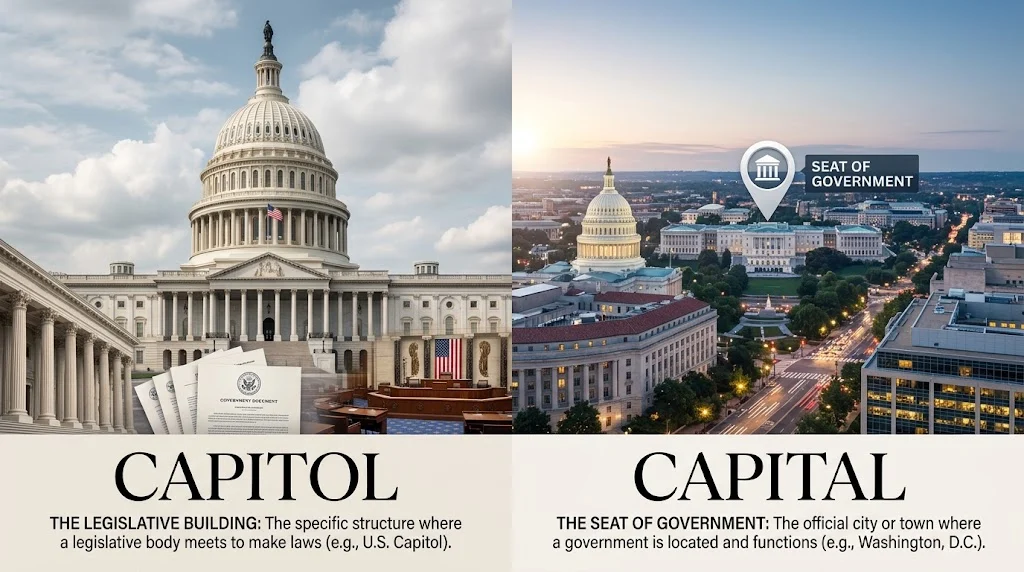
Capitol or capital refers to two different words with different meanings and uses. Capitol usually means a building where a legislature meets, while capital can mean a city that serves as the seat of government, money or wealth, or something especially important.
Have you ever wondered whether you should write Capitol or capital when talking about government? The two words look and sound almost identical, but they are not interchangeable. Capitol is primarily used for a building occupied by a legislative body, especially a state capitol or the United States Capitol.
Capital, on the other hand, has several meanings, including a city that serves as the official seat of government, financial wealth, an uppercase letter, or something of major importance. This small spelling difference can create real mistakes in news writing, academic essays, workplace documents, and everyday communication. Understanding when to use each word makes your writing more precise and professional.
X vs Y: What’s the Difference?
The easiest way to understand capitol or capital is to remember that capitol is a specific government building, while capital has several broader meanings.
Capitol is a noun. It generally refers to a building in which a legislative assembly meets. In the United States, the word is especially associated with the United States Capitol in Washington, DC, where Congress meets. It is also used for state legislative buildings, such as the Texas State Capitol or California State Capitol.
Capital is both a noun and an adjective. As a noun, it can refer to a city that serves as the official seat of government. It can also mean money or financial resources. In writing, capital can mean an uppercase letter. As an adjective, it can describe something important or essential.
| Word | Part of speech | Main meaning | Example |
| Capitol | Noun | A legislative government building | The lawmakers met at the state capitol. |
| Capital | Noun | A city that is the seat of government | Paris is the capital of France. |
| Capital | Noun | Money or financial resources | The company needs more capital. |
| Capital | Noun | An uppercase letter | Begin the sentence with a capital letter. |
| Capital | Adjective | Important or essential | The project reached a capital stage. |
Quick Recap
Use capitol when you mean a legislative building.
Use capital when you mean a city that serves as a government seat.
Use capital for money, uppercase letters, and several other meanings.
The spelling with an o is much narrower than the spelling with an a.
Is Capitol vs Capital a Grammar, Vocabulary, or Usage Issue?
The difference between capitol and capital is mainly a vocabulary and usage issue, rather than a grammar problem.
Both words are grammatically correct. The mistake occurs when a writer selects the wrong word for the intended meaning. Because the words sound nearly identical in ordinary speech, people sometimes confuse them in writing.
They are not interchangeable.
If you are describing a legislative building, capitol is the appropriate word. If you are describing a government city, money, an uppercase letter, or something important, capital is generally the correct choice.
The distinction matters in both formal and casual writing. In a casual conversation, a listener may understand what you mean even if you use the wrong spelling. In academic writing, journalism, business communication, government documents, and professional content, however, the distinction should be maintained carefully.
Formal vs Casual Usage
In formal writing, precision is especially important. A sentence such as “The governor spoke at the state capital” may create confusion if the writer actually means the legislative building. The correct term in that context is “state capitol.”
In casual speech, the distinction may be less noticeable because both words are commonly pronounced in similar ways.
When to Use Capitol
Use capitol when you are referring to a building where a legislative body meets.
The word is most commonly associated with government buildings in the United States. For example, a state legislature may meet inside a state capitol.
Workplace Example
A government employee might write:
“The committee will meet inside the state capitol at nine in the morning.”
Here, capitol is correct because the sentence refers to the physical government building.
Academic Example
A history student could write:
“The legislature moved its meetings to a newly constructed capitol building.”
Again, capitol identifies a legislative building rather than the city itself.
Technology Example
A technology company covering government software might write:
“The digital security system at the state capitol was upgraded last year.”
The word capitol works because the technology is being used in a particular legislative building.
Usage Recap
Choose capitol when you mean the actual building where lawmakers meet. If you can point to the building or describe activities taking place inside it, capitol is often the appropriate choice.
When to Use Capital
The word capital has many more meanings than capitol. Context determines which meaning is intended.
Capital as a Government City
Use capital when referring to a city that serves as the official seat of government.
For example:
“London is the capital of the United Kingdom.”
“Islamabad is the capital of Pakistan.”
“Tokyo is the capital of Japan.”
In each sentence, capital refers to the city, not the government building.
Workplace Example
A business report might state:
“Our company plans to open a new office in the national capital.”
Here, capital refers to the city where the national government is based.
Academic Example
A geography textbook might say:
“The capital of Australia is Canberra.”
The word capital identifies the official government city.
Technology Example
A technology article might say:
“The company launched its new public service platform in the capital.”
Here, capital refers to a city, not a legislative building.
Capital as Money
Capital can also mean money or financial resources used by a person or organization.
For example:
“The business needs additional capital to expand.”
This meaning has nothing to do with government buildings or government cities.
Capital as an Uppercase Letter
Capital can also refer to an uppercase letter.
For example:
“Write the first word of the sentence with a capital letter.”
This is another completely different meaning.
Usage Recap
Use capital for a government city, financial resources, uppercase letters, and other meanings associated with importance or status. Context determines the exact meaning.
When You Should NOT Use Capitol or Capital
Avoid using capitol when you mean the city where a government is based.
Incorrect:
“Canberra is the capitol of Australia.”
Correct:
“Canberra is the capital of Australia.”
Avoid using capital when you specifically mean a legislative building.
Incorrect:
“The senator entered the state capital to attend the legislative meeting.”
Correct:
“The senator entered the state capitol to attend the legislative meeting.”
Here are several common misuse situations to remember:
- Do not use capitol for a government city.
- Do not use capital for a legislative building when precision is required.
- Do not write capitol when discussing financial resources.
- Do not use capitol for an uppercase letter.
- Do not assume every government related reference requires capitol.
- Do not replace capital with capitol simply because the subject involves politics.
- Do not rely only on pronunciation when choosing the spelling.
Common Mistakes and Decision Rules
| Correct sentence | Incorrect sentence | Explanation |
| Washington, DC is the capital of the United States. | Washington, DC is the capitol of the United States. | Capital refers to the government city. |
| Congress meets in the United States Capitol. | Congress meets in the United States Capital. | Capitol refers to the legislative building. |
| The state capital has grown rapidly. | The state capitol has grown rapidly. | The sentence refers to a city. |
| The governor visited the state capitol. | The governor visited the state capital. | The sentence refers to the legislative building. |
| The company raised additional capital. | The company raised additional capitol. | Capital means financial resources. |
| Start the sentence with a capital letter. | Start the sentence with a capitol letter. | Capital means an uppercase letter. |
Decision Rule Box
If you mean a legislative government building, use Capitol.
If you mean a city that serves as the seat of government, use Capital.
If you mean money or financial resources, use Capital.
If you mean an uppercase letter, use Capital.
A useful memory trick is simple: Capitol with an O refers to a government building. Capital with an A has many broader meanings.
Capitol and Capital in Modern Technology and AI Tools
Modern technology has made precise vocabulary even more important. Search engines, grammar checkers, writing assistants, and AI tools often interpret words according to their surrounding context.
For example, an AI writing tool may distinguish between “the state capitol” and “the state capital” based on the words surrounding the phrase. A sentence mentioning lawmakers, a legislature, or a legislative chamber may suggest a building. A sentence mentioning population, geography, or government location may indicate a city.
Writers should still verify the intended meaning themselves. Automated tools can identify patterns, but context remains the writer’s responsibility.
Etymology: Where Did Capitol and Capital Come From?
The connection between capitol and capital goes back to Latin.
The word capital ultimately traces to the Latin word caput, meaning “head.” This connection developed into meanings involving the head, chief importance, wealth, and other concepts.
Capitol also has an ancient Roman connection. The Latin Capitolium referred to the Capitoline Hill and the important temple located there in ancient Rome. Over time, the English word became associated with legislative buildings.
Although the two words share historical roots and have similar pronunciations, their modern meanings have developed in different directions.
“The simplest way to remember the distinction is this: a capital is a place or resource, while a capitol is a particular legislative building.”
Two Practical Case Studies
Case Study 1: Government Reporting
Imagine a journalist covering a meeting of state lawmakers. The journalist writes:
“The governor arrived at the state capital to address the legislature.”
Readers may understand the intended meaning, but if the governor physically arrived at the legislative building, state capitol is more precise.
A revised version would be:
“The governor arrived at the state capitol to address the legislature.”
The correction changes only one letter, but it removes the ambiguity between the city and the building.
Case Study 2: Academic Geography
Consider a student writing about national governments:
“Islamabad is the capitol of Pakistan.”
The intended meaning is the city that serves as the country’s seat of government. Therefore, the correct sentence is:
“Islamabad is the capital of Pakistan.”
This correction ensures that the student is using the standard geographical term.
These examples show why the distinction matters even when the reader can understand the intended meaning.
Error Prevention Checklist
Always use Capitol when
You mean a legislative building.
You are referring to a state capitol building.
You are referring specifically to the United States Capitol.
The sentence describes lawmakers meeting inside a government building.
Never use Capitol when
You mean the city where a government is based.
You mean financial resources.
You mean an uppercase letter.
You mean something important in a general sense.
Related Grammar Confusions You Should Master
Learning the difference between capitol and capital can help you recognize other commonly confused words. Consider studying these pairs as well:
- Affect vs effect
- Advice vs advise
- Principal vs principle
- Stationary vs stationery
- Compliment vs complement
- Further vs farther
- Ensure vs insure
- Its vs it’s
- Then vs than
- Their vs there vs they’re
These words demonstrate an important principle of English vocabulary: words can look or sound similar while serving completely different purposes.
Frequently Asked Questions
Is the state capitol the same as the state capital?
No. The state capital is the city that serves as the state’s government seat. The state capitol is the legislative building located in that state.
Should I say capital building or capitol building?
When referring specifically to a legislative building, capitol building is the standard choice in American English. The word capitol identifies the legislative structure.
Why is Capitol spelled with an O?
Capitol has historical roots connected to the Latin name for the Capitoline area of ancient Rome. In modern English, it became associated with legislative buildings.
Is capital only used for government cities?
No. Capital has several meanings. It can refer to financial resources, uppercase letters, importance, and a government city.
How do I remember capitol vs capital?
Remember that capitol with an O refers to a legislative building. Capital with an A has broader meanings, including a government city, money, and an uppercase letter.
Is capitol or capital used in American English?
Both are used in American English, but they have different meanings. Capitol generally refers to a legislative building, while capital is used for a government city and several other concepts.
Which is correct: state capital or state capitol?
Both can be correct depending on what you mean. Use state capital for the city and state capitol for the legislative building.
Conclusion
The difference between capitol or capital becomes much easier once you focus on meaning rather than pronunciation. Capitol refers primarily to a legislative government building, while capital can refer to a government city, financial resources, an uppercase letter, or something important.
When writing about the government, ask yourself whether you mean the city or the building. If you mean the legislative building, choose the capitol. If you mean the government city, choose the capital. This simple distinction can prevent spelling errors and make academic, professional, and everyday writing much more precise.

Philip Pullman is an American writer dedicated to creating clear and easy to follow English content. Through his work at LingRoya.com, he helps readers strengthen their language skills with practical and reliable guidance so that they can easily understand.