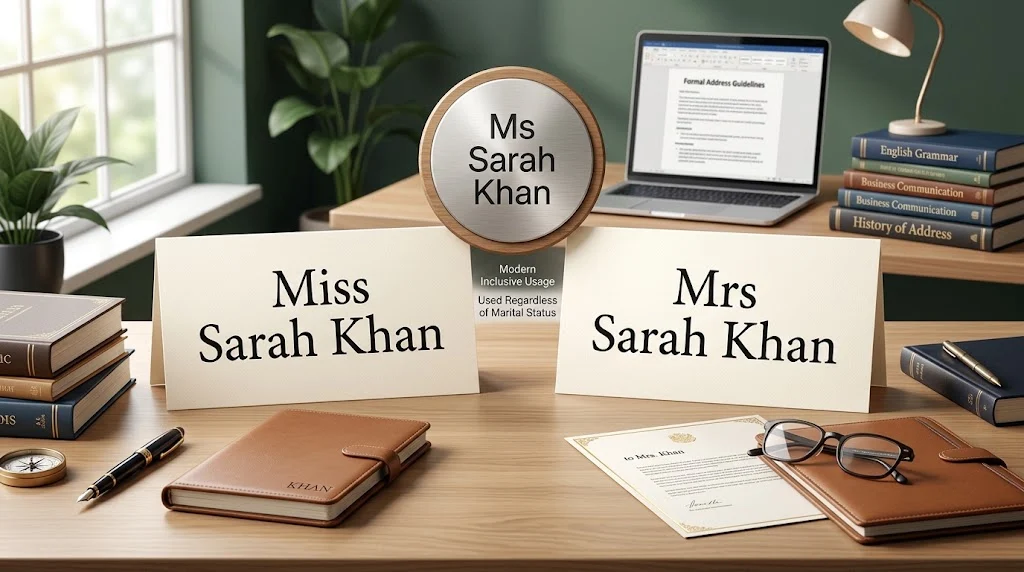
Miss or Mrs depends mainly on marital status and personal preference. Miss traditionally refers to an unmarried woman, while Mrs traditionally refers to a married woman.
The confusion between Miss and Mrs is common because both are honorifics used before a woman’s name. Miss traditionally identifies an unmarried woman, while Mrs traditionally identifies a married woman. The distinction matters because these titles can communicate information about marital status, particularly in formal correspondence, academic records, business communication, invitations, and official documents.
Miss or Mrs: What’s the Difference?
Miss and Mrs are both honorifics, meaning they are titles placed before a person’s name. Their traditional meanings are different.
| Feature | Miss | Mrs |
| Part of speech | Honorific noun or title | Honorific noun or title |
| Traditional meaning | An unmarried woman | A married woman |
| Common use | Girls and unmarried women | Married women |
| Example | Miss Sarah Khan | Mrs Sarah Khan |
| Marital status indicated | Usually unmarried | Usually married |
| Modern flexibility | Depends on personal preference | Depends on personal preference |
| Neutral alternative | Ms | Ms |
Quick recap
Miss traditionally means an unmarried woman.
Mrs traditionally means a married woman.
Neither title should be forced on someone when her preferred form of address is known.
Ms is generally appropriate when marital status is unknown or irrelevant.
Is Miss vs Mrs a Grammar, Vocabulary, or Usage Issue?
The distinction between Miss and Mrs is primarily a matter of vocabulary and usage rather than a difficult grammar rule.
Both words function as titles before a person’s name. They are not interchangeable in traditional usage because they carry different social meanings.
In formal writing, the distinction can be important. An invitation addressed to Mrs Khan traditionally indicates that the recipient is married. An invitation addressed to Miss Khan traditionally indicates that she is unmarried.
In casual conversation, people may simply use a first name, making the distinction unnecessary. In academic writing, these titles usually appear only when directly addressing or referring to a person.
Modern English has also made marital status less central to professional communication. This is one reason Ms has become widely useful. It allows a writer to address a woman respectfully without making an assumption about whether she is married.
The practical rule is simple: use the title a person prefers. If you do not know the preference and marital status matters for the context, traditional usage can guide you. If marital status does not matter, Ms is usually more appropriate.
How to Use Miss Correctly
Miss traditionally refers to an unmarried woman. It can also be used as a respectful title for a young girl or young woman.
For example, a teacher might say, “Miss Patel will speak to the class,” or an event organizer might write, “Dear Miss Ahmed.”
Workplace example
A receptionist might introduce an unmarried employee as “Miss Taylor” in a formal setting if that is the employee’s preferred title.
Academic example
A school record or formal invitation might traditionally refer to an unmarried student as “Miss Emily Carter.”
Technology example
A customer service system may display “Miss Ayesha Malik” when a user has selected Miss as her preferred title.
The important point is that technology should ideally store a person’s chosen title rather than automatically infer it from limited information.
Miss usage recap
Use Miss when the person prefers it or when traditional usage clearly fits the situation.
Remember that Miss traditionally communicates unmarried status.
In modern professional settings, personal preference should take priority.
How to Use Mrs Correctly
Mrs traditionally refers to a married woman. It is normally placed before the woman’s surname or full name.
For example, “Mrs Khan” traditionally refers to a married woman whose surname is Khan.
Workplace example
A formal letter might begin, “Dear Mrs Johnson,” when the recipient is known to prefer Mrs.
Academic example
A university invitation may address a married lecturer as “Mrs Williams” if that is her chosen title.
Technology example
An online registration form may offer Mrs as one of several title options. The system should allow the user to select the title personally rather than guessing marital status.
Mrs is not a synonym for woman. It is specifically an honorific with a traditional association with marriage.
Mrs usage recap
Use Mrs when the woman prefers Mrs or when traditional usage is appropriate.
Do not assume that every married woman wants to be addressed as Mrs.
When marital status is irrelevant, Ms can avoid unnecessary assumptions.
When You Should NOT Use Miss or Mrs
There are several situations where choosing Miss or Mrs automatically can cause problems.
- Do not assume a woman’s title from her age.
A young woman may prefer Ms, Miss, or another form of address.
- Do not assume marital status.
A person’s appearance, surname, age, or occupation does not reliably tell you whether she is married.
- Do not use Mrs simply because a woman is married.
Personal preference can override traditional convention.
- Do not use Miss when you have no reason to believe the woman prefers it.
Miss can imply unmarried status under traditional usage.
- Do not use either title when marital status is irrelevant and Ms would be more suitable.
This is particularly useful in professional correspondence.
- Do not change a person’s chosen title in official communication.
Consistency helps prevent embarrassment and administrative errors.
- Do not treat Miss and Mrs as interchangeable abbreviations.
Their traditional meanings are different.
- Do not assume that every culture uses these titles in exactly the same way.
Forms of address can vary across English speaking communities and cultures.
Common Mistakes and Decision Rules
| Correct sentence | Incorrect sentence | Explanation |
| Dear Miss Carter | Dear Mrs Carter, when she is unmarried and prefers Miss | Miss traditionally refers to an unmarried woman |
| Dear Mrs Brown | Dear Miss Brown, when she is married and prefers Mrs | Mrs traditionally refers to a married woman |
| Please contact Ms Khan | Please contact Miss Khan without knowing her preference | Ms avoids an unnecessary assumption |
| Mrs Smith will attend the meeting | Mrs Smith will attend when the person prefers Ms | Use the person’s preferred title |
| Miss Ahmed is a student | Mrs Ahmed is a student, when she is unmarried and prefers Miss | The traditional titles communicate different marital status |
Decision Rule Box
For an unmarried woman or a woman who prefers the title Miss, use Miss.
If you mean a married woman or a woman who prefers the title Mrs, use Mrs.
If marital status is unknown or irrelevant, consider Ms.
Miss or Mrs in Modern Technology and AI Tools
Modern technology has changed how titles are collected and displayed. Websites, customer relationship systems, email platforms, databases, airline systems, and AI tools may ask users to select a title.
A well designed system should not automatically decide whether someone should be called Miss or Mrs based on a name, age, or other indirect information. Instead, it should provide appropriate options and respect the user’s selection.
AI writing tools face a similar challenge. When generating an email or formal letter, an AI system may know the recipient’s name but not their preferred title. In that situation, Ms can often be a sensible choice when a title is necessary and marital status is unknown.
This reflects a broader principle of professional writing: accuracy includes social accuracy, not just spelling and grammar.
Etymology and History of Miss and Mrs
Miss developed as a shortened form related to Mistress, historically a form of address for a woman. Over time, Miss became associated with unmarried women.
Mrs also developed from Mistress and became associated with married women. The pronunciation and spelling evolved as English developed, while the abbreviations remained established in written communication.
The history explains why Miss and Mrs look related but carry different meanings today.
“The best form of address is not merely grammatically correct; it is the form that accurately and respectfully reflects how a person wishes to be addressed.”
This principle is particularly valuable in workplace writing, customer communication, and academic administration.
Two Practical Case Studies
Case Study One: Workplace Communication
A company introduced a standardized email template for customer communication. The original template automatically inserted Miss or Mrs based on information entered by staff. Complaints occurred when employees selected the wrong title.
The company changed the process so that staff used the customer’s stated preference and selected Ms when no preference was available. The practical result was a reduction in title related corrections and fewer awkward follow up messages.
The lesson is straightforward: automation should not replace accurate personal information.
Case Study Two: Online Registration
An educational organization created a registration form containing Miss and Mrs but did not clearly explain the difference. Some applicants selected a title incorrectly because they assumed the options referred to age rather than marital status.
The organization added a brief explanation and included Ms. The result was clearer data collection and fewer manual corrections by administrators.
The lesson is that even a small language clarification can improve the quality of digital forms.
Error Prevention Checklist
Always use Miss when
The woman prefers Miss.
Traditional context specifically requires Miss for an unmarried woman.
You have reliable information that Miss is the appropriate chosen title.
Never use Mrs when
You are only guessing that the woman is married.
You do not know her preferred title.
Marital status is irrelevant and Ms would communicate more appropriately.
You are changing a person’s selected title without permission.
Related Grammar Confusions You Should Master
Understanding Miss and Mrs becomes easier when you also understand other common English usage distinctions.
- Ms vs Miss
- Mrs vs Ms
- Mr vs Mister
- Madam vs Ma’am
- Dr vs Professor
- Who vs Whom
- Affect vs Effect
- Fewer vs Less
- Its vs It’s
- Then vs Than
These distinctions demonstrate an important feature of English: correct usage often depends on context, convention, and meaning rather than grammar alone.
FAQs
What is the difference between Miss and Mrs?
Miss traditionally refers to an unmarried woman, while Mrs traditionally refers to a married woman. Both are honorific titles used before a person’s name.
Should I use Miss or Mrs for a married woman?
Traditionally, Mrs is used for a married woman. However, the person’s preferred title should always take priority over traditional convention.
Is Miss used only for unmarried women?
Traditionally, yes. Modern usage is more flexible because individuals may choose their preferred title regardless of marital status.
Is Mrs only for married women?
Traditionally, Mrs is associated with married women. In modern communication, however, the most appropriate choice is the title the individual prefers.
Should I use Miss or Mrs if I do not know whether a woman is married?
If marital status is unknown or irrelevant, Ms is generally the safest professional choice because it does not indicate marital status.
Can I use Miss for a young girl?
Yes. Miss can traditionally be used as a respectful title for a young girl or unmarried young woman, although everyday conversation often uses a first name instead.
Is Mrs a grammar word or a title?
Mrs is an honorific title. It is a conventional form of address rather than a special grammatical category.
Should I write Miss or Mrs in a formal email?
Use the recipient’s preferred title when known. If you do not know the preference and marital status is irrelevant, Ms is usually appropriate.
What should I use instead of Miss or Mrs?
Ms is the common neutral alternative when you do not need to indicate marital status or do not know the person’s preference.
Conclusion
The difference between Miss and Mrs is easy to understand once their traditional meanings are clear. Miss traditionally refers to an unmarried woman, while Mrs traditionally refers to a married woman. However, modern English places increasing importance on personal preference.
For professional writing, academic communication, invitations, official documents, and digital forms, accuracy means more than choosing a grammatically possible title. It means selecting the form of address that is appropriate, respectful, and relevant to the context.

Philip Pullman is an American writer dedicated to creating clear and easy to follow English content. Through his work at LingRoya.com, he helps readers strengthen their language skills with practical and reliable guidance so that they can easily understand.