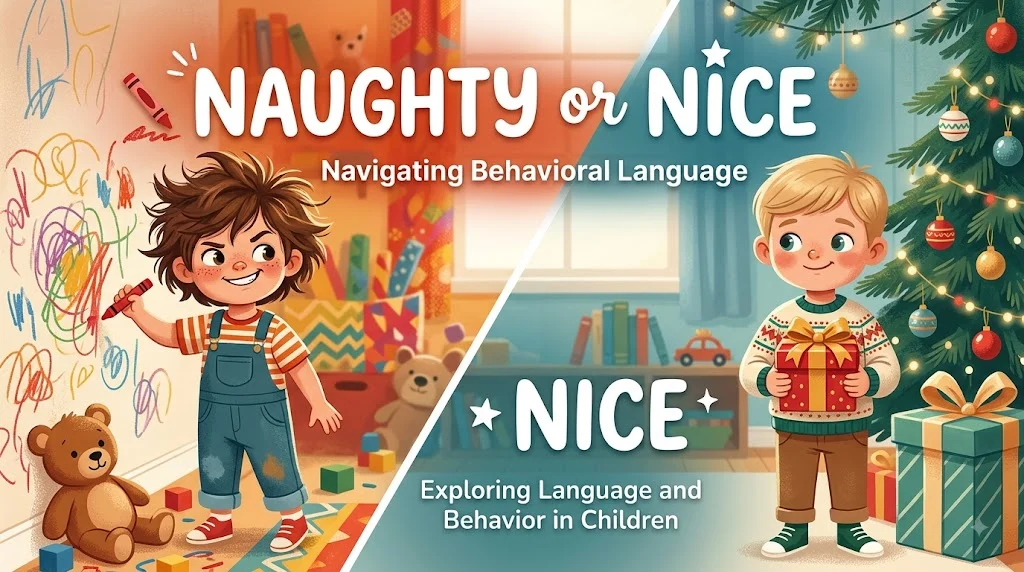
The phrase “naughty or nice” represents two opposing adjectives used to describe behavior, with “naughty” meaning mischievous, disobedient, or mildly bad, while “nice” means kind, polite, pleasant, or well behaved.
Naughty vs Nice: What is the Real Difference?
To understand the distinction between “naughty” and “nice,” we must first establish their core definitions as they function in modern English. Both words are adjectives, but they occupy opposite ends of the behavioral spectrum.
Naughty is an adjective that describes someone, usually a child, who is disobedient, mischievous, or behaves badly in a minor or playful way. It can also refer to something slightly indecent or risqué, particularly in adult contexts, or to an indulgent treat that feels like breaking dietary rules. The key nuance is that naughtiness implies a transgression that is not truly evil or malicious but rather playful, cheeky, or mildly rule breaking.
Nice is an adjective that describes a person who is pleasant, kind, friendly, or agreeable. It can also mean something that is satisfactory, attractive, or done with precision and care. In social contexts, being nice means being polite, well mannered, and considerate of others.
Comparison Table: Naughty vs Nice
| Feature | Naughty | Nice |
| Part of Speech | Adjective | Adjective |
| Core Meaning | Mischievous, disobedient, mildly bad | Pleasant, kind, agreeable, well behaved |
| Connotation | Playful or mild transgression; cheeky | Positive, approving, complimentary |
| Typical Subjects | Children, pets, indulgent treats, flirtatious behavior | People, experiences, weather, food, actions |
| Formal Usage | Rare; considered too informal for serious contexts | Common; widely accepted in formal and casual settings |
| Intensity | Mild to moderate; not used for serious crimes | Mild to strong; can describe deep kindness |
| Historical Origin | From “naught” (nothing), meaning poor or worthless | From Latin “nescius” (not knowing), meaning foolish |
| Modern Frequency | Common in domestic and holiday contexts | Ubiquitous across all registers |
Mini Recap
In essence, “naughty” signals a break from rules or expectations, often with a playful or minor quality, while “nice” signals approval, kindness, and adherence to social norms. These two words are opposites in modern usage, but their historical meanings were far more complicated, and that legacy still influences how we perceive them today.
Is Naughty vs Nice a Grammar, Vocabulary, or Usage Issue?
The question of whether to use “naughty” or “nice” is primarily a usage and vocabulary issue rather than a strict grammar problem. Grammatically, both words function as adjectives and follow standard comparative and superlative forms: naughty, naughtier, naughtiest and nice, nicer, nicest. The challenge lies in choosing the correct word based on context, tone, and intended meaning.
These two adjectives are not interchangeable. Using “naughty” when you mean “nice” would be nonsensical, and vice versa. However, the line can blur in informal or humorous contexts, such as the phrase “naughty but nice,” which describes something that is indulgent and slightly bad but also enjoyable.
Formal vs Informal Usage: “Nice” is widely accepted in both formal and informal settings. You can describe a colleague as nice in a professional email, and you can say a meal was nice in casual conversation. “Naughty,” on the other hand, is decidedly informal. It rarely appears in academic writing, legal documents, or serious professional reports because it carries a childish or playful tone. In formal contexts, you would use words like “disobedient,” “mischievous,” or “rule breaking” instead of “naughty.”
Academic vs Casual Usage: In academic writing, “nice” is often avoided because it is considered vague and subjective. Scholars prefer more precise adjectives like “pleasant,” “agreeable,” or “satisfactory.” “Naughty” is almost never used in academic work except in historical or linguistic discussions about the word itself. In casual conversation, both words are perfectly at home, though “naughty” is more common in domestic settings, especially when talking about children or pets.
Practical Usage: When to Use “Naughty”
Understanding when to deploy “naughty” requires sensitivity to context and tone. This word is not a one size fits all label for bad behavior; it has specific niches where it shines and others where it falls flat.
Workplace Example
In a professional environment, you would almost never call a colleague “naughty.” The word is too informal and carries a playful or even flirtatious undertone that is inappropriate for most workplaces. However, you might use it humorously in a very casual team setting. For instance, if a coworker sneaks an extra cookie from the break room, you might joke, “That was a naughty move.” But if an employee misses a deadline or violates company policy, you would say they were “negligent” or “noncompliant,” not “naughty.”
Academic Example
In an educational context, a teacher might describe a student who talks during class as “naughty,” but this usage is more common in primary schools. In higher education or formal academic discourse, “naughty” is virtually absent. A professor would say a student “failed to follow instructions” or “engaged in academic dishonesty,” not that they were “naughty.”
Technology Example
In the tech world, “naughty” might appear in user interface design or gamification. For example, a parenting app might label a child’s misbehavior as “naughty” to keep the tone light and nonthreatening. In cybersecurity, a “naughty” file might be a playful term for a nonmalicious but annoying piece of software, though this is informal jargon.
Usage Recap for “Naughty”
Use “naughty” when you are describing minor, playful, or mischievous misbehavior, especially in children, pets, or lighthearted contexts. Reserve it for informal settings and avoid it in serious, professional, or academic writing.
Practical Usage: When to Use “Nice”
“Nice” is far more versatile than “naughty” and appears across virtually all registers of English. Its flexibility makes it a go to adjective for expressing approval, but that same flexibility can also make it vague.
Workplace Example
In the workplace, “nice” is perfectly acceptable. You can tell a colleague they did a “nice job” on a presentation, or you can describe a client as “nice” to work with. It conveys positivity without being overly effusive. However, in performance reviews, managers are often advised to use more specific language, such as “collaborative,” “efficient,” or “detail oriented,” because “nice” is too general to provide meaningful feedback.
Academic Example
In academic writing, “nice” is sometimes used but often criticized for being imprecise. A student might write that a theory provides a “nice explanation,” but a professor would prefer “elegant,” “comprehensive,” or “convincing.” In spoken academic settings, such as lectures or seminars, “nice” is more common and acceptable.
Technology Example
In technology, “nice” appears frequently in user experience descriptions. A software interface might be described as “nice” if it is clean and intuitive. In programming, the nice command is used to run a process with a specified priority, though this is a technical term unrelated to the adjective.
Usage Recap for “Nice”
Use “nice” when you want to express general approval, politeness, or pleasantness. It works in almost any context, but for maximum impact, pair it with more specific adjectives to avoid vagueness.
When You Should NOT Use Naughty or Nice
Knowing when to avoid these words is just as important as knowing when to use them. Here are common misuse scenarios:
- Describing serious crimes or moral failings: Do not call a criminal “naughty.” The word is far too mild. Use “criminal,” “violent,” or “evil” instead.
- Formal performance reviews: Avoid “naughty” entirely and use “nice” sparingly. Instead, use precise behavioral descriptors.
- Academic research papers: “Naughty” has no place here. “Nice” is acceptable but often too vague; choose more academic language.
- Legal documents: Neither word belongs in legal writing. Use “noncompliant,” “violated,” or “adhered to” as appropriate.
- Describing adult misbehavior in serious contexts: If an adult breaks a significant rule, calling them “naughty” sounds infantilizing and dismissive. Use “irresponsible” or “unprofessional.”
- When you need to be taken seriously: Both words can undermine your authority if used inappropriately. “Naughty” sounds childish; “nice” sounds noncommittal.
- In cross cultural communication: “Nice” can be misinterpreted as weak or insincere in some cultures, while “naughty” may not translate well at all.
- When describing inanimate objects without human traits: A broken machine is not “naughty”; it is “faulty.” A disappointing meal is not “not nice”; it is “unpalatable.”
Common Mistakes and Decision Rules
Many writers and speakers make predictable errors when choosing between “naughty” and “nice.” The table below highlights the most frequent mistakes and explains why they are wrong.
| Correct Sentence | Incorrect Sentence | Explanation |
| The child was naughty for drawing on the wall. | The child was nice for drawing on the wall. | Drawing on the wall is misbehavior, so “naughty” is correct; “nice” would mean the opposite. |
| She gave a nice presentation to the board. | She gave a naughty presentation to the board. | A presentation cannot be “naughty” unless it is risqué or inappropriate; “nice” means it was good. |
| That chocolate cake is naughty but nice. | That chocolate cake is nice but naughty. | The phrase “naughty but nice” is an established idiom meaning indulgent yet enjoyable; reversing it loses the meaning. |
| He has been naughty all week. | He has been nice all week. | These are opposites; using the wrong one completely changes the meaning. |
| The weather is nice today. | The weather is naughty today. | Weather cannot be naughty; it can be nice (pleasant) or bad (stormy). |
| Be nice to your sister. | Be naughty to your sister. | Telling someone to be naughty to another person means encouraging misbehavior, which is the opposite of what is intended. |
Decision Rule Box
If you mean the action or behavior is mischievous, disobedient, or mildly bad, use “naughty.”
If you mean the person, thing, or experience is pleasant, kind, agreeable, or well behaved, use “nice.”
Naughty and Nice in Modern Technology and AI Tools
The concepts of “naughty” and “nice” have found their way into modern technology and artificial intelligence in surprising ways. In AI development, ethical frameworks often categorize AI behaviors as “good” or “bad,” which loosely maps to “nice” and “naughty.” For example, reinforcement learning models are trained to maximize rewards (being “nice” in the sense of achieving desired outcomes) and avoid penalties (being “naughty” in the sense of making errors).
In content moderation, AI systems classify user generated content as acceptable or violating, a digital equivalent of the naughty or nice list. Social media platforms use algorithms to reward “nice” behavior, such as positive engagement, and penalize “naughty” behavior, such as harassment or spam. Even in gaming, AI driven nonplayer characters may react differently based on whether the player has been “naughty or nice” in their in game choices.
The phrase has also been adopted in marketing technology, where email segmentation might separate “nice” subscribers who engage positively from “naughty” ones who mark messages as spam. This binary, while simplistic, provides a useful heuristic for automated decision making.
The Surprising Etymology of Naughty and Nice
The history of these two words is a testament to how language evolves in unpredictable ways.
Naughty comes from the word “naught,” meaning “nothing.” In the 14th century, it described someone who was poor or needy, someone who had nothing. Over time, the meaning shifted from “lacking in wealth” to “lacking in moral character,” becoming a term for someone wicked or immoral. By the 1630s, it referred to disobedient children, and by the 1860s, it had acquired sexual connotations. Today, “naughty” is a mild term for mischief, a far cry from its original severity.
Nice is even more remarkable. It entered English in the 13th century from the Latin “nescius,” meaning “not knowing” or “ignorant”. For centuries, being called “nice” was an insult. Over the 14th and 15th centuries, it shifted to mean “luxurious” or “finely arrayed,” then “shy or reserved,” then “precise” and “discriminating,” before finally settling on its modern meaning of “pleasant” and “kind”. Shakespeare himself played with the word’s multiple meanings.
“Etymology tells us where a word comes from, but not what it means today.” — Andy Hollandbeck, Managing Editor, The Saturday Evening Post
Case Studies: Real World Consequences of Getting It Wrong
Case Study 1: The Marketing Blunder
A major confectionery brand launched a campaign in the UK with the slogan “Naughty but Nice” for a new line of cream cakes. The campaign was wildly successful, capitalizing on the playful tension between indulgence and restraint. However, when the same slogan was translated for a conservative market in Southeast Asia, it caused confusion. Local consumers interpreted “naughty” as morally wrong, and the campaign had to be pulled. The brand lost an estimated £2 million in market entry costs. This case demonstrates that cultural context is everything when using these emotionally charged adjectives.
Case Study 2: The Performance Review Pitfall
A mid sized tech company in California introduced a peer review system that allowed employees to describe coworkers using a dropdown menu of adjectives, including “nice” and “naughty.” Within six months, HR received over 40 complaints about the system being unprofessional and infantilizing. Employees felt that being labeled “naughty” was demeaning, while “nice” was seen as faint praise. The company replaced the system with a competency based framework, and employee satisfaction scores improved by 15% within a quarter. The lesson: these words have no place in serious professional evaluation.
Error Prevention Checklist
Always use “naughty” when:
- Describing a child’s minor misbehavior
- Referring to playful or mischievous actions
- Talking about indulgent treats that break dietary rules
- Using a lighthearted or humorous tone
- Describing risqué or cheeky content in informal settings
Never use “naughty” when:
- Describing serious crimes or severe moral failings
- Writing formal documents, academic papers, or legal texts
- Giving professional performance feedback
- Speaking in cross cultural or conservative contexts
- Referring to inanimate objects or natural phenomena
Related Grammar Confusions You Should Master
Understanding “naughty or nice” is just the beginning. Here are other common word pairs that confuse writers and speakers:
- Good vs Well — adjective vs adverb
- Fewer vs Less — countable vs uncountable
- Affect vs Effect — verb vs noun
- Lie vs Lay — intransitive vs transitive
- Who vs Whom — subject vs object
- Its vs It’s — possessive vs contraction
- Your vs You’re — possessive vs contraction
- Then vs Than — time vs comparison
- Accept vs Except — receive vs exclude
- Complement vs Compliment — complete vs praise
FAQs
Is “naughty” a bad word?
“Naughty” is not a curse word or profanity, but it can be offensive if used inappropriately, such as describing an adult’s serious misbehavior. It is generally considered mild and acceptable in casual conversation.
Can “nice” be used to describe a person’s appearance?
Yes, “nice” is commonly used to describe someone’s appearance in a general, noncommittal way, such as “She has a nice smile.” However, for more impactful compliments, specific adjectives like “beautiful” or “handsome” are preferred.
Is “naughty or nice” a grammar issue?
No, it is a usage and vocabulary issue. Both words are grammatically correct adjectives, but choosing the right one depends on context, tone, and intended meaning.
What is the origin of “naughty but nice”?
The phrase was popularized in the 1970s by a British advertising campaign for cream cakes, and it carries a playful connotation of indulgent pleasure that feels slightly wrong.
Can adults be described as “naughty”?
Yes, but usually in playful, humorous, or romantic contexts. Describing an adult as “naughty” in a serious setting is generally inappropriate and can be seen as condescending.
Is it better to be nice or naughty?
In most social and professional contexts, being “nice” is preferable because it aligns with positive social norms. “Naughty” behavior is usually discouraged unless it is playful and harmless.
How do you use “naughty” in a sentence?
Examples include: “The naughty puppy chewed my shoe,” “She gave him a naughty wink,” and “That dessert is naughty but nice.”
What is the noun form of “naughty”?
The noun form is “naughtiness,” which refers to the state or quality of being naughty.
Conclusion
Whether you landed on the naughty or nice side, the most important thing is to enjoy the festive spirit and have some fun! Every little choice adds to your holiday personality.
So, are you officially naughty or nice? Whatever your result, keep spreading smiles, enjoying the season, and making some cheerful holiday memories!
.

Neil Gaiman is an American writer who contributes educational content to LingRoya.com. His work focuses on helping readers improve their English with clear, practical and easy to follow guidance.