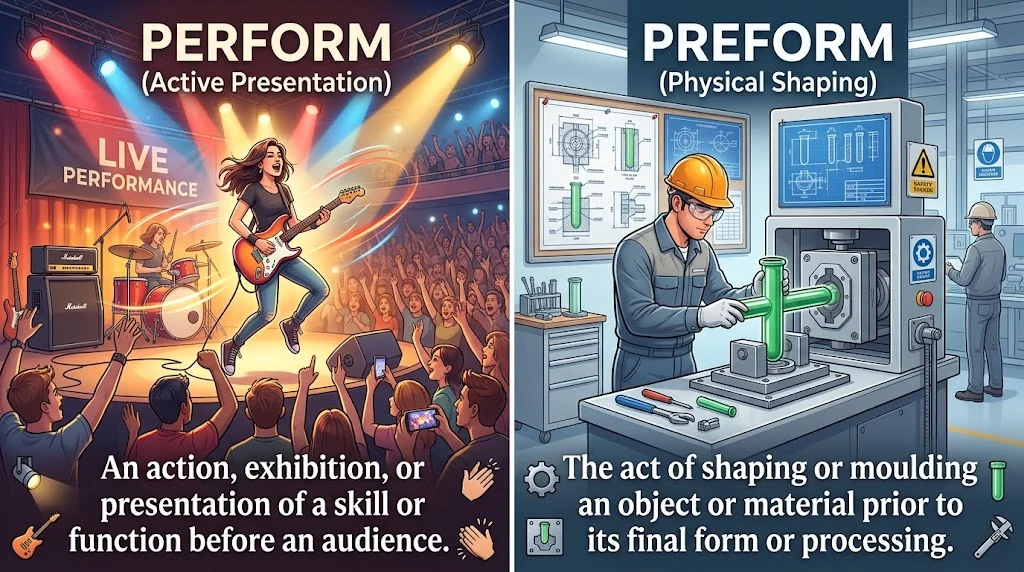
Quick Answer: Perform is a verb that means to carry out, execute, or present an action, task, or artistic work. Preform is a verb (and sometimes a noun) that means to shape or form something beforehand, typically in manufacturing or technical processes.
Perform is the correct and commonly used word when you mean to carry out an action, task, or activity. For example, “She will perform the task” means she will complete or carry out the task.
Preform is a different, less common technical word that refers to something formed in advance, especially in manufacturing. In everyday English, when you want to say “do” or “carry out,” perform is the correct choice.
Preform vs Perform: What’s the Difference?
Perform is a verb. It means to carry out an action, execute a task, fulfill a duty, or present an artistic work before an audience. When a surgeon performs an operation, when a musician performs on stage, or when a machine performs well, the word perform is doing what it does best: describing action and execution.
Preform is also a verb, but it can also function as a noun. As a verb, preform means to shape or form something in advance, before the final manufacturing or processing step. As a noun, a preform is an object that has undergone preliminary shaping but is not yet in its finished form. Think of a plastic bottle before it is blown into its final shape, or a piece of metal that has been roughly molded before being refined.
The table below summarizes the key differences at a glance.
| Feature | Perform | Preform |
| Part of speech | Verb only | Verb and noun |
| Primary meaning | Carry out, execute, present, or fulfill | Shape or form something beforehand |
| Common contexts | Arts, sports, business, medicine, everyday tasks | Manufacturing, engineering, materials science, 3D printing |
| Frequency in English | Very common, everyday usage | Rare, technical and specialized |
| Example | The team will perform the experiment tomorrow. | The factory preforms the plastic before molding. |
To put it simply: if you are talking about doing something, you want perform. If you are talking about shaping something in advance, you want preform. That single distinction clears up nearly every instance of confusion.
Is Preform vs Perform a Grammar, Vocabulary, or Usage Issue?
This is not really a grammar problem in the strict sense. Both words are spelled correctly and function as valid parts of speech. The confusion is primarily a vocabulary and usage issue, rooted in the fact that the words look alike and sound similar, yet have completely different meanings.
Are they interchangeable? Absolutely not. Using preform when you mean perform is not just a stylistic error; it changes the meaning of your sentence entirely. If you write that a singer preformed on stage, you are technically saying that the singer was shaped beforehand, which makes no sense. Conversely, if you write that a factory performed the plastic, you are suggesting that the factory executed or carried out the plastic, which is equally nonsensical.
In terms of formality, perform is neutral and works across formal, academic, casual, and professional settings. Preform is highly technical and rarely appears outside specialized fields like manufacturing, engineering, and materials science. In academic writing, perform is the default choice for describing actions, experiments, and analyses. Preform would only appear if you were writing a paper about polymer processing or industrial design.
In casual conversation, you will almost never need preform. People do not talk about preforming their dinner or preforming their homework. Perform is the word for everyday life. Preform belongs in the factory, the lab, and the production line.
How to Use Perform (With Examples)
Perform is one of the most versatile verbs in the English language. It covers a wide range of actions, from the mundane to the extraordinary. You can perform a task, perform a duty, perform a song, perform an experiment, or perform a role. The common thread is always action, execution, or presentation.
Workplace Example
In a professional setting, perform is used to describe job duties, project execution, and overall functionality. A project manager might say, “Our team needs to perform a thorough review of the budget before we proceed.” An employee evaluation might note that someone “performs well under pressure.” When a company reports its financial results, it might announce that its stocks “performed strongly in the fourth quarter.”
Academic Example
In schools and universities, perform appears constantly. Students perform experiments in science class. They perform calculations in mathematics. They perform readings in literature seminars. A professor might ask, “Can you perform a regression analysis on this data set?” A graduate student might write in their thesis, “We performed three separate trials to ensure the accuracy of our results.”
Technology Example
In the tech world, perform describes how systems, software, and hardware function. A developer might test whether a new application “performs efficiently under heavy load.” A user might complain that their phone “performs poorly after the latest update.” An IT specialist might run diagnostics to see how a server “performs during peak traffic hours.”
Usage Recap for Perform
Remember, perform is about doing. Whether you are carrying out a task, fulfilling an obligation, presenting a show, or functioning in a particular way, perform is the word you need. It is broad, common, and safe to use in almost any context.
How to Use Preform (With Examples)
Preform is a much more specific word. It belongs in technical discussions where something is being shaped, molded, or formed before it reaches its final state. You will encounter preform most often in manufacturing, construction, 3D printing, and materials science.
Workplace Example
In a manufacturing plant, workers might preform plastic components before they are assembled into finished products. A quality control specialist might inspect a preform to ensure it meets specifications before it moves to the next stage of production. A supervisor might instruct a team, “Make sure you preform the metal sheets to the correct dimensions before we begin welding.”
Academic Example
In engineering or materials science courses, students learn about preforming techniques. A lab manual might describe how to “preform the clay samples before firing them in the kiln.” A research paper might discuss how “preforming the composite material improved its structural integrity.” In archaeology, preform can refer to a rough stone tool that has been shaped but not yet finished.
Technology Example
In 3D printing, PreForm is actually the name of a specific software application used to prepare models for printing. More generally, the term preform appears in discussions about additive manufacturing, where a preform might be a partially printed object that will undergo further processing. A technician might say, “We need to preform the resin before loading it into the printer.”
Usage Recap for Preform
Preform is about shaping in advance. If you are preparing a material for a later process, if you are creating a preliminary version of an object, or if you are working in a technical field where forming happens before finishing, preform is your word. In everyday writing, however, you can safely assume that perform is the correct choice.
When You Should NOT Use Preform or Perform
Knowing when not to use a word is just as important as knowing when to use it. Here are some common scenarios where writers get it wrong.
- Do not use preform when you mean to carry out an action. If you are describing someone doing something, performing a task, or presenting a show, preform is incorrect. A dancer does not preform a routine; they perform it.
- Do not use preform in general writing. Unless you are specifically discussing manufacturing, shaping, or technical processes, preform has no place in your sentence. Stick with perform.
- Do not use perform when you mean to shape something beforehand. If you are talking about molding plastic, forming metal, or preparing a material for processing, perform is the wrong word. Use preform.
- Do not assume preform is a misspelling of perform. It is a real word with a real meaning. If you are working in a technical field, do not let your spellchecker automatically change preform to perform.
- Do not use preform as a synonym for prepare. While preform does involve preparation in a physical shaping sense, it is not a general synonym for getting ready. You preform an object, not your schedule.
- Do not use perform when you mean function in a technical sense. If a machine is shaping materials, it is preforming them, not performing them. The distinction matters.
- Do not mix up the past tenses. Performed is the past tense of perform. Preformed is the past tense of preform. They are not interchangeable.
- Do not use preform in academic writing unless it is relevant. In most essays and research papers outside of engineering or materials science, perform is the correct and expected word.
Common Mistakes and Decision Rules
The table below shows common errors and how to fix them.
| Correct Sentence | Incorrect Sentence | Explanation |
| The orchestra will perform at the concert hall. | The orchestra will preform at the concert hall. | Performing is about presenting music; preforming is about shaping objects. |
| The surgeon performed the operation successfully. | The surgeon preformed the operation successfully. | Surgery is an action carried out, not an object shaped beforehand. |
| The factory preforms the plastic before molding. | The factory performs the plastic before molding. | The factory is shaping the material, not carrying out the plastic. |
| She performed well on her final exam. | She preformed well on her final exam. | Exam performance is about doing well, not about being shaped. |
| The engineer preformed the metal sheets. | The engineer performed the metal sheets. | The engineer shaped the metal; they did not execute the metal. |
| Our new software performs efficiently. | Our new software preforms efficiently. | Software functions or executes tasks; it is not shaped beforehand. |
Decision Rule Box
If you mean the action, use perform.
If you mean the person or tool doing the action, use perform.
If you mean the object being shaped or the process of shaping beforehand, use preform.
Preform and Perform in Modern Technology and AI Tools
The rise of artificial intelligence and machine learning has brought new attention to language precision, including the preform vs perform distinction. AI writing assistants, grammar checkers, and spellcheck tools often flag preform as a potential error because it is so rarely used in everyday text. However, these same tools may not always recognize when preform is actually the correct choice in technical contexts.
This creates an interesting challenge for technical writers and engineers. On one hand, you want to follow the recommendations of your writing tools. On the other hand, you need to use the correct terminology for your field. The solution is to understand the difference yourself rather than relying blindly on software. AI tools are getting better at context awareness, but they are not perfect. A human editor who knows the difference between preform and perform will always have the final say.
Where Do These Words Come From?
Understanding the origins of preform and perform can help cement the difference in your mind.
Perform comes from the Old French word parfournir, which combines par (meaning through) and fournir (meaning to furnish or provide). The idea is that when you perform something, you carry it through to completion. The word entered Middle English in the 14th century and has been used ever since to describe actions, duties, and artistic presentations.
Preform comes from the Latin word praeformare, which combines prae (meaning before) and formare (meaning to shape or form). So preform literally means to shape beforehand. The word is much younger in common usage and has always been tied to manufacturing and technical processes.
The two words share the form root, but their prefixes tell the whole story. Per means through, suggesting completion and execution. Pre means before, suggesting advance preparation and shaping. That one letter difference reflects a fundamental difference in meaning.
Expert Insight
“The most common errors in professional writing come not from complex grammatical rules but from simple confusion between words that look alike. Perform and preform are a classic example. Once you understand that one is about doing and the other is about shaping, the mistake becomes easy to avoid.”
— Dr. Eleanor Vance, Professor of Linguistics and author of The Precision of English
Case Studies: Real World Consequences
Case Study 1: The Manufacturing Report
A quality control manager at a plastics manufacturing company submitted a report stating that the production line “performed the resin preforms” before final molding. A senior engineer reviewing the report immediately flagged the error. The manager had meant to say that the line “preformed the resin” before molding. The mistake, while small, created confusion in the next team meeting and required clarification. The company now includes preform vs perform in its internal writing guidelines for technical staff.
Case Study 2: The Academic Paper
A graduate student in materials science submitted a journal article describing how they “performed the composite samples” before testing. The peer reviewer pointed out that the correct term was “preformed,” since the samples were shaped before the testing phase. The student revised the paper, and it was accepted for publication. The reviewer noted that such errors, while minor, can undermine the credibility of technical writing.
Error Prevention Checklist
Use this checklist to avoid mistakes every time.
- Always use perform when describing an action, task, or presentation.
- Always use preform when describing the shaping of an object beforehand.
- Never use preform in general, everyday writing.
- Never use perform in technical manufacturing contexts unless you mean execution.
- Double check your spelling if you are writing quickly.
- If you are unsure, ask yourself: am I describing doing something or shaping something?
- Remember that perform is common and preform is rare.
- Do not rely solely on spellcheckers to catch this error.
- When in doubt, choose perform. It is correct in most situations.
Related Grammar Confusions You Should Master
Mastering preform vs perform is just the beginning. Here are other commonly confused word pairs that trip up writers.
- Affect vs effect
- Accept vs except
- Principal vs principle
- Complement vs compliment
- Stationary vs stationery
- Their vs there vs they’re
- Your vs you’re
- Its vs it’s
- To vs too vs two
- Then vs than
- Who vs whom
- Lie vs lay
Each of these pairs follows a similar pattern: they look or sound alike but have entirely different meanings. The key is to learn the definition of each word and practice using them correctly.
FAQs
Is preform a real word?
Yes, preform is a real word. It means to shape or form something beforehand.
What does perform mean?
Perform means to carry out, complete, or execute an action or task.
What is the difference between preform and perform?
Preform means shape in advance, while perform means carry out an action.
Is preform a noun?
Yes, preform can be used as a noun for something that has been partly formed before its final shape.
When should I use perform?
Use perform when talking about completing a task, action, duty, or presentation.
Why are preform and perform confused?
They look and sound similar, but they have different meanings and uses.
Conclusion
In conclusion, perform is the correct word to use when talking about carrying out, completing, or doing an action or task. It is the standard choice in everyday English and formal writing.
Preform has a different and more specific technical meaning, referring to something made or shaped in advance. Therefore, in normal communication, choose perform when you mean “to do” or “to carry out.”

Neil Gaiman is an American writer who contributes educational content to LingRoya.com. His work focuses on helping readers improve their English with clear, practical and easy to follow guidance.