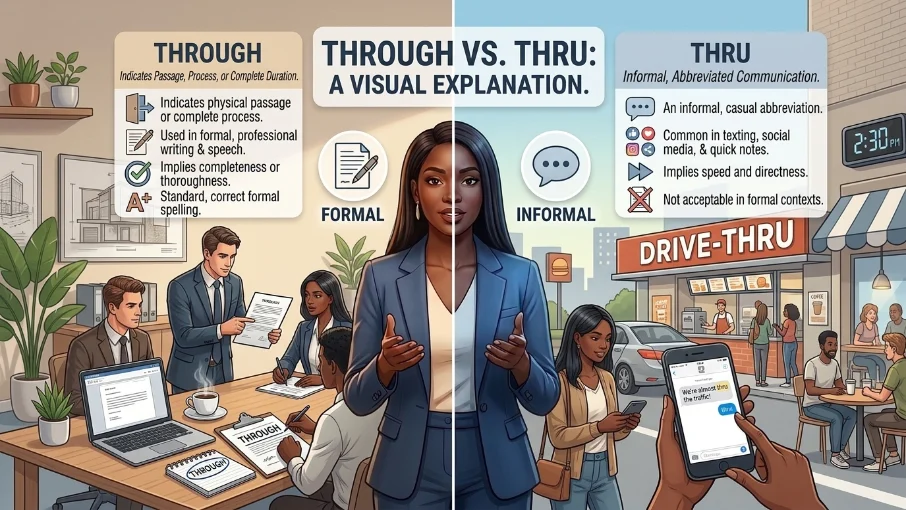
Through is the standard spelling and should be used in formal, academic, and professional writing. Thru is an informal shortened form often used in signs, advertisements, and expressions like drive-thru. When in doubt, use through
The words thru and through have the same pronunciation and generally carry the same basic meaning, but they differ in spelling and usage. Through is the standard and universally accepted spelling used in formal writing, academic work, business communication, and professional contexts. Thru is an informal shortened spelling that is commonly seen in signs, advertisements, and phrases such as drive-thru.
Understanding the difference between thru or through can help you choose the right form for different situations. While through is the safest choice in almost all types of writing, thru may be appropriate in specific informal or fixed expressions. In this guide, we’ll explore their meanings, differences, correct usage, and examples to help you use each word confidently.
Thru vs Through: What is the Difference?
So, what is the actual difference between the words thru and through? In terms of meaning, there is none. They function as the same parts of speech, a preposition, adverb, and adjective, and they both convey the same concept of movement from one side to another, from beginning to end, or by means of something . The only real difference is one of formality.
The word “through” is the accepted and standard spelling in the English language. It is the form you will find in dictionaries, style guides, and all formal writing. “Thru,” on the other hand, is an informal spelling variant . It is a simplified, shortened version that has gained popularity in casual settings.
To help visualize the difference, think of it like this:
| Feature | Through | Thru |
| Formality | Formal, standard, and accepted everywhere | Informal, casual, and nonstandard |
| Parts of Speech | Preposition, adverb, adjective | Preposition, adverb, adjective |
| Best Used In | Academic papers, business reports, professional emails, books, and journalism | Text messages, social media posts, advertising signs, and casual notes |
| Common Examples | “We walked through the park.” | “We walked thru the park.” |
| Acceptance | Universally accepted and correct | Acceptable only in specific informal contexts |
In short, “through” is your safe, professional choice for almost any situation. “Thru” is a more relaxed, modern option for when you are being informal and want to save a few keystrokes .
Is “Thru” vs “Through” a Grammar, Vocabulary, or Usage Issue?
This question gets to the heart of the matter. It is not a grammar issue in the traditional sense, as both words can function grammatically in a sentence. It is also not a vocabulary issue, as the words share the same definition. Instead, the choice between “thru” and “through” is a matter of usage .
The English language has a standard, formal register used in professional and academic settings. The word “through” belongs to this register. In contrast, “thru” is a colloquialism or informal variant. While you cannot be accused of using bad grammar for writing “thru,” you can be accused of using an inappropriate tone for the context. Think of it like wearing a tuxedo to a backyard barbecue; it is not wrong to wear a tuxedo, but it is certainly out of place.
Formal vs Informal Usage
You should always use “through” in formal writing. This includes:
- Academic Work: Essays, research papers, dissertations, and any assignments for school.
- Professional Communication: Business emails, reports, proposals, cover letters, and resumes.
- Journalism and Publishing: News articles, books, and magazines adhere to strict style guides that mandate the standard spelling .
Conversely, “thru” is best suited for informal writing and casual contexts. This is your go to for:
- Text Messages and Instant Messaging: When you are quickly chatting with friends or family.
- Social Media: Posts on platforms like Twitter, Instagram, or Facebook.
- Signage and Advertising: This is where “thru” is most visible, such as in “drive thru” or “no thru traffic” signs, where space is often at a premium .
Practical Usage of “Through”
The word “through” is incredibly versatile, operating as an adverb, preposition, and adjective. Its core meaning is “from one end or side to the other” . Let us look at how it functions in different contexts.
Workplace Example
“The marketing team worked diligently through the weekend to finalize the presentation for the new client, ensuring every detail was perfect.”
Academic Example
“The study’s findings suggest that students learn best through active participation and hands on activities rather than passive lectures.”
Technology Example
“The data was transmitted through the secure server, ensuring that sensitive information remained encrypted and protected from any potential breaches.”
As you can see, in these more formal settings, using “thru” would appear unprofessional and undermine your credibility.
Practical Usage of “Thru”
Because “thru” is an informal variant, its usage is much more limited. It is often used as a space saving measure or to create a more casual, friendly tone.
Workplace Example (Informal)
“Hey, I will run thru the new figures with you after lunch. Does that work for you?”
Academic Example (Informal)
“I am almost thru with this chapter of the textbook, just a few more pages to go.”
Technology Example
“The app lets you order ahead and then just pick up your coffee at the drive thru.”
When You Should NOT Use “Thru”
To avoid common errors, it is helpful to know exactly when “thru” is inappropriate. Here are some scenarios where you should never use it:
- In a cover letter for a job application. This is your first impression; using “thru” suggests carelessness or a lack of attention to detail.
- In a formal business proposal or report. Your writing needs to convey authority and professionalism, which “thru” undermines.
- In an academic essay or research paper. Instructors and professors expect standard English spelling, and “thru” will almost certainly be marked as an error.
- When writing to a client or senior executive. Even if your company has a casual culture, it is always safer to use the standard spelling “through” in professional correspondence.
- In any published work like a book, magazine, or newspaper. These all adhere to style guides that reject “thru” for general use .
- When you want to be taken seriously. If you are trying to communicate clearly and effectively in any formal capacity, “through” is the only appropriate choice.
- When you are in doubt. If you are unsure of the context, it is always safer to use “through.” It is never wrong to use the standard spelling.
Common Mistakes and Decision Rules
The easiest way to solidify the difference is to see it in action and have a clear rule to follow. Here are some examples that show the correct and incorrect usage.
| Correct Sentence | Incorrect Sentence | Explanation |
| She walked through the door. | She walked thru the door. | In any formal or neutral sentence, “through” is the required spelling. |
| We are open Monday through Friday. | We are open Monday thru Friday. | Standard spelling is always preferred in formal announcements and documentation. |
| I got this job through hard work. | I got this job thru hard work. | Professional contexts demand the professional spelling. |
| He went through a lot of trouble. | He went thru a lot of trouble. | Even in spoken language, the standard spelling is correct for written communication. |
| We will go through the details later. | We will go thru the details later. | Unless it is a casual text to a friend, “through” is the correct choice. |
Decision Rule Box
- If you are writing in a formal, professional, or academic context, you should always use “through.”
- If you are writing in an informal context like a text message or for a “drive thru” sign, you can use “thru” to save space or create a casual tone.
“Thru” and “Through” in Modern Technology and AI Tools
The distinction between “thru” and “through” has become an important consideration in the age of AI and natural language processing. Language models are trained on vast datasets that prioritize standard English usage. When you use “through” in a query or prompt, the AI is better able to understand and process it, as it aligns with the formal language patterns it has learned. Using “thru” in a formal setting might not break the interaction, but using “through” is more likely to generate a more accurate and professional response.
Furthermore, tools like professional email assistants and AI driven grammar checkers will almost always flag “thru” as a misspelling or suggest a change to “through.” This is because these tools are programmed to enforce the formal standards of the English language, making “through” the default and recommended choice .
Authority and Trust
The history of these words gives us an interesting perspective on their usage. “Through” is the older, more established form, but “thru” is not a new invention. It has been used as an informal spelling for over a century. The word “through” can be traced back to Old English, where it was often spelled as “thurh” or “thuruh.” Over the centuries, it underwent many changes, influenced by Old Norse and French, and was even spelled “thru” long before “through” became the standardized form .
In the words of linguist June Casagrande, “Had our language achieved a state of freeze it in time now perfection in the 1950s, that would be a valid point. On the other hand, had we been born a couple of centuries earlier, we would have a very different view” . This quote illustrates that the spelling of “through” we consider standard today is just one stage in the long evolution of the English language.
Case Study 1: The “Drive Thru” Revolution
The fast food industry popularized the “drive thru” in the mid 20th century . They needed clear, eye catching signage, and the shorter spelling of “thru” was a practical solution. It saved space and money on materials and was easier to read quickly from a car. This specific context cemented “thru” as the spelling for this particular phrase, showing how practical needs can influence language usage.
Case Study 2: The Associated Press Stylebook Change
The Associated Press (AP) Stylebook, a major authority for many journalists, used to mandate “drive through.” However, they made a highly publicized decision to change their style to “drive thru” . This was a landmark moment, acknowledging that the shorter spelling had become the dominant form in everyday usage for this specific compound word. It demonstrated how even formal authorities can adapt to shifts in language, but it also highlighted that this acceptance is limited and does not extend to all contexts .
Error Prevention Checklist
Always use “through” when…
- You are writing a professional email or business proposal.
- You are completing an academic essay or assignment.
- You are writing for an official publication.
- You are unsure of the context and need to be safe.
- You want your writing to be viewed as credible and polished.
Never use “thru” when…
- You are in a formal setting.
- Your audience expects a high standard of professionalism.
- You are applying for a job.
- Your writing will be evaluated, for example, in a test or by a teacher.
- You are following a specific style guide like APA, MLA, or Chicago, which all prefer the standard spelling.
Related Grammar Confusions You Should Master
Understanding the difference between “thru” and “through” is part of mastering the nuances of the English language. Here are some other common confusions you should be familiar with:
- Your vs You’re
- Its vs It’s
- Their vs There vs They’re
- To vs Too vs Two
- Then vs Than
- Affect vs Effect
- Lose vs Loose
- Who vs Whom
- Which vs That
- Farther vs Further
Advanced FAQs
- Is it “drive through” or “drive thru”?
Both are used, but drive-thru is a common informal spelling, especially for fast-food restaurants. - Is “thru” ever acceptable in formal writing?
Generally, no. Use through in formal, academic, and professional writing. - Is “thru” an American thing?
Yes, thru is especially common in American English, particularly in informal contexts and signage. - Is “thru” a real word?
Yes, thru is recognized as an informal or nonstandard variant of through. - What is the etymology of “through”?
Through comes from the Old English word thurh and has evolved through several historical spellings. - Can I use “thru” in a text message?
Yes, thru is acceptable in casual texts and informal communication. - How did “thru” come to be?
Thru developed as a simplified spelling of through, especially for informal writing and signs. - What is the difference between “through” and “threw”?
Through indicates movement or means, while threw is the past tense of throw. - Is it “No Through Road” or “No Thru Road”?
No Through Road is the standard formal spelling, though thru may appear on some signs. - Is “through” a preposition?
Yes, through is commonly used as a preposition to indicate movement, location, or means.
Conclusion
To master the choice between “through” and “thru,” remember that context is everything. The core difference between “thru” and “through” is their level of formality. “Through” is the universal, standard spelling for all writing, while “thru” is a casual alternative best kept for informal chats and specific signage like a “drive thru.” If you are writing anything with a professional or academic purpose, “through” is the only choice that will maintain the standard of excellence. By following this simple rule, you can avoid a common and easily preventable mistake, ensuring your communication is always clear, credible, and appropriate for its audience.

Neil Gaiman is an American writer who contributes educational content to LingRoya.com. His work focuses on helping readers improve their English with clear, practical and easy to follow guidance.