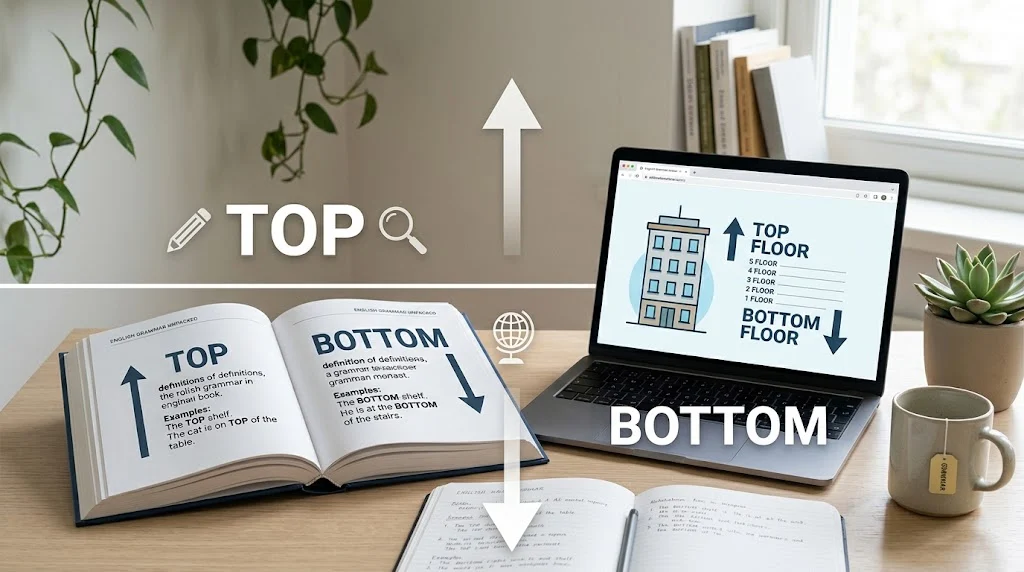
The difference between top or bottom is mainly about position. Top refers to the highest, uppermost, or superior position, while bottom refers to the lowest, lower, or base position. They are not interchangeable, although both can describe physical locations, rankings, containers, pages, screens, and organizational structures.
Where something sits can completely change its meaning. A button at the top of a webpage is different from one at the bottom, just as the top of a mountain differs from its bottom. The same distinction appears in business, education, technology, rankings, and everyday conversation. Understanding top or bottom is therefore more than memorizing two opposite words.
It means knowing how English speakers use position, hierarchy, order, and direction naturally. For students, writers, professionals, and English learners, choosing the right term makes descriptions more precise and prevents confusing or awkward sentences. This guide explains the grammar, vocabulary, usage patterns, common mistakes, and modern applications of both words.
Top vs Bottom: What’s the Difference?
Top is primarily a noun and can also function as an adjective, verb, or adverb depending on the sentence. As a noun, it refers to the highest part or upper surface of something.
Example: The keys are on top of the table.
Bottom is also commonly used as a noun, adjective, verb, or adverb. As a noun, it refers to the lowest part, base, or lower surface of something.
Example: The shoes are at the bottom of the stairs.
| Feature | Top | Bottom |
| Basic meaning | Highest or upper part | Lowest or lower part |
| Common part of speech | Noun, adjective, verb, adverb | Noun, adjective, verb, adverb |
| Physical position | Upper area | Lower area |
| Ranking | Highest position | Lowest position |
| Container | Upper area or surface | Base or lowest interior |
| Page or screen | Upper section | Lower section |
| Opposite | Bottom | Top |
Mini Recap
Top generally indicates an upper or highest position.
Bottom generally indicates a lower or lowest position.
They are opposites in many physical and figurative contexts.
The correct choice depends on what position or relationship you are describing.
Is Top vs Bottom a Grammar, Vocabulary, or Usage Issue?
The difference between top or bottom is primarily a vocabulary and usage issue, although grammar also affects how each word works in a sentence.
Both words can describe physical position.
The picture is at the top of the wall.
The drawer is at the bottom of the cabinet.
They can also describe rankings.
She finished at the top of her class.
The team moved to the bottom of the table.
In these examples, the words cannot simply be exchanged. Replacing one with the other changes the meaning.
The words are neither formal nor informal by nature. Both are ordinary English vocabulary and appear in academic writing, professional communication, technical documentation, and casual speech.
In academic writing, writers may choose more precise terms such as upper section, lower section, highest level, or lowest level when technical precision is important. However, top and bottom remain completely acceptable when the context is clear.
How to Use Top Correctly
Top usually identifies the highest, uppermost, or leading part of something.
Workplace Example
Please add the company logo to the top of the document.
Here, top identifies the upper area of the document.
Academic Example
The researcher placed the most important findings at the top of the table.
The word identifies the upper section of a table.
Technology Example
The search bar appears at the top of the webpage.
In interface design, top commonly describes an upper screen position.
Usage Recap
Use top when you mean the upper or highest position. It can also refer to superiority, leadership, or the beginning of a vertical arrangement.
How to Use Bottom Correctly
Bottom generally identifies the lowest, lower, or base portion of something.
Workplace Example
The contact information appears at the bottom of the email.
The word describes the lower section of the message.
Academic Example
The sources are listed at the bottom of the page.
Here, bottom refers to the lowest section of the page.
Technology Example
Tap the button at the bottom of the screen to continue.
The button occupies a lower position within the interface.
Usage Recap
Use bottom when you mean the lowest or base position. It can also describe the lowest rank, foundation, or final part of something.
When You Should NOT Use Top or Bottom
There are several situations where choosing the wrong word can create confusion.
- Do not use top when you mean the lowest physical position.
Incorrect: The label is at the top of the box.
Use this only when the label is actually on the upper part.
- Do not use bottom when you mean the highest position.
Incorrect: She ranked at the bottom of the competition when she actually finished first.
- Do not use top simply because something is important.
Top can mean superior or leading, but importance depends on context.
- Do not use bottom when you mean the end of a process unless the context supports that meaning.
- Do not confuse the top of an object with its front or back.
- Do not assume top always means physically higher. In expressions such as top priority, it can describe importance.
- Do not assume bottom always means physically lower. Expressions such as bottom line can have a specialized figurative meaning.
- Do not switch the words merely because they sound like natural opposites. The intended meaning must determine the choice.
Common Mistakes With Top and Bottom
| Correct sentence | Incorrect sentence | Explanation |
| The title is at the top of the page. | The title is at the bottom of the page. | The title occupies the upper section. |
| The footer is at the bottom. | The footer is at the top. | A footer normally appears in the lower section. |
| He finished at the top of his class. | He finished at the bottom of his class. | The first means a high ranking. |
| The answer is at the bottom of the article. | The answer is at the top of the article. | The intended location is the lower section. |
| Put the books on the top shelf. | Put the books on the bottom shelf. | The shelves represent different vertical positions. |
Decision Rule Box
If you mean the highest or upper position, use TOP.
If you mean the lowest or lower position, use BOTTOM.
For figurative expressions, check the meaning of the complete phrase rather than relying only on physical position.
Top and Bottom in Modern Technology and AI Tools
Technology uses top and bottom constantly. Websites often have top navigation bars, top menus, and top sections. Applications may place controls at the bottom of a screen.
AI tools also use these terms when describing interfaces, documents, charts, and generated content. For example, an instruction might tell a user to place a heading at the top of a document or a note at the bottom of an image.
The meaning remains straightforward because both words describe relative position.
In user interface design, however, position can depend on screen orientation and responsive layouts. Something displayed at the top on a desktop interface might appear elsewhere on a mobile interface. Therefore, technical writers should describe interface locations carefully when precision matters.
Etymology of Top and Bottom
Top comes from Old English topp, referring to the highest point or summit. Over time, its meaning expanded beyond physical height to include superiority, leadership, and excellence.
Bottom developed from Old English and related Germanic forms associated with the lowest part or foundation of something. Its modern meanings include the base of an object, lowest position, and figurative foundation.
Their long histories explain why both words now operate beyond simple physical descriptions.
An Expert Style Explanation
A useful way to remember the distinction is this: top identifies an upper or leading position, while bottom identifies a lower or foundational position.
This principle works across physical objects, documents, rankings, interfaces, organizations, and many common expressions.
Two Practical Case Studies
Case Study One: Document Formatting
Imagine a business report containing a title, several sections, and a reference note.
If the title appears in the upper section, a writer can say:
The title is at the top of the report.
If the reference note appears in the final lower section, the writer can say:
The reference note is at the bottom of the report.
Changing the words would reverse the described locations and potentially confuse the reader.
Case Study Two: Website Navigation
Consider a website with a navigation menu at the upper edge and a contact section near the lower edge.
A designer might write:
The navigation menu appears at the top of the page.
The same designer could write:
The contact information appears at the bottom of the page.
The result is clearer because each word communicates a specific screen position.
Error Prevention Checklist
Always use TOP when
- You mean the highest physical position.
- You mean an upper section of a page.
- You describe a leading position in a ranking.
- You refer to the upper surface of something.
- You describe something as superior or leading.
Never use BOTTOM when
- You actually mean the highest position.
- You are describing an upper page section.
- You mean first place in a ranking.
- You are referring to the upper surface.
- The context clearly identifies a leading position.
Related Grammar Confusions You Should Master
Learning top or bottom becomes easier when you also understand other commonly confused terms.
- Above or below
- Upper or lower
- Up or down
- Over or under
- Front or back
- Inside or outside
- Beginning or end
- First or last
- Higher or lower
- Leading or following
These pairs often describe position, direction, sequence, or relationship. Understanding the underlying concept makes each distinction easier to remember.
Frequently Asked Questions
What is the difference between top and bottom?
Top refers to the highest or upper part of something, while bottom refers to the lowest or lower part. They often describe opposite positions.
Is top the opposite of bottom?
Yes. In many physical and positional contexts, top and bottom are direct opposites.
Should I say at the top or on the top?
Both can be correct, depending on meaning. At the top commonly identifies a position, while on top often describes something resting on or covering another surface.
What does top mean in a ranking?
In a ranking, top usually means a leading or highest position. For example, She finished at the top of her class.
What does bottom mean in a ranking?
In a ranking, bottom generally means the lowest position. For example, The team was near the bottom of the table.
Is top formal or informal English?
Top is standard English and can be used in casual, professional, academic, and technical contexts.
Is bottom formal or informal English?
Bottom is also standard English. Its suitability depends on the expression and context rather than its level of formality.
Can top and bottom be used figuratively?
Yes. Examples include top priority, top performer, bottom line, and bottom level. Their meanings depend on the complete expression.
Which word should I use for the lower part of a page?
Use bottom. For example, The instructions are printed at the bottom of the page.
Conclusion
The choice between top or bottom is usually simple when you identify the intended position. Top refers to an upper, highest, or leading position, while bottom refers to a lower, lowest, or base position. The distinction appears in everyday conversation, academic writing, workplace communication, website design, rankings, and technology.
When describing physical location, think vertically: top is higher and bottom is lower. When describing figurative meanings, consider the complete expression because both words can extend beyond physical position. Using this simple distinction will help you write clearer sentences and avoid common vocabulary mistakes

Margaret Atwood is an American writer who contributes to LingRoya.com creating clear and engaging content about the English language and everyday communication. She enjoys helping readers build confidence in their writing through simple, practical guidance.