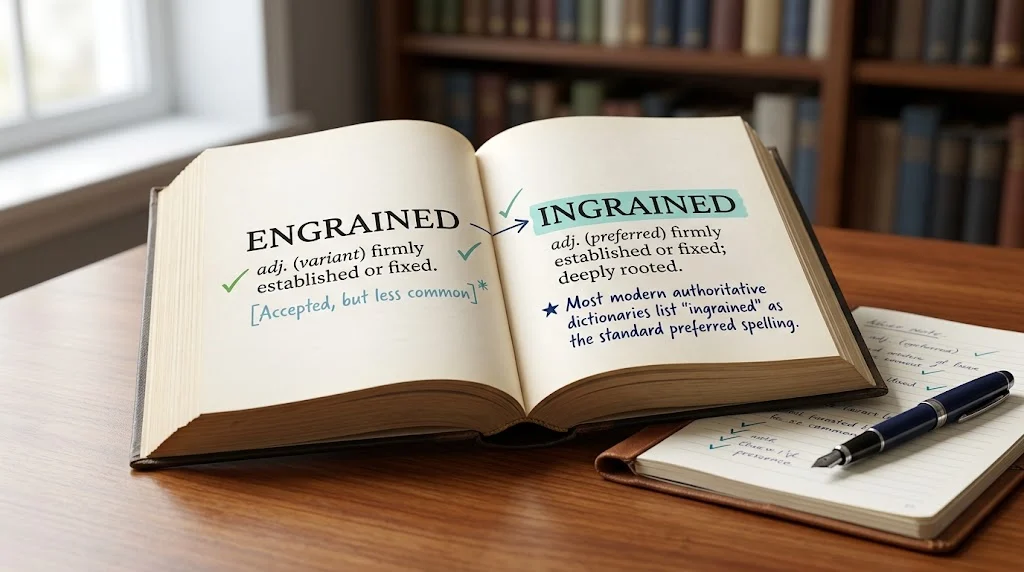
Both engrained and ingrained are accepted English spellings meaning firmly fixed in someone’s mind, habits, or nature. Ingrained is the more widely preferred spelling in modern English, especially in formal and academic writing.
Have you ever wondered whether to write engrained or ingrained when describing a deeply rooted habit, belief, or behavior? These two spellings often confuse students, writers, editors, and professionals because they carry essentially the same meaning. As a matter of standard English usage, both are recognized, but ingrained is generally the safer choice for formal writing, educational content, and professional communication.
Understanding the distinction helps you avoid unnecessary spelling corrections and maintain consistency throughout your writing. Whether you are preparing an academic assignment, drafting a workplace report, or publishing an article, choosing the conventional spelling makes your message easier to read and understand. The key is knowing that the two forms are largely interchangeable rather than treating one as universally incorrect.
Engrained or Ingrained: What’s the Difference?
The main difference between engrained and ingrained is spelling preference, not meaning. Both words describe something established so deeply that it becomes difficult to change, remove, or forget.
Ingrained is the more common spelling in contemporary English. Engrained is also accepted and is often understood as a variant influenced by the word engrave, which means to cut or mark something into a surface.
Definitions of Engrained and Ingrained
Ingrained (adjective): Deeply established in a person’s character, beliefs, habits, or behavior, or firmly embedded in a material.
Example: Her ingrained sense of responsibility made her a dependable team leader.
Engrained (adjective): Firmly fixed in the mind, character, habits, or substance, carrying essentially the same meaning as ingrained.
Example: Years of practice had left an engrained habit of checking every detail.
Both spellings can describe physical substances, such as dirt embedded in fabric, as well as abstract concepts, such as cultural beliefs or personal habits.
Comparison Table
| Feature | Ingrained | Engrained |
| Part of speech | Adjective | Adjective |
| Meaning | Deeply rooted or firmly established | Deeply rooted or firmly established |
| Spelling status | Accepted and preferred in most contexts | Accepted variant |
| Formal writing | Generally preferred | Acceptable, but less conventional |
| Academic writing | Recommended for consistency | Usable when appropriate |
| Example | An ingrained habit | An engrained habit |
Quick recap
Ingrained is the conventional choice for most modern writing.
Engrained is not automatically a spelling error.
Both forms describe something deeply rooted or firmly established.
For most readers, the difference concerns spelling preference rather than meaning.
Is Engrained or Ingrained a Grammar, Vocabulary, or Usage Issue?
The distinction between engrained and ingrained is primarily a spelling and usage issue, not a grammatical one. Both words function as adjectives, and both can modify nouns in the same way.
For example:
- She has an ingrained fear of public speaking.
- She has an engrained fear of public speaking.
Both sentences communicate the same idea.
Are They Interchangeable?
Yes. In ordinary English, the two spellings are generally interchangeable because their meanings overlap almost completely. However, they are not equally common in every writing context.
Ingrained is usually the better option when you want to follow conventional modern usage. Engrained may appear in published writing, personal prose, or sources that favor the alternative spelling.
Formal Versus Informal Usage
In formal writing, including business reports, academic essays, and professional articles, ingrained is generally the most straightforward choice. It is familiar to a broad range of readers and helps maintain consistency with common editorial preferences.
In casual conversations, emails, and personal writing, either spelling is understandable. Most readers will focus on the meaning rather than the spelling variation.
Academic Versus Casual Writing
Academic writing benefits from consistency. If you choose ingrained in an essay, use the same spelling throughout the document. The same principle applies when an institution, publisher, or style guide specifies a preferred form.
In casual writing, the distinction matters less, provided the word is used correctly in context.
When to Use Ingrained
Use ingrained when describing a habit, belief, attitude, behavior, or physical substance that has become deeply established.
This is the preferred spelling for most contemporary English writing.
Workplace Example
Example: An ingrained commitment to customer service helped the company retain loyal clients.
Here, ingrained describes a professional value that has become a lasting part of the organization’s culture.
Academic Example
Example: Researchers examined how ingrained social attitudes influence educational opportunities.
In this sentence, ingrained indicates that certain attitudes have become deeply established within society.
Technology Example
Example: The developer identified an ingrained assumption in the software’s original design.
The word describes an assumption embedded so deeply in the design process that it requires deliberate examination to change.
Everyday Example
Example: Brushing her teeth before bed was an ingrained habit.
The behavior had become a regular part of her daily routine.
Usage recap: Choose ingrained when you want the most conventional spelling for professional, academic, technical, and everyday writing.
When to Use Engrained
Engrained can also describe a firmly established habit, belief, or characteristic. It is an accepted spelling variant, so you do not need to treat it as incorrect whenever you encounter it.
However, because ingrained is generally more conventional, engrained is often best retained when matching an existing text, quotation, publication preference, or established house style.
Workplace Example
Example: The manager recognized an engrained reluctance to share information across departments.
The sentence describes a longstanding workplace behavior.
Academic Example
Example: The study explored engrained assumptions about language learning.
The intended meaning is that the assumptions have become deeply rooted.
Technology Example
Example: The team worked to challenge engrained biases in its decision making process.
Here, engrained refers to persistent assumptions influencing technical decisions. The sentence could equally use ingrained.
Usage recap: Engrained is acceptable when used consistently, but ingrained remains the more practical default when you have no particular reason to choose the alternative.
When You Should NOT Use Engrained or Ingrained
Although these words have broad applications, they are not suitable substitutes for every expression involving depth, permanence, or repetition.
1. When you mean physically carved into a surface. Use engraved for letters cut into metal, stone, or glass. An engraved nameplate is clearer than an ingrained nameplate.
2. When you mean a temporary feeling. A brief moment of nervousness is not necessarily an ingrained fear. Use temporary, passing, or momentary when appropriate.
3. When you mean a newly learned skill. A skill you have just started practicing is not usually ingrained. Consider developing, newly learned, or emerging.
4. When you mean something easily changed. A habit that disappears after one reminder may not be deeply ingrained. Use occasional or short lived if those descriptions fit.
5. When you mean a deliberate physical mark. Use engraved, etched, or inscribed for intentional markings on an object.
6. When describing a simple preference. Liking one flavor more than another does not automatically make that preference ingrained. The word suggests a stronger, more established pattern.
7. When you need a precise technical term. In scientific or engineering contexts, embedded, integrated, or permanent may communicate a specific technical relationship more accurately.
8. When you are following a required spelling convention. Do not alternate between engrained and ingrained in the same article simply for variety. Follow the relevant publication or organizational style.
Common Mistakes: Engrained vs Ingrained
The most common mistake is assuming that engrained is always wrong. Another is confusing ingrained with engraved, which has a different and more specific meaning.
| Correct sentence | Incorrect sentence | Explanation |
| She has an ingrained habit of arriving early. | She has an ingrain habit of arriving early. | Use the adjective ingrained. |
| His ingrained beliefs influenced his decisions. | His ingrained beliefs was influencing his decisions. | The subject and verb must agree. |
| The design contains an ingrained assumption. | The design contains an engraved assumption. | Engraved usually refers to a physical marking. |
| Dirt was ingrained in the carpet. | Dirt was engrave in the carpet. | Ingrained describes dirt embedded in material. |
| The team challenged its ingrained attitudes. | The team challenged its engrained attitudes, which is always incorrect. | Engrained is an accepted variant, not universally incorrect. |
A Simple Decision Rule
If you mean a deeply established habit, belief, attitude, or substance, use ingrained by default.
If you mean a physical inscription cut into a surface, use engraved.
If you encounter engrained in an existing text, remember that it is an accepted spelling variant.
Unlike some confusing word pairs, this distinction does not depend on choosing a different word for an action, person, or tool. It is primarily a matter of spelling convention and context.
Engrained and Ingrained in Modern Technology and AI Tools
The words ingrained and engrained appear naturally in discussions of artificial intelligence, software development, machine learning, and digital culture.
For example, an AI researcher might describe an ingrained bias in a dataset, meaning a recurring pattern that influences the system’s output. A software engineer might identify an ingrained assumption in an older application that makes updates difficult.
In these contexts, ingrained is a useful descriptive adjective, but it should not replace more precise technical language when a specific mechanism is involved. A bias in training data, a hard coded assumption, and an architectural limitation are different problems, even when each is deeply established.
AI writing assistants may suggest either spelling. For publication ready content, choose ingrained unless your chosen style guide or source requires engrained. Automated spelling tools can help identify inconsistencies, but they may not explain the difference between an accepted variant and a preferred spelling.
Etymology: Where Do Engrained and Ingrained Come From?
The word ingrained is associated with the older expression to grain, which historically referred to coloring or dyeing material. The underlying image is that a color or substance has penetrated deeply into a material rather than remaining on its surface.
Over time, the word developed a figurative meaning. Instead of describing a substance embedded in cloth, it could describe habits, beliefs, and attitudes established deeply in a person’s character.
Engrained is commonly associated with the influence of engrave, a word connected with cutting or marking a surface. This association helps explain why English speakers recognize the alternative spelling.
Although the spellings suggest different word associations, their modern meanings overlap substantially. That is why both forms can describe deeply rooted habits and beliefs.
Expert Perspective: Choosing the Clearest Spelling
A useful editorial principle is:
“Prefer the conventional spelling, then apply it consistently.”
This is an editorial recommendation rather than a quotation attributed to a named linguist. It reflects a practical principle of clear writing: readers benefit when spelling choices remain predictable and consistent throughout a document.
For most general English writing, ingrained is the recommended choice. Engrained remains acceptable, but using the more familiar form can reduce unnecessary uncertainty for readers and editors.
Two Practical Case Studies
Case Study 1: Academic Editing
Consider a student preparing an essay about cultural attitudes.
Original sentence: “The research explores engrained beliefs about social responsibility.”
The editor changes it to: “The research explores ingrained beliefs about social responsibility.”
The revision follows the more conventional spelling without changing the meaning. It is a stylistic consistency improvement, not a correction of an unquestionably invalid word.
Result: The sentence retains its original argument while following a widely preferred spelling convention.
Case Study 2: Technology Documentation
Imagine a software team documenting assumptions that have shaped a product over several years.
Original sentence: “An engrained assumption prevented the team from considering alternative designs.”
Revised sentence: “An ingrained assumption prevented the team from considering alternative designs.”
The revised version uses the more conventional spelling and keeps the technical explanation intact. If the documentation already used engrained consistently under an established style guide, however, changing every instance might not be necessary.
Result: The wording becomes more consistent with common editorial preferences without implying that the original spelling was always incorrect.
These examples illustrate editorial decisions rather than reporting measured research outcomes.
Error Prevention Checklist
Use this checklist when proofreading an article, essay, report, or email.
Always use ingrained when:
- You want the conventional spelling for general English writing.
- You are describing a deeply rooted habit or belief.
- You are preparing academic or professional content without a specified alternative style.
- You want consistency across an article or website.
Never use engrained when:
- You are assuming that it is required to describe a different meaning from ingrained.
- You are using it as a substitute for engraved when describing a physical inscription.
- You are switching between spellings merely to avoid repetition.
- Your publisher explicitly requires ingrained and you are editing to that standard.
Remember that the final group concerns situations where the alternative is inappropriate for the intended meaning or conflicts with a required style, not situations where engrained is inherently misspelled.
Related Grammar Confusions You Should Master
Learning the difference between engrained and ingrained can help you recognize other English spelling and usage distinctions. These pairs are useful to study next.
- Affect or Effect: Understand the difference between influence and result.
- Advice or Advise: Learn the distinction between a noun and a verb.
- Breathe or Breath: Separate the action from the noun.
- Ensure or Insure: Understand their overlapping but distinct uses.
- Farther or Further: Explore physical distance and figurative extension.
- Losing or Loosing: Distinguish misplacing something from making it less tight.
- Practice or Practise: Learn the differences between American and British conventions.
- Principal or Principle: Separate a person or primary item from a rule or belief.
- Everyday or Every Day: Understand the difference between an adjective and a time expression.
- Compliment or Complement: Distinguish praise from something that completes or enhances another thing.
Frequently Asked Questions
1. Is ingrained or engrained the correct spelling?
Both spellings are accepted in English. Ingrained is generally the more conventional spelling and is the best default for academic, professional, and general writing.
2. Is engrained a real word?
Yes. Engrained is a recognized spelling variant of ingrained. It can describe deeply rooted beliefs, habits, attitudes, or substances embedded in a material.
3. What does ingrained mean in simple English?
Ingrained means deeply established and difficult to change. An ingrained habit, for example, is a behavior that has become a regular part of someone’s routine.
4. What does engrained mean in a sentence?
Engrained means firmly established, just like ingrained. For example, “Years of practice created an engrained habit of checking every detail” describes a behavior that became deeply rooted.
5. Should I use ingrained in academic writing?
Yes. Ingrained is generally the safer choice for academic writing because it is the more conventional spelling. Follow any specific style requirements set by your institution or publisher.
6. Are ingrained and embedded synonyms?
They can be synonyms in certain contexts. Ingrained often describes deeply established beliefs and habits, while embedded can refer to something physically fixed within a material or structurally incorporated into a system.
7. What is the difference between ingrained and engraved?
Ingrained means deeply established or embedded, either figuratively or physically. Engraved means marked or cut into a surface, usually intentionally. For example, a habit can be ingrained, but a name can be engraved on a ring.
8. Is deeply ingrained grammatically correct?
Yes. Deeply ingrained is a standard expression used to emphasize that a belief, habit, attitude, or characteristic is firmly established. For example, “The tradition is deeply ingrained in the community.”
9. Can I use engrained and ingrained in the same article?
You can, but it is generally better to choose one spelling and use it consistently. In most contemporary articles, ingrained is the practical default.
Conclusion
When choosing between engrained or ingrained, remember that both spellings are accepted and communicate essentially the same meaning. The important distinction is their relative usage: ingrained is generally more conventional and therefore the stronger choice for modern academic, professional, and everyday writing.
Use ingrained to describe deeply established habits, beliefs, attitudes, or substances embedded in a material. Reserve engraved for physical inscriptions, since it conveys a different meaning. If you encounter engrained in a book, article, or workplace document, you do not need to assume that it is wrong. Instead, consider the context and follow a consistent spelling preference. By making ingrained your default, you can write more confidently while understanding why the alternative spelling also exists.

Neil Gaiman is an American writer who contributes educational content to LingRoya.com. His work focuses on helping readers improve their English with clear, practical and easy to follow guidance.