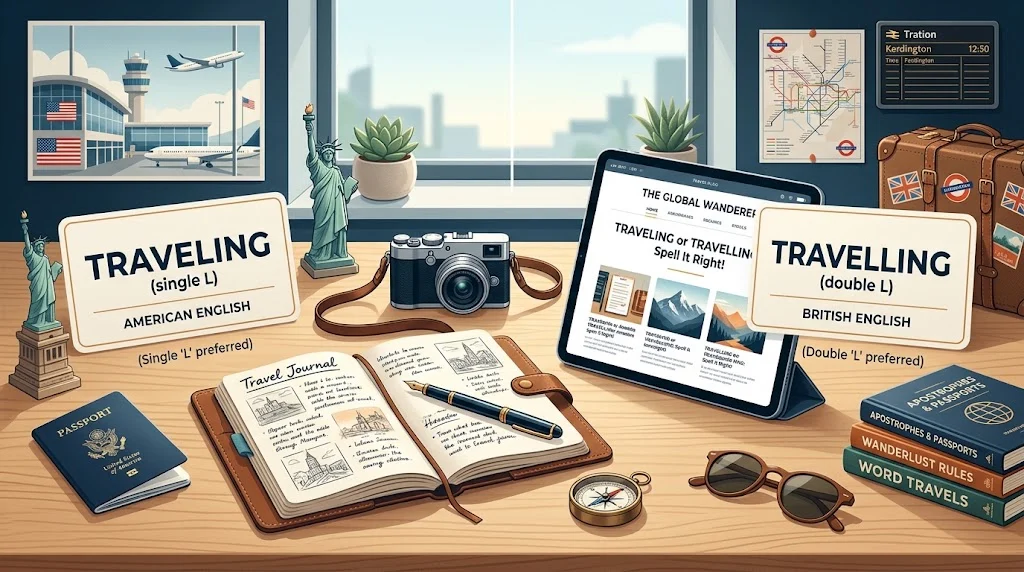
Traveling and travelling are both correct spellings of the present participle and gerund form of the verb travel. The difference is regional: traveling is standard American English, while travelling is standard British English and is also common in other varieties influenced by British usage.
Traveling or travelling is a spelling difference, not a difference in meaning. Traveling is the preferred American English spelling, while travelling is preferred in British English, Australian English, and several other varieties. Both mean the same thing: moving from one place to another. The correct choice depends mainly on your target variety of English.
Traveling vs Travelling: What’s the Difference?
Traveling and travelling are both present participles and gerunds formed from the verb travel.
As a present participle, the word can describe an ongoing action:
She is traveling across Europe.
As a gerund, it can function as a noun:
Traveling can broaden your understanding of other cultures.
The only difference between the two forms is spelling.
| Feature | Traveling | Travelling |
| Part of speech | Present participle or gerund | Present participle or gerund |
| Base verb | Travel | Travel |
| Meaning | Moving from one place to another | Moving from one place to another |
| Standard variety | American English | British English |
| Common in | United States and American influenced writing | United Kingdom, Australia, and British influenced writing |
| Pronunciation | Same | Same |
| Meaning difference | None | None |
| Extra consonant | One l | Two ls |
Mini Recap
Traveling is the usual American English spelling.
Travelling is the usual British English spelling.
Both forms have exactly the same meaning.
The choice depends on the variety of English you’re using.
Consistency is more important than choosing one form universally.
Is Traveling vs Travelling a Grammar, Vocabulary, or Usage Issue?
The difference between traveling and travelling is primarily a spelling and usage issue, not a grammatical one.
Both words perform the same grammatical functions. You can use either as a present participle or gerund, provided the spelling matches the English convention you’re following.
For example:
I am traveling tomorrow.
I am travelling tomorrow.
Both sentences are grammatically correct.
The distinction becomes important when you are writing for a particular audience.
In American English, traveling is expected. In British English, travelling is standard. Australian English generally follows the British spelling pattern as well.
Formal vs Informal Usage
Neither form is more formal than the other.
You can use traveling in formal American documents and travelling in formal British documents.
For example:
The committee is traveling to Washington for the annual conference.
This is perfectly appropriate in formal American English.
A British publication might instead write:
The committee is travelling to London for the annual conference.
The spelling changes because the regional convention changes, not because the level of formality changes.
Academic vs Casual Usage
Academic writers should follow the style guide or regional convention required by their institution.
If an American university requires American English, use traveling.
If a British university expects British English, use travelling.
The same principle applies to professional publications. A journal, publisher, employer, or client may have its own style requirements.
Traveling: When and How to Use It
Traveling is the standard spelling in American English.
The word can describe movement between locations, the activity of going from place to place, or an ongoing journey.
Workplace Example
Our sales team is traveling to several cities this month.
Here, traveling describes an activity currently planned or taking place.
Another example is:
Employees traveling for business must submit their expenses within ten days.
This sentence uses traveling as a participial modifier.
Academic Example
Traveling abroad can expose students to different educational systems.
Here, traveling functions as a gerund and acts as the subject of the sentence.
An academic writer using American English would normally choose this spelling.
Technology Example
Travel applications also commonly use American spelling when their primary audience is American.
For example:
The app provides personalized recommendations for travelers traveling throughout the United States.
Although the sentence can be improved stylistically by avoiding repetition, the spelling traveling is correct in American English.
Usage Recap
Use traveling when writing in American English.
It is correct in formal, academic, professional, and casual writing.
It does not indicate a different meaning from travelling.
Travelling: When and How to Use It
Travelling is the standard spelling in British English.
The extra l follows a broader British spelling pattern in certain words when suffixes are added.
For example:
She is travelling around Scotland.
Travelling by train is often relaxing.
The same spelling convention can appear in related forms such as travelled and traveller.
Workplace Example
Our manager is travelling to Manchester next week.
A British English workplace document would normally use this spelling.
Academic Example
Travelling internationally can influence students’ perceptions of cultural identity.
A British English academic writer can use travelling without any concern about correctness.
Technology Example
A British travel website may write:
Compare prices before travelling abroad.
The website may use travelling, traveller, and travelled consistently throughout its content.
Usage Recap
Use travelling when following British English conventions.
It is not less modern or less professional than traveling.
The extra l reflects a regional spelling convention.
When You Should NOT Use Traveling or Travelling
There are several situations in which writers commonly make mistakes with these forms.
1. Do not mix regional spelling conventions without a reason
If your article uses travelling, traveller, and travelled, suddenly switching to traveling can make the content look inconsistent.
2. Do not assume the shorter spelling is always correct
Some writers mistakenly believe that one l is the universally correct form. It isn’t. American and British English follow different conventions.
3. Do not assume the longer spelling is more formal
The extra l has nothing to do with formality.
4. Do not change the spelling because the pronunciation changes
The two forms are pronounced the same way.
5. Do not use British spelling in an American style guide without checking
Academic institutions, publishers, and companies may require a particular regional variety.
6. Do not mix traveler and traveller carelessly
The same regional distinction affects the related noun.
American English generally uses traveler.
British English generally uses traveller.
7. Do not treat the words as different vocabulary items
They are spelling variants of the same word, not two separate concepts.
8. Do not correct a British writer simply because they use two ls
In British English, travelling is the expected spelling.
Common Mistakes and Decision Rules
| Correct sentence | Incorrect or unsuitable sentence | Explanation |
| She is traveling to Boston. | She is travelling to Boston. | The second form is not wrong generally, but it conflicts with standard American English if American spelling is required. |
| She is travelling to London. | She is traveling to London. | The second form may conflict with a British English style requirement. |
| Traveling can be expensive. | Travelling can be expensive. | Both are correct, but regional consistency matters. |
| He is a traveler. | He is a traveller. | American English normally uses traveler. |
| He is a traveller. | He is a traveler. | British English normally uses traveller. |
Decision Rule Box
When you are writing in American English, use traveling.
If you are writing in British English, use travelling.
If your audience is international, choose one convention and use it consistently.
Unlike some word pairs where the meaning changes depending on the term, this distinction is about regional spelling, not about choosing between an action and a person or tool.
Why Does Traveling Have One L in American English?
The difference comes from broader spelling conventions that developed on opposite sides of the Atlantic.
British English often doubles the final consonant when certain suffixes are added to words ending in a consonant preceded by a stressed vowel pattern. Thus, travel becomes travelling and travelled.
American English generally simplified or regularized several spelling patterns over time. As a result, American usage commonly gives us traveling and traveled.
This does not mean that American spelling is newer in every respect or that British spelling is more traditional in every situation. English spelling developed through many historical influences, including regional standardization, dictionaries, publishing practices, and educational systems.
Traveling or Travelling in Modern Technology and AI Tools
Modern writing tools often identify traveling and travelling as valid words. The important question is whether the selected regional language setting matches your intended audience.
For example, a grammar checker configured for American English may recommend traveling, while a British English setting may prefer travelling.
AI writing tools can also produce either spelling depending on their instructions and contextual signals. If you’re preparing an article for a British audience, explicitly requesting British English can reduce inconsistent spelling.
The same principle applies to other regional pairs such as color and colour, center and centre, and organize and organise.
Traveling vs Travelling: Etymology and Spelling History
The verb travel developed from Middle English and ultimately has roots connected with the Old French word travail, associated with labor or hardship.
The modern meaning developed over time as travel became associated with journeys and the difficulties involved in making them.
The spelling difference between traveling and travelling emerged from broader differences in English spelling conventions. American English became associated with several simplified spellings, while British English retained conventions that frequently double consonants in particular environments.
The result is two standardized forms that coexist successfully today.
An Expert Style Perspective
A useful editorial principle is simple: regional consistency is more important than treating one spelling as universally correct.
Professional editors don’t normally ask whether traveling or travelling is the superior English spelling. They first ask which variety of English the publication uses. Once that decision is made, the appropriate spelling should be maintained throughout the document.
Two Practical Case Studies
Case Study 1: An American university article
Imagine a university in the United States publishing an article titled “The Benefits of Traveling Abroad.”
The article uses traveling, traveled, and traveler throughout the text.
The result is a consistent American English style. A British spelling appearing once would not necessarily make the article grammatically wrong, but it could make the publication’s style appear inconsistent.
Case Study 2: A British travel website
Now imagine a British travel company publishing an article about international tourism.
Its copy reads:
Travelling abroad gives people opportunities to experience different cultures.
The site also uses traveller, travelled, and other British spellings.
The result is consistent British English that matches its target audience.
These examples show why there is no universal winner. The correct form depends on the English variety being used.
Error Prevention Checklist
Always use traveling when
- You are writing in standard American English.
- Your American publisher or institution requires American spelling.
- Your style guide specifies American English.
- Your target audience is primarily in the United States.
Never use travelling when
- Your document must strictly follow American English spelling.
- Your style guide explicitly requires the American form.
- You are deliberately maintaining a consistent American English style.
Likewise, if you’re writing in British English, use travelling consistently rather than switching between regional conventions.
Related Grammar Confusions You Should Master
Once you understand traveling or travelling, several other spelling differences become easier to recognize.
- Canceled vs cancelled
- Traveler vs traveller
- Traveled vs travelled
- Color vs colour
- Center vs centre
- Favorite vs favourite
- Organize vs organise
- Realize vs realise
- License vs licence
- Practice vs practise
These differences are useful because English is not governed by one universal spelling system. American, British, Canadian, Australian, and other varieties have developed their own conventions.
Frequently Asked Questions
Is traveling or travelling correct?
Both are correct. Traveling is the standard American English spelling, while travelling is the standard British English spelling. The meaning and pronunciation are essentially the same.
Is traveling American or British English?
Traveling is the standard American English spelling. American English generally uses one l in this form.
Is travelling British or American English?
Travelling is the standard British English spelling. It is also common in Australian English and other varieties influenced by British spelling conventions.
Should I use traveling or travelling in academic writing?
Use the form required by your academic institution or style guide. American academic writing generally uses traveling, while British academic writing generally uses travelling.
Why does travelling have two ls?
The doubled l reflects a British spelling convention used when certain suffixes are added to words such as travel. American English generally uses the single l form traveling.
Is traveling or travelling more common?
The answer depends on the English speaking region and the audience. Traveling is dominant in American English, while travelling is dominant in British English and several other varieties.
Is traveling or travelling correct in the UK?
Travelling is the standard spelling in the United Kingdom.
Is traveling or travelling correct in the US?
Traveling is the standard spelling in the United States.
What is the difference between traveler and traveller?
Traveler is the standard American spelling, while traveller is the standard British spelling. Like traveling and travelling, the difference is regional rather than semantic.
Should I use traveling or travelling for an international website?
Choose the spelling that matches your primary audience or editorial style. If your audience is genuinely international, either form can work, but consistency throughout the website is essential.
Conclusion
The choice between traveling or travelling is straightforward once you identify the English variety you’re using. Traveling is standard American English, while travelling is standard British English and is also widely used in Australian English. Neither spelling changes the meaning of the word, and neither is inherently more correct.
For American readers, choose traveling. For British readers, choose travelling. If you’re writing for an international audience, establish a clear style and stick with it throughout the article.

Philip Pullman is an American writer dedicated to creating clear and easy to follow English content. Through his work at LingRoya.com, he helps readers strengthen their language skills with practical and reliable guidance so that they can easily understand.